
Written by: Lara Yehia, Cupindy Home & Kitchen Team
Experience note: 8 years of experience creating home and kitchen product guidance, safety-focused buying content, and practical household-use articles for Cupindy readers.
Last reviewed: August 2026 - Reviewed for: food-contact material claims, manufacturer chemical disclosures, published temperature limits, and current reheating research.
Editorial note
This is a buying guide organized around one decision: how you plan to reheat the food. It is not a laboratory test. We have not measured particle release, thermal shock or seal pressure ourselves. What we do instead is read each manufacturer's own material statements and published limits, compare them against what the retail listing claims, and tell you plainly where each option is weak.
Every pick below carries a named drawback. One product we were sent while researching this guide was rejected outright, and we explain why, because the reasons are more useful than another recommendation.
Cupindy is an independent research site. As an Amazon Associate I earn from qualifying purchases, at no extra cost to you. See our affiliate disclosure.
Most meal prep container guides rank sets by how they look in a fridge photo. That is the wrong axis. Two people can buy the same twenty-piece set and have completely different experiences with it, because one of them microwaves lunch at a desk five days a week and the other batch-cooks on Sunday and eats cold salads.
The material that suits those two people is not the same material. So this guide sorts by the only variable that actually changes the answer: how the food gets hot again.
The 30-second answer
Find your row, then jump to the pick.
| How you eat it | Best material | Why | Go to |
|---|---|---|---|
| Microwave, most days | Glass body, lid unclipped | Nothing organic to shed, no warping, no stain or odor carry-over | Pick 1 |
| Portion control, counting macros | Divided glass, compartments molded in | Fixed portions without a second container | Pick 2 |
| Oven or toaster oven | Tempered glass bakeware, lid off | Only material here that takes dry heat well above boiling | Pick 3 |
| Cold or light reheating, carried daily | Tritan copolyester | A fraction of the weight, will not shatter in a bag | Pick 4 |
| You want no plastic at all | 18/8 stainless with a silicone lid | The only pick here with no plastic anywhere in the system | Pick 5 |
| Freeze in portions, reheat later | Platinum-cured silicone tray | Frozen blocks release without thawing the whole batch | Pick 6 |
One rule before you buy anything. While checking these six products, one pattern showed up so consistently it became the spine of this guide: the retail listing sells you, and the manufacturer's own page tells you. Half the products here publish their real temperature limits nowhere on Amazon. We come back to exactly which ones, and what they were hiding, after the picks.
In this guide
- The six picks, sorted by how you eat
- What each listing was willing to tell us
- The one we were sent and rejected
- The listing sells you, the manufacturer tells you
- What "microwave-safe" actually certifies
- The 60-second check almost nobody does
- The lid is the part that fails
- Fridge footprint: measure in inches, not quarts
- Compartment sets and the sauce problem
- Care rules that actually add years
- Frequently asked questions
The six picks, sorted by how you eat
Product links below are affiliate links. Materials described are taken from each manufacturer's own published statements and from the retail listing text as it stood in August 2026. Listings change - re-check the material line before you buy.
1. Pyrex Freshlock glass storage set - the default for daily microwaving
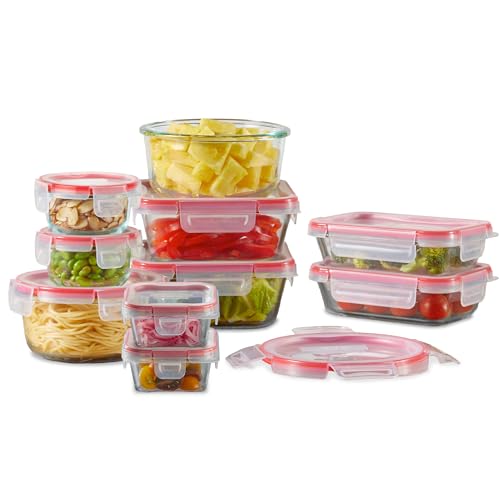
Best for: the person who reheats lunch five days a week and wants to stop thinking about it.
Glass is the only body material here with nothing organic in it to shed, nothing to warp, and no tomato-sauce memory. The Freshlock lids seal with four locking tabs pressing onto a gasket, which is a genuinely different mechanism from a snap-on lid and the reason this style holds liquid when a plain snap lid does not. It is made in the USA and the ten-piece mix covers the sizes people actually use.
The habit that matters: unclip the lid before it goes in the microwave. The glass is the microwave-rated part. The lid is plastic, and it is the component that ages.
Two things this set does better than most. First, the listing's Material field reads "Glass, Plastic" - which is the plain truth that half this category obscures, and we would rather buy from a brand that writes it down.
Second, and more usefully, Pyrex sells Freshlock replacement lids separately, in two-packs, per size, with the gasket included. Given that the lid is what fails, that single fact changes the long-term cost of the set more than anything else on the page.
The drawback we will name: this set is not oven-rated. Pyrex's own product page lists dishwasher, freezer and microwave, and stops there - do not assume that because it says Pyrex it will take a bake.
The gasket is also not described as removable anywhere, on the listing or on Pyrex's site, which means you clean the seal channel in place and replace the whole lid when it finally goes rather than swapping a ring. The warranty is two years, the shortest in this guide.
Check the Pyrex Freshlock set on Amazon
2. MCIRCO divided glass containers - portion control without a second box
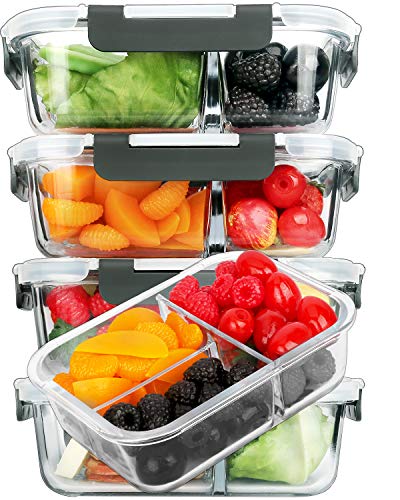
Best for: anyone tracking portions, macros or calories who is tired of packing three containers for one meal.
Three compartments molded into the glass itself, not a plastic insert dropped in - which is the distinction that separates a real divided container from a tray with a liner. Snap-lock lids with silicone seals, 36 ounces total, and the strongest ratings-to-sales profile of any glass set we looked at.
Do not buy this because it says "borosilicate."
The listing leads with "premium borosilicate glass, which is stronger than others' glass food storage containers." That is the industry's most repeated upgrade claim, and it does not survive contact with what a glass manufacturer will tell you.
Anchor Hocking states on its own site that tempered soda-lime-silicate has "equal to or greater thermal shock resistance than annealed borosilicate glass" and "more than double the mechanical strength of annealed borosilicate." On how each fails: tempered soda-lime "breaks into relatively small pieces... generally lacking sharp edges and shards," while borosilicate "breaks into larger, heavier pieces of very sharp glass creating a significant risk of severe cuts."
In fairness: Anchor Hocking makes tempered soda-lime and is defending its own material choice, so read it as an interested party rather than a neutral referee. But the claim is published with numbers attached, and the key word is annealed - borosilicate is usually not tempered, and tempering it is uncommon and expensive. The MCIRCO listing says borosilicate. It never says tempered. Buy this set because it is well-made divided glass with good reviews, not because a word on the listing sounds like an upgrade.
The drawback we will name: the lid polymer is never stated. The Material field says "Borosilicate Glass" and the bullets say "snap lock lids that comes with silicone seals" - which tells you about the seal and nothing about the lid itself. Compare Pyrex writing "Glass, Plastic" in the same field.
The listing also claims oven safe with no temperature anywhere, which is not a usable instruction. And we will not repeat its claim that "these lids will not break or slowly stop working" - nothing in this category is exempt from that, and a manufacturer saying so does not make it true.
Check the MCIRCO divided glass set on Amazon
3. Anchor Hocking glass baking dishes - the oven and batch-cook pick

Best for: people who bake the batch and store it in the same dish, or who reheat in a toaster oven rather than a microwave.
This is the only category here that handles dry oven heat properly. Nothing plastic in this guide goes in an oven, and the two-piece 2-quart and 3-quart set is the right shape for cooking a tray of something on Sunday and putting the lid on it afterward.
It also has the most honest listing of the three glass options. It is the only one that says "tempered glass" outright, and the only one with a dedicated Lid Material: plastic field rather than leaving you to infer it. The warranty is five years - more than double Pyrex's.
Note the phrase "pre-heated oven" in the listing. That is not filler. It means the dish goes into an oven that has already come up to temperature, not into a cold oven that then heats up around it.
Anchor Hocking publishes the rest of the rules on its own site: do not exceed 425 F, never add liquid to a hot dish, and never set hot glass on a cold counter. Follow those and the dish lasts years. Break either of the last two and it can fail suddenly.
One correction worth having while we are here. Guides frequently tell readers to look for an "ASTM C1464 bakeware standard" claim. ASTM C1464 is the Standard Specification for Bent Glass, and it covers architectural glass for building construction, furniture and display. It has nothing to do with bakeware. The documents that actually apply are Chapter 24 of the Cookware & Bakeware Alliance Engineering Standards, which Anchor Hocking cites by name, and ASTM C149, the test method for thermal shock resistance of glass containers. If you see C1464 quoted as a kitchen standard, that page has copied it from somewhere without checking.
The drawback we will name: these are casserole dishes, not lunch portions - a 2-quart and a 3-quart. They are for the batch, not for the desk. The plastic lids are storage lids and do not go in the oven.
And one bullet overclaims: "Anchor Hocking baking glass is healthier than metal and plastic... will not leach dangerous chemicals into food." Stainless steel does not leach dangerous chemicals into food either. We flagged MCIRCO for an unfalsifiable lid claim and we are flagging this one on the same basis.
Check the Anchor Hocking bake set on Amazon

4. Rubbermaid Brilliance - the honest plastic pick

Best for: commuters, gym bags, school runs, anyone carrying five containers at once.
Brilliance is the most-bought product in this entire guide by a wide margin, and it earns it. Tritan is glass-clear, does not cloud, does not hold curry stains, and Eastman - the company that makes the resin - says it survives hundreds of dishwasher cycles. It is a fraction of the weight of an equivalent glass set and it does not shatter.
The detail that matters more than the reviews: the listing specifies Tritan "lids and bases." Both. Every other pick in this guide pairs one material with a lid made of something else. This is the only one where the lid and the container are the same material - which, in an article whose central argument is that the lid is a separate product from the container, is a real point in its favor.
It also carries a lifetime warranty, which is the functional answer to "does this brand sell replacement lids" and a better answer than selling them.
The resin code point that most safety roundups get backwards. Tritan carries resin identification code 7. The rule "avoid number 7" is repeated constantly and it is a poor rule: 7 is not a material, it is the "everything else" bin. It flags Tritan, which contains no BPA, no BPS and no other bisphenol, while polycarbonate - the plastic the rule was invented to warn people about - sits in the same bin on the same shelf. Judge the named resin, not the triangle. Our plastic grades guide goes through all seven.
The drawback we will name: Tritan's FDA food-contact clearance runs up to and including 100 C / 212 F. That is Eastman's own wording, and it explicitly includes microwave heating - so this is cleared for the microwave and we are not suggesting otherwise.
But the listing promotes lid-on microwaving through "built-in vents under latches," and it is worth understanding what those vents do. They release pressure and stop splatter. They do not lower the temperature of the food touching the plastic.
Microwave hot spots in fatty and sugary food routinely run above the boiling point of water - melted cheese and oily sauces are the usual offenders - and Eastman itself says suitability "should be evaluated on a case-by-case basis" depending on article design and food type. Soup and rice sit comfortably inside the envelope. A cheese-topped bake, repeatedly, does not.
Worth separating clearly, because the brand name overlaps: the microplastics lawsuit covered below names Rubbermaid TakeAlongs, which are polypropylene. It does not name the Tritan Brilliance line. Different product, different material, same parent company.
Check the Rubbermaid Brilliance set on Amazon
5. Klean Kanteen Rise Food Box - the only pick with no plastic in it

Best for: the reader who came to this article because they want plastic out of the equation entirely.
Every other product on this page has a plastic lid. This one has a food-grade silicone lid on an 18/8 stainless body, and the listing states the container is free from BPA, BPS, BPF and plastic. If the lid is the weak link in the glass-versus-plastic argument - and it is - this is the product that removes the argument.
The steel is 90 percent post-consumer recycled 18/8. It is leakproof, with an airtight seal plus backup snap-and-lock tabs. It is dishwasher safe. It carries a lifetime limited warranty.
And Klean Kanteen publishes real numbers where almost nobody else does. From their own product page: oven to 350 F for reheating only, 20 minutes maximum, lid removed. Microwave to 1000 watts, 5 minutes maximum, lid out. That is more specific guidance than we found anywhere else in this category.
The drawback we will name: two, and the first is about evidence rather than the product. It has by far the thinnest review history in this guide - a small number of ratings against tens of thousands for the Rubbermaid. That is a new product line from an established twenty-year-old brand rather than an unknown quantity, but we are not going to pretend a handful of reviews is the same signal as twenty thousand.
Second, the exterior carries a chip-resistant "Klean Coat" finish. Food contact is bare steel on the inside, but it is a coated product on the outside and you should know that rather than discover it. It is also several times the cost of a comparable plastic set, which is the honest price of buying once.
Check the Klean Kanteen Rise Food Box on Amazon
6. Souper Cubes silicone freezer trays - for portioning, not for storing

Best for: batch cooks. Freeze soup, stock, chili or grains in measured blocks, pop them out, bag them, and free the tray for the next batch.
100 percent platinum-cured, food-grade silicone with a steel-reinforced rim, half-cup and one-cup fill lines in both standard and metric, and lids included. Microwave, freezer, dishwasher and oven safe to 415 F without the lid - and that phrase is on the Amazon listing itself, number and limitation in the same sentence, which no other product here manages.
Souper Cubes also publishes on its own site that it uses LFGB-certified silicone for its European range and tests quarterly against Proposition 65 and FDA guidelines.
The drawback we will name: the lids are not oven-safe even though the trays are, so tray-plus-lid is not an oven dish. And this is a portioning tool, not a storage system - the manufacturer says so itself, describing frozen portions that "pop out easily for transferring to freezer or vacuum seal bags."
Leaving food in the tray for months ties up the tray and exposes more surface to freezer air than a sealed bag would. The intended workflow is freeze, release, transfer. It is also the most expensive way to buy silicone in this category.
One myth to retire while we are here: the pinch-and-look-for-white test does not detect fillers. Souper Cubes addresses this directly, pointing out that US food-grade raw silicone is naturally white to begin with. If you want the longer version, see is silicone safe for cooking.
Check the Souper Cubes trays on Amazon
What each listing was willing to tell us
We checked the same four things on every product. The gaps are as informative as the answers.
| Product | Body material named | Lid material named | Temperature limit | Warranty |
|---|---|---|---|---|
| Souper Cubes | Platinum-cured silicone | Yes, and stated not oven-safe | 415 F, on the listing | Not stated |
| Klean Kanteen | 18/8 stainless | Yes, food-grade silicone | Brand site only | Lifetime limited |
| Anchor Hocking | Yes, "tempered glass" | Yes, own data field | Brand site only | 5 years |
| Rubbermaid Brilliance | Tritan, in the bullets | Yes, same material as body | Resin clearance only | Lifetime |
| Pyrex Freshlock | "Glass, Plastic" | Plastic, BPA-free | Not oven-rated | 2 years |
| MCIRCO | "Borosilicate", not tempered | No | Oven claimed, no number | Not stated |
Warranty length is the most underrated line in that table. It is a manufacturer betting its own money on the part that fails first. Two years, five years and lifetime are three different levels of confidence, and they cost you nothing to compare.
The one we were sent and rejected
While researching this guide we looked at a 10-piece 304 stainless set from a brand called Cappwery. It did some things well - it stated "food-grade 304 (18/8)" plainly, and its lids have a removable silicone ring, which is a better design than several of the picks above and exactly the feature we praise elsewhere in this article.
We still did not include it. Everything below reflects what we could find as of August 2026, and the reasons are worth spelling out because they generalize:
- No company website that we could locate. Amazon listings and nothing else - no About page, no material documentation, no chemical disclosure page to check. An article that tells you to read the manufacturer's own page cannot then recommend a manufacturer we could not find one for.
- No warranty of any kind stated on the listing, against two years, five years and lifetime elsewhere on this page.
- A bullet headed "DISHWASHER, FREEZER & OVEN SAFE" whose text then discusses dishwasher and refrigerator use and never mentions the oven again. The lids are transparent plastic and cannot go in an oven under any circumstances.
- The lid polymer is never named - the same gap we flagged on MCIRCO, and more of a problem here because the lid design is the selling point.
- A capacity field listing the combined volume of all ten pieces as though it were one container, and a "100% leakproof" claim that nothing in this category can meet.
None of that means the product is unsafe, and we are not suggesting it is. It means there was nothing for us to check it against, and we are not willing to recommend on that basis. If you own one, it is very probably fine. We just cannot show our work on it.
The listing sells you, the manufacturer tells you
Here is the pattern promised at the top, now that you have seen all six products.
Three of our six picks have their real safety numbers published nowhere on the retail listing. Anchor Hocking's listing says "pre-heated oven safe" - the 425 F ceiling is on the company's own site. Klean Kanteen's listing says "safe to use in microwaves, ovens, and freezers" - the actual limits, 350 F for a maximum of 20 minutes in the oven and 1000 watts for a maximum of 5 minutes in the microwave, lid removed in both cases, are on the brand's product page.
Souper Cubes is the honorable exception. Its listing states "oven safe up to 415 F (without the lid)" - the number and the limitation, in the same sentence, where a shopper will actually see them.
So the habit worth building is simple: read the listing to find the product, then read the manufacturer's page before you use it. You will get a number instead of an adjective roughly half the time, and the number is the part that stops you breaking the dish.
What "microwave-safe" actually certifies
This is the most misread phrase in the food storage aisle, and it is worth two minutes because it changes what you buy.
"Microwave-safe" is not a claim that nothing leaves the container. It is a claim about two narrower things: the container will not melt, deform or catch fire at microwave temperatures, and the substances the plastic is known to contain stay within the migration limits set for its food-contact clearance. That is the test. Particle shedding was never part of it.
So when a lid says microwave-safe, the honest translation is: this will survive the microwave and will not leach its listed chemicals above the permitted level. It is a real assurance. It is a narrower one than most shoppers assume.

The 2023 research, described accurately
In July 2023, a team led by Kazi Albab Hussain published work in Environmental Science & Technology measuring particle release from plastic food containers. The headline number traveled a long way: some containers released as many as 4.22 million microplastic and 2.11 billion nanoplastic particles from a single square centimeter in three minutes of microwaving.
Three details usually get dropped when that number is repeated, and all three matter to what you buy:
- It tested polypropylene containers and polyethylene pouches. It did not test Tritan, it did not test glass, and it did not test stainless. Applying the figure to "plastic" as a category is a stretch the paper does not make.
- Polyethylene pouches shed substantially more than the polypropylene containers. The film-type product was the worse performer, not the rigid tub.
- Refrigeration and room-temperature storage over six months also released particles in the millions to billions. The microwave is the fastest route, not the only one, which quietly undercuts "just don't microwave it" as a complete answer.
The part no other guide tells you: this is being litigated, and one case has already collapsed
In April 2025, two California plaintiffs filed a proposed class action against Newell Brands in the U.S. District Court for the Central District of California. The complaint targets Rubbermaid TakeAlongs containers and argues that labeling polypropylene tubs "microwave safe" and "freezer safe" is deceptive, because heating and freezing them is exactly what makes them shed. The complaint cites the Hussain figures above, almost verbatim. These are allegations. Nothing in that case has been proven, and it was still pending when this guide was written.
A near-identical suit was filed against S.C. Johnson over Ziploc bags and containers. That case is over - but it is worth being precise about how, because the difference matters.
The Ziploc case was voluntarily dismissed with prejudice. After S.C. Johnson moved to dismiss, the plaintiff withdrew the claims and a federal judge entered the order. "With prejudice" means it cannot be refiled. But there was no ruling on the merits - no court has decided whether those products shed anything or whether the labeling was misleading. The case ended without being answered, which is not the same as being answered in either direction.
And the FDA's own position, last updated 24 July 2024, is that "current scientific evidence does not demonstrate that the levels of microplastics or nanoplastics detected in foods pose a risk to human health," and that there is "not sufficient scientific evidence to show that microplastics and nanoplastics from plastic food packaging migrate into foods and beverages."
Our read, stated plainly: the laboratory finding is real and it was published in a serious journal. The consumer-harm case built on top of it is unproven - one suit is pending, and the other ended without a court ever reaching the question. The regulator says the evidence is not there yet. That is not a reason to panic. It is a reason to notice that if you were going to reheat in glass anyway, the question does not arise - and glass costs you weight, not money.
If you want the full material-by-material comparison behind that reasoning, we wrote it up separately in glass vs plastic food storage containers, and the label decoding lives in is it microwave safe.
The 60-second check almost nobody does: AB 1200
Here is a check you can run on any brand in this guide, in less than a minute, and it is backed by law rather than by marketing.
California's Assembly Bill 1200 defines cookware as "durable houseware items" used to "prepare, dispense, or store food, foodstuffs, or beverages." The word store is the important one - meal prep containers are squarely inside the definition.
Since 1 January 2023, manufacturers selling into California have had to publish, on their own website, any intentionally added chemicals on the state's designated list that are present in the handle or in any surface that touches food. Physical labeling followed on 1 January 2024.
The reader rule: search the brand name plus "AB 1200". Every compliant manufacturer has a page. What that page looks like tells you something the marketing never will.
Two real examples we checked while writing this, in August 2026:
- Tupperware publishes a table with ten individual SKUs, each named, each with its disclosed chemical. Every entry is a nonstick cookware item - griddles, frypans, sauteuse pans, the MicroPro Grill - and every entry lists per- and polyfluoroalkyl substances. That is a high-quality filing: specific, checkable, and it tells you clearly that the disclosure applies to the nonstick cookware line, not to the storage containers.
- Pyrex hosts an AB 1200 page that links out to a separately dated product disclosure list. It is product-specific and kept current, which is good practice, but you have to open a second document to learn anything.
The contrast is the useful part. Some brands file at SKU level with dates. Others file one blanket sentence covering an entire catalog - technically compliant, practically useless. Filing quality is itself a buying signal. A company that can tell you which of its products contain what usually knows its own supply chain. A company that cannot may simply not know.
We built our non-toxic food storage containers guide around exactly this check if you want the longer walkthrough.
The lid is the part that fails
Across every material in this guide, the container body outlives the lid, usually by years. Bodies fail from accidents. Lids fail from use.

| Lid component | Typical material | How it fails |
|---|---|---|
| Lid body | Polypropylene (resin code 5) | Warps out of flat after repeated dishwasher heat, then stops sealing |
| Snap arms / locking tabs | Polypropylene, thin section | Crack at the hinge - the single most common failure |
| Gasket | Silicone | Goes hard, or the channel it sits in stays dirty and breaks the seal |
| Steam vent | Molded flap | Tears or stops closing flush after a year or two of daily flexing |
So the real question at the point of purchase is: what happens when the lid goes? There are only three good answers. The brand sells replacement lids separately, as Pyrex does for Freshlock. The brand offers a lifetime warranty, as Rubbermaid and Klean Kanteen do. Or the lid is not plastic in the first place, as with the Klean Kanteen silicone lid.
If none of the three applies, the set has the lifespan of its weakest lid - and you should count dishwasher cycles rather than years when you estimate that, because the top rack is where lids age, not the fridge.
Related reading: what should never go in the dishwasher.
Fridge footprint: measure in inches, not quarts
Volume tells you almost nothing about whether a set fits your fridge. Shape does.
- Rectangular beats round for shelf efficiency by a wide margin. Round containers waste the corners, and a fridge shelf is a rectangle.
- Nesting and stacking are different features. Nesting saves cabinet space when empty. Stacking saves fridge space when full. A set that does one well often does the other badly, so decide which problem you actually have.
- Glass costs you height for the same volume, because the walls are thicker and the base is heavier. If your fridge shelves are close together, measure the shelf gap before buying a deep glass set.
- Lids that stack on their own are worth more than they sound. Loose lids are the reason the container drawer is chaos.
For weekly planning around whatever set you land on, our weekly meal plan guide pairs well with this.
Compartment sets and the sauce problem
Divided portion-control containers are excellent for dry components and unreliable for wet ones. The dividers in almost every molded set stop short of the lid, which is a manufacturing necessity rather than an oversight - a divider that sealed against the lid would need its own gasket. The practical consequence is that dressing migrates into the rice the moment the container tilts in a bag.
Most brands leave you to discover this. One does not. LunchBots writes it into its own product bullets for the Medium Uno bento: "The lids and dividers aren't watertight be sure to pack only dry foods." A manufacturer naming its own product's limitation in a sales bullet is rare enough to be worth pointing at, and it happens to confirm exactly what we found across the category.
The fix is not a better compartment set. It is a small separate sauce pot. LunchBots Rounds are the obvious version - 18/8 stainless with BPA-free lids and silicone seals, four ounces, genuinely sealed. Worth knowing that their rating sits a little below the rest of this guide, which for a product whose headline claim is leak-proof is worth a moment's thought before you buy a large set of them.
Check LunchBots Rounds on Amazon
If the container also has to leave the house in a bag every day, the carrying problem is a different one from the storage problem, and we covered it separately in eco-friendly lunch boxes and the best lunch box materials for adults and kids.
Care rules that actually add years
- Lids on the top rack, always. The bottom rack sits closest to the heating element and that is where plastic lids warp.
- Do not stack hot glass. Let it come to room temperature on a towel or a wooden board, never straight onto a cold stone counter.
- Never add cold liquid to a hot glass dish, or hot liquid to a cold one. This is the most common way tempered glass fails in a domestic kitchen.
- Store lids off. Leaving a lid clamped on an empty container keeps the gasket compressed, which is exactly how it takes a permanent set and stops sealing.
- Wash gaskets separately once a month if they are removable, and scrub the channel if they are not. The groove is the failure point, and it is invisible until it leaks.
- Vent before microwaving. Unclip, or leave the lid resting rather than sealed. Pressure is what pops lids and cracks tabs.
Frequently asked questions
Is glass really better than plastic for meal prep?
For reheating, yes, and the reason is simple rather than dramatic: glass has nothing organic in it to shed, does not warp, and does not hold stains or odors. For carrying, plastic wins on weight and on not shattering. Most people who prep seriously end up owning both and using them for different jobs. Our full glass vs plastic comparison breaks it down test by test.
Is borosilicate glass better than tempered glass for food containers?
Not automatically, and the marketing suggests otherwise. Anchor Hocking states that tempered soda-lime-silicate has equal or greater thermal shock resistance than annealed borosilicate and more than double its mechanical strength, and that borosilicate breaks into large sharp pieces where tempered soda-lime breaks into small blunt ones. Anchor Hocking makes tempered soda-lime, so weigh that accordingly. Most borosilicate kitchenware is not tempered. Treat "borosilicate" as a description of the chemistry, not as a grade.
Is Tritan safe? It has a number 7 on it.
Resin code 7 means "other" - a catch-all bin, not a material. Tritan is a copolyester made without bisphenol A, bisphenol S or any other bisphenol, and Eastman states it is cleared by the FDA for food contact up to 100 C / 212 F. The avoid-number-7 rule flags Tritan while missing polycarbonate, which also codes as 7. Read the named resin instead.
Can I put the glass container lid in the microwave?
Most "glass" containers do not have glass lids. The lid is nearly always plastic with a silicone gasket, so a glass container heated with its lid on is not a glass-only system - hot food and steam are in contact with plastic. Unclip or remove the lid.
Can meal prep containers go in the oven?
Only if the manufacturer says so and gives you a number, and only with the lid off. Anchor Hocking publishes 425 F for its tempered glass bakeware. Klean Kanteen publishes 350 F for 20 minutes, reheating only. Souper Cubes publishes 415 F for the tray without its lid. A listing that says "oven safe" and gives no temperature has not told you enough to use it safely.
Are stainless steel containers microwave-safe?
As a general rule, no - metal reflects microwaves and can arc. But check the manufacturer rather than assuming, because at least one major brand permits it under stated limits: Klean Kanteen allows its Rise Food Box in a microwave up to 1000 watts for a maximum of 5 minutes with the lid removed. That is a narrow, specific permission, not a general one. If your container's maker does not publish a limit, treat stainless as a cold-meal or reheat-on-a-plate container.
What does 18/8 mean on a stainless container?
Roughly 18 percent chromium and 8 percent nickel - the composition of grade 304. It is the grade you want for food contact. Grade 201 swaps much of the nickel for manganese, costs less, and holds up less well against salt and acid over time. A listing that says only "stainless steel" without a grade has told you what it wants to tell you. More in stainless steel grades explained.
How long should a set of containers last?
Count dishwasher cycles, not calendar years. Glass and stainless bodies last indefinitely in normal use. Lids are the limiting part. What decides the real lifespan is whether replacement lids are sold, whether there is a lifetime warranty, or whether the lid is silicone rather than plastic in the first place.
Related reading on Cupindy
- Glass vs Plastic Storage Containers: Glass Wins on 3 of 5 Tests
- Non-Toxic Food Storage Containers: What to Check Before You Buy
- Eco-Friendly Lunch Boxes: 6 Picks and the Bamboo Kind to Skip
- Plastic Grades for Food Storage, Explained
- Is It Microwave Safe? How to Read the Label
- Stainless Steel Grades for Cookware
- Is Silicone Safe for Cooking?
- How to Reheat Food Properly
Sources reviewed
- Hussain, K.A., Romanova, S., Okur, I., et al. "Assessing the Release of Microplastics and Nanoplastics from Plastic Containers and Reusable Food Pouches: Implications for Human Health." Environmental Science & Technology, vol. 57, no. 26, 4 July 2023, pp. 9782-9792.
- U.S. Food and Drug Administration, "Microplastics and Nanoplastics in Foods," last updated 24 July 2024.
- Andesilic et al. v. Newell Brands Inc., case 2:25-cv-03736, U.S. District Court for the Central District of California, filed 28 April 2025. Allegations only; pending at the time of writing.
- Trade press reporting on the parallel S.C. Johnson / Ziploc microplastics class action, dismissed voluntarily and with prejudice following the defendant's motion to dismiss, with no ruling on the merits.
- Eastman, "Eastman Tritan copolyester - What about microwave applications?" (document TRS-254) and Tritan product FAQs, on FDA clearance to 100 C / 212 F, bisphenol content and dishwasher durability.
- California Assembly Bill 1200 (2021), cookware definition and website disclosure requirements effective 1 January 2023, labeling effective 1 January 2024; California DTSC candidate chemicals list.
- Tupperware, "California AB 1200 Cookware Disclosure," reviewed August 2026.
- Pyrex, "California AB1200" disclosure page and linked product disclosure list, reviewed August 2026.
- Anchor Hocking, "Bakeware Facts" and "Why Choose Glass," on tempered soda-lime-silicate glass, the 425 F ceiling, comparative thermal shock and mechanical strength against annealed borosilicate, breakage behavior, and compliance with Chapter 24 of the Cookware & Bakeware Alliance Engineering Standards.
- ASTM C1464-21, Standard Specification for Bent Glass (scope: building construction, furniture, display); ASTM C149, Standard Test Method for Thermal Shock Resistance of Glass Containers.
- Klean Kanteen, Rise Food Box product page and food storage FAQ, on 18/8 construction, silicone lid, leakproof design, lifetime limited warranty, and the published oven and microwave limits.
- Souper Cubes product FAQ and retail listing, on platinum-cured silicone, LFGB certification, the 415 F tray rating and lid limitations.
- Retail listing text for Pyrex Freshlock, MCIRCO divided glass containers, Anchor Hocking baking dishes, Rubbermaid Brilliance, LunchBots Medium Uno and Rounds, and Cappwery stainless containers, all read in August 2026.
Freshness note: manufacturer AB 1200 disclosures, product materials, retail listing text and active litigation all change. The pages cited here were read in August 2026, and the Newell case was pending at that date. Re-check the brand's own page before you buy - that is the point of the rule.


