

Written by Sara Ibrahim. Sara researches home and kitchen products for Cupindy. · Published October 2026 · Last reviewed October 7, 2026
Is aluminum cookware safe? For everyday cooking, the health agencies we read do not treat it as a worry. The CDC's toxic-substances agency, ATSDR, says: “Very little enters your body from aluminum cooking utensils.” What changes the answer is the kind of pan, what you cook in it, how worn it is, and where it was made.
How we put this together: we read the aluminum pages of ATSDR (CDC), the European Food Safety Authority and Health Canada, the FDA's 2025 warning on imported cookware, the care pages of Nordic Ware, Calphalon, T-fal and Cuisinart, and the Amazon listings below (checked with a US delivery address on October 7, 2026). Every quote was checked twice, word for word. We have not tested these pans ourselves, and the photos show typical kitchen scenes, not test results.
The short answer
- Everyday aluminum pans: fine for most cooking. Very little aluminum moves into food from them.
- Bare aluminum with acidic or salty food: keep tomato sauce, citrus and brines out of bare pans, and never store leftovers in them.
- Worn or pitted pans: retire them.
- Imported traditional pots: the FDA has found some that can leach lead. Check its list.
- Hard-anodized, clad or nonstick: your food touches the anodized layer, the steel or the coating, not raw aluminum.
As an Amazon Associate we earn from qualifying purchases.
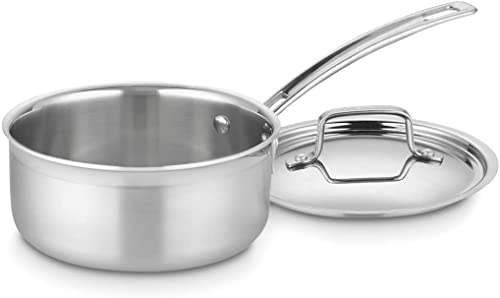
Our quick pick
Cuisinart MultiClad Pro 1.5-Quart Saucepan with Cover
Aluminum's even heat on the outside layers, stainless steel where the food sits. Tomato sauce never touches aluminum in this pan. Sold by Amazon.
See the Cuisinart saucepan on AmazonThe kinds of aluminum cookware, compared
“Aluminum cookware” covers very different pans. For each one, ask what actually touches your food.
Swipe the table sideways on a phone.
| Kind | What touches your food | Acidic food | Watch for |
|---|---|---|---|
| Bare aluminum (sheet pans, stockpots, restaurant pans) | Aluminum | Reacts. Nordic Ware says acidic ingredients “may darken, pit, or corrode the pan” | Long simmers and storing acidic or salty food |
| Hard-anodized, uncoated | A hardened layer of aluminum oxide | Non-reactive, according to Calphalon | Scratches and worn spots |
| Hard-anodized with nonstick (most hard-anodized pans on Amazon) | The nonstick coating | The coating meets the food, not the metal | What the coating is, and its heat limit |
| Clad (aluminum core inside stainless steel) | Stainless steel | Non-reactive | Disc-base pans keep the aluminum under the bottom only |
| Coated “granite” or ceramic | The coating | The coating meets the food | What the coating is, and wear |
| Cast aluminum (calderos, Dutch ovens, many coated pans) | Bare cast aluminum, or a coating | Bare cast aluminum reacts like any bare aluminum | Where it was made (see the FDA warning below) |
What health agencies say about aluminum from pots and pans
Is aluminum toxic? Start with the fact that it is already in your food. ATSDR says “Virtually all food, water, air, and soil contain some aluminum,” and that “The average adult in the U.S. eats about 7-9 mg aluminum per day in their food.” Cookware is a small part of that: “Very little enters your body from aluminum cooking utensils.” And of what you eat, “Only very small amounts of aluminum that you may inhale, ingest, or have skin contact with will enter the bloodstream.” The one group ATSDR singles out is people with kidney disease, some of whom store more aluminum in their bodies. (Its fact sheet was last reviewed in 2015.)
The European Food Safety Authority looked at aluminum from all sources in food in 2008 and set a limit: a “Tolerable Weekly Intake (TWI) of 1 milligram of aluminium per kilogram of body weight.” It counts cookware among the sources: “Aluminium in foods originates from its natural occurrence, from the use of food additives containing aluminium and from the presence of aluminium in food contact materials such as pots, pans and foil.”
Health Canada (updated September 2025) names what makes aluminum move into food more easily: “During cooking, using worn or pitted aluminum pots and pans can transfer aluminum or lead to food more easily.” Acidic and salty food is the other trigger, covered below.
Apart from the FDA's list of specific imported pots, none of these agencies tells people to throw out aluminum cookware. They point at the same few conditions: bare metal, acid or salt, long contact, and damage.
Does aluminum cookware cause Alzheimer's?
Three agencies, three different wordings, so here they are as written, without a verdict of our own:
- ATSDR (CDC): “Some studies show that people exposed to high levels of aluminum may develop Alzheimer's disease, but other studies have not found this to be true.” And: “We do not know for certain whether aluminum causes Alzheimer's disease.”
- EFSA: “based on the available scientific data, the Panel did not consider exposure to aluminium through food to present a risk for developing Alzheimer's disease.”
- Health Canada: “While there has historically been some concern that aluminum exposure is associated with Alzheimer's disease, the current evidence is conflicting.”
EFSA's statement is the one written about food specifically. ATSDR's mention is about people exposed to high levels, which is a different situation from cooking dinner in an aluminum pot.
Aluminum and acidic or salty food
Health Canada: “Foods high in acid or salt, such as tomatoes, citrus products and sauerkraut can also cause aluminum or lead to more readily transfer from cookware.” Its advice: “Don't use aluminum cookware for foods high in acid or salt.” and “Don't cook or store food in aluminum cookware for long periods.”
The pan maker sees it too. Nordic Ware, which sells bare aluminum bakeware, writes: “Aluminum is reactive to acidic ingredients such as vinegar, fruits, and tomato products. These foods may darken, pit, or corrode the pan after use or prolonged exposure.”
Not every source is that strict. A USDA-based home canning guide from Nebraska Extension lists aluminum among acceptable pots for heating pickling brine: “For heating pickling liquids, use unchipped enamelware, stainless steel, aluminum, or glass pots. Do not use copper, brass, iron or galvanized utensils.” The likely difference is time: a brine heated for a few minutes is not the same as a tomato sauce simmered for an hour, or leftovers sitting in the pot overnight. We follow the stricter rule for long cooking and storage.
In practice, move these out of bare aluminum: tomato sauce and chili, citrus marinades and lemon curd, vinegar braises and pickles, wine sauces, sauerkraut and salty brines. And move any leftovers into a glass or stainless container once they cool.

Need a non-reactive pot for sauces? Cuisinart clad saucepan
What is a non-reactive pan?
A non-reactive pan has a cooking surface that acidic or salty food does not attack, so the food keeps its color and taste and the pan does not pit. Non-reactive surfaces:
- Stainless steel, including clad pans with an aluminum core (how to choose a stainless saucepan)
- Enameled cast iron, as long as the enamel is not chipped (our enameled cast iron guide)
- Glass and glass-ceramic bakeware
- Hard-anodized aluminum, which Calphalon describes as nonreactive with acidic ingredients
- Nonstick-coated pans, while the coating is intact (the coating is the surface)
Reactive surfaces are bare aluminum, bare cast iron, carbon steel and copper, which is why recipes ask for a non-reactive pan for tomato sauce, lemon curd and pickles. Is stainless steel non-reactive? Yes. It is the usual choice, and it is on the extension list above.
Is hard-anodized aluminum safe?
Anodizing turns the surface of aluminum into a hard oxide layer. Calphalon describes the result: “The aluminum has undergone anodization, a process that hardens the metal and makes it corrosion-resistant and nonreactive with acidic ingredients, such as lemon.” Health Canada agrees on the main point: “Anodized aluminum cookware reduces the transfer of aluminum from cookware into foods, particularly acidic foods like tomatoes and rhubarb.” Its one condition: “Don't cook or store food in scratched or worn anodized aluminum cookware.”
Many listings blur one point. Nearly every hard-anodized pan we found on Amazon also has a nonstick coating on the inside. On those, the anodized aluminum is the body and the outside, and the coating is what touches your food. T-fal's page for its Ultimate line states: “This product contains PTFE for its nonstick properties.” T-fal also says it and its suppliers “have not used PFOA in their processes since 2012”. Whether PTFE is something you want in your kitchen is a separate question, and our non-toxic cookware guide covers it.
As an Amazon Associate we earn from qualifying purchases.

If you want hard-anodized nonstick
T-fal Ultimate Hard Anodized Nonstick Fry Pan with Lid, 12 inch
A hard-anodized aluminum body with a nonstick coating the listing calls “Titanium Non-stick”, plus a glass lid.
Good for: Eggs, fish and pancakes, when you want food to slide and a sturdy pan that heats evenly.
The drawback: Your food touches the PTFE coating, not the anodized aluminum. T-fal recommends hand washing and lists an oven limit of 400°F (350°F for the lid).
See the T-fal pan on AmazonClad cookware: aluminum you never cook on
Clad pans sandwich a layer of aluminum between layers of stainless steel. You get aluminum's even heat, and the food only meets stainless steel. Cuisinart's description of its MultiClad Pro line: “Professional Triple Ply Construction features an aluminum core and a brushed stainless exterior with polished rim”. Is stainless steel with an aluminum core safe? The aluminum never meets the food, so the acid question does not come up.
For grades (18/10, 304) and what full cladding means for a saucepan, see our stainless steel grades guide.
Our pick for acidic cooking
Cuisinart MultiClad Pro 1.5-Quart Saucepan with Cover
Triple-ply stainless with an aluminum core and a stainless lid. The listing describes 18/10 stainless steel with a solid aluminum core.
Good for: Tomato sauce, rice, oatmeal, reheating soup: small daily jobs, acidic or not.
The drawback: 1.5 quarts is small. It makes sauce or grains for one or two, not a pot of chili. The 2-quart size gives more room but costs more.
See the Cuisinart saucepan on AmazonWant more room? The 2-quart size
Nonstick-coated aluminum: granite, ceramic and PTFE pans
Many nonstick pans are aluminum underneath, including the “granite” and ceramic-coated pans we have checked on this site. Once the coating is on, aluminum is not what touches your food. The coating is, so the real question becomes which coating it is, what the maker discloses about it, and what happens as it wears. A worn or scratched coating is a reason to replace the pan, for the same reason Health Canada gives for anodized pans.
We look at those coatings brand by brand in our non-toxic cookware guide, our granite cookware guide, and our checks of Carote and HexClad.
Cast aluminum and imported pots: the lead question
The most serious warning on this page is about lead, not aluminum. The FDA's warning, updated in 2025: “Some types of imported cookware products made from aluminum, brass, and aluminum alloys known as Hindalium/Hindolium or Indalium/Indolium have been tested by FDA and state partners, and have demonstrated the potential to leach lead under conditions designed to mimic their use in contact with food.”
The products on its list are mostly traditional pots: kadai and karahi, patila and degda pots, milk pans and aluminum saucepans, plus a few brass pots, made in India and Pakistan and sold through US grocers, importers and retailers. Health Canada says the same in general terms: “Some aluminum cookware manufactured outside of North America has been found to transfer lead into food.”
The FDA's instruction for listed items is direct: “Consumers should check their homes for the products listed below and throw away any cookware that may be able to leach lead into food when used for cooking or food storage. Do not donate or refurbish this cookware.” Check the full list by brand and product name on the FDA warning page.
What about cast aluminum in general? Bare cast aluminum, like a traditional caldero, follows the bare-aluminum rules above: no long acidic simmers and no storing food in it. A cast aluminum pan with a nonstick coating falls under the coating question instead.
Bare aluminum: where it still makes sense
Bare aluminum is not a mistake to own. It is light and spreads heat evenly, which is why so many baking sheets are made of it, and it is at its best on dry, quick jobs: cookies, bread, roasted vegetables, toasted nuts, pasta water.
Nordic Ware suggests parchment paper, silicone mats or foil for easy cleanup on its bare pans, and parchment also solves the acid problem: tomatoes roast on the paper, not on the metal. (Our parchment paper guide covers which papers to buy.) If your sheet pans have gone dull or dark after the dishwasher, Nordic Ware's view is reassuring: “This discoloration is merely cosmetic and does not have a negative effect on its performance or safety.”

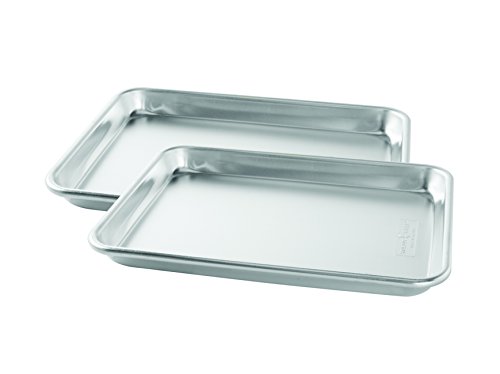
Bare aluminum done right
Nordic Ware Naturals Quarter Sheet, 2 pack
Two uncoated aluminum quarter-sheet pans. The listing describes them as made of pure aluminum that will never rust.
Good for: Cookies, small batches of roasted vegetables, toasting nuts, and catching drips under a baking dish.
The drawback: It is reactive. Nordic Ware itself says tomato and vinegar can darken or pit these pans, so line them with parchment for acidic food. And they are hand-wash pans: the dishwasher discolors them.
See the Nordic Ware sheets on AmazonFor full-size sheets, glass and other bakeware, see our non-toxic bakeware picks.
Aluminum vs stainless steel cookware
Swipe the table sideways on a phone.
| Bare aluminum | Stainless steel | |
|---|---|---|
| Heat | Health Canada: it “conducts heat well” | Spreads heat more slowly on its own, which is why good pans add an aluminum core |
| Weight | Light | Heavier |
| Acidic food | Bare aluminum reacts | Non-reactive |
| Dishwasher | Bare aluminum discolors; most makers say hand wash | Usually fine; some makers still prefer hand washing |
| Cost | Health Canada: “fairly inexpensive” | Usually more |
Is aluminum safer than stainless steel? For acidic or salty food, a stainless surface removes the question. For boiling water or baking cookies, bare aluminum is a perfectly good tool. Clad cookware gives you both: aluminum for heat, stainless for the food. For big pots, see our stainless steel stock pot guide.
How to choose aluminum cookware
- Ask what touches the food. Bare aluminum, an anodized layer, stainless steel or a coating. Amazon's “Material” field often just says Aluminum, even for coated pans, so read the description.
- If it is coated, the coating should be named. “Nonstick” or “granite” alone tells you nothing about what it is made of.
- Know where it was made, especially for traditional pots from small importers, and check them against the FDA's list.
- Match your stove. Plain aluminum is not magnetic, so it needs a steel base plate or a magnetic stainless layer to work on induction.
Old, vintage and worn aluminum pans
Old pans are not the problem; damaged surfaces are. Health Canada's warning is about “worn or pitted aluminum pots and pans”. Retire a pan when:
- The inside is covered in small pits or pinholes
- A coating is flaking, peeling or worn through to the metal
- Deep scratches have cut through an anodized or coated surface
- It matches a product on the FDA's imported cookware list
A dull gray look or dark marks alone are not pitting. We found no special rule for vintage brands, so grandma's pans get the same test: smooth and sound is fine for boiling and baking; pitted goes in the recycling.

Caring for aluminum cookware
Health Canada's care rules for aluminum are short and easy to follow:
- “Wash aluminum cookware by hand using a mild detergent and a soft cloth or sponge to avoid scratching the surface.”
- “Use non-metal cooking utensils to prevent surface damage.”
- “Limit cooking temperature to low or medium heat.”
Can aluminum pans go in the dishwasher? It depends on the kind:
- Bare aluminum: no. Nordic Ware: “Dishwasher use is not advised, as discoloration will occur due to the heat and cleaning agents used in automatic dishwasher detergent.”
- Hard-anodized: only if the maker says it is dishwasher-safe. Calphalon's rule when it is: “If dishwasher-safe, place in your appliance and wash with automatic dishwashing detergent that doesn't contain bleach or citrus additives.”
- Hard-anodized nonstick: T-fal recommends hand washing its Ultimate pans to make them last.
- Clad stainless: makers do not always agree with their own listings. Cuisinart's product page says “hand wash recommended”, while the Amazon listing for the same line says dishwasher-safe. We would hand wash.
More on what not to put in a dishwasher in our dishwasher no-go list.
Aluminum cookware we would buy
All six are sold by Amazon.com and were in stock when we checked on October 7, 2026. Prices change, so we do not print them.
As an Amazon Associate we earn from qualifying purchases.
Swipe the table sideways on a phone.
| Product | Type | Food touches | Best for | The drawback | |
|---|---|---|---|---|---|
| Cuisinart MultiClad Pro 1.5-qt saucepan | Clad, aluminum core | Stainless steel | Sauces and small jobs | Small | See on Amazon |
| Cuisinart MultiClad Pro 2-qt saucepan | Clad, aluminum core | Stainless steel | A little more room | Costs more | See on Amazon |
| Cuisinart MultiClad Pro 12-piece set | Clad, aluminum core | Stainless steel | Replacing a whole set | A big outlay | See on Amazon |
| T-fal Ultimate 12-inch fry pan with lid | Hard-anodized + nonstick | PTFE coating | Eggs and fish | Coating wears; hand wash | See on Amazon |
| T-fal Ultimate 10-inch fry pan with lid | Hard-anodized + nonstick | PTFE coating | Smaller households | Coating wears; hand wash | See on Amazon |
| Nordic Ware Naturals quarter sheets, 2 pack | Bare aluminum | Aluminum | Baking and roasting | Reacts with acid | See on Amazon |
Questions people ask
Should I throw out my aluminum pans?
Not because they are aluminum. Throw out any pot on the FDA's imported cookware list, and retire pans that are pitted, flaking or scratched through. Keep the rest for baking and boiling, and cook acidic dishes in stainless or enamel.
Is it safe to cook tomato sauce in aluminum?
Not in bare aluminum, by Health Canada's advice, and Nordic Ware says tomato products can darken or pit its bare pans. Use clad stainless, enameled cast iron or an intact hard-anodized pan instead.
Can aluminum pans go in the dishwasher?
Bare aluminum, no: it discolors. Hard-anodized only if the maker says so. Nonstick and clad: follow the maker, and hand wash when in doubt. Details are in the care section above.
Can you put aluminum pans in the oven?
Bare aluminum baking sheets are made for it. For pans with handles, lids or coatings, the maker's limit decides (T-fal's Ultimate pans list 400°F, 350°F for the lid). More in is your cookware oven safe.
Are aluminum baking sheets safe?
For everyday baking, yes. Line them with parchment for tomatoes, citrus or vinegar, and do not store food on them. Our bakeware guide compares sheet pan materials.
Is baking in disposable aluminum pans safe?
They are thin bare aluminum, so the same rules apply: fine for baking, not for keeping acidic or salty leftovers. For foil, see our foil guide.
Is aluminum cookware banned in Europe?
We found no ban in the sources we read. What the European Food Safety Authority did in 2008 was set a tolerable weekly intake of 1 milligram of aluminium per kilogram of body weight, counting pots, pans and foil among the sources of aluminium in food.
Which is better, aluminum or nonstick?
They are not opposites: many nonstick pans are aluminum underneath. Health Canada sums up aluminum's appeal: it “is lightweight, conducts heat well, is fairly inexpensive.” Bare or clad for browning and sauces, nonstick for eggs and fish.
Why do aluminum pans turn dark?
Dishwasher detergent and heat discolor bare aluminum, which Nordic Ware calls cosmetic, and acidic food can darken and pit it. Darkening alone is fine; pitting means it is time to replace the pan.
Is Calphalon hard-anodized cookware non-toxic?
Calphalon says its anodized aluminum is nonreactive with acidic food (quoted above). Many Calphalon hard-anodized pans also have a nonstick coating, so check which coating your line uses. Our non-toxic cookware guide lists what Calphalon publishes.
Are IMUSA aluminum pots safe?
IMUSA is not named on the FDA's imported cookware list (content current as of December 3, 2025), but that is not a test result. Bare calderos follow the bare-aluminum rules: no long acidic simmers, no stored leftovers.
Is aluminized steel safe?
Aluminized steel is steel coated with aluminum, mostly used for bakeware, and it behaves like bare metal with acidic food. Our bakeware guide covers it.
Can you put an aluminum pan in an air fryer?
Check your air fryer's manual first and leave room for air to move. The same questions come up with foil: can you put foil in an air fryer.
Are aluminum pressure cookers safe?
Many stovetop pressure cookers are aluminum, and the same rules apply: no long acidic cooking in bare aluminum, and replace a pitted pot. More in are pressure cookers safe.
Should a stock pot be aluminum or stainless steel?
For water, pasta and plain stock, aluminum is light and heats fast. For tomato soups or chili held for hours, stainless avoids the acid question. See our stainless stock pot guide.
Which is healthier, ceramic or hard-anodized cookware?
Many ceramic-coated pans and all hard-anodized pans are aluminum underneath, so compare the cooking surfaces: a ceramic coating, a PTFE coating, or bare anodized metal. Check what the listing names.
Which is better, tri-ply or hard-anodized?
Tri-ply puts stainless steel on the cooking side: non-reactive, no coating to wear out, but food sticks without oil and care. Hard-anodized pans are usually nonstick: easy eggs, but the coating wears out over time.
What is the safest cookware material?
It depends on what you cook. For a material-by-material answer, see our non-toxic cookware guide.
Keep reading
- Best non-toxic, PFAS-free cookware
- Stainless steel grades and the best stainless saucepan
- Is granite cookware safe?
- Non-toxic bakeware picks
- Types of cooking pans and pots
About this guide: Written by Sara Ibrahim. We did not test these products. This guide is general information, not medical advice. Where your pan's own instructions differ from this guide, follow them. Listings change, so check the current ones before you buy. As an Amazon Associate we earn from qualifying purchases.
Sources reviewed
- ATSDR (CDC): ToxFAQs for Aluminum (last reviewed 2015)
- EFSA: Safety of aluminium from dietary intake (2008)
- Health Canada: The safe use of cookware and bakeware (updated 2025)
- FDA: Warning about imported cookware that may leach lead (content current as of December 3, 2025)
- Nebraska Extension: Home canning equipment for making pickles
- Nordic Ware: Naturals aluminum bakeware
- Calphalon: Cookware use and care
- T-fal: PTFE nonstick coating
- Cuisinart: MultiClad Pro 2 qt. saucepan
- Amazon product listings (Cuisinart, T-fal, Nordic Ware), checked with a US delivery address on October 7, 2026.


