

Written by Sara Ibrahim. Sara researches home and kitchen products for Cupindy. · Published October 2026 · Last reviewed October 10, 2026
Plenty of filters say they remove lead or PFAS. Far fewer are certified to. Every pick below was checked against the certifier's own listing, model number by model number, along with the replacement filter you'll keep buying.
The short answer
Pick a filter certified to NSF/ANSI 53 for lead reduction (NSF/ANSI 58 if it's reverse osmosis). For PFAS, the claim should read PFOA/PFOS or Total PFAS. Then find that exact model number in the certifier's own database, not just on the box.
As an Amazon Associate we earn from qualifying purchases.

Our quick pick
PUR PLUS Horizontal Faucet Filter (PFM350V)
NSF lists it for lead; IAPMO lists it for lead and Total PFAS. It clips onto the faucet, no tools.
See the PUR PLUS faucet filter on AmazonIts refill, the PUR RF-9999, is the part you'll buy again every few months.
PUR RF-9999 refills, 2-packHow we checked: on October 10, 2026 we looked up every model on this page in NSF's and IAPMO's public certification listings and read each maker's data sheet or manual. We haven't lab-tested these filters ourselves.
First, read your water report or test your tap
A filter only makes sense once you know what's in your water. If you're on city water, start with your utility's annual report: “EPA requires all community water systems to prepare and deliver an annual water quality report called a Consumer Confidence Report (CCR) for their customers by July 1 of each year.” Find your local report on EPA's site.
Lead is the one a city report can miss, because it usually comes from plumbing, not the treatment plant: “The most common sources of lead in drinking water are lead pipes, faucets, and fixtures.” EPA notes that lead pipes are more likely in homes built before 1986, and “Since you cannot see, taste, or smell lead dissolved in water, testing is the only sure way of telling whether there are harmful quantities of lead in your drinking water.” EPA's Protect Your Tap guide shows how to check your service line.
For PFAS, EPA is blunt: “If PFAS have not been measured in your water, or if PFAS have been measured but are below federal limits, a filter may not be useful to you.” On a private well there's no utility report at all, so a test from a certified lab comes first; EPA's private well page explains where to start.

What “certified for lead” and “certified for PFAS” actually mean
A filter is certified for lead when a certifier lists that exact model for lead reduction under NSF/ANSI 53, or NSF/ANSI 58 for reverse osmosis. For PFAS, the listed claim reads PFOA/PFOS or Total PFAS. EPA's own advice: “If you use a filter, make sure you use a filter certified to remove lead.”
The two standards that matter
NSF/ANSI 53 covers health claims for pitchers, faucet mounts and most under-sink filters; NSF/ANSI 58 covers reverse osmosis. NSF says the 2018 edition of 53 added a PFOA and PFOS claim, and the 2022 edition “expanded the chemical reduction claims to include newer subclasses of PFAS compounds”, the Total PFAS line on some listings. Most filters still carry the older claim: “As of April 2024, filter certifications focus on removing the chemicals PFOA and PFOS, which are two specific types of PFAS,” EPA says.
“NSF 42 certified” or “tested to” is not a lead or PFAS certification
NSF/ANSI 42 covers taste, odor and chlorine. Several best-selling under-sink filters on Amazon put “NSF/ANSI 42 Certified” in their titles right next to the words lead and PFAS. When we looked those models up on October 10, 2026, the listings we found were for NSF/ANSI 42 and 372, not for lead or PFAS reduction. WQA's search returned nothing for any brand that day, so a WQA listing can't be ruled out. That's why the two-minute check below is worth doing.
NSF 372 means lead-free parts, not lead removal
In NSF's listings, 372 marks a product whose own parts meet the “lead free” plumbing limit, a weighted average of 0.25% lead or less. It says nothing about taking lead out of your water.
Certified doesn't mean down to EPA's 4 parts per trillion
EPA's 2024 limit for PFOA and for PFOS in public water is 4.0 parts per trillion each. Current filter standards “do not yet indicate that a filter will remove PFAS down to the levels EPA has now set for a drinking water standard,” EPA says. A. O. Smith's data sheet shows the gap: its PFOA and PFOS test passed against a 0.07 µg/L target, or 70 parts per trillion. Even so, EPA says “reducing levels of PFAS in your water is an effective way to limit your exposure.”
How to check any filter's certification in two minutes
- Find two model numbers on the box, listing or manual: the system and its replacement cartridge.
- Open the certifiers' listings: NSF, IAPMO R&T and WQA. EPA names five accredited certifiers in all, including CSA Group and UL.
- Search the brand, then find your exact model. A sister model doesn't count.
- Read the claims column. “Lead” and “PFOA/PFOS” or “Total PFAS” must appear by name.
- Check the cartridge. The listing names the replacement it covers; a look-alike refill isn't covered.
- Note the capacity in gallons. The claim only holds until then.
Which type of water filter do you need?
Swipe the table sideways on a phone.
| Type | Best for | Watch out for |
|---|---|---|
| Pitcher | No installation; renters | Small batches; some cartridges last very few gallons |
| Faucet mount | Low-cost certified lead filtering at one tap | Won't fit every faucet; slow flow; frequent refills |
| Under-sink carbon | Filtered water from your normal faucet, more gallons per cartridge | Needs a cold-water shutoff valve and cabinet space |
| Under-sink reverse osmosis | The longest claim lists, including metals and dissolved solids | Faucet hole, drain line, tank; sends some water to the drain |
| Whole house | Sediment, chlorine and iron at every tap | A different job; see our whole-house guide |
City water: read the report, then test the tap if your home is older or you're unsure about its pipes. Well water: test first, then match each certified claim to what the lab found. Either way, “Most home water filters—like pitcher or fridge filters—are not designed to remove germs from your water,” the CDC notes. Treating the whole house is a bigger project, covered in our whole-house water filter guide.
Best budget water filter for lead: a faucet mount
If lead is your worry, the simplest certified fix sits on the faucet itself. Only the water you choose to filter runs through it, and a lever switches back to plain tap water for washing up.
As an Amazon Associate we earn from qualifying purchases.
Our pick for lead
PUR PLUS Horizontal Faucet Filter (PFM350V)
NSF lists the PFM350V for lead reduction under NSF/ANSI 53; IAPMO's certificate lists Lead, Mercury, Total PFAS and VOC. PUR's data sheet shows 99.6 to 99.7% lead reduction in certification testing and rates each filter at 100 gallons.
Good for: renters and anyone who wants certified lead and PFAS reduction at one tap without plumbing work
The drawback: PUR says to “replace your PUR filter after 100 gallons of use or every 3 months”, so refills add up; PUR's listing says it fits sinks with an external aerator, and it takes cold water only, up to 82°F.
See the PUR PLUS faucet filter on AmazonReplacement filter: PUR RF-9999, 2-pack
Water filters for PFAS: what's certified, and where EPA's rule stands
EPA lists three filter types that can be effective against PFAS: activated carbon, reverse osmosis and ion exchange resins. Whichever you pick, the certification still has to name PFOA/PFOS or Total PFAS for your exact model.
Where EPA's PFAS rule stands (October 2026)
The 2024 rule set enforceable limits of 4.0 parts per trillion for PFOA and PFOS, and water systems must start telling customers their PFAS levels in 2027. On May 18, 2026, EPA proposed keeping the PFOA and PFOS limits while letting water systems ask for two more years, to 2031. A second proposal would drop the limits for PFHxS, PFNA, GenX and the mixture rule. Both are proposals, not final rules.
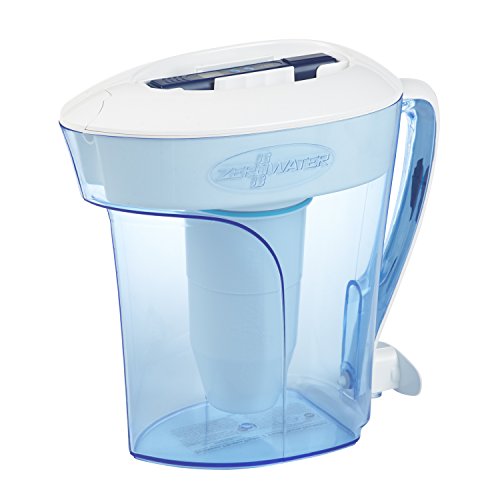
No-install PFAS pick
ZeroWater 10-Cup Pitcher (ZP-010)
IAPMO's certificate lists Lead, Mercury, PFOA, PFOS and Hexavalent Chromium for the ZP-010, with the ZR-017 among its listed replacement filters. Nothing to install.
Good for: renters and small households who want a PFOA and PFOS claim without tools
The drawback: IAPMO rates each filter at 15 gallons, the shortest life here. ZeroWater says it varies with your tap water: 40 or more gallons at low dissolved solids, about 8 to 15 at very high levels. “If the quality of your filtered water reads 006 or more, you know it's time to replace your filter.”
See the ZeroWater 10-cup pitcher on AmazonReplacement filter: ZeroWater ZR-017, 2-pack

Best under-sink water filter for lead and PFAS
A direct-connect under-sink filter treats the cold water going to your normal kitchen faucet, so there's no extra faucet and no countertop hole. It holds far more water per cartridge than a pitcher or faucet mount.

Our under-sink pick
A. O. Smith Advanced Direct Connect (AO-MF-ADV)
IAPMO lists the AO-MF-ADV for Lead and PFOA/PFOS, plus cyst, mercury, MTBE and VOC, at 784 gallons and 1.5 gallons a minute. It feeds your existing faucet through an adapter on the cold-water shutoff valve.
Good for: homeowners who want certified lead and PFAS reduction straight from the kitchen faucet
The drawback: its cartridge is the priciest single refill here, due “every 6 months or every 784 gallons of use”; you need 3 inches of clearance under it and two small screw holes for the bracket, and A. O. Smith suggests a pro if any pipe needs cutting.
See the A. O. Smith under-sink filter on AmazonReplacement filter: A. O. Smith AO-MF-ADV-R

Reverse osmosis: the premium option
“Reverse osmosis is a process that forces water through an extremely thin barrier that separates chemicals from the water,” in EPA's words. Under the sink it means a dedicated faucet, a storage tank and a drain line. Our whole-house guide explains why whole-house RO is rarely worth it; at a single sink it's common.

Premium pick for lead
iSpring RCC7AK-BN Reverse Osmosis System
NSF lists the RCC7AK-BN under NSF/ANSI 58 for lead, plus asbestos, barium, cadmium, trivalent chromium, copper, fluoride, selenium and dissolved solids. iSpring advertises PFAS reduction too, but that claim isn't on the NSF listing we read.
Good for: well owners, or anyone whose test shows several metals, fluoride or high dissolved solids
The drawback: it needs a half-inch faucet hole (iSpring says to drill one if your sink has none), a drain connection, a storage tank and at least 45 psi of water pressure, and part of the water goes down the drain.
See the iSpring RO system on AmazonReplacement filter: iSpring F4AK 6-month set
Need reverse osmosis certified for PFOA/PFOS as well? IAPMO lists GE's GXRV40TBN for both lead and PFOA/PFOS. It isn't a pick here because stock was low when we checked.
The four filters compared
All four were sold or shipped by Amazon to a US address on October 10, 2026.
As an Amazon Associate we earn from qualifying purchases.
| Filter | Certified for | |
|---|---|---|
| PUR PLUS faucet (PFM350V) | Lead (NSF); lead and Total PFAS (IAPMO) | See on Amazon |
| ZeroWater pitcher (ZP-010) | Lead, PFOA, PFOS (IAPMO) | See on Amazon |
| A. O. Smith under-sink (AO-MF-ADV) | Lead, PFOA/PFOS (IAPMO) | See on Amazon |
| iSpring RO (RCC7AK-BN) | Lead (NSF); PFOA/PFOS not listed | See on Amazon |
Filter life and replacement cartridges
A certification only lasts as long as the cartridge. EPA's warning: “Using the cartridge after it has expired can make it less effective at removing lead.”
- PUR PLUS faucet: RF-9999, every 100 gallons or 3 months.
- ZeroWater pitcher: ZR-017, rated at 15 gallons; swap it when the meter reads 006.
- A. O. Smith under-sink: AO-MF-ADV-R, every 6 months or 784 gallons.
- iSpring RO: the F4AK set covers the three pre-filters and the mineral filter every 6 months; the post-carbon filter is yearly and the membrane every 2 to 3 years.
Questions people ask
Do water filters actually remove lead?
Certified ones are tested for it: PUR's data sheet shows 99.6 to 99.7% lead reduction and A. O. Smith's over 99.3%. Look up your exact model, and run only cold water through it.
Does a Brita filter remove lead or PFAS?
IAPMO's certificate for the Brita Elite pitcher filter (OB06) lists lead. We didn't find PFOA or PFOS on that certificate on October 10, 2026, so check your own model before relying on it.
Does boiling water remove lead?
No. EPA says: “Remember, boiling water does not remove lead from water.” Use cold water for drinking and cooking.
Do refrigerator filters remove lead?
Some do. NSF's lead listing includes hundreds of refrigerator filters, many of them aftermarket. Look up your exact cartridge number before trusting a lead claim.
Does a water softener remove lead?
A softener targets hardness minerals; it isn't a lead filter. Our water softener guide explains the difference. For lead, use a filter certified for lead reduction.
Is it safe to shower in water with lead?
EPA says “Bathing and showering should be safe for you and your children, even if the water contains lead over EPA's action level.”
Does reverse osmosis remove PFAS?
EPA lists reverse osmosis among filter types that can be effective, but certification is per model: the iSpring above is listed for lead, not PFOA/PFOS, while GE's GXRV40TBN is listed for both.
Do these filters remove microplastics?
Under NSF/ANSI 401, PUR's data sheet lists microplastics at 99.65% and A. O. Smith's at 99.4%, for particles 0.5 to under 1 micron.
Keep reading
- Whole house water filter guide: types, cost and what it removes
- Water softener guide: how systems work, costs and sizing
- Glass vs stainless steel water bottles
- PFAS-free parchment paper: what to buy
About this guide: Written by Sara Ibrahim. We did not lab-test these filters. Every certification claim comes from NSF's or IAPMO's public listing as shown on October 10, 2026; WQA's product search returned no results that day, and CSA Group and UL listings were not checked. Listings change, so check yours before you buy. This guide is general information, not a test of your water. Cupindy is not affiliated with PUR, ZeroWater, A. O. Smith, iSpring, GE, Brita, NSF, IAPMO or WQA; product names are their owners' trademarks. As an Amazon Associate we earn from qualifying purchases.
Sources reviewed
- US EPA: Per- and Polyfluoroalkyl Substances (PFAS) drinking water regulation (updated May 18, 2026)
- US EPA: Reducing PFAS in Your Drinking Water with a Home Filter (updated August 3, 2026)
- US EPA: Basic Information about Lead in Drinking Water
- CDC: About Choosing Home Water Filters
- NSF: NSF/ANSI 53 Total PFAS reduction (December 11, 2023)
- NSF certified drinking water treatment units listings (PUR PFM350V; iSpring RCC7AK-BN), checked October 10, 2026
- IAPMO R&T Product Listing Directory: files W-29904 (PUR), W-14820 (ZeroWater), WP-11124 (A. O. Smith), WC-9859 (GE), W-13905 (Brita), checked October 10, 2026
- PUR: Performance Data Sheet, faucet mount filters RF9999 / RF3375
- PUR: Faucet System Support & FAQs
- ZeroWater: When to Change Your ZeroWater Filters
- A. O. Smith: AO-MF-ADV Performance Data Sheet
- A. O. Smith: AO-MF-ADV Owner's Manual
- iSpring: Reverse Osmosis Systems installation and owner's manual (RCC7 / RCC7AK)


