

Non-Toxic Guides
You've probably seen the headline about black plastic spatulas. Here's what the research actually says now, what we'd replace, and what we'd leave alone.
What this guide is. A buying guide for cooking utensils, the things you stir and flip and lift with. Not eating utensils, and not a materials lecture. Where the science needs more room, we link to our own guides instead of repeating them here.
How we researched it. We don't run a lab and we didn't test any of these. This is built from a German federal risk assessment, the U.S. Code of Federal Regulations, the paper behind the black plastic story plus both of its published corrections, and live Amazon data recorded on 9 September 2026. Where the evidence is thin, we say so rather than rounding it up.
Lara has eight years of experience creating home and kitchen product guidance, safety-focused buying content, and practical household-use articles for Cupindy readers.
The short version
If you're here because of the black plastic spatula story, you can relax a little. The study behind it has been corrected twice, and the corrected numbers land about fifty times below the safety limit everyone was comparing them to.
But there's a second reason to get a black nylon turner out of your hot pan, and it's the one nobody wrote about. Germany's federal risk agency tested 33 nylon kitchen utensils. Around a third of them released more into food than the agency thinks is acceptable. Its advice is to keep nylon out of contact with hot food as much as you can, which for a spatula is a bit of a problem.
And the part that surprised us most: there's no American limit for the thing the Germans measured. A nylon spatula can be completely legal here and still be one German regulators would rather you didn't leave in the pan.
Here's what we'd buy.
Skip to the full picks or keep reading for why we changed our minds.
The black plastic story, and what happened to it
In autumn 2024 a paper in the journal Chemosphere reported that black plastic household products can carry brominated flame retardants, apparently arriving there through recycled electronic waste. The researchers, from the advocacy group Toxic-Free Future and the Vrije Universiteit Amsterdam, screened 203 black plastic items. Kitchen utensils were among them. Seventeen came back with high levels of flame retardants, and fourteen of those contained decabromodiphenyl ether, or decaBDE, which the EPA restricted back in 2021.
The line that travelled was the exposure estimate. The authors worked out that a black plastic utensil could deliver a daily decaBDE dose approaching the EPA's reference dose. That single sentence produced a year of "throw out your spatula" headlines.

It was wrong twice.
First correction, December 2024The authors had put the EPA reference dose at 42,000 nanograms a day. The real figure is 420,000: seven thousand nanograms per kilo of body weight, times a 60 kg adult. One missing zero. The estimated exposure wasn't close to the limit at all. It was ten times further away than the paper said.
Second correction, July 2025Then the exposure formula itself turned out to have been misapplied. The estimated daily intake dropped from 34,700 nanograms to 7,900.
Put the corrected numbers together and you land at roughly two percent of the reference dose, not the eighty percent that got reported. That's a margin of about fifty times. Not a near miss.
There's one more thing worth knowing. In December 2024, Chemosphere was dropped from Clarivate's Web of Science index for failing to meet editorial quality standards. That doesn't make any single paper wrong. It does suggest the venue wasn't applying the scrutiny a claim with this much reach needed.
What still stands
The measurement wasn't the mistake. Banned flame retardants really were found in black plastic products that have no business containing them, which points at a recycling stream quietly carrying old electronics into things you eat off. Professor Stuart Harrad at the University of Birmingham has made exactly that point. It's a supply-chain problem and a regulatory one. It isn't a reason to empty your utensil drawer tonight.
We touched on this in our 2026 toaster guide, and we're correcting how we framed it there. We'd rather do that out loud than quietly.
The better reason to replace a nylon turner
Most black cooking utensils that aren't silicone are nylon. Polyamide, usually PA 6 or PA 6,6. And nylon has a documented problem that has nothing to do with recycled electronics.
In September 2019 Germany's Federal Institute for Risk Assessment published Opinion No. 036/2019. Researchers took 33 polyamide kitchen utensils, the ordinary kind, cooking spoons and spatulas and whisks, and measured what migrated out of them into food simulant at 100 °C.
The BfR treats 5 milligrams per kilogram of food as the acceptable ceiling for these compounds. Here's what came back:

Years of pan contact leave a record: fine scarring across the face, a patch gone glossy and smooth, a softened uneven edge. This is what "retire it" looks like.
On the toxicology the BfR was careful rather than alarming. These compounds aren't considered genotoxic. At high doses, it judged effects on the liver and thyroid to be possible. Its advice to the public is a single sentence:
"The BfR recommends that consumers keep contact with food as brief as possible when using PA kitchen gadgets, especially at high temperatures (above 70 °C)."
A spatula lives above 70 °C. That's the entire job.
Three honest limits on this, because you should have them. The utensils were bought on the German market, not the American one, so it isn't a direct read on what's in your drawer. The test ran 30 minutes or two hours at 100 °C, longer than most of us leave a spoon sitting in a pan. And exceeding a precautionary limit isn't the same as harming anybody. What it is, though, is a real published number about this exact category of thing, which is more than the viral version ever had.
The bit nobody checks: America has no limit for this
Nylon in American food-contact use is governed by 21 CFR 177.1500. Go looking for a migration limit in it and you won't find one.
What it sets is a maximum extractable fraction of the raw resin, by weight, measured by refluxing about 30 grams of pellets in 300 millilitres of solvent for eight hours. For nylon 6,6 that's 1.5% in water and ethanol, 0.2% in ethyl acetate and benzene.
That's a purity spec for pellets in a laboratory flask. It is not a test of a finished spatula in a hot pan. And across the nylon types the section covers there's no general limit at all on the compounds Germany measured. The one oligomer ceiling in there applies to a different polymer entirely, nylon MXD-6. Separately, nylon 612 is capped at food contact below 212 °F.
So a black nylon turner sold in America can be perfectly legal, and no American authority will ever have measured the thing German regulators found coming out of a third of the ones they tested. Compliance here isn't evidence of safety. It's evidence that nobody looked.
We also went looking for U.S. Consumer Product Safety Commission recalls covering cooking utensils and found nothing of substance. That isn't reassuring either. Utensils aren't the sort of thing that gets recalled, because recalls follow injuries, and migration doesn't produce an injury anyone can trace back to a spoon.
What we'd actually buy
Umite Chef 33-Piece Silicone Utensil Set

The most-reviewed utensil set in its Amazon category, and one of the very few at this price that actually tells you what's inside the silicone: a one-piece stainless steel core. Silicone heads, wooden handles, rated by the maker to 446 °F. On 9 September 2026 it held 4.5 stars across more than 30,000 ratings and sat third in Cooking Utensil Sets. If your drawer is currently all black nylon, this is the one-purchase answer.
OXO Good Grips Small Silicone Flexible Turner

If you only replace one thing, make it the turner. It's the utensil that spends the most time pressed flat against a hot pan. On 9 September 2026 this one held 4.7 stars across more than 19,000 ratings and ranked fifth in Amazon's Spatulas category, and it's the cheapest thing we recommend here. Yes, it's black. That's fine. Black silicone isn't black nylon, and none of the recycling questions apply to it.
Unicook 2-Piece Silicone Turner Set
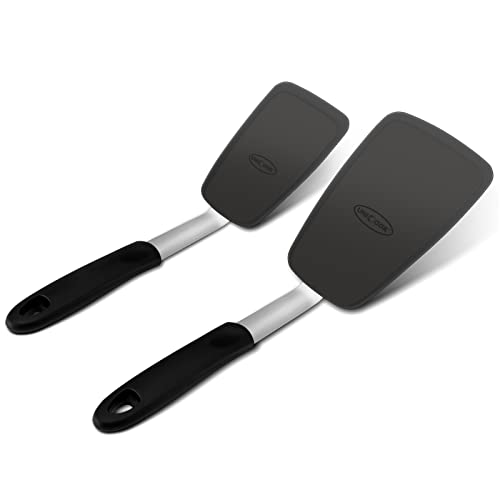
One solid turner, one slotted, and between them they cover nearly everything a home cook flips or lifts. 4.6 stars across more than 17,000 ratings as of 9 September 2026. If a 33-piece set is ridiculous for your kitchen but one small turner isn't enough, this is the middle ground.
Zulay Kitchen 6-Piece Teak Set

If everything above has left you wanting nothing synthetic near hot food, solid wood ends the argument. No coating, no core, nothing to migrate. 4.7 stars across nearly 7,000 ratings as of 9 September 2026. We won't rehash the case for wood here, since we've already covered the pros and cons of wooden cooking utensils properly, including which woods last and how to stop them cracking.
AOTHOD Silicone Cooking Utensils Set

If thirty-three pieces is absurd for your kitchen, here's the sensible middle: turner, tongs, spatula, spoon, brush, whisk. Rated by the maker to 446 °F and dishwasher safe. It held 4.6 stars across more than 22,000 ratings on 9 September 2026.
Platinum Silicone Utensils, 8-Piece

This one is here for what it claims rather than what we can confirm. The listing states LFGB-certified platinum silicone, a solid steel core, no hidden plastics and a 500 °F rating, which is the most complete material description of anything in the category. We haven't seen the certificate and neither have you. We're reporting what the maker says, not verifying it. It held 4.8 stars on 9 September 2026.
Materials, briefly
The full argument lives in our material guides. This is just the short form for choosing a utensil.
Swipe the table sideways on a phone →
| Material | Migration question | Where it fails |
|---|---|---|
| Silicone | Settled in normal use — see our silicone safety guide | Split heads, unstated core, staining |
| Solid wood | None. No coating, nothing to migrate | Cracking, odour, neglect |
| Stainless steel | None at utensil contact times | Scratches nonstick, hot handles |
| Nylon / polyamide | Measured, and unregulated in the U.S. | Melts, scars, goes glossy |
| Unmarked black plastic | Unknown, which is the answer | You can't check what you weren't told |
What to skip, and how to check what you own
1. Nylon, including the well-made stuff
This is a point about a material, not about anyone's workmanship. Nylon utensils are sold by good manufacturers, they're well made, they're cheap, and buyers rate them highly. Several nylon ranges sit at 4.6 to 4.8 stars across many thousands of reviews. None of that is in dispute, and nothing here suggests any of them is unlawful or defective. They're simply made of the polymer the BfR tested, and the BfR's own advice is to keep it away from food above 70 °C.
You'll notice we recommend a silicone turner from a brand that also sells a nylon one, and we chose the silicone. That's the whole of our position. Judge the material, not the maker.
2. Black plastic with no stated material
If a listing says "BPA-free" and stops there, you've been told about one chemical that was never the question. A utensil that won't name its polymer is a utensil whose polymer you can't look up. That's the finding, and it's enough to walk away.
How to tell what's in your drawer right now
Go and get one. This takes ten seconds.

The whole test in one picture. The silicone turner on the left bends and springs back. The nylon one on the right won't flex at all. Colour is not the tell, by the way. Plenty of perfectly good silicone is black. Flex is the tell.
- Bend it. Silicone flexes and springs back, and it feels matte and slightly grippy. Nylon is rigid and glossy and barely moves. That one test sorts most drawers.
- Look for a stamp. Plenty of utensils have PA, PA6 or PA66 moulded into the handle. That's nylon.
- Read the heat rating. Nylon usually says around 400 to 450 °F. Silicone usually says 400 to 600 °F, and says "silicone" on the box.
- Bin anything damaged, whatever it's made of. A melted edge, a scarred face, a split silicone head, a nylon head gone shiny and faintly tacky. All of them increase what comes off the utensil and into dinner, and none of them are worth arguing about. Damage is the one thing every side of this debate agrees on.
- Stop leaving utensils in the pan. This is the change that costs you nothing. The BfR's advice is about contact time, and a spoon parked in a simmering pot is the worst version of it.
Working through the rest of the kitchen on the same logic? Our guides to non-toxic cookware, non-toxic cutting boards and non-toxic silverware and flatware cover the next three drawers.
Questions people ask
What are the safest cooking utensils?
Solid wood and stainless steel, because neither has a coating or a core that can migrate into food. Silicone is the practical third, and the one most people will actually live with. The material we'd avoid is nylon, for the reasons above.
Should I throw away my black plastic utensils?
Not because of the 2024 study. Its headline number was corrected twice and now sits about fifty times below the limit it was compared to. If your black utensils are nylon there's a separate and better-evidenced case for replacing them, but it isn't urgent. Swap them when you next buy utensils, and in the meantime stop leaving them in the pan.
Are black silicone utensils a problem too?
No. The recycled-electronics question is about hard black plastic. Silicone is a different chemistry and wasn't part of that finding. A lot of people threw out perfectly good black silicone in 2024 because the headlines said "black plastic" and nobody bothered drawing the distinction.
Is nylon safe to cook with?
It's legal to cook with in America, which isn't quite the same thing. Germany's federal risk agency found about 30% of the nylon utensils it tested exceeded its migration limit, and advises keeping contact with food above 70 °C as brief as possible. There's no equivalent American limit for those compounds.
Do silicone utensils have plastic inside them?
Most have an internal core for stiffness, and it might be steel or it might be a rigid polymer. The core doesn't touch food while the silicone is intact, which is exactly why we treat a split head as a reason to retire the utensil rather than repair it. Very few listings say which core they use. The ones that do are worth preferring, all else equal.
Are metal utensils better than silicone?
For migration, yes, straightforwardly. For everyday use it depends what you cook in. Stainless will scratch a nonstick surface, so most kitchens end up with metal for cast iron and stainless pans and silicone for everything else.
How often should I replace cooking utensils?
By condition, not by calendar. Retire a polymer utensil when the head is melted, scarred, split or gone glossy and tacky. Retire a wooden one when it cracks or holds a smell you can't wash out. A utensil in good shape doesn't need replacing on a schedule.
Sources reviewed
- German Federal Institute for Risk Assessment (BfR), Opinion No. 036/2019, 17 September 2019 — "Polyamide kitchen utensils: keep contact with hot food as brief as possible"
- U.S. Code of Federal Regulations, 21 CFR 177.1500 — Nylon resins
- Liu et al., "From e-waste to living space: Flame retardants contaminating household items add to concern about plastic recycling," Chemosphere, 2024, together with its published corrections of December 2024 and 3 July 2025
- U.S. Consumer Product Safety Commission recall notices — checked for cooking utensils, September 2026
- U.S. Environmental Protection Agency — decaBDE regulatory status
- Amazon Best Sellers, Cooking Utensil Sets and Spatulas — ratings, review counts and category ranks recorded 9 September 2026
Freshness note: every star rating, review count and category rank here was recorded on 9 September 2026 and they change constantly, so check the current figures on the product page before you buy. Heat ratings and material descriptions are as stated by the seller on that date. We re-check this guide quarterly.


