
Written by Lara Yehia. Lara researches home and kitchen products for Cupindy.
How we researched this. We did not lab-test anything. We have not measured seal pressure, insulation or particle release ourselves. What we did instead was read each manufacturer's own published statements, compare them against the retail listing, and read what Amazon's review summaries say buyers actually complain about. Where a manufacturer publishes nothing, we say so, because that gap is usually the most useful thing on the page.
Published: August 2026. Last reviewed: September 2026, for food-contact material claims, manufacturer disclosures, published temperature limits and current California chemical listings.
You already know which lunch you are packing. The question is what you are packing it in, and almost every guide answers that by listing the same eight brands that pay the most attention to their own branding.
This one sorts differently. It sorts by the thing that actually decides the answer: how the food gets from your kitchen to your mouth. Somebody who microwaves a plate of rice at a desk needs a different object from somebody who eats a cold salad on a building site, and neither of them needs the object the other one bought.
Six picks below. Every one names a drawback taken from Amazon's own review summary, not from us. Two things we would not buy are explained rather than linked, and one of them is the material this whole category likes to call eco-friendly.
As an Amazon Associate we earn from qualifying purchases, at no extra cost to you.
The 30-second answer
Find the row that sounds like your week.
Hot food, carried
A vacuum jar, not a box. Nothing else keeps a stew hot without a microwave at the other end.
Thermos Stainless King on AmazonCompartments, no plastic
Steel with dividers and a clamped lid. The deepest review history of any steel box in the category.
Blockhütte steel box on AmazonMicrowaved at a desk
Divided glass. Lid off, and there is no plastic anywhere near the hot food.
MCIRCO divided glass on AmazonLight, and it will get dropped
The best-selling adult bento in the category, with one thing it will not tell you.
Bentoheaven box on AmazonCarrying is the problem
Freeze the bag itself. Solves the thing a better box cannot solve.
PackIt freezable box on AmazonNo plastic at all
Steel body, silicone lid, published numbers. Thin review history, and we say so.
Klean Kanteen Rise on AmazonWhat actually decides this
Two things, and neither of them is the material of the box.
The first is reheating. If you reheat at work, the box has to survive a microwave and the lid has to come off, which rules out most of what looks good in a photograph. If you reheat nowhere, you need insulation instead, and insulation is a completely different object that most lunch box guides do not even list.
The second is that the lid is a separate product from the box, and it is the part that dies. Bodies fail from accidents. Lids fail from use, on a schedule, in the dishwasher. We came back to this repeatedly while reading reviews for this guide, and it turned out to be the single most common complaint across every material and every price. There is a whole section on it further down, because it is the thing that decides whether you buy one of these again in eighteen months.
One pattern worth carrying with you before the picks: the retail listing sells you, and the manufacturer's own page tells you. Of the six products here, two publish real numbers on their own websites. Two publish a grade or a material and no number. Two publish neither, and one of those two is the one marketing itself hardest on being eco-friendly.
If you carry hot food
This is the case almost every eco lunch box guide ignores, and it is the most common one on a building site, in a van, on a ward, or anywhere the nearest microwave is a twenty-minute walk away.
A vacuum jar is not a box with a coat on. It is two steel walls with the air pumped out between them, so heat has almost nothing to travel through. That construction is why the numbers are measured in hours rather than minutes, and it is also why a vacuum jar cannot go in a microwave, cannot go in an oven, and cannot be flattened into a bag.
It also means there is no coating and no liner in the food space. The food sits against bare steel. That is a stronger claim than most of the plastic-free marketing in this category, and it comes from the construction rather than from a brand promise.
Buy without hesitating
Thermos Stainless King food jar, 16 oz

As an Amazon Associate we earn from qualifying purchases. Every write-up on this page names a drawback, and we would rather you read the drawback first.
Thermos publishes what most of this category will not. On its own product page: 18/8 stainless steel, double-wall vacuum insulation, hot food held up to nine hours and cold food up to fourteen, dishwasher safe on the top rack only. There is a pressure relief stopper and a folding steel spoon in the lid, so you are not hunting for cutlery in an office drawer. The wide mouth matters more than it sounds, because the failure mode of a narrow flask is that you cannot get a spoon to the bottom or a brush in to clean it.
The honest trade: Amazon's review summary says the seal divides opinion. In its words, while some say the lid seals perfectly and the stainless steel is top quality, others report that the containers do not have a tight seal. And Thermos does not publish what the stopper is made of. The words plastic, BPA and lead do not appear on the product page at all, and the listing does not name the stopper material either. The vessel is steel inside and out, which is documented. The part you unscrew is not described anywhere we could find, and on a page about what touches your food that is worth knowing rather than assuming.
If you want compartments and no plastic
Steel bento boxes are what people picture when they search for a plastic-free lunch box, and the category is smaller and stranger than the search results suggest. Almost every listing is a few hundred reviews deep, sold by a name you have not heard of, at a price that assumes you care a great deal.
Two things are worth knowing before you spend. The first is that a steel box cannot go in a microwave, so this is a cold-lunch object or a tip-it-onto-a-plate object. The second is the grade. Food-grade steel usually means 18/8, which is roughly eighteen percent chromium and eight percent nickel, the composition sold as grade 304. Grade 201 swaps much of the nickel for manganese, costs less, and holds up less well against salt and acid over time. Plenty of listings in this category say only "food-grade stainless steel" and leave it there, which tells you what the seller wanted to tell you.
Good, with one caveat
Blockhütte stainless steel lunch box, 27 oz, three compartments

We picked this one on depth rather than on polish. It has several thousand ratings, which in this category is extraordinary, and it is the only steel box we found where enough people have owned it long enough to tell you how it ages. Amazon's review summary reports that buyers praise the quality, the water-tight design and the durability, and one describes it surviving school use without scratches. It is dishwasher safe and it ships with a spare seal, which is a quiet signal that the maker knows which part goes first.
The honest trade: two, and we would rather name both. Amazon's review summary says that while the sealing lid fastens tightly with latches, customers report that the separators do not stay in place. On a three-compartment box, that is the compartment. And the listing markets the box as eco-friendly and leak-proof while never publishing the steel grade anywhere. It says food-grade stainless steel and stops. We would take a published 18/8 over an unpublished promise, and here you are taking the promise. It also sits a fraction below the rating we normally insist on, which we decided to accept rather than pretend a thinner listing was a safer bet.
If you microwave lunch at your desk
Glass is the only body material here with nothing organic in it to shed, nothing to warp, and no memory of last week's curry. The habit that goes with it is one line long: the glass goes in, the lid stays out. That costs nothing and it removes the only plastic that would otherwise be in contact with hot food.
One warning about the word this category leans on hardest.
Do not buy glass because the listing says borosilicate. Anchor Hocking, which makes tempered soda-lime glass, states on its own site that tempered soda-lime-silicate has "equal to or greater thermal shock resistance than annealed borosilicate glass" and "more than double the mechanical strength of annealed borosilicate". On how each one fails: tempered soda-lime "breaks into relatively small pieces... generally lacking sharp edges and shards", while borosilicate "breaks into larger, heavier pieces of very sharp glass creating a significant risk of severe cuts".
In fairness, Anchor Hocking is defending its own material and should be read as an interested party. But the claim is published with numbers attached, and the word that matters is annealed. Borosilicate kitchenware is usually not tempered, and tempering it is uncommon and expensive. So treat borosilicate as a description of the chemistry, not as a grade.
Buy without hesitating, with the lid off
M MCIRCO divided glass containers, 36 oz, three compartments
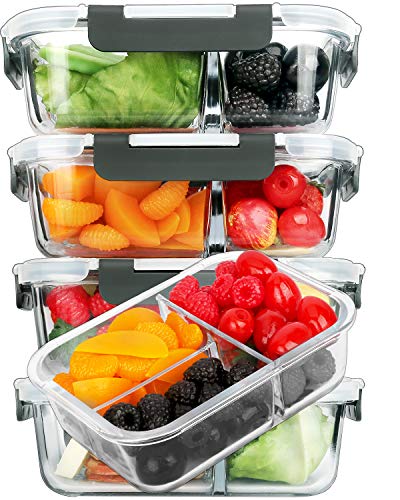
The three compartments are moulded into the glass itself rather than being a plastic tray dropped inside, which is the distinction between a real divided container and a liner. Snap-lock lids with silicone seals, and the deepest ratings profile of any divided glass set we looked at. If you eat at a desk and want your rice separate from your dressing without carrying two objects, this is the straightforward answer.
The honest trade: the lid polymer is never stated. The material field says borosilicate glass and the bullets describe the silicone seals, which tells you about the gasket and nothing about the lid it sits in. The listing also claims oven safe with no temperature attached, which is not a usable instruction. And Amazon's review summary is blunt about the thing that matters: while some find them durable and the lids lock tightly, others report lids cracking after two weeks and seals coming off, and on leak-proofing some find them totally leak-proof while others report food spilling into other sections. Buy it as good divided glass, not as a sealed system.
If it is light or it is not coming with you
There is a point in every plastic-free conversation where somebody has to say the unfashionable thing. A glass box in a bike pannier is a bad idea, a steel box in a school bag gets dented, and the box that actually travels every day is usually plastic, because it weighs a third as much and it bounces.
While we are here, the resin code rule that most safety roundups get backwards. Code 7 means "other". It is a catch-all bin, not a material. The advice to avoid number 7 flags copolyesters that contain no bisphenol A, no bisphenol S and no other bisphenol, while polycarbonate, the plastic that rule was invented to warn people about, sits in exactly the same bin. Judge the named resin, not the triangle. Our plastic grades guide goes through all seven.
Which is the problem with this pick, and we will come straight to it.
Fine, with a caveat
Bentoheaven adult bento box, 40 oz, stackable

This is the most-bought adult bento box in the category by a wide margin, with more than twelve thousand ratings behind it, and the design earns the volume. Two stacking twenty-ounce tiers with a removable divider and a dip cup, a silicone-sealed lid with an air-vent plug you press down to lock, and a full set of reusable cutlery including chopsticks so nothing is missing at the far end. The listing states microwave-safe with the lid off and dishwasher-safe on the top rack, which is the correct instruction rather than the flattering one.
The honest trade: it never names its plastic. The bullets say "food-grade, lab-tested BPA-free materials" and that is the whole disclosure. Not the resin, not the code, nothing. That is the same gap we criticise on the divided glass lid, and it is more conspicuous here because the body is the plastic. Amazon's review summary adds the predictable second problem: while some customers say it holds up well in the microwave and dishwasher, others report issues with the top lid breaking apart, and on sealing, some say it seals perfectly while others report the lid does not close tightly. Buy it for what it is, which is the box most people carry every day and replace when the lid goes.
If the problem is carrying it, not storing it
Half the people who go looking for a better lunch box do not have a lunch box problem. They have a temperature problem, and they are trying to solve it by buying a nicer container.
A box keeps food in a shape. It does nothing about the five hours between your fridge and your lunch break. The usual answer is an insulated bag plus an ice pack, which works until you forget the ice pack, and you will forget the ice pack.
The alternative is to make the bag the ice pack. Freezable lunch bags have gel sealed inside the walls, so the whole thing goes in the freezer overnight and comes out as a cold box with no separate part to lose. It is a genuinely different product from everything else on this page, and it sits alongside your box rather than replacing it.
Good, with one caveat
PackIt freezable classic lunch box

PackIt is unusually specific about its own materials, which is why it is the one we would buy. Its safety page states the products are made from "food-safe, nontoxic poly canvas and EVA" and are "free of harmful PVC, BPA, phthalates, formaldehyde and lead", tested by a third party and meeting Proposition 65 and CPSIA requirements. That is a named polymer and a named standard, which puts it ahead of most of the boxes on this page, never mind most bags.
The honest trade: the gel itself is not described anywhere on that page, and nothing tells you what to do if a wall is punctured. We could not find a statement either way. The second caveat is about the evidence rather than the product: Amazon's review summary for this bag is overwhelmingly about school use, praising it for third graders and first graders and as a mini cooler, and noting the inner plastic wipes down easily. It has fourteen thousand ratings, but they are not mostly adults carrying a work lunch. And the whole thing only works if the bag spent the night in the freezer, which is a habit, not a feature.
If you want no plastic anywhere
Every other product on this page has a plastic component in the lid, even the steel ones. If that is the thing you came here to remove, there is one obvious answer and we are going to recommend it with a warning attached.
We would buy it. We cannot vouch for it on reviews yet

A stainless body with a food-grade silicone lid, so there is no plastic in the system at all. What sold us is that Klean Kanteen publishes real numbers where almost nobody else does. From its own food box FAQ, verbatim: "Max 350F/ 176C degrees" in the oven and "up to 20 minutes"; "Do not use in microwaves over 1000W" and "Do not exceed 5 minutes in microwave"; and "Do not use vessel and lid together in microwave". That is more specific guidance than we found anywhere else in this category, and it is the difference between an adjective and an instruction.
The honest trade: the review history is thin. Not modest, thin. It has a couple of dozen ratings against twelve thousand for the Bentoheaven, which is far too few for Amazon to even generate a review summary for it, and that absence is the drawback. A new line from an established twenty-year-old brand is not an unknown quantity, but we are not going to pretend a handful of reviews tells you how something ages. It is also sold through a third-party seller rather than the brand or Amazon directly, it costs more than a comparable plastic set, and the exterior carries a coated finish. Food contact is bare steel on the inside; the outside is a coated product, and you should know that rather than discover it.
What the review counts actually say
Here is something we did not expect to find, and it changes how you should read every other guide in this category.
There is no stainless steel lunch box on Amazon that clears four and a half stars on thousands of ratings. Not one. We went looking for it specifically, because that is the bar we normally hold products to, and the category does not contain a product that meets it. The deepest-rated steel box in the whole category sits a fraction below that rating on several thousand reviews. Everything rated higher sits in the hundreds.
The second finding is more awkward. The plastic-free brands that every eco lunch box guide recommends, the ones with the good stories and the recycled steel and the B Corp pages, rate worse on Amazon than the anonymous plastic boxes they are supposed to be better than. Two of the most-recommended names in this category sit in the low four-point-twos. One sits at four and a half on a few hundred ratings. Meanwhile an unglamorous plastic bento sits at four and a half on more than twelve thousand.
We are not telling you the plastic one is better. Ratings measure whether a thing did what the buyer expected, not whether it was a good idea. What we are telling you is that the list of brands you have seen in every other article is a list of reputations, and the reputations and the review histories do not point the same way. Anybody publishing those names without the numbers next to them has not checked.
The bamboo boxes everyone recommends
Search for an eco-friendly lunch box and you will be shown something the colour of oatmeal, described as bamboo fibre or bamboo composite, usually by a guide that has put it near the top of the list.
A bamboo fibre lunch box is not wood. It is a plastic, normally a melamine-formaldehyde resin, with ground bamboo mixed into it as a filler. The bamboo is what makes it opaque and warm-coloured. The resin is what makes it a box.
That matters because of what European regulators concluded about the filler. Plastic food-contact materials sold in the EU may only be made with substances that have been assessed and authorised under Regulation (EU) 10/2011, and bamboo flour is not on that list. The EU working group's conclusion was that "no legal basis exists for the use of bamboo flour as an additive in plastics". The Commission's position is that these plant-based additives "are not authorised and are not on the Union list". Note what that does and does not say: never assessed is not the same as assessed and rejected, and melamine resin on its own is an established food-contact plastic. It is the filler that has no authorisation.
The enforcement is the part worth knowing. A coordinated action across twenty-one countries, ending in April 2022, recorded 748 cases, of which 644 were products found on the EU market and 104 were goods rejected at the border. Alongside it, more than fifty RASFF notifications concerned high levels of formaldehyde migration from such products, and more than ten percent of those exceeded the specific migration limit by more than a factor of ten.
None of that is a United States rule, and none of it is a finding about any particular box on sale today. What it is, is a regulator in another market looking hard at a material and not liking what it found. We are not willing to put a bamboo fibre box on a list of recommendations while that is the state of the evidence, and we would rather explain why than quietly leave it off.
And if you came here for disposable ones. A good number of people searching for eco-friendly lunch boxes are looking for single-use catering boxes, the compostable or bagasse kind bought by the hundred for an event or a food business. That is a different product and a different supply chain, and this guide does not cover it.
The one-line version: compostable usually means industrially compostable, which requires a commercial facility most households cannot reach, and several fibre-based food containers have historically used fluorinated treatments for grease resistance. If you are buying in bulk, ask the supplier for the migration testing and ask specifically whether any fluorochemicals are intentionally added. If you are buying one box for yourself, a reusable one you keep for five years beats anything disposable on every measure that matters.
The lid is the part that fails
Across every material and every price on this page, the body outlives the lid, usually by years.
We did not set out to make that the argument of this guide. It became the argument because of what came back when we read the review summaries. Of the six products here, four have a lid or seal complaint as the single most-repeated negative: a top lid breaking apart, lids cracking after two weeks, a lid that does not close tightly, separators that will not stay in place. Different materials, different brands, different prices, same part.
Lid body
Warps out of flat after repeated dishwasher heat, then stops sealing.
Snap arms and latches
Crack at the hinge. The most common single failure in the category.
Gasket
Goes hard, or the channel it sits in stays dirty and breaks the seal.
Vent plug
Tears or stops seating flush after a year or two of daily flexing.
So the real question at the point of purchase is what happens when the lid goes. There are only three good answers: the brand sells replacement lids separately, the brand offers a lifetime warranty, or the lid is not plastic in the first place. If none of the three applies, the set has the lifespan of its weakest lid, and you should count dishwasher cycles rather than years when you estimate that. The top rack is where lids age, not the fridge.
Related reading: what should never go in the dishwasher.
Compartment sets and the sauce problem
Divided boxes are excellent for dry components and unreliable for wet ones. The dividers in almost every moulded set stop short of the lid, which is a manufacturing necessity rather than an oversight, because a divider that sealed against the lid would need a gasket of its own. The practical consequence is that dressing migrates into the rice the moment the box tilts in a bag.
Most brands leave you to discover this. One does not. LunchBots writes it into its own product bullets for the Medium Uno bento: "The lids and dividers aren't watertight be sure to pack only dry foods." A manufacturer naming its own product's limitation in a sales bullet is rare enough to be worth pointing at, and it confirms exactly what the reviews say across the rest of the category. It is also why the steel box above comes with a separator caveat rather than a promise.
The fix is not a better compartment set. It is to stop trying to carry dressing in a compartment. A small sealed pot, or dressing added at the desk, solves in one move what no divider design has solved yet.
The 60-second check almost nobody does
There is a check you can run on any brand on this page in under a minute, and it is backed by law rather than by marketing.
California's Assembly Bill 1200 defines its terms plainly. In the statute's own words: "'Cookware' means durable houseware items that are used in homes and restaurants to prepare, dispense, or store food, foodstuffs, or beverages. 'Cookware' includes pots, pans, skillets, grills, baking sheets, baking molds, trays, bowls, and cooking utensils."
Read that carefully, because it cuts both ways. The word store is in the definition, which on its face reaches an object you keep lunch in. But the list of examples names no container and no lunch box, and we could not find a determination from California's Department of Toxic Substances Control saying either way. So this is us reading a definition, not reporting a ruling, and you should treat it as the former.
What the law then requires is specific. Since 1 January 2023, manufacturers selling cookware into California have had to publish, on their own website, any intentionally added chemicals from the state's designated list that are present in the handle or in any surface that touches food. Physical labelling followed on 1 January 2024. And there is a second provision that almost nobody mentions, which changes how you should read a package. Quoting the statute:
"Commencing on January 1, 2023, on the internet website for the cookware, and on January 1, 2024, on the cookware package, a manufacturer shall not make a claim that the cookware is free of any specific chemical if the chemical belongs to a chemical group or class identified on the designated list, unless no individual chemical from that chemical group or class is intentionally added to the cookware."
In other words, a free-of claim on a covered product is a regulated statement rather than a marketing one. That is worth holding in mind the next time a listing tells you what it does not contain and nothing about what it does.
And there is something happening this autumn. On 18 June 2026 California's Department of Toxic Substances Control finalised a regulation adding microplastics to its Candidate Chemicals List, effective 1 October 2026. On the same page, DTSC states plainly that "adding chemicals to the Candidate Chemicals List does not create new regulatory requirements". Several law firms have nonetheless published client alerts arguing that because the cookware disclosure duty keys off that list, disclosure obligations follow from that date. We are not going to tell you who is right. We are telling you the listing happened, on that date, and that the disagreement about what it triggers is live while you read this.
The reader rule, either way: search the brand name plus "AB 1200". Filing quality is itself a buying signal. A company that can tell you which of its products contain what usually knows its own supply chain. A company that cannot may simply not know.
We ran that search for all six brands on this page in September 2026 and found no AB 1200 disclosure page for any of them. That sentence records our search and nothing more. It is not a statement that any of these companies has failed to comply with anything, and it should not be read as one. We built our non-toxic food storage guide around this check if you want the longer walkthrough.
What "microwave-safe" actually certifies
If you reheat lunch at work, this is the most misread phrase you will meet, and it is worth two minutes because it changes what you buy.
Microwave-safe is not a claim that nothing leaves the container. It is a claim about two narrower things: that the container will not melt, deform or catch fire at microwave temperatures, and that the substances the plastic is known to contain stay within the migration limits set for its food-contact clearance. That is the test. Particle shedding was never part of it.
So the honest translation is: this will survive the microwave and will not leach its listed chemicals above the permitted level. That is a real assurance. It is a narrower one than most people assume. And the habit that makes the whole debate go away costs nothing: the container goes in, the lid stays out.
The 2023 research, described accurately
In July 2023 a team led by Kazi Albab Hussain published work in Environmental Science & Technology measuring particle release from plastic food containers. The headline number travelled a long way: some containers released as many as 4.22 million microplastic and 2.11 billion nanoplastic particles from a single square centimetre in three minutes of microwaving.
Three details usually get dropped when that number is repeated, and all three matter to what you buy. It tested polypropylene containers and polyethylene pouches, not every plastic. The pouches shed substantially more than the rigid tubs, so the film-type product was the worse performer. And refrigeration and room-temperature storage over six months also released particles in the millions to billions, which quietly undercuts "just do not microwave it" as a complete answer.
This is being litigated, and one case has already collapsed
In April 2025 two California plaintiffs filed a proposed class action against Newell Brands in the United States District Court for the Central District of California, arguing that labelling polypropylene tubs microwave safe and freezer safe is deceptive because heating and freezing them is what makes them shed. The complaint cites the Hussain figures almost verbatim. These are allegations. Nothing has been proven, and the case was still pending when this guide was written.
A near-identical suit against S.C. Johnson over Ziploc products is over, and how it ended matters. It was voluntarily dismissed with prejudice after the defendant moved to dismiss, meaning it cannot be refiled, but no court ruled on the merits. The case ended without being answered, which is not the same as being answered in either direction.
The FDA's own position, last updated 24 July 2024, is that "current scientific evidence does not demonstrate that the levels of microplastics or nanoplastics detected in foods pose a risk to human health", and that there is "not sufficient scientific evidence to show that microplastics and nanoplastics from plastic food packaging migrate into foods and beverages".
Our read, stated plainly: the laboratory finding is real and published in a serious journal, the consumer-harm case built on top of it is unproven, and the regulator says the evidence is not there yet. That is not a reason to panic. It is a reason to notice that if you were going to reheat in glass or steel anyway, the question does not arise, and that costs you weight rather than money. The full material comparison is in glass versus plastic food storage containers, and the label decoding lives in is it microwave safe.
Care rules that actually add years
- Lids on the top rack, always. The bottom rack sits closest to the heating element and that is where plastic lids warp.
- Store lids off. Leaving a lid clamped on an empty box keeps the gasket compressed, which is how it takes a permanent set and stops sealing.
- Wash gaskets separately once a month if they come out, and scrub the channel if they do not. The groove is the failure point and it is invisible until it leaks.
- Vent before microwaving. Unclip, or rest the lid rather than sealing it. Pressure is what pops lids and cracks latches.
- Never add cold liquid to hot glass or hot liquid to cold glass, and do not put hot glass straight onto a cold stone counter.
- Preheat or prechill a vacuum jar with hot or cold water for five to ten minutes and empty it before filling. It is the difference between four hours and nine.
Questions people ask
What is the most eco-friendly lunch box material?
The one you keep for a decade. That is not a dodge: the footprint of any of these is dominated by manufacturing, so the box you actually carry beats the better box you replace twice. If you want a ranking anyway, steel and glass last effectively forever and lose on weight, silicone lasts well and stains, and plastic is lighter and has a lid clock running on it from day one.
Is stainless steel microwave-safe?
As a general rule no, because metal reflects microwaves and can arc. But check the manufacturer rather than assuming, because at least one brand permits it within stated limits. Klean Kanteen allows its Rise food box in a microwave up to 1000W for a maximum of five minutes with the lid removed. That is a narrow, specific permission and not a general one. If your box's maker publishes no limit, treat steel as a cold-lunch container.
What does 18/8 mean?
Roughly eighteen percent chromium and eight percent nickel, which is the composition of grade 304. It is the grade you want for food contact. Grade 201 swaps much of the nickel for manganese, costs less, and holds up less well against salt and acid over time. A listing that says only "stainless steel" has told you what it wanted to tell you. More in stainless steel grades explained.
Are bamboo lunch boxes safe?
A bamboo fibre box is a plastic with ground bamboo in it, normally a melamine resin. EU regulators concluded there is no legal basis for using bamboo flour as an additive in plastics, and a coordinated enforcement action recorded hundreds of cases along with more than fifty notifications of high formaldehyde migration. That is a European finding rather than a United States rule, and it is not a statement about any individual product on sale. We do not recommend the category on that basis.
Is there lead in a stainless steel vacuum flask?
This question comes up because of how the things are built. A double-wall vacuum vessel has to be sealed at its base after the air is removed, and at least one major flask brand has confirmed that the pellet it uses for that seal contains lead, while stating that no lead contacts the contents or the user. The seal sits outside the food space by construction. We could not find a statement from Thermos either way on its own site, so we are describing how this class of product is made rather than telling you what is inside any particular one. A single-wall bottle has no vacuum chamber and therefore no such seal at all.
Do I really need a leak-proof box?
Leak-proof is the most-repeated and least-reliable claim in this category. Four of the six products here make some version of it, and the review summaries for three of them include buyers reporting the opposite. Assume any box will leak if it goes in sideways with soup in it, carry wet things upright, and treat the claim as a design intention rather than a guarantee.
Glass or plastic for carrying?
Glass for reheating, plastic for carrying, and most people who pack lunch seriously end up owning both and using them for different days. Glass has nothing organic in it to shed and does not hold stains or odours. Plastic weighs a third as much and does not shatter on a tiled office floor.
How long should a lunch box last?
Count dishwasher cycles, not calendar years. Glass and steel bodies last indefinitely in normal use. Lids are the limiting part, and what decides the real lifespan is whether replacement lids are sold, whether there is a lifetime warranty, or whether the lid is silicone rather than plastic in the first place.
Related reading on Cupindy
- Lunch box materials compared, for adults and kids
- Packing a school lunch without the plastic questions
- Glass versus plastic storage containers
- Non-toxic food storage containers: what to check before you buy
- Plastic grades for food storage, explained
- Is it microwave safe? How to read the label
- Stainless steel grades for cookware
- Is silicone safe for cooking?
- How to reheat food properly
Sources reviewed
- California Assembly Bill 1200 (2021), bill text: definition of cookware, the website and packaging disclosure dates, Health and Safety Code section 109013 on free-of claims, and section 109014 on the sale condition.
- California Department of Toxic Substances Control, Candidate Chemicals page, on the 18 June 2026 microplastics rulemaking effective 1 October 2026 and on what listing does and does not require. Reviewed September 2026.
- European Commission, Food Safety, "Bamboo-zling" coordinated action: 748 cases, 644 on the market, 104 rejected at the border, 21 participating countries, concluded April 2022.
- Food Packaging Forum, on bamboo in plastic food contact materials, quoting the working group conclusion that no legal basis exists for the use of bamboo flour as an additive in plastics, and on formaldehyde migration notifications.
- Regulation (EU) No 10/2011 on plastic materials and articles intended to come into contact with food.
- Klean Kanteen food box FAQ, on the published oven and microwave limits, reviewed September 2026.
- Thermos product page for the 16 oz Stainless King food jar, on 18/8 construction, vacuum insulation, retention hours and dishwasher guidance, reviewed September 2026.
- PackIt safety standards page, on poly canvas and EVA construction, the PVC, BPA, phthalate, formaldehyde and lead statement, third-party testing, Proposition 65 and CPSIA.
- Anchor Hocking, "Bakeware Facts" and "Why Choose Glass", on tempered soda-lime-silicate against annealed borosilicate for thermal shock, mechanical strength and breakage behaviour.
- Hussain, K.A., Romanova, S., Okur, I., et al. "Assessing the Release of Microplastics and Nanoplastics from Plastic Containers and Reusable Food Pouches: Implications for Human Health." Environmental Science & Technology, vol. 57, no. 26, 4 July 2023, pp. 9782-9792.
- United States Food and Drug Administration, "Microplastics and Nanoplastics in Foods", last updated 24 July 2024.
- Andesilic et al. v. Newell Brands Inc., case 2:25-cv-03736, United States District Court for the Central District of California, filed 28 April 2025. Allegations only, pending at the time of writing.
- Trade press reporting on the parallel S.C. Johnson action, voluntarily dismissed with prejudice following the defendant's motion to dismiss, with no ruling on the merits.
- Retail listing text and Amazon customer review summaries for each of the six products named above, read in September 2026. Every drawback quoted in this guide is taken from those summaries rather than asserted by us.
Freshness note: manufacturer disclosures, product materials, retail listing text, chemical listings and active litigation all change. The pages cited here were read in September 2026. Re-check the brand's own page before you buy. That is the point of the rule.


