

It is Tuesday night. There is half a portion of pasta left, and you reach for whatever container is nearest. That is the whole decision, made in about two seconds, roughly four hundred times a year.
So it is worth about five minutes of your time to get it right once.
We put glass and plastic through five tests that match how people actually use containers — not laboratory conditions, but Tuesday-night conditions. Glass won three. Plastic won two. And the two that plastic won are the two that decide whether a container ever leaves your kitchen.
There is also one thing almost every other comparison misses entirely, and we will start there, because it changes the answer.
The 30-second answer
- Glass for anything you heat, anything with tomato or oil in it, and anything living in the fridge for days.
- Plastic for anything that travels — lunches, commuting, a packed freezer. For children, check the age line on the box; several good sets exclude under-12s.
- Take the lid off before you microwave. Nearly every glass container has a plastic lid, so this is the one habit that matters most, whichever material you own.
- Owning one set of each is not indecision. It is the right answer.
The three we would buy
Full reasoning and the drawback of each is further down. If you only want the answer, it is here.
No plastic touches food
Bentgo Signature Glass Food Storage Containers with Lids, 12 Piece Set

Check current price on Amazon
Glass bowl, glass lid, silicone frame — and Bentgo is the only brand here that publishes the full material breakdown itself. The one set you can reheat with the lid on.
The mainstream buy
Komax Biokips Foodsaver Set, Square Lunch Box Containers with 4 Removable Compartments, Pack of 5

Check current price on Amazon
Glass bowl, plastic lid, sensible price. Its own listing tells you to remove the lid before heating — which is exactly the right advice.
For food that leaves the house
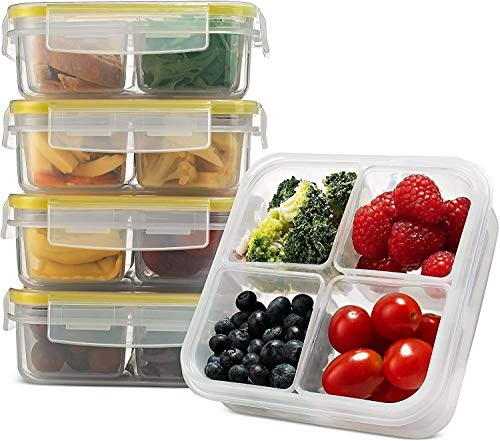
Komax Biokips Foodsaver Set, Square Lunch Box Containers with 4 Removable Compartments, Pack of 5
Check current price on Amazon
The only brand we found that names its resin: polypropylene, stated outright. Shatterproof, and the right tool for a lunch bag.
These are affiliate links. Cupindy earns a commission if you buy through one, at no extra cost to you. We name a drawback for every product below, including the ones we like most.
The bit everyone misses: your glass container has a plastic lid
Go and look at the glass set in your cupboard. The bowl is glass. The lid is not.
Glasslock, one of the bigger tempered-glass brands, says so plainly on its own website: "The lids are made of polypropylene," sealed with a silicone gasket. That is not one brand cutting a corner. That is how almost the entire category is built.
Now here is the part that makes it matter. Pyrex tells you that in the microwave, "the cover must be unsealed from the dish and lay off-center to allow steam to escape" — vented by about a quarter of an inch. That instruction is there for a sensible reason: a sealed lid builds pressure.
But picture what it actually creates. Boiling-hot food underneath. A sheet of plastic directly above it. Steam rising, condensing on the plastic, and dripping straight back down into your dinner.

So a glass container reheated with the lid on is not a glass container. It is a glass-and-plastic container, and the plastic is in the hottest part of the system.
Some makers say it outright. One glass container set we looked at carries this line in its own product description:
"Note: Please remove the lid before heating."
That is the manufacturer, not us. It is printed on the listing, under the same heading that calls the set microwave safe.
The one habit that settles most of this article
Take the lid off before it goes in the microwave. Cover with a plate or a sheet of kitchen paper instead. It costs nothing, it does exactly what the manufacturer's venting instruction is trying to approximate, and it removes the single biggest hot-plastic moment in ordinary container use — on glass containers and plastic ones alike.
One more consequence: rate the lid separately from the bowl. A set with a glass lid and a silicone rim is a genuinely different product from a set with a plastic snap lid, even when both sit on the same shelf at a similar price. We score them separately further down.
The scorecard
Five tests. Here is how they landed.
Test 1
Heat and reheating
Glass wins
Not close — as long as you take the lid off.
Test 2
What gets into your food
Glass wins
Clear on the mechanism. Honestly unresolved on health.
Test 3
Breaking and shattering
Plastic wins
And it is not close either.
Test 4
Weight and travel
Plastic wins
Lunch bags, kids, packed freezers.
Test 5
Cost over the years
Glass wins
Narrowly. One dropped dish flips it.
Test 1: Heat
Glass wins, comfortably.
Glass has no upper limit you will ever reach cooking dinner. Pyrex describes its glassware as made for a fully preheated oven "at any temperature that is called for in a baking recipe."
Plastic does not enter this conversation. Pyrex is blunt about its own lids: they "must not be used in conventional or convection ovens because they will melt."
That one difference is why glass earns its shelf space. Last night's lasagne goes fridge to oven to table in the same dish. No transferring, no second pan to wash, and you get a proper browned top instead of a microwave-soft one. Plastic can do none of that.

Where glass loses points inside its own win: the lid still cannot go in the oven, so the dish sits uncovered the whole time — and when it comes out, you need somewhere safe to put it. Which brings us to the test glass loses.
About that "freezer straight to oven" claim
Some glassware is sold on the promise that you can move it from freezer to hot oven. A little of it can. Most of what is on shelves cannot, and trying is a common way people break a dish.
Pyrex's own guidance is that the oven must be completely preheated before the dish goes in, and that you should never add liquid to hot glassware. Read the instructions for the specific dish you own. Do not assume from the brand name.
Test 2: What gets into your food
Glass wins on mechanism — but we are not going to overstate the health part.
Glass is inert. There is nothing in it to give up. It will not take on the orange of last week's curry, and it will not still smell faintly of garlic in March. Plastic does all of that, and heat and acidity speed all of it up.
Then there is the study everybody quotes. In 2023, a University of Nebraska–Lincoln team published work in Environmental Science & Technology that has been repeated across the internet ever since. They microwaved polypropylene baby-food containers and a polyethylene pouch at full power for three minutes and measured what came off.
4 million microplastic particles
2 billion nanoplastic particles
per square centimetre of container surface, after three minutes in a 1,000‑watt microwave
That is a real number from a real paper. Now here are three things about it that almost nobody repeating the headline mentions — and they cut both ways.
- Those containers were filled with water or vinegar solution, not food. The acidic version was chosen deliberately to be harsh. It is not a plate of leftovers.
- The same study found particles released during ordinary fridge and cupboard storage too, over a simulated six months. If you quote this paper to stop microwaving in plastic, it also argues against storing in plastic. Most articles use the first half and quietly drop the second.
- It is measured per square centimetre of container wall, not per meal. It does not tell you what actually reaches a person.
And the counterweight, which belongs in any honest version of this: the FDA's stated position, last updated July 2024, is that "current scientific evidence does not demonstrate that levels of microplastics or nanoplastics detected in foods pose a risk to human health."
So where does that leave you? The particles are real, they are measured, and heat releases more of them. Whether they do you harm at these doses is honestly not settled, and any site telling you it is settled is selling you something.
Glass wins this test because it removes the question, not because the question has been answered against plastic.
"BPA-free" tells you what is missing, never what is there
This is the most useful sentence in the article, so here it is plainly: "BPA-free" is a statement about one chemical that is not in the product. It tells you nothing about which plastic is in the product — and that is the thing that decides how it behaves when it gets hot.
Pyrex, to take one example, says its plastic items "DO NOT contain BPA, BPS, BVP, Latex, Phthalate, Polycarbonate, Polychlorinated Vinyl, Polystyrene, PFAS, or PVC." That is a genuinely long list of good absences. It still never names what the lid actually is. Glasslock, to its credit, does.
The rules are moving, and in one direction. The EU passed Regulation (EU) 2024/3190, banning BPA and related bisphenols across food-contact materials — plastics, coatings, adhesives, rubbers and silicones. It came into force on 20 January 2025, and the grace period for reusable items ran out on 20 July 2026, a month before this article was reviewed. In the United States, the FDA still considers BPA safe at current food-contact levels; it withdrew approval for baby bottles, sippy cups and infant formula packaging because industry had stopped using it there, not on safety grounds, and its last full review dates from 2014.
What that means when you are standing in a shop: European-market containers are now on a stricter footing by law. And if a listing is vague about the plastic, look for the little number in the triangle. #5 is polypropylene, which is what you want in a lid. Our guide to plastic grades for food storage explains what each number means.
Test 3: Breaking and shattering
Plastic wins, and it is not close.
Glass breaks. Everyone knows that. What most people do not know is that the more alarming failure is not dropping it — it is the dish that seems to explode on its own, and the industry has quietly made that more likely.
Why some glass shatters and some does not
Two kinds of glass dominate the kitchen aisle.
Borosilicate barely expands when it heats up, so a sudden temperature change does not tear it apart. Soda-lime expands more, and does not cope nearly as well. Tempering — cooling the surface fast so it sits under compression — is how manufacturers make soda-lime tough enough to sell.
Here is the gap, from R.C. Bradt and R.L. Martens, whose analysis of shattering glass cookware was published in the American Ceramic Society's Bulletin in September 2012.
Roughly three times the tolerance. And the more uncomfortable half of their finding: when they examined soda-lime glassware bought in shops, they reported minimal, if any, evidence of the heat strengthening manufacturers claim for it. Consumer Reports found the same in practice — soda-lime dishes taken from a hot oven and set on a damp worktop failed readily, while borosilicate handled it. In fairness to the manufacturers, their long-standing response is that those test conditions went beyond the printed instructions, which tell you never to do that in the first place. Both things are true: the instruction exists, and most people break it without realising.
Put 100°F in kitchen terms. That is less than the gap between a dish just out of the oven and a damp granite worktop. It is roughly the gap between the fridge and a warm kitchen on a summer afternoon.
That is the mechanism behind every "my dish exploded" story. It is also why every glassware maker's safety page says the same things: never put hot glass on a wet or cold surface, never add liquid to hot glass, never use it under a grill or on a hob.
The Pyrex question, answered properly
Here is where we part company with most of the pages you will find.
The story everywhere online is that US Pyrex switched from borosilicate to soda-lime in 1998, when Corning sold the brand, while European pyrex stayed borosilicate. Tidy, memorable, and too simple.
The date is disputed
The 1998 brand sale is real. But World Kitchen has said the glass changeover at its Charleroi plant began decades earlier, and Consumer Reports concluded in 2011 that it is not clear when it happened.
The brand will not tell you
Pyrex's current FAQ discusses both materials — soda-lime resists impact slightly better, borosilicate resists heat change slightly better — without saying which one is in the dish in front of you.
There is no badge to look for
No safety mark exists for glass bakeware the way a UL sticker does for electricals. If a guide tells you to look for one, it has not checked. For the glass baking dishes we would buy, see our non-toxic bakeware picks.
A myth worth killing
You may see advice to look for an "ASTM C1464" claim on glass bakeware. We checked. ASTM C1464 is the Standard Specification for Bent Glass — architectural glazing, nothing to do with cooking. The document that does cover this property, ASTM C149, is a laboratory test method, not a mark a manufacturer prints on a box. There is nothing for a shopper to look for.
So what can you actually do? Look for the word borosilicate written in the product's own specification. Not "heat-resistant." Not "tempered tough." Not "oven safe." Those all mean soda-lime in practice. If the brand will not say the word, assume soda-lime and treat it gently.
Test 4: Weight and travel
Plastic wins, by a distance.
A glass container weighs several times what a plastic one of the same size does. That is the entire argument, and it is enough.
Lunch bags
A week of glass is a genuinely heavy bag, and glass next to a laptop is a bad idea. See our comparison of lunch box materials.
Children
Not a close call. Glass does not belong in a school bag.
A full freezer
Glass will not squeeze into an awkward gap, and a container filled to the brim will crack as the contents freeze and expand. Plastic flexes and forgives.
High shelves
A stack of glass overhead is a real hazard in a way a stack of plastic simply is not.
Where plastic loses points inside its own win: lids warp. Dishwasher heat is usually the cause, which is why every manufacturer says top rack only for plastic lids — and a warped lid is a lid that no longer seals. That is the failure that ends most container sets. It happens to glass sets and plastic sets equally, because they share the same lid.

Test 5: Cost over the years
Glass wins, narrowly — thinner than glass fans will tell you.
We do not print prices, because they are wrong within weeks. The shape of the cost is what matters.
A glass set costs meaningfully more on day one — roughly double a comparable plastic set is typical. But if you do not break it, the glass bowl does not really wear out. It will not stain, will not cloud, will not hold a smell. Plastic stains from tomato and turmeric, scratches, and goes hazy in the dishwasher, and most households bin plastic sets because they look tired long before they stop working. Over five years or more, glass usually comes out ahead.
Three things eat that margin, and nobody mentions them:
Both fail at the lid
Replacement lids are a steady product line for the big glass brands precisely because that is the part that goes. You get long life from the bowls and a rolling cost on the lids. Budget for it.
One break resets everything
A dropped glass container is a total loss plus a floor to sweep. A dropped plastic one usually bounces. Tile floor and small children? Expect a shorter life than the box implies.
The warranty is short
Pyrex glassware carries a two-year limited warranty covering breakage from oven heat and manufacturing defects, if you followed the instructions. Its Snapware plastic line carries a lifetime warranty on defects. "Glass lasts forever" is not a commercial promise.
On throwing them away, glass has the better story, though the usual figures describe packaging rather than reusable containers: EPA data for 2018 puts glass containers and packaging at a 31.3% recycling rate against 13.6% for plastic. One catch worth knowing — tempered and borosilicate kitchen glass is generally not accepted in kerbside glass recycling, because it melts differently and spoils the batch. Check your local rules rather than assuming.
So which one, for which job?
Fridge leftovers
Glass
No stains, no smells, and you can see what is in there — which is the real reason glass leftovers get eaten and plastic ones get thrown out.
Tomato sauce, curry, dressings
Glass
Acid and oil are exactly the two conditions that stain plastic permanently and speed up what comes out of it.
Microwave reheating
Glass, lid off
The bowl is inert. The lid is the plastic. Take it off, cover with a plate.
Oven to table
Glass only
Plastic cannot do it at all. Preheat fully, and land the hot dish on a dry cloth — never a wet or cold worktop.
Lunch and commuting
Plastic or stainless
Weight and breakage decide it. Reheat at the other end in a bowl, not in the container.
Children's food
Stainless, usually
Breakage rules out glass. But check the plastic set too — several good ones carry an explicit "not for children 12 and under" line that buyers never read.
Long-term freezing
Either, with rules
Glass: leave headspace, cool first, thaw before heating. Plastic: fine, but the lid will stiffen and crack eventually.
Dry pantry goods
Either
No heat, no acid, no question to answer. Choose on looks and shelf strength.
What to buy — and the drawback of each
We do not test twenty sets in a laboratory, and we are not going to pretend we do. What we do is read what the food actually touches rather than what the box is called, and tell you the catch the retailer will not.
Three picks. Which one depends entirely on the table above.
Option 1 — nothing plastic touches the food
Bentgo Signature Glass Food Storage
What it is: the only set in this article whose maker publishes a full material breakdown on its own website rather than leaving you to guess: "Borosilicate Glass (Container), Tempered Glass (Lid Panel), Silicone (Lid Frame and Steam Valve)." Glass bowl, glass lid, silicone frame. No plastic anywhere near the food.
Buy it if: the plastic question is your main reason for switching. It is also the pick if shattering worries you — a borosilicate body handles roughly three times the temperature swing of ordinary soda-lime.
Because the lid has no plastic in it, this is the one set here you can reheat without taking the lid off — there is a steam valve built into it. That is the whole point of paying more.
The drawback nobody prints: the retailer lists it as oven safe, but Bentgo's own site never confirms the lid is — and a silicone frame has a temperature ceiling the glass does not. Treat the bowl as oven-safe and leave the lid out. It is also the heaviest and priciest option here, and the silicone frame is a wear part: when it stops sealing, that is the end of the container, not just the lid.
Option 2 — the mainstream buy
KOMUEE Glass Meal Prep Containers
What it is: the standard product in this category, and honest about it. The listing states plainly that each container "comes with a BPA-free plastic lid featuring a silicone ring" — glass bowl, plastic lid, snap locks.
Buy it if: you want what glass is good at — no staining, no smells, oven-capable, see-through — at a sensible price, and you are happy to take the lid off to reheat.
This is the set whose own instructions say "Please remove the lid before heating." We would rather link a brand that tells you that than one that stays quiet.
The drawback nobody prints: the listing calls the glass borosilicate, but that word appears only in the retailer's specification field — there is no brand website publishing a material sheet we could check it against. By the standard we set earlier in this article, that is an unverified claim, and we are not going to apply a looser rule to a product we earn from. Treat the glass as soda-lime unless the seller documents otherwise. The plastic lid is also a consumable: top rack only, and expect to replace lids well before bowls.
Option 3 — because plastic won two tests
Komax Biokips Foodsaver Set
What it is: the reason this one is here rather than a better-known brand is a single word. Its material field reads Polypropylene. Not "plastic." Not "BPA-free." The actual resin, named. We checked Sistema, Lock & Lock, Rubbermaid and Snapware first, and not one of them will tell you.
Buy it if: food leaves your house. This is not settling — for a lunch bag it is the right tool, and it is the shatterproof one.
The drawback nobody prints: the listing carries the line "THIS ITEM IS NOT INTENDED FOR USE BY CHILDREN 12 AND UNDER" — so despite being the unbreakable option, it is not the answer for a school bag. The care field manages to say both "Dishwasher Safe" and "Hand Wash Only." And the internal dividers are not leak-proof; only the outer lid is, which the seller does state. Expect staining from tomato and turmeric like any polypropylene.
The thing we could not find anywhere
We went looking for containers whose makers name the plastic. Sistema says "BPA Free" and "high-quality, food safe materials." Lock & Lock, Rubbermaid and Snapware say versions of the same. Four established brands, and not one of them will print the resin.
So do not look for it on the listing. Turn the container over. The resin code is moulded into the base, in a small triangle. A 5 is polypropylene, which is what you want. That mark is the only place in the entire purchase where the answer is written down.
Five things to check before you pay
- What is the lid made of? If the listing will not say, that is information too. You want the plastic named — polypropylene or #5 — or glass with a silicone gasket. When it arrives, turn it over: the resin code is moulded into the base even when no brand will print it.
- Does the brand's own specification say "borosilicate"? "Tempered," "heat-resistant" and "oven safe" all mean soda-lime in practice.
- Can you buy replacement lids in this exact size? The lid fails first. If you cannot replace it, the set has an expiry date.
- Does the gasket come out? A fixed gasket cannot be dried or replaced, and it will eventually smell.
- What does the warranty actually cover? Two years on heat breakage is normal for glass. Do not assume anything longer.
Questions people actually ask
Is glass really safer than plastic?
For the bowl, yes in mechanism: glass is inert and gives up nothing, while plastic releases measurable particles, more so when heated. But the health significance of those particles is unresolved — the FDA's position as of July 2024 is that current evidence does not demonstrate a risk at the levels found in food. And most glass sets come with plastic lids, so switching to glass reduces plastic contact rather than ending it.
Can I microwave a glass container with the lid on?
Only vented. Manufacturers say the lid must be unsealed and set off-centre, or vented by about a quarter inch, so steam can escape — a sealed lid builds pressure. Better still: take the lid off and cover with a plate. It is the only way to keep hot steam off the plastic. Not sure your glass is microwave safe in the first place? See our type-by-type guide to microwaving glass.
Is Pyrex borosilicate or soda-lime?
It depends on the item and the market, and the brand name will not tell you. Pyrex's own FAQ discusses both without saying which is which. The popular "US Pyrex switched in 1998" story is oversimplified — the brand changed hands that year, but World Kitchen has said the glass changeover began much earlier, and Consumer Reports concluded the date is unclear. Look for "borosilicate" in the specification for that exact item, or treat it as soda-lime.
Why did my glass dish shatter?
Almost always thermal shock, not a fault. Soda-lime glass copes with a temperature difference under roughly 100°F. Setting a hot dish on a wet or stone worktop, adding cold liquid to a hot dish, or putting a cold dish into a half-heated oven all exceed that easily. Land hot glass on a dry cloth or a dry rack, every time.
Are plastic lids dishwasher safe?
Top rack only. The bottom rack sits closer to the heating element, and heat is what warps lids out of shape. A warped lid stops sealing, and that is what ends most sets.
Does "BPA-free" mean non-toxic?
No. It means one specific chemical is absent. It says nothing about which plastic was used or how it behaves when hot. In the EU, Regulation (EU) 2024/3190 banned BPA in food-contact materials outright, with the grace period for reusable items ending 20 July 2026. In the US, the FDA still considers BPA safe at current food-contact levels. Our explainer on what "free-of" labels really mean goes further.
Can glass go in the freezer?
Yes, with two rules. Leave headspace, because liquid expands as it freezes and a brim-full container is a common way to crack one. And let food cool to fridge temperature first rather than going hot to freezer. Thaw in the fridge before reheating, rather than moving frozen glass into a hot oven.
The bottom line
Glass wins on heat, on what reaches your food, and on cost if you keep it long enough. Plastic wins on breaking and on weight — which happen to be the two things that decide whether a container ever leaves the house.
Buy glass for the fridge, the microwave and the oven. Buy one plastic or stainless set for everything that travels.
And whichever is in your hand tonight: take the lid off before you reheat. Because on both of them, that lid is the plastic.
Keep reading
- Plastic grades for food storage: what the numbers mean
- Plastic food containers: benefits, limits and care
- Stainless steel containers: the third option
- Is it microwave safe? How to read the symbols
- How to reheat food properly
- Is silicone safe for cooking?
- Non-toxic lunch boxes
- Choosing the right drinkware
How we put this together
This is a materials and use-case comparison, not a laboratory report. Cupindy does not run migration assays or destructive heat testing. Every number here comes from a named primary source — manufacturer documentation, peer-reviewed research, ASTM standards, FDA and EU regulation — all listed below so you can check them yourself. Cupindy is an independent research site and does not sell containers. Some retailer links are affiliate links; see our Affiliate Disclosure.
Sources reviewed
Hussain, K.A. et al., "Assessing the Release of Microplastics and Nanoplastics from Plastic Containers and Reusable Food Pouches: Implications for Human Health," Environmental Science & Technology, 2023, and the University of Nebraska–Lincoln summary of the same study.
US Food and Drug Administration, "Microplastics and Nanoplastics in Foods," last updated 24 July 2024.
US Food and Drug Administration, "Bisphenol A (BPA): Use in Food Contact Application."
Regulation (EU) 2024/3190 on bisphenol A and other bisphenols in food contact materials, in force 20 January 2025.
Bradt, R.C. and Martens, R.L., "Shattering Glass Cookware," American Ceramic Society Bulletin, September 2012, as reported by the American Ceramic Society.
ASTM C1464, Standard Specification for Bent Glass; ASTM C149, Standard Test Method for Thermal Shock Resistance of Glass Containers.
Pyrex, "Frequently Asked Questions" and "Product Warranties, Safety and Usage."
Glasslock, "What is Glasslock?" manufacturer materials page.
Iowa State University Extension and Outreach, AnswerLine, "Glass Kitchenware Cautions."
Consumer Reports glass bakeware testing, as reported by Snopes and the American Ceramic Society.
US Environmental Protection Agency, "Containers and Packaging: Product-Specific Data," 2018 figures.
Pyrex Help Centre, "Is it possible to recycle borosilicate glass?", and municipal recycling guidance on kitchen glassware.
Freshness note: food-contact rules are moving. The EU grace period for reusable items closed on 20 July 2026, and the FDA has been asked to reconsider its BPA position. We review this page whenever either changes.


