
By Rawia Younis · Published November 2026 · Images are AI-generated illustrations
An average boneless chicken breast takes about 12 to 15 minutes at a gentle simmer, counted from when the water starts to bubble. It's done when the thickest part reads 165°F (74°C) on a food thermometer. Thin cutlets need less time, big breasts and bone-in pieces need more, and frozen ones take about half as long again.
- Start cold: chicken in the pot, cover with cold water, then heat.
- Simmer, don't boil hard: small, lazy bubbles once it gets going.
- Check, don't guess: 165°F (74°C) in the thickest part, per USDA.
- Rest 5 minutes before you slice or shred.
Any pot that fits the chicken in one layer, with about an inch (2.5 cm) of water over it and room to spare, will do. If you're choosing one, our guide to stainless steel stock pots compares sizes and bases.
As an Amazon Associate we earn from qualifying purchases.
The one tool that ends the guessing

An instant-read thermometer. Alpha Grillers Meat Thermometer Digital. Every time on this page is a starting point. This is what tells you the chicken is actually at 165°F (74°C). The listing gives a 1 to 2 second reading. It's hand wash only, not dishwasher safe. The listing rates it IP67 waterproof, so rinsing it under the tap is fine.
See the thermometer on AmazonListing checked 20 November 2026.
How long to boil chicken breast, by size
Minutes start when the water reaches a simmer, with the pot lid on. These are typical ranges, not rules. Pot size, how much water you use and how cold the chicken was all move the number, so start checking at the low end.
| Chicken | Size | Simmer time | Done at | Note |
|---|---|---|---|---|
| Thin-cut cutlets | under ½ in (1.3 cm) thick | 8–10 min | 165°F (74°C) | Check early; they overshoot fast |
| Average boneless breast | 6–8 oz (170–225 g) | 12–15 min | 165°F (74°C) | The usual supermarket size |
| Large boneless breast | 10 oz (280 g) or more | 15–20 min | 165°F (74°C) | Or halve it lengthwise first |
| Bone-in, skin-on breast | 12–16 oz (340–450 g) | 20–30 min | 165°F (74°C) | Probe next to the bone, not on it |
| Frozen boneless breast | 6–8 oz (170–225 g) | 18–23 min | 165°F (74°C) | About 50% longer, per USDA |
The 165°F (74°C) target, the thickest-part rule and the 50% for frozen chicken come from USDA FSIS Chicken from Farm to Table, checked 20 November 2026. USDA's own chart lists longer, approximate simmering times: 25 to 30 minutes for a 4 oz (115 g) boneless breast half and 35 to 45 minutes for a 6 to 8 oz (170 to 225 g) bone-in half. The ranges above are typical recipe times for a gentle simmer, so start checking early and let the thermometer decide.
Why recipes disagree
You'll see 8 minutes in one recipe and 30 in another. Most of the gap is size: a 5 oz (140 g) cutlet and a 12 oz (340 g) breast are not the same job. The rest is method. Some recipes count from cold water, some from the boil, and some turn the heat off and let the chicken sit. None of that changes the finish line, which is why the thermometer matters more than the clock.
Cold water or boiling water? Start cold
Put the chicken in the pot first, add cold water to cover it by about an inch (2.5 cm), then bring it up over medium-high heat. As the water warms, the chicken warms with it, so the outside isn't overcooked by the time the middle catches up. Dropping a cold breast into a rolling boil tends to tighten the outside first.
Season the water while it heats: a good pinch of salt, and a bay leaf, a smashed garlic clove or a few peppercorns if you have them. Salted water seasons the meat a little and gives you better broth at the end.

Chicken in first, cold water over the top, then the heat goes on. (AI-generated scene)
Gentle simmer, not a hard boil
Once the water starts to bubble, turn the heat down until you see small bubbles breaking slowly at the surface, then put the lid on, slightly ajar if it keeps boiling over. A rolling boil cooks the outside faster than the inside and is a common reason boiled chicken comes out tough. A simmer takes a few more minutes and gives you meat that slices and shreds cleanly.
Most recipes say “boil,” but what you're really doing is poaching.

Left: a gentle simmer. Right: too hot. (AI-generated scene)
How to tell when boiled chicken is done
USDA's rule is 165°F (74°C), measured in the thickest part of the breast. Lift a piece out with tongs, push the probe in from the side so the tip sits in the middle of the thickest part, and wait for the number to settle. With bone-in chicken, keep the tip close to the bone without touching it.
If it reads under 165°F (74°C), put it back for 2 or 3 minutes and check again. Once it's there, let it rest on a board for about 5 minutes. The temperature keeps climbing a few degrees and the juices settle, so you lose less when you cut it. Our chicken internal temperature guide explains where that number comes from.

Probe from the side, into the thickest part. 165°F (74°C) is the number. (AI-generated scene)
Pink chicken, cloudy water and white foam
Pink inside but 165°F (74°C)? It's done. USDA says safely cooked poultry can be white, pink or tan, and color alone can't tell you it's safe. The reverse matters too: chicken can look white and still be under temperature.
Gray-white foam on top? That's protein. As the chicken heats, a little water leaves the meat carrying some protein, which sets as it cooks, the way egg white does. Mark Traynor, director of culinary science at Auburn University, told Mashed it is water-soluble protein that rises out of the meat and sets in the heat. It's safe, just not pretty. Skim it if you plan to keep the broth. If you're throwing the water out, leave it.
Cloudy water is the same protein spread through the liquid, mostly from a hard boil. It doesn't mean anything is wrong. A gentler simmer keeps it clearer.
Boiling chicken breast from frozen
You can cook chicken straight from frozen on the stove. USDA says it will take about 50% longer than thawed chicken. For a 6 to 8 oz (170 to 225 g) breast, that's roughly 18 to 23 minutes at a simmer.
- Put the frozen breasts in the pot and cover with cold water as usual. Don't thaw them on the counter first.
- Separate pieces that froze together as soon as they loosen, so they cook evenly.
- Check each piece. Frozen breasts are often uneven, and the thick end lags.
A slow cooker is different: USDA advises thawing chicken before it goes in one. If you're baking instead, our baked chicken breast guide covers oven times.
Handling raw chicken safely
Don't rinse raw chicken before it goes in the pot. USDA advises against it: washing doesn't make it safer, and the splashes can carry raw juices onto the sink, the counter and anything nearby. Cooking to 165°F (74°C) is what takes care of bacteria.
- Use one board and knife for raw chicken and a different one for anything that won't be cooked.
- Wash your hands with soap after touching raw chicken, and wipe down anything it touched.
- Don't put cooked chicken back on the plate or board that held it raw.
A board with a groove around the edge keeps raw juices from running onto the counter. The Farberware 15 x 20 inch plastic cutting board (38 x 51 cm) has a deep perimeter groove, is reversible and goes in the dishwasher, per the listing. It's big, so measure your counter and sink first.
Why boiled chicken turns rubbery, and how to fix it
Rubbery or dry boiled chicken usually comes down to one of three things:
- The water was boiling hard. Turn it down to a simmer.
- It cooked too long. Start checking at the low end of the chart. Every minute past 165°F (74°C) dries it further.
- The pieces were uneven. The thin end overcooks while the thick end finishes. Pound the thick end flatter, or cut big breasts in half.
Already overcooked? Slice it thin across the grain or shred it, and let it sit in a little of the warm cooking liquid for a few minutes. It won't undo the cooking, but it helps a lot for salads, wraps and soups.
Don't pour out the water
The liquid left in the pot is a light chicken broth. Strain it, and use it to cook rice or grains, as a soup base, or to moisten the shredded chicken. It's thinner than a stock made from bones, so taste it and reduce it on the stove if you want more flavor. Cool it and store it like any other cooked food (below).
How to shred, cool and store boiled chicken
Shred chicken while it's still warm. It pulls apart much more easily than cold chicken. Two forks work fine: hold the piece with one and pull along the grain with the other. For a big batch, a stand mixer on low or a twist shredder is faster. The twist chicken shredder we looked at is a plastic bowl with teeth in the lid. Its listing says it's for cooked meat only, never raw.

Shred it warm. Two forks are all you need. (AI-generated scene)
Get it into the fridge within 2 hours of cooking. USDA gives cooked chicken 3 to 4 days in the fridge, or about 4 months in the freezer for best quality. Spread it into shallow containers so it cools quickly. For the full day-by-day breakdown, see how long cooked chicken lasts in the fridge. When you warm it up again, take it back to 165°F (74°C); how to reheat food covers the stove, oven and microwave.
What you need to boil chicken
Nothing special. A pot with a lid, a way to lift the chicken out, a board and a thermometer. We didn't test these products; each description below comes from its Amazon listing, checked 20 November 2026, and each limit is about how the item fits this job.
As an Amazon Associate we earn from qualifying purchases.

Amazon Basics 8-Quart Stainless Steel Stock Pot with Glass Lid
Best for: boiling 2 to 4 breasts with room for water and broth. The listing describes an aluminum-encapsulated base for even heating, a glass lid with a steam hole so you can watch the simmer, and induction-compatible, dishwasher-safe steel.
Good to know: 8 quarts (7.6 L) is more pot than 1 or 2 breasts need. For a small batch, a 3 to 4 quart saucepan heats up faster.
Check the pot on Amazon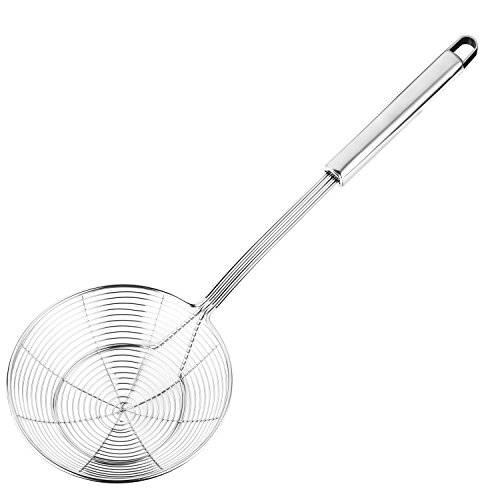
Hiware Stainless Steel Spider Strainer, 5.4 inch
Best for: lifting chicken out of hot water and skimming foam off the broth. The listing gives an 18/8 stainless steel basket and a 15.5 inch (39 cm) handle.
Good to know: the 5.4 inch (14 cm) basket lifts one breast at a time.
Check the strainer on AmazonFor turning and lifting pieces to check them, 12-inch tongs are easier than a fork, which pokes holes and lets juice out. The KitchenAid 12-inch utility tongs lock closed for storage and go in the dishwasher, per the listing; they measure about 11.6 inches (29 cm), a little short of a true 12, so mind the steam over a deep pot.
Questions people ask
How long do you boil chicken breast to shred it?
The same time as for slicing: about 12 to 15 minutes at a simmer for an average boneless breast, until the thickest part reads 165°F (74°C). Chicken shreds best when it's just cooked through and still warm. Cooking it longer makes it dry, not easier to shred.
Can you boil chicken breast for 30 minutes?
It will be safe once it passes 165°F (74°C), but an average boneless breast simmered that long is usually dry. Thirty minutes suits bone-in breasts, which take 20 to 30 minutes in the chart above. USDA's approximate chart allows 25 to 30 minutes for a 4 oz (115 g) boneless half, which is why the thermometer, not the clock, is the test.
Can you boil frozen chicken breast?
Yes. USDA says chicken can be cooked from frozen on the stove, and it takes about 50% longer, roughly 18 to 23 minutes for a 6 to 8 oz (170 to 225 g) breast. Check each piece with a thermometer.
How long does boiled chicken last in the fridge?
3 to 4 days, per USDA, if it went in within 2 hours of cooking. It keeps about 4 months in the freezer for best quality.
Should the pot be covered when boiling chicken?
Yes, mostly. A lid helps the water come up to a simmer faster and keeps the temperature steady. Leave it slightly open if the pot keeps boiling over.
What are the most common mistakes when boiling chicken?
Boiling it hard instead of simmering, cooking by the clock without checking the temperature, cooking pieces of very different sizes together, and rinsing the raw chicken first, which USDA advises against.
Can you put frozen chicken in a slow cooker instead?
USDA advises thawing chicken before it goes in a slow cooker. Boiling on the stove from frozen is fine; the slow cooker is the exception.
How we checked
On 20 November 2026 we read the USDA FSIS pages below on cooking, handling and storing chicken and on the color of cooked poultry. The 165°F (74°C) target, the frozen-chicken guidance and the storage times come from USDA. The simmer times are typical recipe ranges for a gentle simmer, not lab results. USDA's approximate chart gives longer simmering times for breast halves, and we note them under the table. The thermometer reading is what decides. The images are AI-generated illustrations, not photos of our own cooking. Product details come from the Amazon listings linked above.
Written by Rawia Younis. Rawia researches home and kitchen topics for Cupindy. This page is general cooking and food-safety information, not medical or nutrition advice.
Sources
- USDA FSIS: Chicken from Farm to Table (read 20 Nov 2026)
- USDA FSIS: The Color of Meat and Poultry (read 20 Nov 2026)
- Mashed: Here's Why Your Chicken Foams When It's Boiling (quoting Auburn University's culinary science director) (read 20 Nov 2026)
As an Amazon Associate we earn from qualifying purchases. Cupindy earns a commission if you buy through the Amazon links on this page, at no extra cost to you. No brand paid to be included.


