

Written by Lara Yehia. Lara researches home and kitchen products for Cupindy. · Published October 2026 · Last reviewed October 4, 2026
Search for PFAS-free parchment paper and you will find plenty of lists that call one brand or another "non-toxic". Then look at the actual boxes on Amazon. None of the parchment listings we checked says PFAS-free anywhere. They tell you the paper is unbleached, how hot it can go, and sometimes what it is coated with. The PFAS part you have to piece together yourself.
So we did. Below is what each maker says about its coating and bleaching, what the one independent lab spot check found, what the FDA has and has not said, and the three papers we would buy.
How we put this together: we have not baked with these papers. We read the Amazon listings and Amazon's buyer review summaries with a US delivery address on October 4, 2026, the makers' own websites, FDA and EPA documents, and a blogger-commissioned lab test, all listed at the end. Drawbacks come from the listings and buyer reviews, and we say which is which.
The short answer
- Is parchment paper toxic? Used below the temperature printed on the box, it is not a known health problem. The things worth checking are the coating, PFAS and bleaching.
- PFAS: no Amazon listing we checked claims to be PFAS-free. In the one independent spot check we could find, If You Care and Katbite showed no detectable fluorine; regular white Reynolds and Costco's Kirkland showed low levels of total fluorine.
- Our pick: Katbite pre-cut 12 x 16 inch sheets. Unbleached, silicone coating named on the listing, rated to 450°F, and they lie flat in a half-sheet pan.
- Best roll: If You Care, whose listing names its coating and explains the choice. Cheapest: Reynolds Unbleached, with the lowest heat limit of the three.
As an Amazon Associate we earn from qualifying purchases. This does not change which products we recommend.

The parchment we would buy first
Katbite Unbleached Parchment Sheets, 12 x 16 in, 200 pack
Pre-cut to fit a half-sheet pan, so no curling roll. Unbleached, silicone coated, rated to 450°F.
See the sheets on AmazonIs parchment paper toxic?
Parchment paper is paper with a non-stick finish. Used inside its temperature limit it does not burn, and food lifts off it cleanly, which is the whole point. The worry people have is about what is in or on the paper. That comes down to four separate questions, and they have different answers:
- What makes it non-stick? Usually silicone. Some commercial paper uses a chromium-based coating called Quilon. More below.
- Does it contain PFAS? The makers that name a coating say silicone, but no box we checked promises PFAS-free, and the testing is thin.
- Is bleached paper a dioxin risk? That worry comes from how paper mills used to bleach pulp. We could not find evidence that heating bleached parchment in an oven releases dioxin.
- How hot can it go? Between 425°F and 450°F for the papers on this page. Above that, it darkens and turns brittle.
One thing this page does not cover: paper liners for air fryers. They raise their own questions about airflow and heating elements, and we answer those in are air fryer liners safe?
What makes parchment non-stick: silicone or Quilon
Plain paper soaks up grease and grabs onto sugar and cheese. Parchment gets its release from a treatment on the surface, and there are three kinds you will run into.

What each kind of baking paper uses to release food, according to the makers.
- Silicone. A thin layer of food-grade silicone on one or both sides. Katbite, If You Care and Zenlogy all say their parchment is silicone coated. Reynolds does not name the coating on its Amazon listing or on its own page about its unbleached paper.
- Quilon. A chromium(III) release treatment used mostly on commercial bakery pan liners. Its maker, Zaclon, says it contains only chromium(III) and no chromium(VI), the form of chromium known as a health hazard, and that it is FDA approved for incidental food contact. A pan-liner seller lists Quilon liners for ovens up to about 400 to 425°F.
- Uncoated. Greaseproof paper with no coating on top. It handles fat well, but food can stick more than on coated paper.
If You Care makes the strongest claim in this market. Its Amazon description says most other parchment papers are coated with Quilon, which it describes as containing "chrome, a heavy metal", and that it uses silicone because it costs more but avoids that. That is the brand's own argument, not a finding we can confirm: Quilon's maker says its coating is safe for food contact, and we did not find independent testing of chromium in retail parchment. What we can say is practical. If you want to know what touches your food, buy a paper whose maker tells you, and two of our three picks do.
As an Amazon Associate we earn from qualifying purchases.

Best roll, coating named
If You Care Parchment Baking Paper, 70 sq ft roll
Unbleached, totally chlorine-free, FSC certified and certified compostable, with a silicone coating on both sides according to the listing. If You Care's help center gives a maximum of 428°F. Sold and shipped by Amazon.
Good: anyone who wants a roll from a maker that names its coating, and who composts.
The drawback: getting a clean sheet off the roll. Many buyers say it is hard to tear a clean sheet off the roll, and like any roll it wants to curl back up in the pan. Its heat limit is also a little lower than the pre-cut sheets'.
See the If You Care roll on AmazonDoes parchment paper have PFAS?
PFAS are the "forever chemicals" once used to make paper food packaging resist grease. In February 2024 the FDA announced that grease-proofing substances containing PFAS were no longer being sold into the US market for paper food packaging. That covers paper and paperboard packaging. The FDA's notice does not mention parchment or baking paper, and it does not mean every roll on the shelf has been tested. Our air fryer liner guide walks through that FDA history in more detail.
On Amazon, none of the nine parchment listings we checked on October 4, 2026 makes a PFAS claim, not even the ones built around a "non-toxic" message. The maker pages we read for Katbite, Zenlogy and Reynolds did not add one either.
The only product testing we found comes from Mamavation, a consumer blog that paid a lab it describes as EPA-certified to measure total fluorine in eight baking papers, bought in 2021 and early 2024. Total fluorine is a screening test: it catches PFAS and other fluorine compounds without naming them, and the lab could not detect anything below about 9 to 10 parts per million. Here is what it reported:
| Paper | Result in the spot check | What that tells you |
|---|---|---|
| If You Care roll and If You Care sheets | No fluorine detected | No sign of a fluorine treatment at that detection limit |
| Katbite parchment | No fluorine detected | Same |
| Reynolds parchment (regular white) | 14 ppm total fluorine | Low level; does not identify which compound |
| Kirkland (Costco) | 12 ppm total fluorine | Low level; Costco's own brand |
| Reynolds Unbleached, Zenlogy, King Arthur, Amazon Basics | Not tested | No data either way |
Read that table for what it is: one small spot check, of specific packs bought years apart, by a site that says itself it has only spot-checked the industry, and the tested pack may not be the exact size or version linked on this page. It is useful as a tiebreaker. It is not proof that any brand is PFAS-free, and it is not proof that the 12 to 14 ppm papers contain added PFAS.
What to look for: a maker that names its coating (silicone), says unbleached or chlorine-free, and prints a heat limit. If PFAS is your main concern, pick one of the papers with a non-detect result: Katbite or If You Care.
Bleached vs unbleached parchment: the dioxin question
White parchment is bleached; brown parchment is not, or is less so. Some articles and search results say bleached parchment releases dioxins when it is heated. We could not find a study or regulator that says that.
Here is where the dioxin story actually comes from. Dioxins formed at pulp mills that bleached wood pulp with elemental chlorine. In 1990 the EPA said dioxin levels in paper products were "small enough to be no cause for alarm" but should still be reduced, and asked the FDA to manage food-contact paper. The EPA's 1998 Cluster Rule then pushed US mills off elemental chlorine and onto chlorine dioxide bleaching, with a required 96 percent cut in dioxin and furan in mill wastewater. In other words, the problem was in how pulp was bleached at the mill, not in your oven. That rule covers US mills; paper made elsewhere follows other countries' rules, which is one more reason to read the box.
So is unbleached better? It is a reasonable preference: less bleaching chemistry at the mill, and the unbleached brands here also carry chlorine-free and compostability claims. It is not an emergency fix, and it does not change how the paper bakes.
Cheapest, and the one most people buy
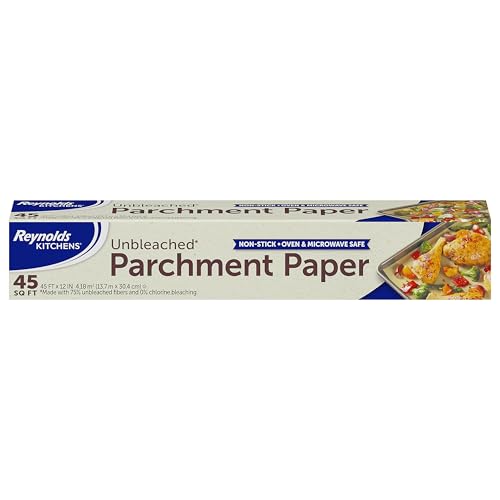
Reynolds Kitchens Unbleached Parchment Paper, 45 sq ft roll
Reynolds says this paper is totally chlorine free and made with 75 percent unbleached fibers, FSC certified and tested for home composting. The listing says it is oven safe to 425°F and fine in the microwave. Sold and shipped by Amazon, and number two on Amazon's parchment best-seller list when we checked.
Good: everyday roasting and cookies under 425°F at the lowest cost.
The drawback: the lowest heat limit on this page, and Reynolds does not say what the coating is. The unbleached version was not part of the spot check (only regular Reynolds was, at 14 ppm fluorine), so if PFAS testing matters most to you, choose Katbite or If You Care instead. Some buyers also say it tears when lifting heavy food.
See Reynolds Unbleached on AmazonCan parchment paper go in the oven? Heat limits by brand
Yes. Parchment is made for the oven, but only up to the temperature its maker prints, and that number is lower than many people assume. Here are the limits for the papers on this page.

Printed maximum temperatures, from each maker's listing or website (October 2026).
- Stay under the printed number. Near its limit the paper darkens and turns brittle, like the toasted edges you often see on a tray of roasted vegetables.
- No broiler, no direct flame. Do not use parchment under a broiler or where it can touch an element or a burner.
- Crusty bread at 475 to 500°F is beyond all of these papers. Bake straight on the pan or a preheated stone. A silicone mat only helps up to its own limit, 480°F for the Amazon Basics mat.
- Toaster oven: check your oven's manual first, since some say no paper. If it allows parchment, trim it to the tray so it cannot touch the elements, and stay under the paper's limit.
- Microwave and freezer: Reynolds lists microwave use, and Katbite lists microwave and freezer use (down to -68°F).

At roasting temperatures the exposed paper edges toast. That is normal; blackened, crumbling paper means it is too hot for that paper.
For pans that can take more heat than any paper, see our non-toxic bakeware guide and our guide to oven-safe cookware.
Rolls or pre-cut sheets?
Rolls are cheaper per square foot and you can cut any length. Their problem is that the paper remembers being rolled: it curls up off the pan and slides around while you scoop dough. Pre-cut sheets ship flat, so they lie down and stay put. If you bake on half-sheet pans, a 12 x 16 inch sheet covers the base; for quarter-sheet pans and 9 x 13 inch dishes, look for 9 x 13 sheets.

A pre-cut 12 x 16 sheet fits the base of a half-sheet pan and lies flat.
Thickness is the other difference. Katbite says its sheets are 45 gsm, heavier than the 35 to 40 gsm it says is common. A heavier sheet holds up better when you lift a whole loaf or a tray of vegetables by the paper.
Our pick: pre-cut, half-sheet size
Katbite Unbleached Parchment Sheets, 12 x 16 in, 200 pack
Unbleached sheets made from wood pulp with a food-grade silicone coating, rated from -68°F to 450°F, according to the listing. Katbite's site adds FSC certification. A Katbite parchment showed no detectable fluorine in the Mamavation spot check. Ships from Amazon, sold by Katbite, and one of the ten best-selling parchment products on Amazon when we checked.
Good: cookies, roasting and anyone tired of fighting a curling roll. Of the big pre-cut packs we compared, buyers complain least about food sticking to this one.
The drawback: it is sold as heavy duty, but some buyers still say sheets tear when they lift heavy food. And 450°F is the ceiling, so it is not for very hot bread baking.
See the Katbite sheets on AmazonA second option: Zenlogy pre-cut 12 x 16 sheets, from a small company that describes itself as US based and says its paper is silicone coated, chrome free and totally chlorine free, rated to 450°F. The box holds 100 sheets, so it costs more per sheet, and it has far fewer buyer reviews than Katbite. It was not in the PFAS spot check.
The five compared
Swipe the table sideways on a phone.
| Product | Format | Coating the maker names | Bleaching claim | Printed max | One real drawback |
|---|---|---|---|---|---|
|
Katbite Best for: most bakers See it |
200 pre-cut sheets, 12 x 16 in | Silicone | Unbleached | 450°F | Some sheets tear under heavy food |
|
If You Care Best for: a roll, composting See it |
70 sq ft roll | Silicone, both sides | Unbleached, totally chlorine-free | 428°F | Hard to tear off cleanly; curls |
|
Reynolds Unbleached Best for: lowest cost See it |
45 sq ft roll | Not stated | 75% unbleached fibers, totally chlorine free | 425°F | Lowest heat limit; coating not named |
|
Zenlogy Best for: a second pre-cut choice See it |
100 pre-cut sheets, 12 x 16 in | Silicone; says chrome free | Unbleached, totally chlorine free | 450°F | Only 100 sheets per box |
|
Amazon Basics silicone mat Best for: reusable, no paper See it |
2 mats, 16.5 x 11.6 in | Silicone (whole mat) | Not paper | 480°F | Builds an oily film; never cut on it |
Parchment paper vs wax paper
They look alike and they are not interchangeable. Wax paper is coated with wax, which melts and smokes in a hot oven, so it is for wrapping, rolling out dough and lining a counter, not for baking. Parchment can do almost everything wax paper does, and it can also go in the oven. If a recipe says to line the pan, it means parchment.
A reusable alternative: silicone baking mats
If you bake cookies every week, a silicone mat replaces a lot of paper. It is reusable, rated a little hotter than most parchment, and it sits flat on a half-sheet pan. It is not a full replacement, though: you cannot cut on it, you cannot lift a loaf out with it, and it needs washing.
Reusable alternative
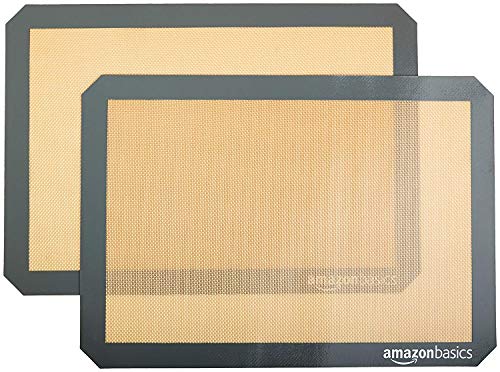
Amazon Basics Silicone Baking Mat, 2-pack, 16.5 x 11.6 in
Food-safe silicone mats rated to 480°F. The listing says to use them on a baking tray, never directly on the oven rack, and that they are dishwasher safe. Sold and shipped by Amazon, with a very long review history.
Good: regular cookie and roasting batches, and cutting down on paper.
The drawback: the most common complaint is cleaning: an oily film builds up that is hard to wash off. Some buyers also find food still sticks, and you must never cut on a mat.
See the silicone mats on AmazonOther swaps: a greased and floured pan works for most cakes, and foil works for roasting, though acidic foods like tomatoes can react with it. We cover mats and pans in the bakeware guide.
Why some popular papers are not on our list
- King Arthur pre-cut parchment. A favorite in baking reviews, but it has only a few hundred ratings on Amazon, where it is sold as a grocery item, and some buyers say the sheet size does not fit their pans.
- SMARTAKE and BRILLBOW pre-cut sheets. Both sell well, but buyers complain about food sticking far more often than with Katbite.
- Amazon Basics parchment roll. White paper, not sold as unbleached, whose listing does not name the coating, and many buyers describe it as waxy.
- Kirkland (Costco). Costco's own brand, so we did not check it on Amazon; it showed 12 ppm total fluorine in the spot check.
Questions people ask
Is unbleached parchment paper better?
It is a reasonable preference, not a safety necessity. Unbleached paper skips most of the bleaching step at the mill, and the unbleached brands we checked also claim to be chlorine-free and compostable. It bakes the same as white parchment.
Which parchment paper is healthiest?
We would choose an unbleached paper whose maker names a silicone coating and prints a heat limit, and that showed no detectable fluorine in independent testing. On this page, that is Katbite or If You Care.
Does Reynolds parchment paper contain PFAS?
Reynolds does not make a PFAS claim on its listing. In a blogger-commissioned lab test, regular white Reynolds parchment showed 14 parts per million of total fluorine, a low level that does not identify the compound. Reynolds Unbleached was not tested.
Is Costco parchment paper PFAS free?
Kirkland parchment showed 12 parts per million of total fluorine in the same spot check. That is a low level and does not prove PFAS were added, but it is not a non-detect result either.
Does parchment paper release toxins when heated?
Below its printed temperature limit, we found no evidence that it does. Above the limit it darkens, turns brittle and can scorch, so stay under the number on the box and never use it under a broiler.
Is parchment paper safer than aluminum foil?
They do different jobs. Parchment is better for baking and for acidic foods, which can react with foil. Foil handles higher heat, including the broiler, where parchment should never go. For the air fryer question, see foil in an air fryer.
Can parchment paper go in the oven at 450 degrees?
Only if the maker says so. Katbite and Zenlogy print 450°F; If You Care says 428°F and Reynolds 425°F.
Can you put parchment paper in the microwave, toaster oven or freezer?
Reynolds lists microwave use and Katbite lists microwave and freezer use. In a toaster oven, check the manual first; if parchment is allowed, trim it so it cannot touch the heating elements and stay under its temperature limit.
Is parchment paper compostable?
Some is. If You Care sells its parchment as certified compostable, and Reynolds says its unbleached paper was tested for home composting. Greasy paper may not be accepted by every city compost program.
What is a healthier alternative to parchment paper?
A silicone baking mat is the usual reusable swap, rated to 480°F for the Amazon Basics mat. A greased bare pan also works for most cakes and cookies.
Keep reading
About this guide: Written by Lara Yehia. We did not bake with these papers. Listings, stock and ratings change, so check the one you buy. As an Amazon Associate we earn from qualifying purchases.
Sources reviewed
- FDA: market phase-out of grease-proofing substances containing PFAS (updated January 2025)
- EPA: EPA to regulate dioxin in paper industry (April 1990)
- EPA National Center for Environmental Economics: working paper on the pulp and paper Cluster Rule (2020)
- Mamavation: parchment paper total fluorine tests (2021, updated December 2024)
- Zaclon: Quilon safe and healthy (maker's statement)
- Sunshine Paper: Quilon-coated pan liner paper
- If You Care: maximum temperature for paper products
- Reynolds: introducing unbleached parchment paper
- Katbite: heavy duty unbleached parchment sheets
- Zenlogy: parchment paper FAQs
- Parchment paper and wax paper: overview
- Amazon listings and buyer review summaries for B08M3STRVM, B001T6JTMY, B07PFYT8MC, B06XJHB2YN, B0725GYNG6, B07H79KX8W, B081TZ5KPD, B085CM4BWJ and B09NQGXJ5C, and the Parchment best-seller list (checked October 4, 2026).


