
By Lara Yehia · Last reviewed November 2026. Images on this page are AI-made illustrations, not photos of a tested steak.
FSIS says to roast meat in an oven set no lower than 325°F (163°C). A reverse sear starts the steak lower, most often at 250°F (121°C), so it sits outside that advice. What USDA does set is the finish line: 145°F (63°C) in the center on a food thermometer, then a 3-minute rest.
- Reverse sear thick steaks only, about 1½ inches (3.8 cm). Thin ones are done before the oven helps.
- Set the steak on a wire rack inside a rimmed baking sheet (baking tray). Need a rack that fits? See our best baking racks guide.
- Go by the thermometer, not the clock. Recipes for the same steak disagree by up to 10 minutes.
- Move the steak straight from the oven to a very hot pan. Don't leave it sitting on the counter.
- Cooking to USDA's number? Check the center after the sear: 145°F (63°C), then rest 3 minutes.
As an Amazon Associate we earn from qualifying purchases.

The one tool this method needs
Reverse sear depends on pulling the steak at the right number, so you need a thermometer you trust. We'd start with the Alpha Grillers instant-read. The listing gives it a 1 to 2 second reading, a backlit screen and a recalibration feature. Instant-read thermometers are for spot checks, not for leaving in the oven: open the door, read, take it out.
See the thermometer on AmazonWhat USDA says about cooking steak in a low oven
FSIS, the USDA's food safety agency, gives two numbers that matter here. One is for the oven. When you roast meat, it says to "use an oven temperature no lower than 325 °F" (163°C). The other is for the meat. Beef steaks should reach 145°F (63°C) in the center and rest at least 3 minutes before you cut or eat them.
The reason for the oven number is time. On its holiday roasting page, FSIS explains that in a cooler oven, meat could stay too long in the "Danger Zone," 40 to 140°F (4 to 60°C). Its temperatures page, linked above, says bacteria grow fastest in that range and can double in as little as 20 minutes.
Every steak passes through that range on its way to done, whatever the oven is set to. A 250°F (121°C) oven makes the climb slower. That slow climb is the whole point of the method, and it's also why the method sits outside USDA's roasting advice. So reverse searing is a choice you make knowing that. FSIS's roasting advice doesn't cover it.
The pull temperature is a second, separate choice. Most reverse sear recipes aim for rare to medium, and those finish below 145°F (63°C). FSIS says people may choose to cook meat hotter than its minimum. It doesn't offer a lower number. If you're cooking for someone who should stick to USDA's numbers, finish at 145°F (63°C) or above. The oven-time section below shows how.
Needle-tenderized steak is a different case
Some beef is run through blades or needles to make it more tender. FSIS warns that bacteria on the surface can be pushed inside the meat during that process, and it asks you to cook all mechanically tenderized beef to 145°F (63°C) with a 3-minute rest. These steaks look like any other. FSIS says the label is the only way to tell, so check the package before you plan a rare one.
When reverse sear beats a regular sear, and when to skip it
A regular sear cooks from the outside in at full heat. On a thick steak, by the time the center turns pink there's often a band of gray meat under the crust. A reverse sear flips the order. The steak warms slowly in the oven, then gets a short, very hot sear at the end. In the recipes we read, the goal is an even doneness from edge to center, with a thin brown crust on the outside.
| Reverse sear | Regular pan sear | |
|---|---|---|
| Order | Low oven first, sear last | Sear first, oven only for thick cuts |
| Steak thickness | At least 1 to 1½ in (2.5 to 3.8 cm), by recipe | Any; thick cuts finish in the oven |
| Time | 20 to 40 minutes in the oven at 250°F (121°C) for rare to medium, plus the sear | 3 to 4 minutes a side for a 1 in (2.5 cm) steak |
| At the stove | A minute or two | The whole cook |
| Smoke | One short burst at the end | As long as the steak is in the pan |
| USDA's 325°F oven advice | Outside it: the oven runs lower | Inside it: stovetop, or a 400°F (204°C) oven finish |
Reverse sear times and thickness from the three recipes in the oven-time section. Pan sear times from our cast iron steak guide.
Skip the reverse sear in these cases:
The steak is thin. Food Network's recipe asks for at least 1 inch (2.5 cm) and says a thin steak won't work. Inkbird's asks for 1½ inches (3.8 cm). Under that, the center is done before the slow oven has done anything useful. Pan sear it instead.
Dinner needs to happen in 15 minutes. The oven stage alone runs 20 minutes or more in every recipe we read, before you heat the pan.
Your kitchen doesn't vent well. The finish is a very hot sear in an oiled pan. It only lasts a minute or two, but it smokes. Turn the hood on first, or open a window.
You'd rather stay inside USDA's roasting advice. Sear the steak first, then finish it in an oven at 325°F (163°C) or hotter. Our skillet guide's thick-steak section does exactly that at 400°F (204°C).

The thicker steak is the reverse sear candidate. Thinner steaks do better in a hot pan.
How long to reverse sear a steak in the oven
We looked for a USDA or university chart for reverse sear times and found none. What exists are recipe charts, and they don't agree. Here's what three of them say for a 250°F (121°C) oven. We read each one in full on 18 November 2026.
| Recipe and steak | Pull from oven | Oven time | After the sear |
|---|---|---|---|
| Food Network, medium rare to medium At least 1 in (2.5 cm) |
120°F (49°C) | 20 to 40 min | Not given |
| Inkbird, medium rare About 1½ in (3.8 cm) |
115°F (46°C) | 30 to 40 min | 130°F (54°C) |
| WebstaurantStore, medium rare 1½ in (3.8 cm) |
115°F (46°C) | 25 to 30 min | 130°F (54°C) |
Each row is that recipe's own numbers, not ours. Links under Sources. These finishes are chef doneness levels, below USDA's 145°F (63°C).
Compare the last two rows. Same thickness, same oven, same pull temperature, and one expects 25 to 30 minutes while the other expects 30 to 40. How cold the steak was going in, the cut and your own oven all move the time. So treat the minutes as a cue to start checking. FSIS gives the same advice for instant-read thermometers: take the reading toward the end of the cooking time, before you expect the food to be done.
For a finish at USDA's number, both 1½ inch (3.8 cm) charts have a medium-well row that pulls the steak at 135°F (57°C) and ends at 150°F (66°C) after the sear. Inkbird gives it 40 to 50 minutes in the oven, WebstaurantStore 35 to 40. Whatever the chart says, check the center after the sear. It should read 145°F (63°C) or higher, then rest 3 minutes.
Pull temperature and carryover
Carryover is the rise in the center after the meat leaves the heat. ThermoWorks, the thermometer maker, puts it at about 3°F (about 2°C) for a resting steak, and notes that a hot oven drives more carryover than a cool, low-and-slow cook. Coming out of a 250°F (121°C) oven, the steak won't creep up much while the pan heats.
The sear is where the big jump happens. In the Inkbird and WebstaurantStore charts, every row ends 15°F (about 8°C) above its oven pull, and that gap covers the sear and anything after it. That's our arithmetic from their charts. It's also why reverse sear pull numbers look so low: 115°F (46°C) for a steak that ends up medium rare.
Names like rare and medium rare are chef ranges, not USDA ones. Our steak doneness temperature chart lists every level from rare to well done in °F and °C, next to USDA's 145°F (63°C).
Set up the rack and tray
Put a wire rack (cooling rack) inside a rimmed baking sheet and lay the seasoned steak on the rack. Warm air reaches the underside, so the bottom doesn't sit in its own juice and the whole surface stays drier for the sear. Line the sheet with foil if you want an easy clean-up.
The one thing to check is fit. The rack has to sit inside the tray's rim, not balance on top of it, or it slides when you pull the tray out. Measure the inside of your tray and compare it with the rack's size before you buy.

The rack sits inside the rim, with room for air under the steak.
As an Amazon Associate we earn from qualifying purchases.

Ultra Cuisine stainless steel rack set
Why it fits: plain 304 stainless steel, two racks in the set, each 16.5 x 11.5 inches (42 x 29 cm). The listing rates it oven safe to 575°F (302°C), far above a reverse sear oven, and says it's dishwasher safe and sized for a 13 x 18 inch (33 x 46 cm) half sheet pan.
The drawback: it's cut for a half sheet. It won't fit a quarter sheet or most toaster ovens, so measure first.
Check it on Amazon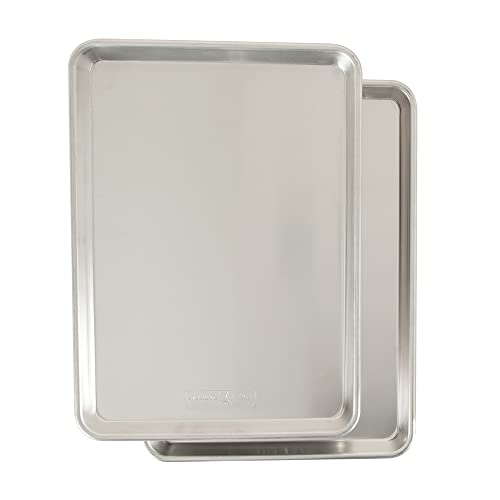
Nordic Ware Naturals half sheet, 2-pack
Why it fits: uncoated aluminum with a steel-reinforced rim. The listing puts the inside at 17.1 x 12.1 inches (43 x 31 cm), so by the listed sizes the rack above sits inside the rim. We worked that out from the two listings; neither maker claims it.
The drawback: the maker advises against the dishwasher, which can discolor the aluminum. Plan on washing it by hand.
Check it on AmazonWhere to put the thermometer probe
The FSIS rule is short: the tip goes in the thickest part, away from bone, fat or gristle. For thinner food, FSIS says to go in through the side until the tip reaches the center. On a steak, that means sliding the probe in from the edge, level with the board, so the tip ends up in the middle of the thickest part. Going straight down from the top makes it easy to push past the center.
On a bone-in cut, keep the tip clear of the bone. On an uneven steak, check more than one spot, as FSIS suggests for food that may not heat evenly, and go by the lowest reading.
Instant-read or leave-in? An instant-read thermometer is for spot checks: open the oven, take a reading, pull it out, close the door. FSIS advises using an instant-read thermometer toward the end of the cooking time. A probe built to stay in the oven lets you watch the number without opening the door. If you use one, check its oven limit in the maker's instructions. Either way, FSIS says most food thermometers read within 2 to 4°F (about 1 to 2°C) of the true temperature, and only when the tip is in the right place.

In through the side, tip in the center of the thickest part.
As an Amazon Associate we earn from qualifying purchases.
Alpha Grillers instant-read thermometer
Why it fits: the listing gives it a 1 to 2 second reading, a backlit screen and a recalibration feature. A fast reading means the oven door is open for a few seconds, not half a minute.
The drawback: the listing tops it out at 300°F (149°C) and it's hand wash only. Like any instant-read, it's for checking, not for leaving in the oven.
Check it on AmazonRest it, or not?
The sources don't agree on this. FSIS asks for a rest of at least 3 minutes once the steak reaches temperature, for safety and quality. WebstaurantStore's recipe rests the steak at least 5 minutes after the sear. Food Network's and Inkbird's both say a reverse-seared steak doesn't need a rest and can be served right away.
If you're cooking to 145°F (63°C), the 3 minutes are part of USDA's standard, so take them. For a rarer steak it's your call. The carryover is small after a low oven, so a short rest won't change much. Leave the foil off so the crust you just made stays crisp.
The finishing sear
Keep this part short and hot. Start heating a heavy skillet while the steak finishes in the oven, cast iron if you have it. Pat the steak dry with paper towels (kitchen roll), add a thin film of refined oil, and sear once the oil shimmers. Food Network's recipe gives it about 45 seconds a side. WebstaurantStore's gives 1 to 2 minutes a side, plus 30 seconds on the edges. You're only browning the outside. The center is already where you want it.
Go straight from the oven to the pan. A steak pulled at 115°F (46°C) is still inside FSIS's 40 to 140°F range, so this isn't the moment to leave it waiting on the counter. For oils, smoke points and basting with butter, see our guide to cooking steak in a cast iron skillet.

What the method is for: a thin crust and pink most of the way to the edge.
Reverse sear mistakes and how to fix them
Going by the clock. Two charts for the same 1½ inch (3.8 cm) steak give 25 to 30 minutes and 30 to 40 minutes. Start checking at the low end of a recipe's range and pull on the number.
Judging doneness by color. FSIS says color and texture aren't reliable signs that meat is cooked, and with an even pink steak, they tell you even less. Use the thermometer.
Reading the wrong spot. A tip resting in fat, touching bone or pushed past the center gives you the wrong number. Go in from the side, into the thickest part.
A few smaller slips are easy to avoid. Don't leave the steak waiting on the counter between oven and pan: heat the pan during the last minutes in the oven. Don't sear for several minutes a side, or the gray band comes back; get the pan fully hot so the crust forms in the 45 seconds to 2 minutes a side the recipes give. And read the package label, because FSIS says mechanically tenderized beef needs 145°F (63°C) and a 3-minute rest and the label is the only way to tell.
Questions people ask
Is reverse sear steak safe to eat medium rare?
Medium rare finishes below USDA's minimum. FSIS says beef steaks should reach 145°F (63°C) and rest 3 minutes, and it advises roasting in an oven no lower than 325°F (163°C). A medium-rare reverse sear is outside both numbers. FSIS's roasting advice is written for meat and poultry in general, so what to do about it is your choice. Mechanically tenderized steak should always reach 145°F (63°C).
What oven temperature is best for reverse sear?
Inkbird's recipe allows anywhere from 225 to 275°F (107 to 135°C), and all three recipes we read in full use 250°F (121°C). That's below the 325°F (163°C) FSIS gives as the lowest oven setting for roasting meat.
Is steak at 155°F safe?
155°F (68°C) is above USDA's 145°F (63°C) minimum for beef steaks, so it meets the USDA standard once the steak rests 3 minutes. It's well past medium rare, though. On the Inkbird and WebstaurantStore charts it falls between medium-well, 150°F (66°C), and well done, 160°F (71°C).
What temperature kills bacteria in steak?
USDA's answer for beef steaks, chops and roasts is 145°F (63°C) in the thickest part, measured with a food thermometer, followed by a rest of at least 3 minutes.
How long does steak need to stay at 145°F?
FSIS asks for the steak to reach 145°F (63°C) and then rest at least 3 minutes off the heat before you cut or eat it.
Can you reverse sear without a thermometer?
Not reliably. The whole method depends on pulling the steak at a set temperature, and recipe times for the same steak differ by up to 10 minutes. FSIS also says color and texture aren't reliable signs of doneness.
Can you reverse sear a thin steak?
It doesn't work well. Recipes ask for at least 1 to 1½ inches (2.5 to 3.8 cm), and Food Network's says a thin steak won't work. Under that, a hot pan on its own does the job in a few minutes a side.
Does reverse sear work for ribeye and filet mignon?
Yes, as long as the cut is thick. The pull temperatures don't change with the cut. A ribeye carries more fat, so expect more smoke during the sear. Filet is lean, so watch the final sear closely.
How we checked
On 18 November 2026 we read the FSIS pages on oven temperatures, safe minimum internal temperatures, food thermometers and mechanically tenderized beef, a thermometer maker's guide to carryover, and three reverse sear recipes in full. We also compared the reverse sear guides that rank in US search for this topic. We found no USDA, university or maker chart for reverse sear oven times, so the time table shows recipe numbers and says so. The images are illustrations made with an AI image tool, including the main image at the top. The times and temperatures come from the sources below, not from our own kitchen test. Product details come from the product listings linked above, checked on 18 November 2026.
Written by Lara Yehia. Lara researches home and kitchen products for Cupindy. This page is general cooking and food-safety information.
Sources
- FSIS: How Temperatures Affect Food (oven 325°F, Danger Zone, 145°F and rest; read 18 Nov 2026)
- FSIS: Roasting Those "Other" Holiday Meats (read 18 Nov 2026)
- FSIS: Safe Minimum Internal Temperature Chart (read 18 Nov 2026)
- FSIS: Food Thermometers (placement, accuracy; read 18 Nov 2026)
- FSIS: "Is It Done Yet?" brochure (when to check, several places; read 19 Nov 2026)
- FSIS: Kitchen Companion (color and texture; read 19 Nov 2026)
- FSIS: Mechanically Tenderized Beef (read 19 Nov 2026)
- ThermoWorks: What Temperature Is Medium Rare? (carryover; read 18 Nov 2026)
- Food Network: Reverse Sear Steak (read 18 Nov 2026)
- Inkbird: How to Reverse Sear a Steak (posted 31 Jul 2025; read 18 Nov 2026)
- WebstaurantStore: How to Reverse Sear a Steak (updated 14 Jan 2026; read 18 Nov 2026)
As an Amazon Associate we earn from qualifying purchases. Cupindy earns a commission if you buy through the Amazon links on this page, at no extra cost to you. No brand paid to be included.


