
There is a pan sitting in your cart from a brand you had never heard of three days ago, and you want to know what you are actually buying.
Many titanium pans share a hammered look and a similar promise, so the names alone tell you little. The product page does. This guide shows what to read on it, using what three companies publish about their own pans as worked examples.
Here is the fastest check you can do. Hold a fridge magnet against the base of a titanium pan you own or are about to buy. It will usually stick. That does not mean anything is wrong. It tells you something specific about the base of the pan, and by the end of this page you will know what.
The short version
Siraat states on its website that its pan has a 0.5 mm titanium cooking surface bonded to aluminium and stainless steel layers (read 11 November 2026).
Our Place and Viking each describe a clad build with a stainless steel exterior, an aluminum core and a titanium cooking surface (read 11 November 2026).
A magnet sticking points to a magnetic layer in the base. Induction pans generally need one.
We did not test any pan. This page reports what the companies publish, with the date we read it.
Written by Lara Yehia. Lara researches home and kitchen products for Cupindy. We read what each company publishes about its own pans. Brand facts last read 11 November 2026. Last reviewed 11 November 2026.
As an Amazon Associate I earn from qualifying purchases. Cupindy may earn a commission when you buy through links on this page, at no extra cost to you. Full details in our affiliate disclosure.
What the magnet tells you
Induction hobs heat a pan through a magnetic field, so an induction-ready pan generally needs a magnetic layer in its base. A fridge magnet sticking to the bottom of a pan is a sign that such a layer is there.
Siraat, for example, states on its product page that the bottom layer of its pan is 0.6 mm stainless steel (grade 430) and that the pan is compatible with all cooktops including induction (read 11 November 2026). Our Place states that its Titanium Always Pan Pro works on every type of cooktop, including induction, and Viking states that its PureGlide Pro works on induction (both read 11 November 2026).
So the magnet check is useful, but for a narrow reason. It speaks to the base of the pan. It does not show what the cooking surface is made of. For that, read the construction details the company publishes. A pan where the magnet does not stick would not generally be expected to work on an induction hob.

Half a millimetre
Once you know there is steel in the base, the next question is how the layers fit together. Siraat publishes its numbers, which makes it a useful worked example. According to the specification on its own website, read 11 November 2026, the Hammered Pan Pro is built like this.
0.5 mm titanium
the cooking surface, the part food touches
1 mm aluminium
the core, described as spreading heat
0.6 mm stainless steel, grade 430
the induction-compatible base
Layer thicknesses as stated by Siraat. The bars are a simple sketch, not to scale.
A standard credit card is about 0.76 mm thick, so half a millimetre is a thin layer.
Those three layers add up to 2.1 mm, so the titanium is the surface layer of a clad build rather than the whole pan. Layered construction is common in cookware, because a surface layer, a conductive core and a magnetic base each do a different job.
What matters for a buyer is to read each listing's specification, because the word titanium in a product name can refer to the cooking surface rather than the whole pan.

What three companies publish about their pans
Here is what each company's own pages state, read on 11 November 2026. This is a summary of what we read, not a ranking.
Siraat. States a fully clad three-layer build with a 0.5 mm pure titanium cooking surface with a hammered pattern, a 1 mm aluminium core and a 0.6 mm stainless steel (430) base. States that the pan is heat safe up to 548°C (1000°F) and dishwasher safe. Siraat product page.
Our Place. States that the Titanium Always Pan Pro has a fully clad tri-ply build with a stainless steel exterior, an aluminum core and a coating-free titanium interior. States that it is dishwasher safe, metal-utensil safe and heat safe up to 1000°F, and that the gold finish is oven safe up to 750°F. Also states a limited lifetime warranty. Our Place product page.
Viking. States that the PureGlide Pro 3-ply fry pan combines a stainless steel exterior, an aluminum core and a titanium cooking surface that is made without PFAS, PFOA or PTFE nonstick coatings. States that it works on induction, is oven and broiler safe up to 600°F, should be hand washed, and carries a limited lifetime warranty. Viking 10-inch fry pan page.
The three companies describe their pans differently, which is why the checks further down are useful for any pan you are considering. For other cookware, see what the companies publish in our guides to HexClad and GraniteStone.
Similar names, different products
Shoppers often search for a "Titanium Pro Pan". Several products use similar words, for example the Titanium Always Pan Pro from Our Place and the PureGlide Pro from Viking, and they are different products from different companies.
So there is no single answer about "the Titanium Pro Pan". Judge the individual listing: who the seller is, what the specification says the pan is made of, and what the return terms are.
Our picks for this page
Three options, chosen for the construction details their listings or makers state. Prices change often, so check each listing for the current price and what is included.
As an Amazon Associate I earn from qualifying purchases. See our affiliate disclosure.
Option 1: VocVoi

Titanium-surface pan
A 12 inch pan sold under the name VocVoi. We have not re-read this listing's specification since 20 September 2026, so use the listing itself for the current construction details, seller, price, shipping and return terms.
Good to know: read the Material and Coating Description fields on the listing, as in check 2 below.
Option 2: Our Place

Our Place Titanium Always Pan Pro
Brand states: coating-free titanium interior
Our Place states a fully clad tri-ply build with a stainless steel exterior, an aluminum core and a coating-free titanium interior, and a limited lifetime warranty (brand page read 11 November 2026). Check the listing for the size, seller and price.
Good to know: the brand states heat safe up to 1000°F and, for the gold finish, oven safe up to 750°F. Check the listing for the finish and size you are buying.
Option 3: Viking
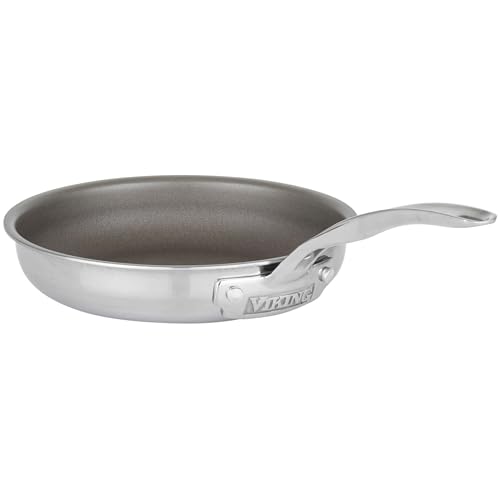
Brand states: titanium cooking surface
Viking states that the PureGlide Pro line has a stainless steel exterior, an aluminum core and a titanium cooking surface made without PFAS, PFOA or PTFE nonstick coatings (Viking's 10-inch page, read 11 November 2026). Check the listing for the 8 inch details.
Good to know: Viking states the pan is hand wash only and oven safe up to 600°F. Check the listing for its care instructions.
Five checks you can run yourself in two minutes
You do not have to take our word for any of this. Here is the method, so you can apply it to whatever pan you look at next.

1. The magnet
It will usually stick. That points to a magnetic layer in the base and tells you nothing about the cooking surface. If it does not stick, the pan would not generally be expected to work on induction.
2. The specification block
Scroll past the marketing bullets to the table with Brand, Material and Coating Description in it. Together with the product name, those fields show what the pan is made of and what the surface is.
3. The terms of service page
Stores built on Shopify usually publish one at /policies/terms-of-service. It normally says who operates the store and how to contact them.
4. The returns clause
Read the warranty and the return terms side by side. Note how long each lasts and what condition the item must be in, for example whether returns require an unused item.
5. Which policy applies where you buy
Marketplaces such as Amazon apply their own return policies, while a brand's own website sets its own. Check which policy applies where you buy.
Questions people ask
Is a magnet sticking to my titanium pan a bad sign?
No. It points to a magnetic layer in the base, which induction-compatible pans generally have.
Are these pans solid titanium?
Where a company publishes its construction, it describes the titanium as a surface layer over aluminum and steel. Siraat's published specification, for example, lists 0.5 mm of titanium (read 11 November 2026). Check each product's specification for its construction.
Can I use these pans on an induction hob?
Siraat, Our Place and Viking each state that their pans work on induction (read 11 November 2026). For any other pan, check the specification and the magnet.
Is titanium cookware safe?
We do not make safety claims in our own voice and we did not test any pan. Viking states that its titanium surface is made without PFAS, PFOA or PTFE, and Our Place states a coating-free titanium interior. For general information about cookware materials, you can look at the guidance of regulators such as the US Food and Drug Administration, and at each company's own materials and care notes.
Sources
- Siraat, Original Siraat 100% Pure Titanium Pan with Hammered Pattern, read 11 November 2026
- Our Place, Titanium Always Pan Pro, read 11 November 2026
- Viking Culinary Products, PureGlide Pro 3-Ply 10 Inch Fry Pan, read 11 November 2026
- US Consumer Product Safety Commission, SaferProducts.gov recall database, searched 11 November 2026
- Amazon product listings for the pans linked above. The VocVoi listing was last read on 20 September 2026.
Editorial note. Cupindy does not test products in a laboratory. This article reports what manufacturers and retailers have published, as of the date shown. Brand names are used only to identify products. Cupindy is not affiliated with or endorsed by any brand named. This is general information, not medical, legal or professional advice.
Brand right of reply. If you represent a brand named on this page and believe a statement is inaccurate, email us through the contact page with the page link and the exact statement. We review requests within 5 business days and correct errors we can verify.
Corrections. Information on this page is as of 11 November 2026. Brands change specifications, warranties and policies without notice. If you find an error, tell us through the contact page with the page link and we will review it and correct verified errors promptly.


