
Written by Sara Ibrahim. Sara researches home and kitchen products for Cupindy.
Published November 2026 · Last reviewed 6 Nov 2026 · Cupindy is not affiliated with any brand on this page.
The short answer
For most kitchens, get the Utopia Kitchen 1.3-gallon bin. It is plain stainless steel, it fits on a counter, and Bob Vila's testers named it their best overall. If you want a body with no seams to scrub, get the Epica. The ceramic Chef'n looks the nicest, but your scraps sit in a plastic bucket inside it. And the filter in the lid matters less than you think.
As an Amazon Associate we earn from qualifying purchases.
Our quick picks

Best overall
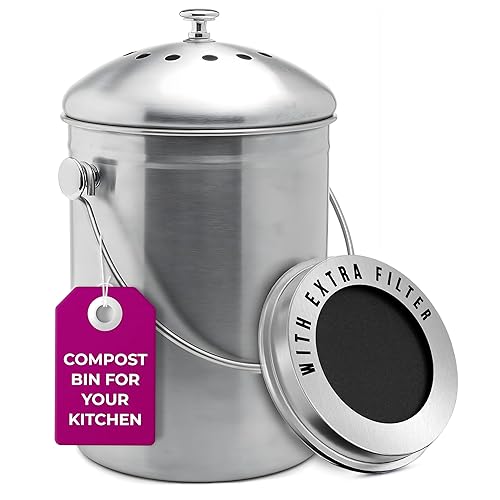
Utopia Kitchen Compost Bin, 1.3 Gallon
A stainless pail with a charcoal filter in the lid and a spare filter in the box. Small enough to leave out by the cutting board.
See the Utopia bin on AmazonThe drawback: the lid lifts straight off, which is clumsy with one hand full of peels.
No seams to scrub
Epica Stainless Steel Compost Bin, 1.3 Gallon
One piece of molded stainless steel, so there is no seam at the bottom for gunk to hide in.
See the Epica bin on AmazonThe drawback: no bags come with it, and the filter needs replacing every few months.

Ceramic option
Chef'n EcoCrock Counter Compost Bin
A white ceramic crock with a lift-out inner bucket and a charcoal filter in a vented lid.
See the Chef'n EcoCrock on AmazonThe drawback: the inner bucket that holds the scraps is plastic.
This page is about the small bin that sits on your counter or under the sink and holds food scraps until you take them out. Backyard bins and tumblers are a different job, so they are not here. What each bin is made of and how to wash it comes from the maker or the listing, read 6 Nov 2026, along with tests by America's Test Kitchen, The Kitchn and Bob Vila.
As an Amazon Associate we earn from qualifying purchases.
| Bin | Made of | Size | Lid and filter | The catch | |
|---|---|---|---|---|---|
| Utopia Kitchen | Stainless steel | 1.3 gal | Lift-off lid, charcoal filter, one spare | Lid is clumsy one-handed | See it |
| Epica | One-piece stainless steel | 1.3 gal | Sealed lid, replaceable charcoal filter | No bags included; filters wear out | See it |
| RED FACTOR | Stainless steel | 1.3 gal | Dome lid, two-layer carbon filter | Hand wash only; tall lid | See it |
| Chef'n EcoCrock | Ceramic outside, plastic bucket inside | 0.75 gal (3.3 L) | Vented lid, charcoal filter | Scraps sit in plastic; heavy | See it |
| OXO Easy-Clean (plastic) | Plastic | 1.75 gal | Lid stays open, no filter | All plastic | See it |
What is your compost bin actually made of?
Most kitchen compost bins are stainless steel, ceramic or plastic. Bins sold as "bamboo" are usually plastic too, made of resin with bamboo fibre mixed in.
Scraps sit in the bin for days, wet and acidic. Stainless steel shrugs that off and does not hold on to smells. Ceramic does not either, but it is heavy, and most ceramic bins hide a plastic bucket inside, so the ceramic never touches the food. Plastic is light and cheap, and it can take on smells over time.
"Bamboo" is the label to read twice. Germany's Federal Institute for Risk Assessment (BfR) says products sold as "bamboo ware" are generally melamine-formaldehyde resin with bamboo fibres as a filler, and that they are plastic. Its health warning is about hot food and drinks, which a scrap bin never holds. So this is not a safety issue. It just means a bamboo bin is not the plastic-free choice it looks like. That is why none is on this list.
Stainless steel
Feel: Light, sturdy, does not hold smells
Watch for: Seams and filter grooves where water can sit
Best for: A plastic-free bin that lasts
Ceramic
Feel: Heavy; looks like a crock
Watch for: Usually a plastic bucket inside; can chip
Best for: The nicest-looking bin on the counter
Plastic
Feel: Lightest and cheapest
Watch for: Can stain and take on smells over time
Best for: The easiest bin to wash
"Bamboo"
Feel: Light, looks natural
Watch for: Usually resin with bamboo filler, so still plastic
Best for: Nobody trying to avoid plastic
The same trade-offs come up with food containers. Our glass vs plastic container guide walks through them.
The best stainless steel kitchen compost bins
If you want the scraps to touch nothing but steel, pick one of these three. All hold 1.3 gallons and fit on a counter.
As an Amazon Associate we earn from qualifying purchases.
If you want one simple bin that just works
Best overall
Utopia Kitchen Compost Bin, 1.3 Gallon
Good for: most kitchens, and anyone starting to compost for the first time.
Why we picked it: It is a plain stainless pail with a handle, a charcoal filter in the lid and a spare filter in the box. Bob Vila's testers named it the best compost bin they tried, ahead of bins built for serious indoor composting. It is about 11 inches tall, so it fits under most upper cabinets.
What to know: Lining it with a compost bag is optional. Bob Vila tested it both ways and found a liner just meant less cleaning.
The drawback: the lid has no hinge, so you lift it off every time, and Bob Vila found scraps stick to the lid once the bin is full. Some owners also say water sits in the filter grooves after washing, and a few report rust on the lid. Dry the lid well.
See the Utopia bin on AmazonIf you hate scrubbing seams
No seams to scrub
Epica Stainless Steel Compost Bin, 1.3 Gallon
Good for: people who rinse the bin often and want nothing at the bottom for gunk to hide in.
Why we picked it: The body is one piece of molded steel, with no seam where the side meets the base. The lid closes tight and holds a charcoal filter you can swap out.
What to know: Epica says to replace the filter every 3 to 6 months. Buy a pack of filters when you buy the bin.
The drawback: no bags come in the box, and The Kitchn found it harder to clean than it looks.
See the Epica bin on AmazonIf smell is the thing that worries you most

Two-layer filter
RED FACTOR Premium Compost Bin, 1.3 Gallon
Good for: kitchens where the bin sits close to where you eat.
Why we picked it: The dome lid holds a two-layer carbon filter, and the body is stainless steel.
What to know: The maker says to wash it by hand. Filters still need changing, so keep spares.
The drawback: it cannot go in the dishwasher, and the dome lid needs more room under a cabinet than a flat lid.
See the RED FACTOR bin on AmazonA ceramic compost bin, with one catch
The Chef'n EcoCrock has a ceramic outside, but the scraps go into a plastic bucket that lifts out.
As an Amazon Associate we earn from qualifying purchases.
Ceramic pick
Chef'n EcoCrock Counter Compost Bin
Good for: a counter where looks matter, and a household that empties the bin often.
Why we picked it: It looks like a crock, not a trash can. The vented lid has a sprout-shaped handle and a charcoal filter, and two filters come in the box. You lift out the inner bucket to empty it.
What to know: The inner bucket can go on the top rack of the dishwasher. The ceramic outside should only be rinsed with hot water and wiped.
The drawback: the bucket that holds your scraps is plastic, so this is not a plastic-free bin. It is also the heaviest bin here and the smallest, at 3.3 liters (0.75 gallon).
See the Chef'n EcoCrock on AmazonThe plastic bin that tests well anyway
One of the most popular kitchen compost bins is plastic, and it is worth knowing why. America's Test Kitchen picked the OXO Good Grips Easy-Clean bin as its winner because the inside is smooth, the lid stays open while you scrape, and it rinses clean fast. It has no filter. If you do not mind plastic, it is the easiest bin on this page to wash. If you are trying to cut plastic out of your kitchen, choose one of the steel bins above.
Do charcoal filters really stop the smell?
Not by much. In America's Test Kitchen's test, bins with filters did not smell better than bins without them. How often you empty the bin matters more.
That surprises people, because the filter is the main thing these bins advertise. What stops the smell is what you put in and how long it sits. Here is what helps:
- Empty it every two or three days. Smell comes from scraps that sit too long, so a full bin is the problem, not the filter.
- Keep meat, fish and dairy out. They smell fastest, and most home compost can't take them anyway.
- Rinse and dry it. A quick rinse every time you empty it, and a full dry, does more than any filter.
- Change the filter if you use one. Swap it every few months. An old filter does nothing.

Fresh peels and trimmings barely smell. It is scraps left for a week that do.
How big should a kitchen compost bin be?
A 1.3-gallon bin (about 5 liters) suits one to three people. Bigger households, or anyone who juices, should go up to about 2 gallons or plan to empty it more.
Bigger is not better on a counter. A large bin takes longer to fill, so scraps sit longer and smell more. Choose the smallest bin you can empty every two or three days. If one cook makes a lot of salads, or there is a juicer in the kitchen, the OXO's 1.75 gallons gives you more room.
How do you keep fruit flies and ants out?
Close the lid every time, empty the bin often, and wipe the rim. If flies still find it, keep scraps in the freezer until you take them out.
Fruit flies get in through a gap at the lid or the filter vents, and ants follow anything sticky on the outside. A tight lid like the Epica's helps. So does wiping the rim when you empty it. In summer, try the freezer trick. Keep scraps in a lidded container in the freezer and empty it on collection day. Frozen scraps don't smell and don't draw flies. Our freezer-safe container picks work well for this.

Sweep trimmings straight off the board, then close the lid.
What can go in a kitchen compost bin?
Fruit and vegetable scraps, coffee grounds with paper filters, paper tea bags and crushed eggshells. Keep meat, fish, bones, dairy, oils and grease out of a home compost pile.
That list comes from the US EPA's home composting guide. The EPA says meat, dairy and greasy food can attract animals, and that backyard piles usually do not get hot enough to break them down. If your city collects food scraps, its rules may be different and may allow more. Check before you start.
How do you clean a compost bin?
Rinse it every time you empty it, before anything dries on. Once a week, wash it with warm soapy water and let it dry fully with the lid off. Check each maker's rule before using the dishwasher. RED FACTOR says hand wash, and the Chef'n bucket goes on the top rack only. Pay attention to the lid. That is where the filter grooves, the seal and any rust live.
How we chose
On 6 Nov 2026 we checked each bin's Amazon US listing for stock and model, read what each maker says about materials, filters and washing, and read the compost bin tests from America's Test Kitchen, The Kitchn and Bob Vila. Drawbacks come from those tests or from owners' reviews, and we say which. We did not use these bins ourselves, and no brand saw this page before it went up. We left out electric composters, because they cost far more than these bins, and bamboo bins, for the reasons above.
Questions people ask
Do you need compostable bags in a kitchen compost bin?
No. A bag just keeps the bin cleaner. Bob Vila's testers found a liner meant less washing. One catch: the EPA says compostable bags don't fully break down in a backyard pile, so use them only if your city collection or compost site takes them. A sheet of newspaper in the bottom is a simple alternative.
Can coffee grounds go in a kitchen compost bin?
Yes. The EPA lists coffee grounds, paper filters included, as good compost. Grounds are wet and heavy, so a daily coffee habit fills a small bin fast. Empty it a little more often.
Is an electric composter like Lomi worth it?
That depends on your budget. Electric units dry and grind scraps into a smaller, drier mix, and they cost many times more than any bin here. If you have a backyard pile or city collection, a simple bin does the job.
Can I hang a compost bin under the sink or on a cabinet door?
Yes. Hanging bins clip over a cabinet door so you can sweep scraps straight off the counter. Most are plastic and small, so empty them every day or two.
Why is there mold in my compost bin?
Scraps sat too long, or the bin went back together wet. Empty it, wash it with hot soapy water, let it dry fully, and empty it more often from then on.
Where do kitchen scraps go once the bin is full?
Into a backyard compost pile or tumbler, a city food-scrap cart, or a drop-off site. Many cities and farmers markets collect scraps. Check your local rules for what they take.

When the kitchen bin is full, it goes to the pile, the city cart or a drop-off site.
The verdict
Get the Utopia Kitchen bin if you want a simple steel pail that works. Choose the Epica if seams bother you. Pick the Chef'n if looks come first and a plastic bucket inside is fine with you. Whichever you choose, empty it every few days, and don't count on the filter to do that job for you.
See the Utopia bin on AmazonSee the Epica bin on Amazon
More for the counter and the pantry: bread boxes, airtight pantry containers and freezer-safe containers.
Sources (opened 6 Nov 2026). Sizes, filters and care rules come from each brand's Amazon product page unless named above.
- America's Test Kitchen: The best countertop compost bins
- The Kitchn: The best kitchen compost bins
- Bob Vila: The best compost bins, tested
- BfR: Do not use "bamboo ware" tableware for hot drinks and meals (25 Nov 2019)
- US EPA: Composting at home
- Chef'n EcoCrock specifications (ceramic outer, plastic inner bucket)


