
Written by: Sara Ibrahim, Cupindy Home & Kitchen Team
Experience note: Sara covers kitchen product safety claims for Cupindy, with a focus on reading what manufacturers actually publish rather than what their packaging says.
Last reviewed: August 2026 — Reviewed for: recall status, active litigation, California AB 1200 disclosure, coating material claims and published temperature limits.
About 15 minutes to read · Covers 1 recall, 1 active settlement, 6 product listings
Some links below are affiliate links. If you buy through one, Cupindy may earn a commission at no cost to you. It does not change what we recommend or what we say about it. As an Amazon Associate we earn from qualifying purchases.
Editorial note
This guide is about one brand: GraniteStone, made by E. Mishan & Sons. It covers what the company publishes about its coatings, an open product recall, and a proposed class action settlement with a deadline this month.
It is not a laboratory test, a chemical analysis or legal advice. We did not test these pans for migration and we do not know what is in the coating beyond what the manufacturer publishes. Where a claim is disputed in court, we say so and report both sides. For general guidance on granite-style coatings, care and lifespan, see our granite cookware guide.
The short answer
We found no evidence that GraniteStone's coating has made anyone ill, and no recall has ever been issued over what that coating is made of.
But three things are true at the same time, and none of them appear in the brand's marketing:
- An open CPSC recall covers roughly 740,000 GraniteStone sauté pans — for a handle part that can eject when heated, not for the coating.
- A proposed class action settlement is running right now over the words "non-toxic" and "free from PFOA, PFOS, PTFE". Claims close 25 September 2026.
- The granite-coated set that made the brand's name showed as unavailable on Amazon when we checked, replaced by a ceramic line that publishes less information than the product it replaced.
None of that makes the cookware dangerous. All of it makes the label harder to trust than the label suggests.
IN THIS GUIDE
Two things with deadlines · Why the recall is not a coating recall · What "Swiss granite coating" actually is · Six listings compared · Why "PFOA-free" is not a feature · The one-minute AB 1200 check · Should you buy it? · Five alternatives · Questions people ask
If you own GraniteStone, two things have deadlines
These are separate matters. One is a mechanical safety recall. The other is a marketing dispute. Both have dates attached, and one of those dates is this month.
1. The sauté pan recall — check your UPC
On 2 April 2026 the US Consumer Product Safety Commission announced recall number 26-377. E. Mishan & Sons of New York recalled approximately 740,000 Granitestone Diamond Pro Blue stainless steel sauté pans, sold as a two-piece set of a 10-inch and an 11.5-inch pan.
The identifier to check is UPC 0-80313-08131-6. It will be printed on the packaging or the product label.
- The hazard — in CPSC's words, "the metal cap on the screw that connects the sauté pan to the handle can become detached and forcefully eject when heated, posing impact and burn hazards."
- Scale — at least 98 reported incidents of the cap detaching. One consumer suffered bruising and burn injuries.
- Where they were sold — Costco and Costco.com, Walmart.com and Amazon.com, from August 2021 through February 2026, for about $40.
- The remedy — a full refund. The pans must be returned.
- Where they were made — China.
2. The settlement — claims close 25 September 2026
This is the one most readers have not heard about.
Jeffrey Fouse and Brianna Miller v. E. Mishan & Sons, Inc., Case No. CVRI2505343, in the Superior Court of California, County of Riverside.
The proposed class covers anyone who bought Gotham Steel, Granite Stone or Bell & Howell brand cookware products with stainless steel components, in California or Colorado, between 8 September 2021 and 6 July 2026. Resale purchases are excluded.
According to the settlement notice, the allegation is that these products were marketed as "Healthy, Non-Toxic Ceramic Cookware & Bakeware," "Non-toxic," "Safe," and "Free from PFOA, PFOS, PTFE, BPA, lead, and cadmium," while concealing the presence of chromium, iron, nickel, lead, cadmium, PFOA, PFAS, PTFE or PFOS.
We want to be precise about what that means.
These are allegations. They have not been proven and no court has ruled on them. The settlement notice states that the defendant denies the allegations and that the court did not rule in favour of either side. A settlement is a decision to stop arguing about a dispute, not a finding that one side was right.
What is not in dispute is the timetable:
- Claim deadline — 25 September 2026, 11:59 p.m. Pacific Time
- Opt-out and objection deadline — 25 September 2026
- Final approval hearing — 2 November 2026
- Payment — $6.00 per eligible product, limit two products per household
The claim form asks you to attest, under penalty of perjury, that you bought the products in California or Colorado within that window. The administrator states that claims are subject to verification and that you may be asked for supplemental information. If you think you qualify, read the official claim form rather than relying on any summary, including ours.
Two separate matters, one timeline
Grey entries are the product recall. Dark entries are the settlement.
AUGUST 2021 – FEBRUARY 2026
Recalled Diamond Pro Blue sauté pans on sale at Costco, Walmart.com and Amazon.com
8 SEPTEMBER 2021
Settlement class period opens — purchases in California and Colorado from this date count
2 APRIL 2026
CPSC recall 26-377 announced — about 740,000 pans, UPC 0-80313-08131-6, full refund on return
6 JULY 2026
Settlement class period closes — purchases after this date are not covered
25 SEPTEMBER 2026
Claims, opt-outs and objections all close, 11:59 p.m. Pacific Time
2 NOVEMBER 2026
Final approval hearing
Freshness note: the final approval hearing is scheduled for 2 November 2026. If approval is granted, denied or delayed, the position described here changes. Check the official settlement administrator's site before relying on any date above.
Why the recall is not a coating recall
Search results for this brand blur two separate things, and the blurring runs in one direction. People who hear "GraniteStone recall" assume the nonstick surface was found unsafe.
It was not.
Recall 26-377 is a mechanical failure. A screw cap on a handle assembly detaches under heat and flies off. It is a burn and impact hazard, it injured someone, and it is serious. But it says nothing at all about what you are eating off.
There is a second detail worth noticing. The recalled product is the Diamond Pro Blue stainless steel line. It is not the granite-coated nonstick cookware the brand is named after. A reader who throws out a granite-coated frying pan because of this recall has thrown out the wrong pan.

We are making this point in a guide that is otherwise critical of the brand's labelling, because the alternative is letting a real safety problem be misunderstood as a different problem that has not been demonstrated.
What "Swiss granite coating" actually is
Start with the word itself. "Granite" and "granite coating" describe an appearance — the speckled, stone-like finish. The nonstick performance does not come from granite. It comes from whatever the coating is made of, and that is the part worth reading carefully.
So we read it carefully, across every GraniteStone listing we could find in August 2026. Here is what those listings actually say.
The Original set describes a "multilayer nonstick" over anodized aluminium. That names no material at all — not a polymer, not a resin, not a mineral.
The current Ceraluxe set does better, but not by much. It says ceramic, and lists Ceramic as the material. That tells you the coating family: ceramic nonstick coatings are generally silica-based sol-gel finishes rather than fluoropolymers. What it does not tell you is the composition — which specific compounds are in it, what the binder is, or what else was intentionally added. "Ceramic" on cookware is a category, roughly the way "plastic" is a category.
The listing then adds that the surface is "coated three times and then reinforced with diamonds." That is a marketing sentence, not a specification.
The material named in a product's name is frequently not the material touching your food. Check the food-contact surface, not the brand.
We check this every time now, because it keeps catching us out. A slow cooker sold as stainless steel can have a nonstick aluminium insert. A pan sold as granite is a speckled coating over aluminium. The name describes the look; the listing has to describe the surface.
The Original is gone
The GraniteStone Original 10-piece nonstick cookware set — granite-coated, over 3,300 customer ratings, the product that built the brand — showed "Currently unavailable. We don't know when or if this item will be back in stock" on Amazon when we checked in August 2026.
What is offered in its place is Ceraluxe, the ceramic line.
We cannot tell you the company's plans, and availability on one retailer is not the whole picture. But it means something practical for anyone reading this: if you are researching "Swiss granite coating" because you are about to buy, the pan you are researching may not be the pan on sale.
Six listings, one question
We pulled the live product listings for GraniteStone and five alternatives and asked each the same two questions. What is the coating made of? How hot can it go?
The answers sort in an order that runs opposite to the marketing.
| Product | What the listing says about the coating | Stated oven limit |
|---|---|---|
| All-Clad HA1 Hard Anodized | "The high-quality PTFE nonstick" — names the polymer outright | 500°F (lid 350°F) |
| Tramontina Boston Tri-Ply Clad | "Stainless Steel" — there is no coating to disclose | 500°F (lid 350°F) |
| Lodge cast iron | "Made without PFOA or PTFE" — true, and easily so; no synthetic coating, seasoned with oil | Not stated |
| GreenLife ceramic | "PFAS-Free Nonstick Coating" — a whole-class claim, still not a composition | 350°F |
| Tramontina Professional nonstick | "Reinforced Non-Stick Coating" — names nothing at all | 400°F |
| GraniteStone Ceraluxe | "Non Toxic PFOA/PFOS/PTFE Free", ceramic, "reinforced with diamonds" — a category plus three absences | Not stated |
Listing text read in August 2026. Manufacturers revise product copy without notice.
The pan that admits to PTFE tells you the most and tolerates the most heat. The pan that leads with "non-toxic" publishes no temperature at all.
The missing number is the tell
Of everything in that table, the blank cell is the thing to remember.
"Oven and dishwasher safe" with no temperature attached cannot be checked, met or breached. It is a claim shaped like a specification.
Compare it to the others. GreenLife caps itself at 350°F in writing — a low ceiling, and an inconvenient thing to publish. Publishing it is exactly why you can hold them to it. All-Clad publishes 500°F for the pan and 350°F for the glass lid, so you know where the line sits.
The GraniteStone Original stated 500°F. Its ceramic replacement states nothing. The brand went from a number to no number.
If you already own one, treat that absence conservatively. Keep it on the stovetop, and if it goes in the oven, keep the oven low. Our oven-safe cookware guide explains how to work out a safe ceiling when the manufacturer has not given you one.
Why "PFOA-free" is not a feature
The Original set's headline chemical claim was "PFOA-Free." It sat in the product title. In 2026 it is close to meaningless, and here is why.
Under the US EPA's 2010/2015 PFOA Stewardship Program, eight major fluoropolymer manufacturers — Arkema, Asahi, BASF, Clariant, Daikin, 3M/Dyneon, DuPont and Solvay Solexis — committed to cutting PFOA by 95% from a 2000 baseline by 2010, and to eliminating it from emissions and products by 2015. EPA records that all participating companies state they met those goals.
A nonstick pan sold in the US in 2026 is PFOA-free the way a new car has seatbelts. Advertising it as a health feature is advertising compliance.
Three claims that sound similar are not equivalent, and the gap between them is the whole game:
- PFOA-free — one specific compound, phased out industry-wide over a decade ago. Says nothing about PTFE.
- PFOA/PFOS/PTFE-free — three named compounds. PFAS is a class numbering in the thousands. Three absences do not add up to a class claim.
- PFAS-free — a claim about the entire class. Materially stronger, and on the listings we examined, not one GraniteStone makes.

Every one of those claims describes what is missing. None describes what is there. We went into that gap in more detail in what "free-of" labels actually mean.
The one-minute check almost nobody runs
California's AB 1200 is the most useful consumer tool in this category, and it is barely used.
Since 1 January 2023, cookware manufacturers selling into California have had to publish, on their own website, every intentionally added chemical from the state's designated list that is present in the cookware's handles or its food-contact surfaces — naming the authoritative lists each chemical appears on, and linking to them. Since 1 January 2024, that information also has to appear on the product label and on online product listings.
The California Attorney General's enforcement advisory adds a detail that matters here: a manufacturer violates AB 1200 by claiming cookware is "free of any specific chemical" if that chemical belongs to a group on the designated list and was intentionally added.
The reader rule
Search the brand name plus "AB 1200". Most established cookware brands have a page. Compare what it says to what the marketing says. The difference is the interesting part.
What we found for this brand. We checked granitestone.com's notices section, tried the disclosure URL pattern other manufacturers use, and ran a site-wide search. We did not find an AB 1200 disclosure page.
What that does and does not mean. We are not saying the company is in breach of the law, and nothing here should be read that way. A page might exist somewhere we did not look. Disclosure obligations turn on facts we cannot see — what is intentionally added, in which SKU, sold where. Only a court decides a violation. What we can tell you is what we searched for and what we found.
What we would draw from it is narrower and more useful: disclosure quality varies enormously between manufacturers, and that variation is itself a buying signal. We ran the same test on multi-cookers in our non-toxic slow cooker guide, where one brand's filing was broken down by SKU series and manufacturing date, and another's was a single sentence covering the entire catalogue. Both were compliant. Only one was useful.
So should you buy GraniteStone?
The honest version: we would not. And the reason is not that we think the coating is harmful — we have no evidence of that, and we have not seen any.
The reason is narrower. When a company describes its coating only by category, publishes no oven temperature, has no disclosure page we could locate, and is currently in a settlement about the accuracy of its chemical claims, you are being asked to take a safety claim on trust alone. Pans in the same price range simply tell you.
If you already own one
- Check your set against recall UPC 0-80313-08131-6.
- If you bought in California or Colorado since September 2021, check the settlement before 25 September 2026.
- Keep the heat moderate, and keep it off high oven temperatures while no limit is published.
- Replace it when the surface is visibly scratched or flaking — the right rule for any nonstick pan, any brand.
Five alternatives, each with its drawback
Every pick below names the thing that is wrong with it. If a recommendation has no drawback, it has not been looked at properly.
Jump to the one that fits you
"I want nonstick and I want to know what it is" → All-Clad HA1
"I want no coating at all" → Tramontina Tri-Ply Clad, or Lodge cast iron
"I want nonstick without PFAS" → GreenLife, if you can live with 350°F
"I want cheap and it just has to work" → Tramontina Professional
1. All-Clad HA1 Hard Anodized Nonstick, 12-inch
The honest nonstick
Best if you want nonstick and full disclosure

The listing states outright that the coating is PTFE, and gives you 500°F for the pan and 350°F for the glass lid. Induction compatible. Hard-anodized aluminium with a stainless base.
The drawback: it is PTFE. If avoiding PTFE is your goal, this pan does not meet it - it simply refuses to pretend otherwise. It is the most expensive pan here, designed in Pennsylvania and made in China, and the lid's 350°F ceiling is easy to forget.
2. Tramontina Boston Tri-Ply Clad Stainless Steel Sauté Pan
The no-coating answer
Best if you want nothing between you and the metal
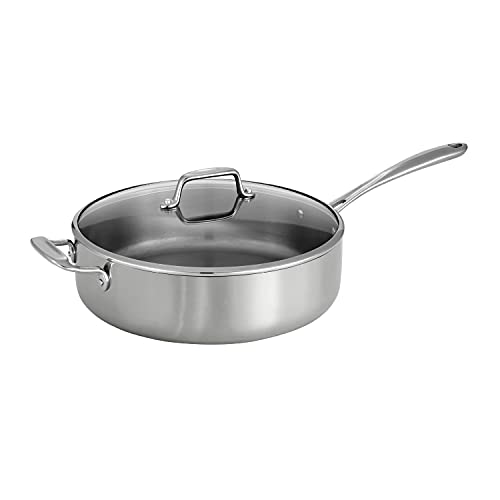
The coating description on the listing reads "Stainless Steel," because there is nothing sprayed on it. Aluminium core for even heating, NSF certified, induction ready, 500°F without the lid, lifetime warranty. Nothing can degrade, flake or migrate from a surface that does not exist.
The drawback: food sticks until you learn to preheat properly, and that learning curve is real. At over six pounds it is heavy, and the glass lid drops the oven ceiling to 350°F.
3. GreenLife Ceramic Nonstick, 16-piece
The ceramic set that makes the stronger claim
Best if a PFAS-free claim is the priority

The listing says "PFAS-Free Nonstick Coating," and free of PFAS, PFOA, lead and cadmium - a class claim rather than three named compounds. Vessels are made from a minimum of 65% recycled materials.
The drawback: 350°F is a genuinely low oven ceiling, it does not work on induction, and the handles are Bakelite. Ceramic nonstick surfaces are also widely reported to lose their release performance sooner than PTFE does, and the listing itself recommends hand washing despite calling the set dishwasher safe.
4. Lodge Pre-Seasoned Cast Iron Skillet, 15-inch
No coating, no chemistry question
Best if you want a pan that outlives you

Free of PFAS, PFOA and PTFE for the straightforward reason that there is no synthetic coating on it - just iron and a seasoning layer of polymerised oil. Works on any stovetop, in the oven, on a grill or over a fire. Made in the USA.
The drawback: the 15-inch is heavy enough to be awkward for everyday cooking, so consider a smaller size unless you cook for a crowd. It needs seasoning maintenance, and it is not nonstick out of the box whatever the marketing implies. Cast iron also transfers some iron into acidic foods - harmless for most people, but worth raising with your doctor if you have haemochromatosis or have been advised to limit iron.
5. Tramontina Professional Nonstick Fry Pan, 10-inch
The budget workhorse
Best if budget decides it

NSF certified, which is a real third-party mark and rare at this price. Heavy-gauge aluminium, made in Brazil, 400°F oven safe, lifetime warranty, and listed as a category best seller when we checked.
The drawback: it is the same drawback we have been criticising. The listing calls it a "reinforced non-stick coating" and never says what that coating is, and it makes no PFOA or PFAS claim in either direction. It is cheap and it performs, but on disclosure it tells you no more than GraniteStone does. It is also not induction compatible.
If you have read all of the above and still want it
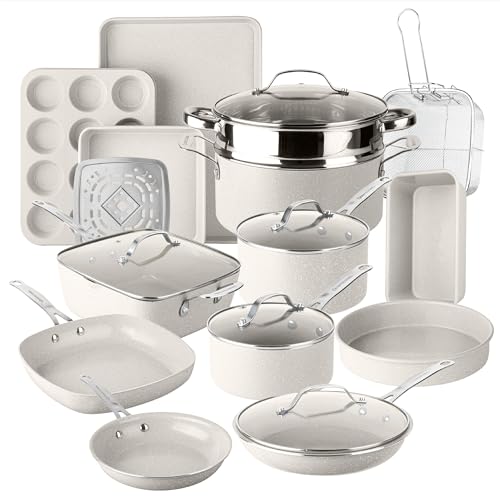
The current product is the Ceraluxe ceramic line. It is inexpensive for the piece count, light, and releases food well when new.
The drawback: everything in this article, plus one more - when we checked, it shipped from Amazon but was sold by a third-party reseller rather than the brand. Worth knowing before you rely on the ten-year warranty.
Questions people actually ask
What is GraniteStone cookware made of?
The body is aluminium — anodized aluminium on the Original, aluminium on the Ceraluxe line — with stainless steel handles. The coating is where it gets thin. The Ceraluxe listing says ceramic, which tells you the family but not the composition. The Original said only "multilayer nonstick," which tells you nothing.
Is granite coating actually granite?
No. It is a speckled finish designed to look like stone. The nonstick performance comes from the coating chemistry, not from granite.
Has GraniteStone cookware been recalled?
Yes, but not over the coating. CPSC recall 26-377, announced 2 April 2026, covers about 740,000 Diamond Pro Blue stainless steel sauté pans under UPC 0-80313-08131-6, for a handle screw cap that can eject when heated. We found no GraniteStone recall concerning coating safety.
What are the pros and cons?
In favour: inexpensive for the piece count, light, good food release when new, widely available, 10-year limited warranty. Against: coating described only by category, no published oven temperature on the current line, no AB 1200 disclosure we could find, an open recall on one line, and a live settlement over its chemical marketing claims.
Is PFOA-free the same as PFAS-free?
No. PFOA is one compound within the PFAS class, and it was phased out of US production over a decade ago. PFAS-free is a claim about the whole class. On the listings we examined, GraniteStone claims PFOA-free and, on the Ceraluxe line, PFOA/PFOS/PTFE-free — but not PFAS-free.
Should I throw mine away?
Not on the basis of anything in this article. Check the recall UPC, check whether the settlement class applies to you, avoid overheating, and replace it when the surface is visibly scratched or flaking — which is the right rule for any nonstick pan regardless of brand.
Related reading on Cupindy
- Granite Cookware Guide: Safety, Care and Maintenance Tips
- Granite vs Stainless Steel Cookware
- Granite vs Ceramic Cookware
- Best Non-Toxic Slow Cooker
- Stainless Steel Grades for Cookware
- Oven Safe Cookware Guide
- What "PFOA-Free" Actually Means
How we put this together
We read the live Amazon listings for GraniteStone and five comparison products in August 2026 and recorded, verbatim, what each said about its coating and its oven temperature limit. We took the recall record directly from CPSC rather than from news coverage. We read the settlement terms on the official administrator's website rather than from a claims aggregator. We searched the manufacturer's own site for an AB 1200 disclosure and reported what we found.
We did not test any of these pans. We have not measured migration from any coating and we do not claim to know what is in one. Where this article states an allegation, it is identified as an allegation. Every factual statement above is traceable to a source below.
Sources reviewed
- US Consumer Product Safety Commission, Recall 26-377, "E Mishan Recalls Granitestone Diamond Pro Blue Stainless Saute Pans Due to Impact and Burn Hazards," 2 April 2026.
- Jeffrey Fouse and Brianna Miller v. E. Mishan & Sons, Inc., Case No. CVRI2505343, Superior Court of California, County of Riverside — official settlement administrator website, including the claim form, read August 2026.
- California Attorney General, AB 1200 Enforcement Advisory, Hazardous Chemicals in Food Packaging and Cookware.
- California AB 1200 (2021-2022 session), Plant-based food packaging: cookware: hazardous chemicals.
- US EPA, Fact Sheet: 2010/2015 PFOA Stewardship Program.
- Manufacturer product listings for GraniteStone Original, GraniteStone Ceraluxe, All-Clad HA1, Tramontina Boston Tri-Ply Clad, Tramontina Professional, GreenLife ceramic and Lodge cast iron, read August 2026.
Corrections and right of reply
This article quotes public records and published product listings. If you represent E. Mishan & Sons or any brand mentioned and believe something here is inaccurate or out of date, write to us and we will check it and correct the article where correction is warranted. Readers who spot an error are equally welcome to tell us. Contact Cupindy.
Cupindy participates in the Amazon Associates Program and earns from qualifying purchases. This does not affect which products we recommend or what we say about them. See our affiliate disclosure.


