
Written by Rawia Younis. Rawia researches home and kitchen products for Cupindy.
Published November 2026 · Last reviewed November 8, 2026 · Cupindy is not affiliated with any brand on this page.
The short answer
Bake bacon at 400°F (204°C) on a rimmed sheet pan (baking tray). Laid flat on foil or parchment, regular strips take 12 to 18 minutes; on a wire rack, 18 to 23. Thick cut needs about 4 minutes more, and you never have to flip it.
- Use a pan with a rim. On a flat cookie sheet the grease runs off the edge and onto the oven floor.
- Keep the strips in one layer. They can touch, but they shouldn't overlap.
- Bake on the middle rack and start checking at 12 minutes.
- Pour the fat into a glass jar once it has cooled to warm. Never down the sink.
- Never part-cook bacon to finish later. USDA warns bacteria may survive. Cook it all the way, then reheat.
As an Amazon Associate we earn from qualifying purchases.
Our quick pick for oven bacon
Nordic Ware Naturals half sheet + Ultra Cuisine stainless rack
An uncoated aluminum pan with a 1-inch (2.5 cm) rim, and a 304 stainless steel rack its maker rates to 575°F (302°C). The rack is 16.5 by 11.5 inches (42 by 29 cm) and the pan measures 17.1 by 12.1 inches (43 by 31 cm) inside, so it drops straight in.
See the Nordic Ware pans on AmazonSee the Ultra Cuisine racks on AmazonThe drawback: Nordic Ware says the dishwasher discolors bare aluminum, so the pan is a hand wash. The rack can go in the dishwasher.
Frying bacon means standing at the stove, turning strips one at a time and wiping grease off the backsplash afterwards. The oven does a whole pack at once, flat and evenly browned, while you get on with the eggs. Almost everything that goes wrong comes down to the pan you use and when you take it out. If your sheet pan is warped or has no rim, our guide to the best cookie sheets and sheet pans compares uncoated aluminum, stainless and nonstick ones.
Bacon in the oven: time and temperature chart
These ranges come from two published methods. Wholesome Yum gives times for bacon on a rack from 350 to 425°F, and The Kitchn's flat-pan method puts thick cut about 4 minutes behind regular, so the thick-cut column adds those 4 minutes. Use each range as the window to start checking. Ovens run hot or cool, and one brand's regular cut is close to another brand's thick.
| Oven temperature | Regular cut, on a rack | Thick cut, on a rack |
|---|---|---|
| 350°F (177°C) | 22 to 27 min | 26 to 31 min |
| 375°F (191°C) | 20 to 25 min | 24 to 29 min |
| 400°F (204°C), the best all-rounder | 18 to 23 min | 22 to 27 min |
| 425°F (218°C) | 15 to 20 min | 19 to 24 min |
Flat on a lined pan, expect roughly 4 to 5 minutes less. The Kitchn's 400°F method lands near 14 minutes for regular bacon and 18 for thick cut.
Why 400°F? It is hot enough to crisp the fat before the meat dries out, and it stays under the 425°F (218°C) limit printed on common parchment rolls. 350°F is slower and a little more forgiving with thick cut. At 425°F the bacon is done sooner, but there is less time between done and burnt, so stay close to the oven.
How to cook bacon in the oven, step by step
- Set a rack in the middle of the oven. Preheat to 400°F (204°C), or skip the preheat and use the cold-start method in the questions below.
- Line a rimmed half sheet pan with foil or parchment, pressed into the corners and up over all four sides. When The Kitchn re-tested its method, foil and parchment did the same job. The overhang is what counts, because it stops the fat creeping under the lining.
- Add a rack if you want flat, crisp strips, then lay the bacon on it in one layer. Strips shrink as they cook, so they can start out touching. Where two overlap, the bacon stays pale and soft.

One layer, edges touching, nothing on top of anything else.
- Slide the pan in level so the fat doesn't run to one end.
- Bake without turning the strips. Start checking at 12 minutes for flat regular bacon, or 18 on a rack. If the back row browns faster, spin the pan around once.
- Take it out a shade lighter than you want it. Lift the strips with tongs onto a plate lined with paper towel (kitchen roll). They keep cooking for a minute and firm up as they cool.
- Leave the pan until the fat is warm, not hot, then save it or throw it out (see below).

The middle rack keeps the strips away from the top and bottom heat.
Rack or no rack?
Both work, but they give you different bacon. Flat on a lined pan, the strips cook in their own fat, almost like shallow frying. You get richer bacon, chewy in spots and a little wavy. On a rack, the fat drips away and hot air gets underneath, so the strips come out flatter and crisp from end to end. The Wholesome Yum author says rack plus foil beat foil alone when she tested it. The Kitchn calls the rack an optional upgrade.
The price is a few extra minutes and more washing up. Bacon fat sets hard in a wire grid, so put the rack in hot soapy water while it is still warm and a brush will get it clean.
Check what the rack is made of before it goes into a 400°F oven. Solid stainless steel handles the heat. Chrome-plated and nonstick racks usually have lower limits, and nonstick grids often stop at 400 to 450°F (204 to 232°C), right where bacon cooks. Our guide to oven-safe baking racks lists each maker's limit and a quick way to spot plating.
As an Amazon Associate we earn from qualifying purchases.

If you want crisp, flat strips
Ultra Cuisine Stainless Steel Cooling and Baking Rack, Set of 2
Racks of 304 (18/8) stainless steel with a tight grid, standing 1 inch (2.5 cm) tall. The maker rates them oven safe to 575°F (302°C). Each one is 16.5 by 11.5 inches (42 by 29 cm), sized for a standard 13 by 18 inch (33 by 46 cm) half sheet pan.
Good for: Bacon, wings, roast vegetables, cooling cookies
The drawback: The listing says the racks don't stack, so two of them take up a drawer.
See the Ultra Cuisine racks on AmazonFoil, parchment or a bare pan?
Line the pan. Bacon fat on bare aluminum or steel bakes into a brown film that takes real scrubbing. With a lining, you wait for the fat to set and lift the whole lot out.
Foil is the safe choice at any bacon temperature. Our guide to foil in the oven covers the rules, including why foil should never line the oven floor. Parchment works just as well up to the number on the box. The Reynolds and Amazon Basics rolls are rated to 425°F (218°C), so 400°F is fine and 425°F is right at the limit. Our parchment paper guide has the details.
Two things to avoid. Wax paper isn't made for the oven: the wax coating can melt and smoke. And skip the flat cookie sheet: the Wholesome Yum author warns against it because grease runs over the edge, and fat on the oven floor smokes.
As an Amazon Associate we earn from qualifying purchases.
If your sheet pan has no real rim
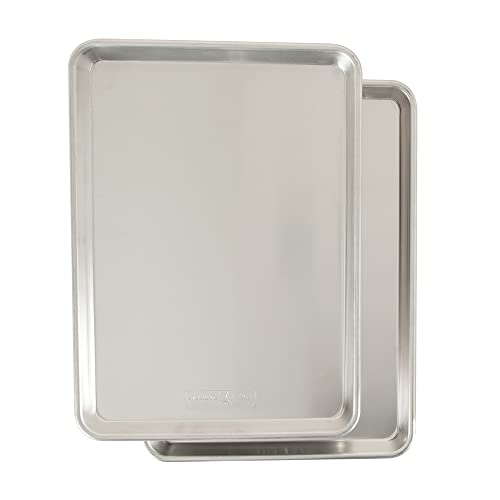
Nordic Ware Naturals Half Sheet Pan, 2-Pack
Uncoated aluminum half sheets with a galvanized steel rim sealed inside the edge, made in the USA from domestic and imported materials, according to the listing. The outside measures 17.9 by 12.9 inches (45 by 33 cm) and the rim stands a full inch (2.5 cm), enough to hold the fat from a pack of bacon. With two in the box, you can cook two packs at once.
Good for: Bacon, roasting, cookies, catching drips
The drawback: Nordic Ware says the dishwasher discolors these pans and that tomato and vinegar can darken or pit them, so hand wash them.
See the Nordic Ware pans on AmazonHow to make oven bacon extra crispy, or keep it chewy
- Use a rack. Wholesome Yum and Just a Taste both credit the rack for the crunchiest strips, because the bacon isn't sitting in its own fat.
- Choose regular or thin cut. Thick cut crisps at the edges but stays meaty in the middle.
- Give the strips room. Crowded bacon steams instead of crisping.
- Go 2 or 3 minutes past the chart, checking every minute. That last stretch is where crisp turns into burnt.
- Cool it on paper towel. The strips harden as they cool, so bacon that looks almost there in the oven is usually crisp on the plate.
For chewy bacon, do the opposite. Cook it flat in its own fat, take it out at the low end of the range and let it rest on a plate.

Out of the oven and onto paper towel. The strips crisp a little more in the first minute.
What to do with the bacon grease
Never pour it down the sink. It sets as it cools and coats the inside of the pipes. You have two easy options.
- Keep it. Let the fat cool until it is warm, then strain it through a fine sieve or a coffee filter into a clean glass jar with a lid. Hot fat can crack cold glass and soften thin plastic, so give it time. Keep the jar in the fridge, which is also what the Wholesome Yum author does. A spoonful is good for frying eggs, roasting potatoes and greasing a cornbread pan.
- Throw it out. Leave the pan until the fat turns white and firm, fold the foil or parchment over it and put it in the trash.

Strain it while it is warm, then cap the jar and keep it in the fridge.
Storing and reheating cooked bacon
The USDA Food Safety and Inspection Service (FSIS) says perishable cooked food shouldn't sit out for more than 2 hours, or 1 hour when the air is above 90°F (32°C). In the fridge, bacon you cooked at home keeps 4 to 5 days. In the freezer, FSIS gives it about 1 month. Raw bacon keeps 7 days in the fridge, or 4 months frozen at 0°F (-18°C).
Cook it all the way through in one go. FSIS says not to part-cook bacon, refrigerate it and finish it later, because bacteria may survive. If you want bacon ready for the week, cook it fully, cool it, then reheat what you need.
To reheat, spread the strips on a sheet pan in a 350°F (177°C) oven for a few minutes, or microwave them on a paper towel. For precooked bacon, FSIS suggests about 10 seconds per strip in the microwave.
Questions people ask
Do you have to flip bacon in the oven?
No. The heat reaches both sides, especially on a rack. If your oven browns one end faster, turn the pan around once halfway.
Should you preheat the oven or start bacon in a cold oven?
Either works. A preheated oven gives you the times in the chart. For a cold start, put the pan in and then set the oven to 400°F (204°C). Just a Taste and Brown Eyed Baker both cook bacon this way. Just a Taste allows 10 to 20 minutes from cold and Brown Eyed Baker 25 to 35, which shows how differently ovens heat up. The fat melts more gently while the temperature climbs, so the strips curl less. Check early the first time you try it.
Can you cook frozen bacon in the oven?
Yes. FSIS says it is safe to cook meat straight from frozen and that it takes about 50% longer. If the strips are frozen together in a block, put the block on the pan, bake until the strips loosen, then pull them apart with tongs and spread them out.
How do you know when bacon is done?
By color and feel. Done bacon is golden to deep brown with no pale, see-through fat, and it stiffens a few seconds after you lift it. FSIS says crisp bacon has reached a safe temperature. Cured bacon can stay a little pink even when it is fully cooked, and a strip is too thin to check with a thermometer anyway.
Why does bacon splatter or smoke in the oven?
Some spitting is normal as the fat melts. It lands on the oven walls instead of your stovetop, and a rimmed pan keeps most of it in. Smoke usually means fat is burning somewhere it shouldn't be: an old spill on the oven floor, a pan that overflowed, or a pan too close to the top element. A temperature above 425°F (218°C) makes it worse. Use a rimmed pan on the middle rack, and if the floor is dirty, our guide to cleaning an oven covers the gentle way to do it.
How much bacon fits on one sheet pan?
A half sheet pan usually takes one standard pack in a single layer. For two packs, use two pans on the racks just above and below the middle, swap them halfway and allow a few extra minutes.
Can you cook turkey bacon in the oven?
Yes, with the same pan and temperature. It has much less fat, so it won't crisp the same way and it burns sooner. Start checking well before the times in the chart and follow the package directions.
Can you cook bacon in a toaster oven?
Yes, for a few strips. Use the toaster oven's own tray or a small rimmed pan, line it, and keep the bacon in one layer at the same 400°F (204°C). The heating elements sit much closer to the food than in a full oven, so fat spits onto them more easily and the bacon browns faster. Check early, and don't let the strips hang over the edge of the tray.
How do you cook bacon in a convection oven?
Turn the temperature down 25°F (14°C), so 375°F instead of 400°F, unless your oven does it for you. LG, for example, says its convection modes take off the 25°F automatically. The fan also speeds things up, so check a few minutes early.
How we put this together
On November 7 and 8, 2026 we read the oven bacon methods published by The Kitchn, Wholesome Yum, Just a Taste and Brown Eyed Baker, FSIS's pages on bacon, leftovers and thawing, and LG's convection help page. The chart is built from those published ranges, not from our own kitchen tests. Product facts come from each Amazon listing on November 8, 2026, when both products showed in stock. No brand saw this page before it went up.
Sources (opened November 7 and 8, 2026). Product facts come from each Amazon listing on November 8, 2026.
- USDA FSIS: Bacon and Food Safety
- USDA FSIS: Leftovers and Food Safety
- USDA FSIS: The Big Thaw, safe defrosting methods
- The Kitchn: How to cook perfect bacon in the oven
- Wholesome Yum: How to cook bacon in the oven
- Just a Taste: How to cook bacon in the oven
- Brown Eyed Baker: Perfect oven baked bacon
- LG: Understanding convection cooking on an LG range


