

There is a pan sitting in your cart from a brand you had never heard of three days ago, and something about it is bothering you.
Probably this: every one of these pans looks identical. The same hammered finish, the same promise, the same photograph of an egg sliding around. Plateful. Taima. Smith Titanium. Okura. Siraat. Five names, and what looks an awful lot like one product.
Here is the fastest thing you can do about it. Take a magnet off your fridge and hold it against the base of any titanium pan you own or are about to buy. It will stick. That is not a scandal, and it does not mean you have been cheated. It means something quite specific, and by the end of this page you will know exactly what.
What we found
The one brand that publishes its build says the pan is 0.5 mm of titanium over aluminium and steel. Not solid titanium.
A magnet sticking is normal. Every induction-ready pan in this category needs a steel base, and titanium is not magnetic.
Three of the six brands publish no company name, no country and no material spec. We could not find any of them on Amazon either.
"Titanium Pro Pan" is not a brand. It is listing wording that dozens of unrelated sellers copy.
Written by the Cupindy editorial team. We read what each company publishes about its own pans, in its own words, and we say plainly where the information runs out. Last checked 20 September 2026.
As an Amazon Associate I earn from qualifying purchases. Cupindy may earn a commission when you buy through links on this page, at no extra cost to you. It does not change which pans we recommend or what we say about them. Full details in our affiliate disclosure.
What the magnet actually tells you
Titanium is not magnetic. Not weakly magnetic, not sometimes magnetic. A magnet will not cling to a piece of pure titanium any more than it clings to a piece of glass.
So when the magnet grabs your titanium pan, people reach one of two conclusions. Either the pan is fake, or the internet lied to them about titanium. Neither is right.
Here is what is actually going on. Induction hobs work by generating a magnetic field that heats the metal sitting on them, which is how induction cooking works in the first place. Titanium will not respond to that field. Neither will aluminium. If a manufacturer wants to sell you a titanium pan that works on induction, and almost all of them do, the pan must have a layer of magnetic stainless steel on the bottom. There is no way around it. It is physics, not marketing.
Look at how the brands themselves put it. VocVoi, which sells the best-selling titanium pan on Amazon, states in its own product bullets that "high magnetic conductivity ensures full compatibility with induction, gas, electric, ceramic, and glass stovetops." Siraat is more specific still and names the material: a "0.6 mm stainless steel (430)" base. Grade 430 is a magnetic stainless, and if you want to know why that matters for cookware, we cover it in our guide to stainless steel grades in cookware. That layer is what your fridge magnet has found.
So the magnet test is useful, but not for the reason most people think. It does not tell you whether the cooking surface is titanium. It tells you the pan has a steel base, which every induction-ready pan in this category has by design. A pan where the magnet does not stick would be the surprising one, and it would not work on an induction hob.

Half a millimetre
Once you accept that there is steel in the bottom of the pan, the obvious next question is how much titanium is actually in it.
Most of these companies will not tell you. Siraat will, and the number is worth sitting with. On its own website and on its Amazon listing, Siraat publishes the full build of its Hammered Pan Pro.
0.5 mm titanium
the cooking surface, the part food touches
1.0 mm aluminium
the core that spreads the heat
0.6 mm stainless steel, grade 430
the magnetic base your hob talks to
A credit card is about three quarters of a millimetre thick. The titanium in one of these pans is thinner than that.
It is bonded to a sandwich of aluminium and steel that makes up roughly four fifths of the pan you are holding.
That is not a criticism. It is how almost all good cookware is built, and it is the same logic behind every quality tri-ply pan, as we explain in our breakdown of what cooking pans are actually made of. A cooking surface that behaves well, a conductive core that spreads heat, a base that talks to the hob. Nobody makes a frying pan out of a single solid metal any more, because a single metal is always bad at one of those three jobs.
The problem is not the construction. The problem is that a pan built this way is being sold to you as "100% pure titanium", and a reasonable person reads that as a pan made of titanium all the way through.

And this is not just the cheap end doing it. Our Place, an established brand with a real head office and a real customer service department, sells its Titanium Always Pan Pro with the line "stainless steel, aluminum, and titanium come together" in the product bullets, and lists the Material field on Amazon as "Aluminum, Stainless Steel". The pan is good. The description is accurate. It is simply that the word titanium in the product name is doing more work than the titanium in the pan.
There is one more corroboration, and it comes from buyers rather than sellers. Amazon's own summary of 1,545 customer reviews on the category best seller describes it as heating evenly thanks to its "tri-ply stainless steel construction". The people cooking on these pans have worked out what they are.
What each brand actually publishes
We went through all six companies the same way. Not the ads, not the reviews, but the documents: the product pages, the terms of service, the returns policies, the Amazon listings. Here is who tells you what.

Siraat
Publishes the most
Layer spec
Full, both channels
Company
SiraatsKitchen LLC, Delaware
On Amazon
Yes
Our Place
Established brand
Layer spec
Tri-ply stated
Company
Long-standing, contactable
On Amazon
Yes
Plateful
Partly documented
Layer spec
No thicknesses given
Company
Plateful LLC, New York
On Amazon
Yes
Taima
Partly documented
Layer spec
Not on its own site
Company
OneClick Digital LLC, Wyoming
On Amazon
Not found
Okura
Little to check
Layer spec
None published
Company
None published
On Amazon
Not found
Smith Titanium
Little to check
Layer spec
None published
Company
None published
On Amazon
Not found
Siraat
Siraat is the most forthcoming company in this group, and it deserves to be said first because the rest of this page is going to be harder on everyone else.
Its terms of service name SiraatsKitchen LLC at an address in Claymont, Delaware. It publishes the three layer thicknesses. It states that the pan is third party tested with PFAS, PTFE, lead and cadmium reported as not detected, which is the kind of claim we look for when assessing any non-toxic cookware. It sells on Amazon under its own brand store at exactly the same prices as its own website, to the dollar, which is more than most direct-to-consumer brands can say.
The thing to read carefully is the returns policy, because it sits oddly against the marketing. Siraat offers what it calls a 75 year limited warranty. Its returns clause says a product may be returned within 30 days only if it is "unused: not cooked with, washed or seasoned". So the warranty covers three quarters of a century of manufacturing defects, and the refund window covers only a pan you have taken out of the box and put back.
If you want one, buy it on Amazon rather than from Siraat directly. Same pan, same price, and Amazon will take it back after you have cooked on it. The Siraat Hammered Pan Pro is here, though be aware the listing is new and carries no customer ratings yet.
Plateful
Plateful is the brand most of you arrived here asking about, and it is a mixed picture rather than a bad one.
On the good side: its terms of service name Plateful LLC at 750 Lexington Avenue, New York, and that same address appears on its Trustpilot profile, which is the sort of small consistency that is reassuring when you find it. Its Trustpilot score is 4.4 out of 5 across 1,513 reviews. It sells on Amazon through its own brand store at the identical price to its own site. It ships from Amazon, which means Amazon returns.
On the less good side: the Amazon listing describes the Finish Type as "Uncoated" and the Coating Description as "Titanium", in the same specification block, which cannot both be the plain reading of the same pan. There are no layer thicknesses anywhere. The pan holds 3.8 stars from 625 Amazon ratings, and 19 percent of those are one star. Amazon's own summary of those reviews says the non-stick surface gets mixed reviews, with some buyers finding it great and "others say it's not as advertised".
We are not going to tell you it is a bad pan, because plenty of people are happy with theirs. We will say that at this price, with that rating, there are better-reviewed options further down this page. If you want it anyway, the 12 inch Plateful pan is here, and buying it through Amazon gets you a 30 day return that the brand's own 90 day policy makes you argue for.
Taima
Taima has the most independent review coverage of any brand here. Prudent Reviews bought one and put a thermometer on it. The Roundup used one for six months and disclosed that the unit was a gift. That is more genuine testing than the rest of this list has received put together, and if you are considering a Taima, read those two.
What Taima does not do is publish much itself. Scroll to the bottom of its terms of service and you will find the line "Website Is Managed By: OneClick Digital LLC, 30 N Gould St Ste R, Sheridan, WY 82801." The same document still contains Shopify's unedited template placeholder, referring to the company as "My Store" in its liability and indemnity clauses, and a broken link to its own refund policy with the domain misspelled.
We could not find a Taima-branded listing on Amazon. As far as we can see it sells only through its own website, which means returns and any warranty claim go through OneClick Digital rather than through a retailer.
Okura
Okura tells a lovely story. A meeting in Japan in 2014, a co-founder who moved his family to America in 2017, a launch in 2018, tens of thousands of kitchens. The about page names eight team members and quotes a Michelin-starred chef in Tokyo.
What it does not name is a company. There is no legal entity on the about page, no country of manufacture, no alloy grade and no layer thicknesses. The page title promises cookware "built to last 25 years" while the banner at the foot of the same page offers a lifetime warranty. The site claims an average of 4.8 stars across more than 12,000 verified reviews.
We searched Amazon for Okura titanium cookware and got 201 results, none of them Okura. We could not find an Okura-branded listing at all, so everything you buy from them, and every return you might need to make, runs through their own website.
Smith Titanium
Smith Titanium is the one we would want you to read most carefully, and we are going to be careful about how we put this, because everything below is simply what the company's own website says.
The site carries a page headed "What's the Catch?" It tells the story of two brothers, James and Robert Smith, who spent more than thirty years making titanium pans, and who decided three weeks ago to close the workshop. Final inventory. Up to 70 percent off. No restock. The page carries photographs credited to named photographers and publications, including one credited to a photographer "for The Washington News" and another "for daily news".
We could not verify those credits. We could not find the publication named in the first one. We could not find a company registration, a country of manufacture, an alloy grade, a warranty document or a returns policy anywhere on the site. Its terms of service page returns a 404.
Its Trustpilot rating is 3.6 out of 5, which sounds middling until you look at the shape of it: only 46 reviews in total, 61 percent of them five star and 33 percent one star, on a profile claimed in June 2026. There is almost nothing in the middle.
We could not find Smith Titanium on Amazon, or at any other retailer. If you buy one, you are buying from that website alone, with no published returns policy and no published warranty. We are not telling you it is a scam, because we do not know that and neither does anyone else writing about it. We are telling you exactly how much of this company is checkable, which is very little, and letting you make the call.
Our Place
Our Place is the grown-up in the room, and the comparison is instructive rather than flattering to anyone.
The Titanium Always Pan Pro holds 4.3 stars from 1,435 Amazon ratings, carries an Amazon's Choice badge, sells over a thousand units a month and ships from Amazon with a 30 day return. The brand publishes its construction honestly as tri-ply stainless steel and aluminium with a titanium surface.
And Amazon's summary of those 1,435 reviews still says the non-stick performance gets mixed feedback, with some owners finding it very non-stick and others reporting food sticking more than expected, and that opinions on value are divided. That is the same complaint the 3.8 star pans get. Spending three times as much does not make the sticking question go away, which tells you something useful about the whole category. If sticking is your real worry, our guide to choosing a frying pan material is a better starting point than any titanium brand comparison.
"Titanium Pro Pan" is not a brand
A lot of people arrive at pages like this one searching for the Titanium Pro Pan, as though it were a company with a factory and a customer service line.
It is not. "Titanium Hammered Pro" and "Titanium Pro Pan" are phrases that appear in dozens of different Amazon listing titles from unrelated sellers, because sellers copy whatever wording is currently ranking. Search the phrase on Amazon and you will find the same hammered pan under a dozen names, some of them brands, most of them not.
So if you are asking whether the Titanium Pro Pan is legitimate, there is no single answer, because there is no single product. Judge the individual listing: who the seller is, whether there is a brand store behind it, how many ratings it has, and whether anyone has published what is inside the pan.
So what would we actually buy
Three options, for three different kinds of buyer. We should say up front that this category has no cheap credible entry. The pans with thousands of ratings all sit near or above a hundred dollars, and the ones under seventy five dollars have a handful of reviews each. If you were hoping for a forty dollar titanium pan worth owning, we could not find one.
As an Amazon Associate I earn from qualifying purchases. See our affiliate disclosure.
If you want the one most people are actually buying

Best rated with real volume behind it
The best-reviewed titanium pan we found with genuine sales behind it: 4.3 stars from 1,545 ratings, 75 percent of them five star, over two thousand sold in the past month, and the number one best seller in its Amazon category. In stock, sold by the brand, shipped by Amazon with a 30 day return. It carries three sustainability certifications, which none of the direct-to-consumer brands do.
The catch: Amazon's own review summary says the non-stick surface gets mixed reviews, with some buyers finding it truly non-stick and others reporting food sticking. Every pan in this category has that complaint, including the expensive ones.
If you would rather buy from a company that will still exist next year

Our Place Titanium Always Pan Pro, 10.6 inch
The one with a real returns department
4.3 stars from 1,435 ratings, Amazon's Choice, more than a thousand sold a month, in stock and sold by Our Place itself. A real company with a published tri-ply construction and a spatula in the box. If the thing bothering you about this category is that you cannot tell who you are buying from, this is the answer to that specific worry.
The catch: it is the most expensive pan on this page by a wide margin, and Amazon's review summary notes that opinions on whether it is worth the money are divided. The sticking complaints exist here too.
If you just want a pan that works and you do not care what it is called
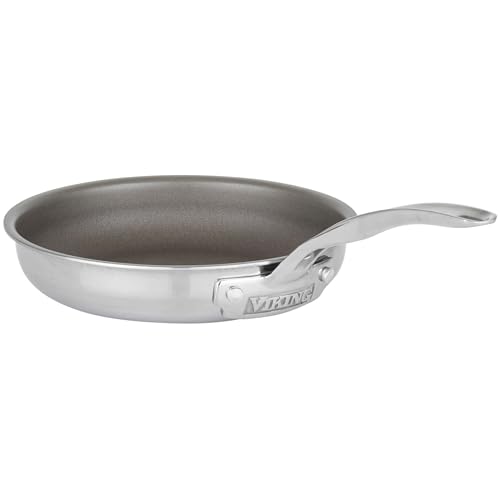
The one that describes itself honestly
We are including this one because of how it describes itself. Viking calls the surface a "titanium nonstick surface" and a "laser-clad titanium cooking surface", and in its own product copy calls it "a fourth layer" and a "titanium coating". No claim that the pan is made of titanium. Just a clear statement of what the titanium is doing and where it sits. 4.3 stars from 277 ratings, 400 plus sold a month, from a cookware company that has been around for decades.
The catch: hand wash only, while most of the pans above claim dishwasher safety, and it is oven safe to a lower temperature than the solid-surface pans. Some buyers find it expensive for the size.
Five checks you can run yourself in two minutes
You should not have to take our word for any of this. Here is the method, so you can apply it to whatever pan you are looking at next month when three new brands have appeared.

1. The magnet
It will stick. That confirms a steel base and tells you nothing about the cooking surface. If it does not stick, the pan will not work on induction.
2. The specification block
Scroll past the marketing bullets to the grey table with Brand, Material and Coating Description in it. When Material says "Aluminum, Stainless Steel" on a pan called titanium, you have learned something.
3. The terms of service page
Every Shopify store has one at /policies/terms-of-service. Scroll to the bottom. A real company usually names itself there. If the page is missing, that is worth knowing before you spend a hundred and fifty dollars.
4. The returns clause
Not the warranty headline. A seventy five year warranty is worth less than a thirty day return you can actually use. Look for the words "unused" or "unopened" in the refund policy.
5. Whether anyone else sells it
A brand that sells through Amazon or Walmart has accepted somebody else's returns policy and somebody else's rules about product claims. A brand that sells only through its own checkout has accepted nobody's.
Questions people ask
Is a magnet sticking to my titanium pan a bad sign?
No. It means the pan has a magnetic stainless steel base so it works on induction. Every induction-compatible pan in this category has one, by necessity.
Are these pans actually solid titanium?
The ones that publish a specification are not. Siraat's is half a millimetre of titanium over aluminium and steel. The brands that publish no specification have not said either way, and we could not find the information.
Where are they made?
For most of these brands we could not find a stated country of manufacture. Independent reviewers have reported China for Taima. The others do not say on their own sites, and we are not going to guess.
Is Plateful a real company?
Its terms of service name Plateful LLC in New York, and the same address appears on its Trustpilot profile. It sells through its own Amazon brand store. Whether the pan is right for you is a separate question from whether the company exists, and on the first question its 3.8 star average is the number to weigh.
Why do they all look the same?
Because in a fast-moving category, sellers copy the listing wording, the photography style and the finish of whatever is currently selling. It does not prove they come from the same factory, and we have no evidence that they do.
Is titanium cookware safe?
That is a materials question rather than a brand question. We answer it separately in our guide to titanium cookware, which covers the safety research, the coated versus uncoated distinction and how titanium compares with ceramic and stainless steel.
Do other cookware brands get investigated like this?
Yes, and the results are worth reading before you buy anything marketed as non-toxic. We did the same document-level check on HexClad and on Granitestone.
Every brand claim on this page was read directly from the company's own website, its own Amazon listing or its Trustpilot profile on 20 September 2026. Where we write that we could not find something, that means we looked and did not find it, not that it does not exist. Prices and ratings change; check the listing before you buy.


