
Written by Sara Ibrahim. Sara researches home and kitchen products for Cupindy.
Published November 2026 · Last reviewed November 8, 2026 · Cupindy is not affiliated with any brand on this page.
Short answer: honing pushes a bent edge back into line and removes almost no metal. Sharpening grinds away a little steel to make a new edge.
Most home cooks should hone every few uses and sharpen about once or twice a year, which is what Victorinox tells its customers; Shun says once a year is often enough for many home cooks. A whetstone does the best job; a pull-through is the quick fix.
The steps below work on any straight-edged kitchen knife, from the chef's knives we checked to an old paring knife. Serrated knives get their own section.
As an Amazon Associate we earn from qualifying purchases.

Our quick pick
Sharp Pebble 1000/6000 Grit Whetstone
A two-sided water stone: 1000 grit to sharpen, 6000 grit to polish. The listing includes an angle guide, which helps on your first few sessions.
See the Sharp Pebble on AmazonThe drawback: there is no coarse side, so a chipped or badly rounded edge takes many minutes on the 1000 side, or a trip to a pro.
How we put this together: on November 8, 2026 we read the sharpening and care pages of five knife makers and the Amazon listings of every product here. Where makers disagree, we show both numbers. We did not test these products, and the photos on this page are illustrations, not our test shots.
Does Your Knife Need Honing, Sharpening or a Pro?
Test before you reach for a tool. Most knives that feel dull have a rolled edge, and a few strokes on a rod fix that in under a minute. A sharpening session is only needed when honing stops working.
| What you notice | Quick test | The fix |
|---|---|---|
| Slides off tomato skin or squashes it | Rest the edge on a tomato and draw it back with no downward push. A sharp edge bites at once. | Hone first. No change? Sharpen. |
| Snags or tears paper | Hold a sheet of printer paper by one corner and slice down from heel to tip. | Snags in one spot: hone. Tears all along: sharpen. |
| Shiny glints on the edge | Point the edge at a lamp and look straight down at it. A sharp edge shows no light. | Small bright spots: hone. A bright line: sharpen. |
| Still dull after sharpening | Color the bevel with a marker and make three light strokes on the stone. | Ink left at the very edge: raise the spine a little. Ink left at the top of the bevel: lower it. |
| Chips you can see, a bent or broken tip | Look along the edge in good light. | A coarse stone, or a professional sharpener. |
| Bread knife tears the crust | Slice a crusty loaf with no sawing pressure. | See the serrated section below. |

The paper test: a sharp edge leaves a straight cut (left), a dull edge tears the sheet (right).
The marker test answers the most common complaint: you sharpened for twenty minutes and nothing changed. Often the stone never reached the very edge because the angle was too low.
Honing vs Sharpening: What a Rod Can and Cannot Do
Wüsthof says honing “realigns the microscopic teeth on the edge of the blade”, while sharpening takes a small amount of steel off to create a new one. Shun says the same about its honing steels: they do not remove metal.
So a rod is maintenance. It can bring back an edge that has bent over from use, but it cannot rebuild one that has worn round. If honing worked last month and does nothing today, it is time for a stone.
How to hone a knife
- Stand the rod upright with its tip on a folded towel so it cannot slip. Zwilling tells you to hold the steel point down on a flat surface.
- Set the blade against the rod at your knife's angle. Victorinox says 20°, Wüsthof says 14° (10° for Asian-style knives), and Zwilling says about 15° for its own knives.
- Draw the knife down and toward you in one stroke, heel to tip, with about the weight of the knife itself. Pressing hard does not help.
- Switch sides each stroke. Victorinox suggests five strokes on each side, then a paper test.

Honing with the rod tip on a folded towel: the knife moves, the rod stays still.
The rod also has to be harder than the knife, as Zwilling points out. A plain steel rod suits stamped and softer knives. Victorinox says its stamped knives are easy to hone on a standard steel, while forged knives need a diamond, tungsten carbide or ceramic one for best results.
As an Amazon Associate we earn from qualifying purchases.

For softer Western knives
Utopia Kitchen 12-Inch Honing Rod
A 12-inch (30 cm) steel rod with a hanging hook. The listing describes it as nickel-chrome plated carbon steel. The long rod suits an 8-inch chef's knife.
Good for: stamped knives and softer everyday knives
The drawback: A steel rod can be softer than a hard Japanese blade, so use ceramic for those. The listing also says it works on serrated knives; Zwilling, a knife maker, says never to hone serrated knives.
See the Utopia rod on AmazonMatch the Method to Your Knife
The wrong tool can chip a hard blade or barely touch a soft one. Check three things before you pick a method: how hard the steel is, how the edge is ground, and whether it has teeth.
| Your knife | How to tell | Use |
|---|---|---|
| Softer Western steel | German-style chef's knives, stamped knives, most knife-block sets | Steel or ceramic rod, a whetstone, a pull-through |
| Hard Japanese steel | Thin blade sold as Japanese steel; the maker gives 10 to 12° or lists a high hardness | Ceramic rod and a whetstone. Skip steel rods and coarse pull-throughs |
| Single bevel | Ground on one side only, flat on the back (yanagiba, deba); the listing says so | A whetstone only, or a professional. Pull-throughs and electrics grind both sides |
| Serrated | Teeth or scallops along the edge | A professional, or a thin tapered rod used one scallop at a time |
Global is a good example of why this matters. It grinds its knives to 10 to 15 degrees, a thinner edge than most German knives, and notes that holding the right angle is hard for beginners. Its US site points owners to a waterstone or ceramic stone, and to ceramic or diamond rods.
Most knives sold in the US are double bevel, so they work in either hand and on any home sharpener. Our santoku vs chef's knife guide lists the angle each maker uses on those two knives.
As an Amazon Associate we earn from qualifying purchases.
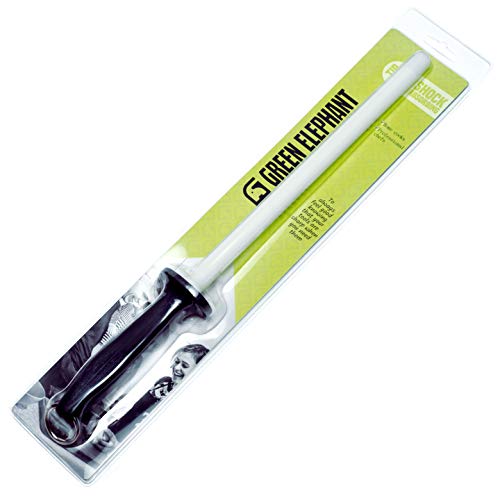
For hard Japanese steel
Green Elephant 11-Inch Ceramic Honing Rod
An 11-inch (28 cm) ceramic rod with a 1500 grit finish, per the listing. Ceramic is harder than a steel rod, so it can hone thin, hard blades that a steel would chip.
Good for: Japanese knives, Global-style knives and anyone who wants one rod for every straight-edged knife
The drawback: Ceramic is slightly abrasive, so it takes off a little metal each time; light strokes every few uses are enough. The rod also turns gray with steel dust and needs a scrub with a damp sponge.
See the Green Elephant on AmazonWhat Angle Should You Sharpen a Knife At? Use the Maker's Number
The angle is the slope ground on each side of the edge. Lower means a thinner, keener edge that also chips more easily. Use your knife's number. Here is what the makers publish.
| Maker | Angle per side | What the number is for |
|---|---|---|
| Wüsthof | 14°; 10° for Asian-style knives | Stone and honing steel |
|
Zwilling Henckels belongs to the same company |
About 15°; santoku and all Miyabi 9 to 12° | Honing steel; it gives 10 to 20° on a stone |
| Shun | 16° | Honing and sharpening |
| Global | 10 to 15° | Factory edge |
| Victorinox | 20° | Honing steel |
Across these five makers the numbers run from 9 to 20 degrees per side. If you see a figure such as 30 or 40 degrees, it is usually the two sides added together, not the angle you hold.
No number from the maker? Hold the blade straight up from the stone (90°), tip it halfway (45°), halfway again (about 22°), then a little lower. That lands near 15 to 20 degrees, where most Western kitchen knives sit. Then run the marker test and adjust.
Holding the angle steady matters more than the exact figure. A knife held at 15° on every stroke ends up sharper than one that wobbles between 12° and 20°.
How to Sharpen a Knife With a Whetstone
- Wet the stone. Soaking stones go under water until the bubbles stop: Wüsthof says about ten minutes, Zwilling about five. Splash-and-go stones need only water on the surface. Follow the instructions that came with your stone, and keep it wet as you work.
- Set it down so it cannot move. Use its base, a damp towel or a silicone mat, coarse side up.
- Find the angle. Lay the edge on the stone, raise the spine to your maker's angle and put two or three fingertips of your other hand flat on the blade, just behind the edge.
- Make full strokes. Push the blade across the stone as if slicing a thin layer off it, sweeping from heel to tip so the whole edge meets the stone. Use light, even pressure.
- Feel for the burr. Zwilling says a thin line of waste metal, the burr, shows up after about five strokes. Check by drawing your thumb from the spine off the edge on the other side, never along it. Keep going until you feel the burr along the whole length, then do the same on the second side.
- Move to the fine side. Repeat with lighter strokes, then alternate one stroke per side to remove the burr. Five to ten light strokes per side is plenty here.
- Strop, rinse and test. A few edge-trailing strokes on plain leather or folded newspaper remove the last of the burr. Rinse and dry the knife, then run the paper test.
Your first session will take longer than the instructions suggest. That is normal. After two or three sessions a 1000 grit touch-up on a knife you keep honed takes a few minutes.
Which grit does what
Grit is the size of the abrasive in the stone. The lower the number, the faster it cuts and the rougher the edge it leaves.
- Coarse, below about 1000: repairs chips and reshapes a very dull or rounded edge. Most kitchens need it rarely.
- Medium, around 1000: the everyday sharpening grit. If you buy one stone, this is the grit to have.
- Fine, from about 3000 up: polishes the edge so it slices cleanly and stays sharp a little longer.

Two grits side by side: a coarser stone on the left, a fine polishing stone on the right. Two-sided stones put both on one block.
Flatten the stone now and then
Stones wear into a shallow dip, and a dished stone rounds your edge. Draw a pencil grid on the wet surface, rub the stone on a flattening plate or on coarse wet-and-dry sandpaper laid on glass, and stop when every pencil line is gone. Doing this every few sessions takes a minute.
As an Amazon Associate we earn from qualifying purchases.
Our quick pick
Sharp Pebble 1000/6000 Grit Whetstone
The stone from our quick pick. It covers steps 1 to 6 above on most kitchen knives.
Good for: a first whetstone for chef's, santoku and paring knives
The drawback: No coarse side for chips, and like any stone it will dish with use, so plan to flatten it.
See the Sharp Pebble on AmazonHow to Sharpen a Serrated Knife
The makers are cautious here. Zwilling says never to hone serrated knives and to have them professionally sharpened or replaced. Victorinox says larger wavy blades such as bread knives should be sharpened by a professional.
Serrated knives also stay sharp much longer than straight ones, because the points do the work and the scallops barely touch the board. Many bread knives go years before they need anything.
If you want to do it yourself, you need a thin tapered rod, ceramic or diamond, that fits the scallops:
- Find the beveled side. Most serrated knives are ground on one side only; the other is flat.
- Rest the rod in one scallop, matching the angle of the bevel, and push it out toward the edge a few times. Use the part of the taper that fills the scallop.
- Repeat scallop by scallop along the blade. It is slow work.
- Lay the flat side on a fine stone or the rod and make one or two light passes to remove the burr.

A thin ceramic rod in one scallop at a time, on the beveled side only.
Whetstone, Pull-Through, Electric or a Pro: Which Method?
Methods differ in how much steel they remove, how much skill they ask for and which knives they suit.
As an Amazon Associate we earn from qualifying purchases.
| Method | The drawback | Buy |
|---|---|---|
|
Whetstone Sharp Pebble 1000/6000. Any straight edge, any angle |
Takes practice to hold the angle; the stone needs flattening | See it |
|
Pull-through Kitchellence 3-stage. Fast fix for everyday knives |
Fixed angle; the coarse slot removes steel quickly; straight edges only | See it |
|
Electric Presto EverSharp. Least effort |
Fixed angle; grinds both sides, so not for single-bevel knives | See it |
|
Steel honing rod Utopia 12-inch. Upkeep between sharpenings |
Cannot fix a worn edge; too soft for hard Japanese steel | See it |
|
Ceramic honing rod Green Elephant 11-inch. Upkeep for any straight edge |
Removes a little metal; turns gray and needs scrubbing | See it |
|
Professional sharpening Chips, single-bevel and serrated knives |
You are without the knife for a while; quality varies by shop | Shun's own service |
Shun sharpens Shun knives for free if you send them in. For other brands, a local knife shop or a farmers' market sharpener is the usual route; ask whether they sharpen by hand or on a belt, since a belt removes more steel.
As an Amazon Associate we earn from qualifying purchases.
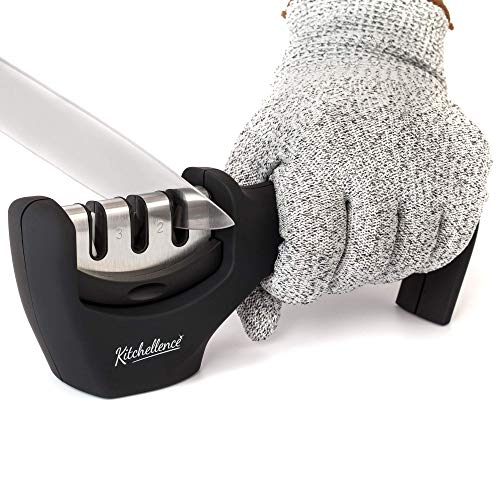
If you will never use a stone
Kitchellence 3-Stage Pull-Through Sharpener with Glove
A three-stage pull-through; the listing describes the stages as repair, restore and polish. It bundles a cut-resistant glove, which is worth wearing while you learn.
Good for: everyday stainless knives, cooks who want a quick edge without learning a stone
The drawback: Its angle is fixed, so it cannot follow a knife ground finer than that angle; keep thin Japanese knives on a stone or a ceramic rod. Keep serrated knives out of it; Zwilling says serrated blades need a professional.
See the Kitchellence on AmazonUsing a pull-through well: hold it flat on the counter, pull the knife through toward you with light pressure, and use the coarse slot only when the fine slot no longer brings the edge back. Wüsthof gives the same rule for its own two-slot sharpener: fine slot regularly, coarse slot once or twice a year.
How to Sharpen a Knife Without a Sharpener
If you have no stone and no rod, a few things will get a dull knife through dinner. None of them replaces a real sharpening.
- The bottom of a ceramic mug. Many mugs have an unglazed ring on the base. Turn the mug over and stroke the knife across that ring at your angle, alternating sides, as on a fine stone. Wipe off the gray streaks afterward.
- A ceramic plate or bowl, on the same unglazed ring.
- Leather or newspaper. A belt or folded newspaper will strop off a small burr and freshen an edge that is only slightly off. It will not fix a dull one.
Skip the back of another knife, a concrete step, a nail file and sandpaper on a soft surface. They either round the edge or chip it, and the next proper sharpening has to undo the damage.
Safety and Care: Keep the Edge Longer
- Stone on the counter, never in your hand. Use its base or a damp towel so it cannot slide.
- Fingers flat on the blade, behind the edge. Wear a cut-resistant glove for your first few sessions.
- Hand wash and dry at once. Dishwasher jostling nicks edges, and heat and detergent are hard on handles; Victorinox recommends washing all large knives by hand. More in our guide to what never goes in the dishwasher.
- Dry before storing. Rust starts on the edge, and carbon steel spots within hours if left wet.
- Cut on wood or soft plastic. Glass, stone and ceramic boards dull an edge fast. Our cutting board guide covers which boards are kind to knives.
- Store edges covered. A block, a magnetic strip or blade guards, never loose in a drawer.
One note for a non-toxic kitchen: a water stone needs nothing but water. If your stone is an oil stone, use food-grade mineral oil, not cooking oil, which turns sticky and rancid. We also leave out stropping pastes; plain leather does enough for a kitchen knife.
Questions People Ask
How often should you sharpen a kitchen knife?
Most home cooks need to sharpen about once or twice a year and hone every few uses. Victorinox suggests honing before or after each cooking session and sharpening once or twice a year; Shun says sharpening about once a year is often enough for many home cooks. Sharpen sooner if honing no longer brings the edge back.
Do you soak a whetstone?
Soaking stones, yes: Wüsthof says about ten minutes, Zwilling about five. Splash-and-go stones, no; they only need water on top. Follow the instructions that came with yours.
Can a honing rod sharpen a knife?
No. A steel rod realigns an edge that has bent over; it does not grind a new one. A ceramic or diamond rod removes a little metal, so it can freshen an edge that is slightly dull, but a worn or chipped knife still needs a stone or a sharpener.
What grit whetstone do I need?
A 1000 grit stone handles most kitchen sharpening. A two-sided 1000/6000 stone adds a polishing side. Add a coarse stone below 1000 only if you need to repair chips or reshape a very dull edge.
Are pull-through sharpeners bad for knives?
Not for everyday stainless knives, used gently. They work at a fixed angle and the coarse slot removes steel quickly, so use the fine slot most of the time. Keep thin Japanese knives, single-bevel knives and serrated knives out of them.
What angle should I sharpen my kitchen knife at?
Use your maker's number from the angle table above. If the maker gives none, 15 to 20 degrees per side suits most Western kitchen knives.
Is it better to sharpen knives yourself or pay a professional?
For straight-edged everyday knives, doing it yourself on a stone costs less over time and keeps the knife in your kitchen. Send chipped, single-bevel and serrated knives to a professional, or to the maker if it offers a service, as Shun does.
Sources (opened November 8, 2026; the Amazon listings were read the same day from the US store)
- WÜSTHOF: How to sharpen your WÜSTHOF knives
- WÜSTHOF: FAQ
- Victorinox: How to sharpen your kitchen knife
- Victorinox: Knife care tips
- ZWILLING: Knife sharpening
- Shun: Sharpening vs honing
- GLOBAL Cutlery USA: Knife care
Brand names belong to their owners. Product details and listings change; check the listing and your knife maker's care guide before you sharpen.


