

Titanium cookware sounds premium, safe, and almost too good to be true. But the label can mean very different things: pure titanium, titanium-coated cookware, titanium-reinforced nonstick, or titanium-strengthened stainless steel. This guide explains what each type means, how safe it is, when it is worth buying, and what claims to check before choosing a titanium pan or cookware set.
Quick Answer: Is Titanium Cookware Worth It?
Titanium cookware is worth buying when the construction matches your need: pure titanium is best for lightweight camping, titanium-strengthened stainless steel can suit premium home cooking, and titanium-reinforced nonstick may help with easy food release. Safety depends on the cooking surface, coating disclosure, heat limit, and how the pan is used.
Short verdict
Titanium cookware can be worth it, but only when the type of titanium construction matches your cooking need. Pure titanium is excellent for lightweight camping cookware, while titanium-strengthened stainless steel may suit premium home cooking. Titanium-reinforced nonstick can be convenient, but its safety and lifespan depend mostly on the coating system.
The biggest mistake is buying titanium cookware only because the word “titanium” sounds stronger, safer, or more nonstick.
Best use case
Choose titanium cookware when you need lightweight handling, corrosion resistance, clear material disclosure, or a specific premium construction. Be cautious when the product makes vague claims like “chemical-free,” “medical grade,” or “forever nonstick” without explaining the cooking surface.
What Does Titanium Cookware Really Mean?
The phrase titanium cookware is used for several different cookware types. This is the main reason shoppers get confused when comparing titanium pans, titanium cookware sets, titanium nonstick cookware, and pure titanium cookware.

| Product label | What it usually means | Best for | What to check before buying |
|---|---|---|---|
| Pure titanium cookware | Cookware made mostly from titanium metal. | Camping, backpacking, boiling water, simple meals, lightweight travel. | Thickness, heat distribution, handle design, and whether it is designed for home or outdoor use. |
| Titanium-coated cookware | A titanium-related surface layer applied over another base metal. | Depends on the coating and base material. | Coating type, heat limit, scratch guidance, warranty, and PFAS/PTFE disclosure. |
| Titanium-reinforced nonstick | A nonstick surface strengthened or marketed with titanium particles or technology. | Eggs, delicate foods, easy cleanup, low-to-medium heat cooking. | Whether it uses PTFE, PFAS, ceramic coating, or another nonstick system. |
| Titanium-strengthened stainless steel | Stainless steel cookware that includes titanium in the steel or bonded surface design. | Premium daily cooking, durability, induction compatibility if supported. | Ply construction, steel grade, induction compatibility, oven limit, and care rules. |
Titanium Cookware Claim Decoder
Cookware brands often use titanium-related terms in different ways. Use this quick decoder before trusting a product label.
| Marketing claim | What it may mean | What to verify |
|---|---|---|
| Titanium nonstick | Usually a nonstick pan with titanium-related reinforcement or surface technology. | Check PTFE, PFAS, ceramic coating, heat limit, and utensil guidance. |
| Titanium-infused | Titanium may be part of a coating, surface layer, or marketing description. | Check whether titanium is the food-contact surface or only part of the coating claim. |
| Pure titanium | The cookware is made mostly from titanium metal. | Check thickness, heat distribution, intended use, and whether it is designed for camping or home cooking. |
| Medical-grade titanium | A marketing phrase unless the exact grade and surface are disclosed. | Look for the actual material grade, food-contact surface, and manufacturer documentation. |
| PFOA-free | The product says it does not use PFOA, but that does not automatically mean PFAS-free or PTFE-free. | Check the full coating disclosure, not only one chemical claim. |
How To Read A Titanium Cookware Listing In 30 Seconds
Most titanium cookware confusion disappears once you stop reading the product name and start reading three specific fields that almost every listing contains. None of them require you to trust the marketing.
Signal 1: the material field, not the product name
Nearly every online listing has a specifications table with a Material row. That row is filled in separately from the product title, and it is often far more honest than the title above it.
Real examples, all taken from live product listings in August 2026:
| Product name says | Material field says | What that tells you |
|---|---|---|
| “Ultimate Hard Anodized Titanium Nonstick” (T-fal) | Aluminum | The pan is aluminium. Titanium is a reinforcement inside the nonstick coating, not the metal you cook on. |
| “Titanium Series 316Ti Skillet” (Heritage Steel) | Stainless Steel | Honest labelling. The titanium is an alloying element inside the steel, and the brand does not pretend otherwise. |
| “Valencia Pro Ceramic Nonstick” (GreenPan) | Coating Description: Ceramic | The coating type is stated outright, which is what you want to see. |
| “Titanium 750ml Pot” (TOAKS) | Material: Titanium, Finish Type: Uncoated | Genuinely a titanium pot. Note this is camping cookware, not a home skillet. |
If the product name contains the word titanium and the material field says aluminium, you now know more about that pan than the title ever told you.
Signal 2: the oven-safe temperature
This is the most useful number on any cookware listing, and almost nobody explains why. The maximum oven temperature tells you whether there is a coating on the pan and roughly what kind. Bare metal tolerates far more heat than any coating.
| Stated oven limit | What it usually indicates | Example |
|---|---|---|
| No limit stated, or very high | Uncoated metal, often camping cookware with no handle rating to worry about | TOAKS pure titanium pot: no oven limit stated |
| Around 800°F | Uncoated clad stainless steel. Nothing on the surface to degrade | Heritage Steel 316Ti: “oven safe to 800° F & broiler safe” |
| Around 600°F | Typically a ceramic sol-gel nonstick coating | GreenPan Valencia Pro: “oven and broiler safe up to 600°F” |
| Around 400°F | Typically a fluoropolymer (PTFE-family) nonstick coating | T-fal Ultimate: “oven temperatures up to 400°F (lids up to 350°F)” |
These are patterns rather than laws, and a manufacturer can always be the exception. But a pan marketed as “pure titanium” that is rated to only 400°F is telling you something the headline is not.
Signal 3: the induction claim
This one is covered in full in the next section, because it is the single most common inconsistency in titanium cookware listings.
We ran these three checks across four pans covering four different constructions — pure titanium, titanium inside the steel, titanium inside the coating, and ceramic as the alternative. Skip to the four pans and what is wrong with each →
Pure Titanium And Induction: The Claim Worth Checking
A large number of titanium frying pans sold online describe themselves as uncoated or pure titanium and, in the same list of bullet points, as induction compatible. This combination appears across many unrelated brands, so it is worth understanding rather than treating as one company’s wording.
Here is the physics, simply. A domestic induction hob works by generating a changing magnetic field that induces heating in the base of the pan. For that to work efficiently, the base needs to be ferromagnetic — the kind of metal a fridge magnet sticks to. Cast iron and magnetic stainless steel qualify. Titanium does not. A magnet will not stick to titanium.
So when a pan claims to be titanium throughout and induction ready, one of two things is true, and both are worth knowing:
There is a magnetic layer
The pan has a bonded magnetic stainless steel base or exterior. That is a perfectly good pan — but it is not titanium throughout, and “pure titanium construction” is then a loose description of a multi-layer product.
It will not work on induction
If the pan really is titanium all the way through, it will not heat on a domestic induction hob, whatever the listing says.
The useful thing is that the honest manufacturers make this easy to check, because they explain the layers:
| What the brand says | Why it holds together |
|---|---|
| Our Place Titanium Pro: “Fully-clad stainless steel exterior, aluminum core … and titanium interior” | Titanium is the cooking surface; the induction compatibility comes from the stainless exterior. The construction is stated, so the claim is coherent. |
| GreenPan Valencia Pro: “MAGNETO INDUCTION BASES” on hard-anodized aluminium bodies | An aluminium pan with a magnetic base added. Again, the mechanism is named. |
| Heritage Steel: 5-ply with a “ferritic exterior” | Ferritic stainless is magnetic. The layer doing the work is identified. |
| TOAKS pure titanium pot: makes no induction claim at all | A manufacturer selling genuinely pure titanium does not promise induction, because pure titanium cannot deliver it. |
| T-fal hard anodized: “suitable for all stove tops, excluding induction” | Aluminium is not magnetic, and the listing says so plainly. |
If you are comparing specific brands, we checked what Plateful, Taima, Smith Titanium, Okura, Siraat and Our Place each publish about what is inside the pan, and why a magnet sticks to the base: titanium pan brands, compared on what they actually disclose.
Is Titanium Cookware Safe?
Titanium cookware can be safe, but the answer depends on what the pan actually is. With many “titanium” pans, the coating and construction matter more than the word titanium.
A pure titanium camping pot has different safety considerations from a titanium nonstick frying pan. A titanium-strengthened stainless steel pan is also a different category from both.
| Type of titanium cookware | Main safety concern | Practical verdict |
|---|---|---|
| Pure titanium | Not naturally nonstick; thin cookware may heat unevenly and burn food if misused. | Generally stable as a metal surface, but not automatically the best everyday pan. |
| Titanium-reinforced nonstick | Coating quality, overheating, scratches, and unclear PFAS/PTFE claims. | Safety depends mostly on the nonstick coating and how the pan is used. |
| Titanium-coated cookware | Coating wear, unclear surface composition, and heat-limit claims. | Check the exact coating type, heat limit, and care instructions. |
| Titanium-strengthened stainless steel | Mostly similar to stainless steel concerns, including nickel sensitivity for some users. | Can be durable and premium if the construction is clearly disclosed. |
If you are comparing cookware safety more broadly, read our non-toxic cookware guide and our guide to stainless steel cookware safety.
Titanium Cookware Health Risks: What Actually Matters?
The main titanium cookware health risks are usually not about titanium metal alone. They are more often connected to coatings, overheating, scratches, unclear PFAS/PTFE claims, or vague product descriptions.
Because many cookware brands use the word “titanium” differently, this guide avoids treating titanium cookware as one single material. A pure titanium pot, a titanium-reinforced nonstick pan, and titanium-strengthened stainless steel cookware should be evaluated separately.
Coating damage
Many titanium nonstick pans are still coated pans. If the coating is scratched, peeling, flaking, or heavily worn, the pan should usually be replaced.
Overheating
High heat can shorten the life of nonstick surfaces. If the manufacturer recommends low or medium heat, do not use the pan for aggressive searing.
Unclear PFAS/PTFE claims
Do not assume a titanium pan is PFAS-free or PTFE-free unless the manufacturer clearly states the coating system and safety details.
Marketing confusion
Terms like “medical grade,” “chemical-free,” or “titanium technology” are not enough. The product should explain the actual cooking surface.
Titanium dioxide confusion
Some readers confuse titanium cookware with titanium dioxide, a white color additive used in some products. These are not the same topic. Titanium cookware refers to a metal or cooking surface, while titanium dioxide is a separate substance regulated differently in food and product contexts.
Is Titanium Cookware Really Nonstick?
Pure titanium cookware is not naturally nonstick like traditional nonstick cookware. Food can stick to pure titanium, especially if the pan is thin, overheated, under-oiled, or used for delicate foods such as eggs or fish.

When a product is sold as titanium nonstick cookware, it usually means one of these:
This is why the better question is not only “Is titanium nonstick?” The better question is: what type of nonstick system is being used?
Does Titanium Cookware Contain PTFE Or PFAS?
Some titanium nonstick cookware may use PTFE-based nonstick technology, while other products may use ceramic-style coatings, coating-free textured surfaces, or different proprietary systems. The word “titanium” alone does not prove that a pan is PFAS-free, PTFE-free, or coating-free.
If this matters to you, check the manufacturer’s exact coating disclosure instead of relying only on claims such as “titanium nonstick,” “PFOA-free,” or “non-toxic.” PFOA-free does not automatically mean the cookware is PFAS-free or PTFE-free.
The chemical disclosure section below shows what four major cookware brands publish about their own products, and how much the quality of those disclosures varies.
Pure Titanium vs Titanium-Coated vs Titanium-Reinforced Nonstick
Pure titanium cookware
Pure titanium cookware is valued because it is lightweight, strong for its weight, and corrosion-resistant. It is especially common in camping, backpacking, and travel cookware.
However, pure titanium is not always ideal for everyday home cooking. Thin titanium cookware may heat unevenly and may allow food to stick if you expect it to behave like a coated nonstick pan.
Titanium-coated cookware
Titanium-coated cookware usually has a titanium-related surface layer over another base material. The base may be aluminum, stainless steel, or another metal. The safety and performance depend on the coating, bonding method, base metal, and heat limit.
Titanium-reinforced nonstick cookware
Titanium-reinforced nonstick cookware is designed for easier food release and cleaning. Titanium may support coating durability, but the coating system still matters most.
If the pan is coated, treat it like coated cookware: avoid overheating, avoid abrasive scrubbers, use suitable utensils, and replace the pan if the surface is badly damaged.
Titanium-strengthened stainless steel
Some premium cookware uses titanium-strengthened stainless steel or titanium-bonded surfaces. This is usually closer to a premium stainless steel category than to pure titanium camping cookware.
A concrete example: Heritage Steel’s Titanium Series uses a 316Ti stainless steel cooking surface, which the manufacturer describes as an alloy “strengthened with molybdenum and titanium to better protect against salt pitting and metal leaching.” The titanium is inside the steel, not a separate layer you cook on. That is a legitimate use of the word titanium, and it is also a very different product from a titanium camping pot.
For more background, see our stainless steel grades cookware guide.
Pros of Titanium Cookware
Lightweight
Titanium is valued for strength relative to weight, which makes pure titanium cookware attractive for camping and travel.
Corrosion-resistant
Titanium has strong corrosion resistance, which is one reason it appears in outdoor gear and premium cookware claims.
Useful for outdoor cooking
Pure titanium pots and cups are practical for boiling water, simple meals, and lightweight packing.
Premium options exist
Some titanium-strengthened stainless steel or engineered titanium cookware is designed for durability and long-term use.
Cons of Titanium Cookware
Can be expensive
Titanium cookware often costs more than basic stainless steel, aluminum, or nonstick cookware.
May heat unevenly
Thin pure titanium cookware can develop hot spots and may not cook as evenly as thicker multi-ply pans.
Not always naturally nonstick
Pure titanium is not the same as coated nonstick cookware. Eggs and delicate foods may still stick.
Marketing can be unclear
Some products use titanium language even when the pan is mostly aluminum, stainless steel, or nonstick-coated cookware.
The trade-offs nobody puts in the product description
The four points above are the general case. These are the specific ones that come up once you own the pan.
| If you buy… | The advantage that is real | The drawback the seller rarely mentions |
|---|---|---|
| Pure titanium (camping style) | Extremely light, corrosion-resistant, no coating to wear out or replace. | Titanium conducts heat poorly and these pots have very thin walls, so they scorch anything thicker than water. Excellent for boiling, poor for simmering a sauce. Folding handles get hot. |
| Titanium-strengthened stainless (316Ti) | No coating to fail, very high oven tolerance, genuinely lasts decades. | It is stainless steel, so it is not nonstick and it is heavy — the opposite of titanium’s weight advantage. Austenitic stainless steels also contain nickel, which matters to people with a nickel sensitivity. |
| Titanium-reinforced nonstick | Genuinely easy food release, easy cleaning, low cost per pan. | It is a consumable, not a lifetime pan. The titanium in the name does not change that the coating will eventually wear, and the low oven limit rules out high-heat finishing. |
| Ceramic-coated as an alternative | Coating chemistry that is usually disclosed clearly, higher heat tolerance than fluoropolymer coatings. | Ceramic nonstick generally loses its release performance faster than fluoropolymer nonstick. “Metal utensil safe” claims tend to encourage exactly the habit that shortens its life. |
Titanium Cookware vs Stainless Steel, Ceramic, and Granite
Titanium cookware vs stainless steel
Stainless steel is more common, easier to compare, and often more practical for everyday cooking. Titanium can be lighter and corrosion-resistant, but it is usually more expensive and less standardized as a cookware label.
If you want a durable daily pan, high-quality stainless steel may be more practical. If you want lightweight camping cookware or a premium titanium-strengthened surface, titanium may make sense.
Titanium cookware vs ceramic cookware
Ceramic cookware usually means ceramic-coated nonstick cookware. Titanium nonstick cookware may also be coating-based. So the real comparison is often between two coating systems, not two solid materials.
For more detail, read our ceramic cookware pros and cons guide.
Titanium cookware vs granite cookware
Granite cookware is usually not made from solid granite. It is often a coating style with a speckled granite look. Titanium cookware may also be coating-based or reinforced, so both categories require careful material checking.
See our granite cookware guide and granite vs stainless steel cookware comparison for related material guidance.
| Comparison | Better choice if you want... | Watch out for... |
|---|---|---|
| Titanium vs stainless steel | Stainless steel for daily cooking; titanium for lightweight or specialty use. | Confusing titanium-strengthened stainless steel claims. |
| Titanium vs ceramic | Ceramic or titanium nonstick for easier food release, depending on coating quality. | Assuming either coating lasts forever. |
| Titanium vs granite | Whichever product clearly explains the real coating and base metal. | Marketing names that hide the actual food-contact surface. |
Titanium vs Ceramic Cookware: The Full Comparison
This is the comparison people ask about most, and it is usually framed wrongly. “Titanium” and “ceramic” are not two competing metals. In the great majority of cases you are comparing a coated pan to another coated pan, and the interesting question is which coating system, on which base metal, with which heat limit.
| Titanium-reinforced nonstick | Ceramic nonstick | Pure titanium | |
|---|---|---|---|
| What touches your food | A nonstick coating containing titanium particles | A ceramic sol-gel coating | Titanium metal |
| Usual base metal | Aluminium, often hard-anodized | Aluminium, often hard-anodized | Titanium |
| Typical oven limit | Around 400°F | Around 600°F | Usually not stated; bare metal |
| Food release when new | Excellent | Excellent | Poor — it is bare metal |
| How release ages | Declines gradually over years of correct use | Usually declines faster than fluoropolymer coatings | Does not decline, because there was never a coating |
| Coating chemistry | Often a fluoropolymer; frequently undisclosed at model level | Usually disclosed, and commonly stated as PFAS-free | None |
| Best for | Eggs, fish, low-fat cooking, easy cleanup | The same jobs, if you want a stated PFAS-free coating | Boiling and camping |
| Lifespan expectation | A consumable | A consumable, often shorter | Effectively permanent |
So which is better?
It depends on which failure mode you mind least.
Choose ceramic nonstick if
You want easy release and a coating whose chemistry is clearly stated. Ceramic brands tend to name what is and is not in the coating, and the higher oven tolerance gives you more room for finishing a dish under heat. Accept that you will replace it sooner.
Choose titanium-reinforced nonstick if
You want easy release that holds up for as long as possible, and you are comfortable with a fluoropolymer coating used within its stated heat limit. Check the brand’s own chemical disclosure rather than the pan’s marketing name.
Choose pure titanium if
Weight is the deciding factor and you are mostly boiling. It is the right answer for a backpack and the wrong answer for an omelette.
Choose neither if
You mainly sear, roast and deglaze. Uncoated clad stainless or cast iron will outlast both coatings and tolerate far more heat.
Titanium vs Stainless Steel Cookware: The Full Comparison
This comparison has a twist that catches people out: a lot of cookware sold as “titanium” is stainless steel. Titanium-stabilised grades such as 316Ti contain titanium as an alloying element within the steel, so the pan is legitimately described as titanium-strengthened while the surface you cook on is stainless.
| Pure titanium | Titanium-strengthened stainless (e.g. 316Ti) | Standard clad stainless | |
|---|---|---|---|
| Cooking surface | Titanium metal | Stainless steel containing titanium | Stainless steel |
| Weight | Very light | Heavy — multi-ply construction | Heavy |
| Heat distribution | Poor; thin walls create hot spots | Very good; aluminium core spreads heat | Very good with a bonded core |
| Induction | No, unless a magnetic base is added | Yes, via the ferritic exterior layer | Yes, if the exterior is magnetic |
| Oven tolerance | High (bare metal) | High — around 800°F is common | High |
| Nonstick | No | No | No |
| Nickel content | None | Yes — austenitic stainless contains nickel | Yes, in 18/8 and 18/10 grades |
| Best for | Backpacking, boiling | Searing, roasting, sauces, everyday cooking | The same, usually for less money |
The practical answer for most kitchens: if you want one pan that will still be usable in twenty years and you are willing to learn to preheat properly, clad stainless steel wins, and the titanium-strengthened versions are a genuine upgrade to it rather than a different material. If you want light weight above all else, pure titanium wins and nothing else comes close. Very few people need both.
What The Brands Actually Disclose About Chemicals
Since 2023, California’s AB 1200 has required cookware manufacturers selling into that state to publish, on their own websites, a list of intentionally added chemicals present in their cookware from a designated list. This is the single most useful tool a cookware shopper has, and almost nobody uses it.
The rule is easy to apply: search the brand name plus “AB 1200” and read what the company says about its own products. What you find varies enormously in usefulness, which is itself informative.
| Brand | How the disclosure is organised | What it says |
|---|---|---|
| Heritage Steel | Direct statement on the product listing | States the cookware is “made without any type of PFAS (PFOA, PTFE aka Teflon, PFOS, or other), ceramic sol-gel, nanoparticles, lead, cadmium, or any other chemically applied coating.” An explicit negative claim, naming the chemicals. |
| Hestan | Split by product line — the most useful format | Its TITUM nonstick line is listed as containing “Polytetrafluoroethylene, fluorinated ethylene and propylene, and perfluoroalkoxy alkane polymer.” Its NanoBond stainless line appears in a separate table without those entries. The same brand, two very different answers. |
| Our Place | Organised by product category | Lists “Titanium Pro Cookware — all variants, shapes, sizes and colors” as containing aluminium and chromium, with no PFAS entries. |
| T-fal | One blanket statement for a whole category | States that “PTFE coated products contain PFAS chemicals (polytetrafluoroethylene (PTFE), perfluoroalkoxy alkane (PFA), fluorinated ethylene propylene (FEP)).” Compliant and honest, but it does not tell you which individual models are PTFE-coated. |
All four are lawful disclosures. The difference is how much they tell an individual shopper about the individual pan in front of them. A disclosure broken down by product line answers your question. A blanket statement tells you the brand uses fluoropolymers somewhere in its range and leaves you to work out whether that includes your model.
Disclosures are updated by the manufacturers over time. The summaries above reflect what those pages said in August 2026; check the current version before making a decision.

How To Choose The Best Titanium Cookware
If you are searching for the best titanium cookware, avoid choosing only by brand name, color, or “titanium” wording. Use this checklist instead.
Best Titanium Cookware By Situation
The best titanium cookware depends on how you cook. Use this quick guide before choosing a pan, pot, or cookware set.
| Situation | Best direction | Why |
|---|---|---|
| Camping or backpacking | Pure titanium pot or cup | Lightweight, corrosion-resistant, and easy to carry. |
| Eggs and delicate foods | Titanium-reinforced nonstick | Better food release, but only if the coating disclosure is clear. |
| Daily home cooking | Stainless steel or titanium-strengthened stainless steel | More practical heat distribution and durability for everyday meals. |
| High-heat searing | Usually stainless steel, cast iron, or carbon steel | Thin pure titanium and coated pans are usually not the best choice for aggressive searing. |
| Induction cooking | Titanium cookware with a magnetic stainless base | Pure titanium alone may not work on induction unless the cookware has a compatible base. |
| Budget buying | Compare stainless steel or standard nonstick first | Titanium cookware can be expensive and is not always the best value. |
- Identify the exact type: pure titanium, coated, reinforced nonstick, or titanium-strengthened stainless steel.
- Check the base metal: aluminum, stainless steel, titanium, or multi-ply construction.
- Read the coating disclosure: look for clear PFAS, PTFE, PFOA, ceramic, or coating-free details.
- Match the cookware to the use: camping, eggs, daily cooking, searing, boiling, or lightweight travel.
- Check induction compatibility: not every titanium pan works on induction.
- Check oven-safe temperature: handles and lids may have different limits.
- Review care instructions: some pans require low heat, hand washing, or non-metal utensils.
- Read the material field, not the product name: the specifications table is often more accurate than the title.
- Search the brand name plus “AB 1200”: the manufacturer’s own chemical disclosure beats any marketing claim.
For a broader cookware material comparison, see our best frying pan material guide and cooking pans materials guide.
Who Should Buy Titanium Cookware?
- you want lightweight cookware for camping or travel;
- you are comparing premium cookware materials;
- you want corrosion-resistant cookware;
- you understand the difference between pure titanium and titanium nonstick;
- you are willing to check coating and care details before buying.
Who Should Avoid Titanium Cookware?
- you want the lowest-cost cookware option;
- you expect pure titanium to behave like a nonstick pan;
- you cook mostly high-heat seared foods;
- you do not want to research coating claims;
- you already own good stainless steel, cast iron, or ceramic cookware that fits your needs.
If you are deciding between long-lasting cookware types, you may also find our carbon steel vs cast iron guide and enameled cast iron cookware guide useful.
How Long Does Titanium Cookware Last?
The lifespan of titanium cookware depends on the type of construction. Pure titanium cookware can last for many years if it is not warped, dented, or abused, but it may still develop discoloration or hot spots with heavy use. Titanium-strengthened stainless steel can also last a long time when the pan is well built and cared for properly.
Titanium-reinforced nonstick cookware is different. Its useful life depends mostly on the nonstick coating, not only on the titanium claim. If the surface starts peeling, flaking, losing food release, or showing deep scratches, it is usually time to replace the pan.
| Cookware type | Expected lifespan factor | Replace when... |
|---|---|---|
| Pure titanium cookware | Metal thickness, heat use, dents, warping, and cleaning habits. | It becomes badly warped, damaged, or unsafe to use on the stove. |
| Titanium-reinforced nonstick | Coating quality, heat exposure, utensils, and cleaning method. | The coating is peeling, flaking, deeply scratched, or no longer releases food well. |
| Titanium-strengthened stainless steel | Ply construction, base quality, handle/rivet durability, and maintenance. | The pan is warped, the handle is loose, or the cooking surface is severely damaged. |
Care And Cleaning Tips For Titanium Cookware
Care depends on the type of titanium cookware you own. Always follow the manufacturer’s instructions first.
| Care rule | Why it matters |
|---|---|
| Use moderate heat unless instructed otherwise. | Helps protect coated surfaces and reduces sticking or hot spots. |
| Use oil when needed. | Pure titanium and textured surfaces may not release food like coated nonstick. |
| Avoid abrasive scrubbers on coated pans. | Scratches can shorten coating life and reduce food release. |
| Stop using badly damaged coated cookware. | Peeling, flaking, or deeply scratched surfaces are signs the pan should be replaced. |
| Dry cookware before storage. | Helps protect rivets, handles, and any stainless steel parts. |
Practical Questions About Using Titanium Pans
Why does food stick to my titanium pan?
Usually one of four reasons, in this order of likelihood. The pan is bare titanium and was never nonstick to begin with. The pan was not preheated properly, so the food bonded to a cold surface before the metal came up to temperature. There was not enough fat. Or a coated pan has reached the end of its coating life. On bare titanium, preheat gently, add oil once the pan is warm, and let protein release on its own rather than forcing it.
Can titanium pans go in the oven?
It depends entirely on the whole pan, not the metal. Bare titanium tolerates high temperatures easily, but the handle, any silicone or plastic parts, the rivets and the lid all have their own limits — and lids are frequently rated lower than the pan. Look for the manufacturer’s stated figure and treat the lowest number in the listing as the real limit.
Can I use metal utensils?
On bare titanium and uncoated stainless, yes. On any coated pan, the safe answer is no, regardless of what the marketing says. Several coated pans are advertised as metal-utensil safe; this is usually accurate in the sense that a metal spoon will not instantly destroy the coating, but abrasion is cumulative and it is the fastest way to shorten a coating’s life. Wood, silicone and nylon cost very little.
How do I clean a titanium pan?
Bare titanium tolerates thorough scrubbing, and discoloration or a bronze tint from heat is cosmetic rather than damage. Coated pans should be washed gently with a soft sponge; abrasive pads and harsh scouring are what turn a three-year pan into a one-year pan. Let any pan cool before washing — running cold water into a hot pan is a common cause of warping in thin metal.
Are titanium pans magnetic?
No. Titanium is not ferromagnetic, so a magnet will not stick to it. This is exactly why the induction question in the section above is worth checking on any pan that claims both pure titanium construction and induction compatibility.
How long should a titanium nonstick pan last?
Treat any coated pan as a consumable. With moderate heat, no metal utensils and hand washing, a well-made coated pan can serve for several years; used at high heat with metal tools and a dishwasher, the same pan may be finished within a year. The word titanium in the name does not change this arithmetic — the coating is what wears, and the coating is what determines the lifespan.
Four Pans Worth Considering, And What Is Wrong With Each
These four are not “the best titanium cookware.” They are four different constructions, chosen because each one’s material claims can be checked against something the manufacturer publishes, and each is included with the drawback its own marketing leaves out.
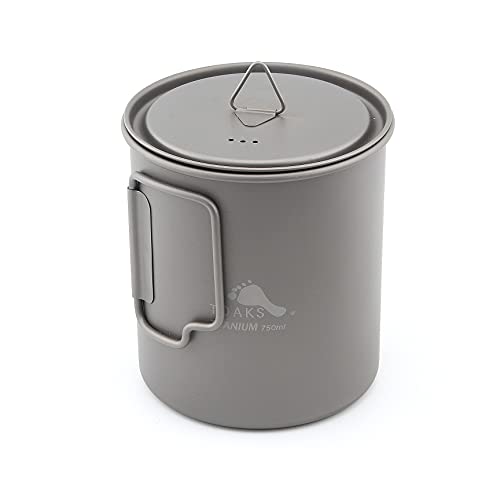
TOAKS Titanium 750ml Pot
Price: $26.00
What it is: a genuine pure titanium camping pot. The listing states “pure, uncoated titanium,” the material field says Titanium and the finish field says Uncoated. Around 86 g for the pot, 103 g with the lid, with internal volume markings in ml and oz. The brand discloses that it is designed in the USA and manufactured in China, which most brands do not volunteer.
Why it is here: it is the reference point for what pure titanium actually is — and note that it makes no induction claim, because pure titanium cannot deliver one.
The drawback: it is not a frying pan and it is not nonstick. Titanium conducts heat poorly and the walls are thin, so it scorches anything thicker than water. Excellent for boiling and reheating, poor for a sauce, and the folding handles get hot. One curiosity worth noting: the same specification table lists “Finish Type: Uncoated” and, three rows later, “Coating Description: Titanium” — a good reminder that spec fields are entered by sellers and are not proof on their own.
Heritage Steel Titanium Series 12" Fry Pan

Price: $159.95
What it is: 5-ply fully clad cookware with a 316Ti stainless steel cooking surface, three aluminium layers and a ferritic exterior. The manufacturer describes the alloy as “strengthened with molybdenum and titanium to better protect against salt pitting and metal leaching,” states it is oven safe to 800°F and broiler safe, made in Clarksville, Tennessee, and covered by a lifetime warranty.
Why it is here: its own specification field says Material: Stainless Steel. A brand selling a “Titanium Series” that does not claim the pan is made of titanium is telling you something about how it writes the rest of its copy. It also publishes an explicit statement that the cookware is made without PFAS, ceramic sol-gel, nanoparticles, lead or cadmium.
The drawback: the titanium is inside the steel, not under your food. Anyone searching for a titanium pan and landing here is buying stainless steel — which means it is not nonstick, it is heavy, and like all austenitic stainless it contains nickel, relevant if you have a nickel sensitivity. It is also the most expensive way to buy into the word “titanium” on this list.
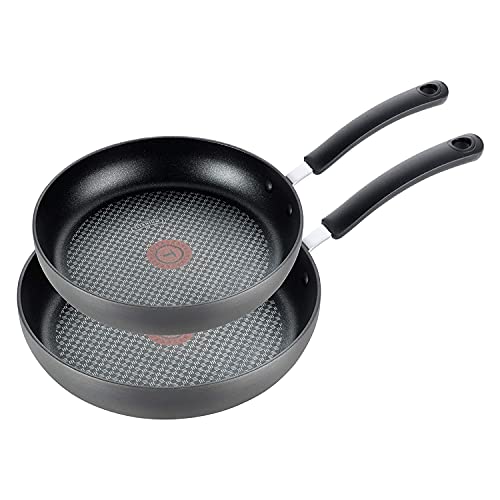
T-fal Ultimate Hard Anodized Titanium Nonstick, 8" and 10"
Price: $62.99
What it is: a hard-anodized aluminium pan with what the brand calls a titanium nonstick coating, a Thermo-Spot preheat indicator, riveted handles, oven safe to 400°F with lids to 350°F, and explicitly not induction compatible.
Why it is here: because it is the clearest example of the naming problem in the whole category. The model name is “Ultimate Hard Anodized Titanium Nonstick.” The material field says Aluminum. Both are true: the titanium is a reinforcement in the coating, not the pan.
The drawback: the listing does not disclose the coating chemistry, and T-fal’s published chemical disclosure answers only at category level, stating that its PTFE-coated products contain PFAS chemicals (PTFE, PFA and FEP) without identifying which models those are. If a stated PFAS-free coating matters to you, this is not the pan that gives you that certainty. The 400°F ceiling also rules out oven finishing and hard searing, and like every coated pan it is a consumable.
GreenPan Valencia Pro 12" Ceramic Nonstick

Price: $99.99
What it is: a hard-anodized aluminium pan with a ceramic nonstick coating and an added magnetic induction base, oven and broiler safe to 600°F with lids to 425°F. The brand states that its ceramic nonstick coating is free of PFAS, PFOA, lead and cadmium, and cites recognition from America’s Test Kitchen and a 2023 Good Housekeeping Sustainable Innovation Award.
Why it is here: it answers the titanium-versus-ceramic question with an actual product, and its claims are worded the right way — scoped to the coating, naming specific chemicals, and explaining that the induction compatibility comes from a magnetic base rather than from the aluminium body.
The drawback: ceramic nonstick generally loses its release performance faster than fluoropolymer coatings, and no ceramic pan is exempt from that. The “metal utensil safe” claim invites the exact habit that shortens ceramic life fastest. Note also that its specification field reads Material: Stainless Steel, which describes the handle — the body is hard-anodized aluminium, as the bullet points state. Read the bullets, not the field.
Final Verdict: Is Titanium Cookware A Good Choice?
Titanium cookware can be a good choice, but it is not a magic upgrade for every kitchen. Pure titanium is useful when weight matters, especially for outdoor cooking. Titanium-strengthened stainless steel can be a premium daily option if the construction is strong. Titanium-reinforced nonstick can be convenient, but the coating details matter more than the titanium label.
For safety-focused buyers, the most trustworthy product is not the one with the strongest marketing claim; it is the one that clearly discloses the cooking surface, coating system, heat limit, and care rules.
FAQ About Titanium Cookware
Is titanium cookware safe?
Titanium cookware can be safe, but it depends on the cookware type. Pure titanium is different from titanium-coated or titanium-reinforced nonstick cookware. With coated pans, coating quality, heat limits, and scratch resistance matter most.
What are the health risks of titanium cookware?
The main concerns are usually coating damage, overheating, scratches, unclear PFAS/PTFE claims, and confusing marketing. The risk is not usually the word titanium itself, but the full construction of the pan.
Is titanium cookware non-toxic?
It depends on what the cookware is made from. Pure titanium, titanium-strengthened stainless steel, and titanium nonstick pans are different categories. A non-toxic claim should be supported by clear material and coating information.
Does titanium cookware have Teflon?
Some titanium nonstick cookware may use PTFE-style nonstick technology, while other products may claim ceramic, PFAS-free, or coating-free surfaces. Always check the product’s material disclosure instead of assuming.
Is titanium cookware really nonstick?
Pure titanium is not naturally nonstick like traditional nonstick cookware. Titanium-reinforced nonstick pans may release food more easily, but that usually depends on the coating system.
Is pure titanium cookware better?
Pure titanium is better for lightweight cooking, camping, and boiling water. It is not always better for everyday home cooking because it can heat unevenly and may allow food to stick.
Is titanium cookware better than stainless steel?
Not always. Stainless steel is often more practical for everyday home cooking, while titanium can be better for lightweight or specialty uses. Titanium-strengthened stainless steel is a hybrid premium category.
Is titanium cookware better than ceramic?
It depends on the surface. Ceramic cookware usually means ceramic-coated nonstick. Titanium nonstick may also be coating-based, so compare coating type, heat limit, durability, and safety disclosure before choosing.
Why does food stick to titanium pans?
Food can stick to titanium pans if the cookware is pure titanium, too thin, overheated, under-oiled, or used like traditional nonstick cookware. Proper heat control and oil often help.
Is titanium cookware worth buying?
Titanium cookware is worth buying if you need lightweight cookware, premium construction, or a clearly explained titanium surface. It may not be worth it if the product is expensive but does not clearly explain its material and coating.
Can titanium cookware go in the oven?
Some titanium cookware can go in the oven, but it depends on the full construction, handle material, lid material, and manufacturer heat limit. Do not assume a titanium pan is oven-safe just because it contains titanium.
Is titanium cookware induction compatible?
Pure titanium cookware is not always induction compatible by itself. For induction cooking, the pan usually needs a magnetic stainless steel base or another induction-ready layer. Always check the product specifications before buying.
How long does titanium nonstick coating last?
Titanium nonstick coating life depends on coating quality, heat use, utensils, cleaning method, and how often the pan is used. If the surface starts peeling, flaking, deeply scratching, or losing food release, it is usually time to replace the pan.
What is the difference between titanium cookware and Teflon?
Titanium is a metal or surface-related cookware claim, while Teflon usually refers to PTFE-based nonstick technology. Some titanium nonstick cookware may still use PTFE-style coatings, so the product label should be checked carefully.
Are titanium pans magnetic?
No. Titanium is not ferromagnetic, so a magnet will not stick to it. This matters because domestic induction hobs need a ferromagnetic base to work. If a pan is described as pure titanium and also as induction compatible, it will normally have a bonded magnetic layer such as a stainless steel base or exterior.
What does “titanium” mean on a nonstick pan?
On most nonstick pans it means titanium particles have been added to the nonstick coating for durability. The pan body is usually aluminium. Checking the material field in the specifications table, rather than the product name, is the quickest way to see this.
How can I tell if a pan is coated without asking the seller?
The stated oven-safe temperature is a strong clue. Uncoated clad metal is commonly rated to around 800°F, ceramic nonstick to around 600°F, and fluoropolymer nonstick to around 400°F. A low oven limit on a pan described as bare metal is worth questioning.
What is California AB 1200 and how do I use it?
AB 1200 is a California law requiring cookware manufacturers to publish, on their own websites, a list of intentionally added chemicals from a designated list that are present in their cookware. Searching the brand name plus “AB 1200” will usually find the page. Disclosures broken down by product line are far more useful than a single blanket statement covering an entire catalogue.
This guide was prepared as a consumer cookware material guide, not medical advice. Cupindy reviewed public safety and standards information from the U.S. FDA, EPA, and NSF food-equipment material standards for context on food-contact materials, PFAS-related wording, and cookware safety claims. We also reviewed common titanium cookware product descriptions to separate pure titanium, coated titanium, reinforced nonstick, and titanium-strengthened stainless steel claims. Product specifications, coating claims and chemical disclosures quoted in this guide were read from the manufacturers’ own listings and disclosure pages in August 2026 and may be updated by those companies at any time. We have not laboratory-tested any cookware. Always follow the cookware manufacturer’s instructions for heat limits, utensils, cleaning, and replacement.
- FDA: Titanium Dioxide as a Color Additive in Foods
- FDA: Questions and Answers on PFAS in Food
- EPA: PFAS Explained
- NSF: Food Equipment Standards
- T-fal: California AB 1200 and Other Chemical Disclosures
- Hestan Culinary: Product Disclosures
- Our Place: California AB 1200 Cookware Disclosure
- Heritage Steel: product and material information


