

Cupindy is reader-supported. Some links on this page are affiliate links, which means we may earn a small commission if you buy through them, at no extra cost to you. As an Amazon Associate we earn from qualifying purchases. We recommend cookware on what the food-contact surface is actually made of and how it performs, and we name the trade-off on every product. See our Affiliate Disclosure.
Choosing the best stainless steel cookware is not only about brand, price, or how shiny the pan looks. The stainless steel grade matters too. Some grades are better for everyday cooking, some resist corrosion more strongly, and others are better used in budget cookware or induction base layers rather than as the main cooking surface.
For most home cooks, the safest and most practical choice is usually 304 stainless steel, often labeled as 18/8 or 18/10 stainless steel. For premium cookware or frequent cooking with salty or acidic ingredients, 316 stainless steel can offer extra corrosion resistance. This guide explains what those grades mean, which ones are best for cookware, and what to check before buying stainless steel pots and pans.
Before choosing a stainless steel grade, first decide the cookware shape you need. This pan and pot types guide explains what each piece is used for.
Quick Answer: What Is the Best Stainless Steel Cookware Grade?
18/10 and 18/8 are not different grades from 304 — they are 304. The numbers describe the chromium and nickel content of the same alloy family, so a pan labeled 18/10 is a 304 pan whose nickel sits at the top of the 304 range. There is no separate 18/10 grade to shop for.
304 stainless steel, commonly labeled 18/8 or 18/10, is the best all-around stainless steel grade for most cookware. It offers a strong balance of corrosion resistance, durability, and everyday cooking safety. 316 stainless steel is a premium upgrade with added molybdenum, making it more resistant to corrosion from salty or acidic foods.
If you want a simple buying rule: choose cookware with a 304 or 316 stainless steel cooking surface, avoid very thin unknown-grade cookware, and look for fully clad construction when possible. In practice that means 304, because verified 316 cookware is close to impossible to buy — here is why.
In a hurry? The pan we would buy is the Tramontina Signature Tri-Ply 3-Quart Sauce Pan — tri-ply clad, uncoated, NSF-certified. Its catch, and two other pans including the one everything else is compared with, are in what we would buy.
Table of Contents
Use this guide to quickly compare stainless steel cookware grades and jump to the section you need.
- Stainless Steel Cookware Grades at a Glance
- 304 Stainless Steel Cookware
- 316 Stainless Steel Cookware
- 18/8 Stainless Steel
- 18/10 vs 304: Are They the Same?
- 430 Stainless Steel
- 201 Stainless Steel
- Construction Quality vs Grade
- Which Grades Are Safest for Cooking?
- 304 vs 316 Stainless Steel Cookware
- FAQ
Stainless Steel Cookware Grades at a Glance
The table below gives you a simple overview before we go deeper into each grade.

| Grade | Common Label | Best For | Buyer Note |
|---|---|---|---|
| 304 | 18/8 or 18/10 | Everyday stainless steel cookware | Best all-around choice for most home kitchens. |
| 316 | Marine grade stainless steel | Premium cookware and acidic or salty cooking | Offers stronger corrosion resistance, usually at a higher price. |
| 430 | 18/0 stainless steel | Induction base layers, appliances, budget items | Magnetic and affordable, but less corrosion-resistant than 304 or 316. |
| 201 | Lower-nickel stainless steel | Budget cookware and low-cost kitchenware | Can be less durable and less corrosion-resistant for long-term cookware use. |
So what do 304, 316, 18/8 and 18/10 stainless steel actually mean? Stainless steel is an iron-based alloy that contains chromium. Chromium helps form a protective surface layer that improves resistance to rust and corrosion. According to the British Stainless Steel Association, stainless steels are corrosion-resistant steels with at least 10.5% chromium, and elements such as nickel and molybdenum can further affect corrosion resistance and performance.
For cookware buyers, the most important thing is not to memorize every industrial grade. Instead, focus on the grades most commonly used in food-contact cookware: 304, 316, 18/8, 18/10, 430, and 201.
304 Stainless Steel Cookware
304 stainless steel is the most common high-quality stainless steel used in cookware. It is part of the austenitic stainless steel family and is known for strong corrosion resistance, durability, and a clean cooking surface.
When cookware is labeled 18/8 or 18/10, that steel is 304. The two numbers are not a separate grade; they state the approximate chromium and nickel content of the same alloy — about 18% chromium with either about 8% or about 10% nickel. Both sit inside the 304 specification.
316 Stainless Steel Cookware
316 stainless steel is often called marine grade stainless steel because it offers stronger resistance to corrosion, especially in salty or harsh environments. The main difference is that 316 stainless steel contains molybdenum, which helps improve corrosion resistance.
For cookware, 316 stainless steel can be useful if you frequently cook acidic or salty foods, such as tomato-based sauces, vinegar-heavy dishes, citrus marinades, or salted water recipes. It is not always necessary for every kitchen, but it is a premium option.
We searched for it. What comes back is mostly 304 pans appearing in the results for a 316 query, plus drinkware — bottles, tumblers and food containers, where 316 genuinely is common. Actual 316 pots and pans from established manufacturers are close to absent.
The listings that do claim 316 tend to share a profile: an unfamiliar brand name, a few dozen reviews rather than a few thousand, the grade asserted in a marketing bullet and nowhere else, and no certification, mill documentation or NSF mark to support it. One we looked at spelled its own brand name two different ways on the same listing.
A grade claim you cannot verify is not a grade. This is the same problem as the unknown-grade cookware described further down this page, just with a more impressive number printed on it. If 316 mattered enough for home cooking to justify the price, the established manufacturers would sell it and certify it, the way they already do with NSF marks on their 304 lines.
What to do instead: buy 304 from a manufacturer that states the grade in writing, and manage salt and acid with technique rather than alloy. Add salt only after the water is hot and stir it in, do not leave acidic food standing in the pan, and wash it before storing. Those three habits close most of the real-world gap between 304 and 316.
If you do find a 316 pan you are seriously considering, ask for one thing before buying: where the grade is documented other than the product description. A certification, a specification sheet, or a manufacturer page. If the only place it appears is the sales copy, treat it as unverified.
18/8 Stainless Steel
18/8 stainless steel generally means the steel contains about 18% chromium and 8% nickel. It is widely used in cookware, utensils, food containers, and kitchen tools because it offers good corrosion resistance and durability.
If you are choosing forks, spoons, and tableware rather than pots and pans, see our guide to non-toxic flatware materials.
For most home cooks, 18/8 stainless steel is a reliable choice when the cookware is well-made and not too thin.
18/10 vs 304 Stainless Steel: Are They the Same Thing?
Yes. 18/10 is 304. It is not a higher grade, a different alloy family, or an upgrade over 304. 18/10 is a marketing label for stainless steel that sits at the nickel-rich end of the 304 specification — about 18% chromium and about 10% nickel. Every 18/10 pan on sale is a 304 pan. The same is true of 18/8, which is the same alloy nearer the bottom of the nickel range.
So the question is not which of the two to buy. It is what else the listing tells you, because the label on its own separates almost nothing.
| 18/10 | 304 | |
|---|---|---|
| Is it a formal grade? | No. A marketing label for chromium and nickel content. | Yes. An AISI grade with a defined composition range. |
| Chromium / nickel | About 18% / about 10%. | 18–20% / 8–10.5%. |
| Relationship | 18/10 sits inside the 304 specification. It is 304 steel, described a different way. | |
| Corrosion resistance | Equivalent in practice. Nothing you would notice at the stove. | |
| Finish and shine | Slightly brighter, from the higher nickel. | Depends on the polish, not the number. |
| What it tells a buyer | That the maker is willing to state a composition at all, which is worth something. | That the grade is named to a standard you can look up. |
| What matters more | Cladding, thickness and core, on both. A fully clad 18/8 pan beats a thin 18/10 pan every time. | |
Because the difference is small, do not judge cookware by the 18/10 label alone. A well-made 18/8 fully clad pan can perform better than a thin 18/10 disc-bottom pan if the 18/8 pan has better construction, thickness, and heat distribution.
430 Stainless Steel
430 stainless steel is part of the ferritic stainless steel family. It is usually magnetic and contains little or no nickel. This makes it useful in induction-compatible cookware bases and some budget kitchen products.
However, 430 stainless steel is generally less corrosion-resistant than 304 or 316. It can still be useful in cookware construction, especially as part of the base, but it is usually not the best choice for a premium cooking surface.
201 Stainless Steel
201 stainless steel is a lower-nickel stainless steel that uses more manganese. It is often less expensive than 304. While it may appear in budget cookware and kitchenware, it is usually less desirable for long-term cookware performance because it can be less corrosion-resistant than 304 or 316.
Construction Quality vs Grade: Why Build Matters Too

Stainless steel grade is important, but it does not tell the full story. A well-made 18/8 fully clad pan can perform better than a thin 18/10 disc-bottom pan because heat distribution depends heavily on construction, thickness, and the aluminum or copper core inside the cookware.
For everyday cooking, look at both the grade and the build. A quality 304 stainless steel pan with full cladding, a stable base, and solid handles is usually a better choice than a lightweight pan that only highlights “18/10” on the label but feels thin or heats unevenly.
| Factor | Why It Matters | What To Look For |
|---|---|---|
| Grade | Affects corrosion resistance and long-term durability. | 304, 316, 18/8, or 18/10 for the cooking surface. |
| Cladding | Improves heat distribution across the pan. | Fully clad construction when possible. |
| Thickness | Helps prevent warping and hot spots. | A pan that feels stable, not overly thin or flimsy. |
| Core Material | Stainless steel alone is not the best heat conductor. | Aluminum or copper core for better heating. |
Which Stainless Steel Grades Are Safest for Cooking?
For most home kitchens, the safest and most practical stainless steel cookware grades are usually 304 stainless steel and 316 stainless steel. These grades are commonly used for food-contact applications because they offer good corrosion resistance and durability.
The FDA Food Code emphasizes that food-contact equipment should use surfaces that are durable, smooth, corrosion-resistant, and cleanable. This is one reason stainless steel is widely used in food-service environments.
| Question | Best Answer | Why It Matters |
|---|---|---|
| Best everyday grade? | 304 stainless steel | Strong balance of safety, durability, and corrosion resistance. |
| Best premium grade? | 316 stainless steel | Better corrosion resistance, especially around salty or acidic foods. |
| Best common label? | 18/8 or 18/10 | Both are 304. The label tells you the maker is willing to state a composition, not that one steel beats the other. |
| Budget grade to review carefully? | 201 or 430 | May be less corrosion-resistant or less durable as a main cooking surface. |
Are Stainless Steel Pans Non-Toxic?
High-quality stainless steel pans are generally considered a safe, durable, non-coated cookware option for everyday cooking. Unlike traditional non-stick pans, stainless steel cookware does not rely on a PTFE-style coating to release food. That means there is no non-stick coating layer that can wear away in the same way.
However, it is better to avoid extreme claims like “100% non-toxic” or “chemical-free.” Stainless steel is an alloy, and small amounts of metals such as nickel or chromium can migrate under certain conditions, especially with acidic foods, long cooking times, or damaged cookware. For most people, normal use of quality stainless steel cookware is not a concern, but people with nickel sensitivity may want to be more careful.
Which Stainless Steel Grades Should You Avoid or Be Careful With?
You do not need to panic if you see 201 or 430 stainless steel in kitchen products. The real question is where and how the grade is used.
- 430 stainless steel can be useful for magnetic induction bases, but it is less corrosion-resistant than 304 or 316.
- 201 stainless steel is often cheaper but may not offer the same long-term corrosion resistance as 304.
- Unknown-grade stainless steel is the biggest concern because the buyer cannot easily judge quality, durability, or food-contact performance.
- Very thin stainless steel cookware may heat unevenly, discolor faster, and feel less stable on the stove.
For the main cooking surface, especially for pots and pans used often, 304 or 316 stainless steel is the safer buying direction.
How to Choose the Best Stainless Steel Cookware
Grade matters, but it is not the only factor. A good stainless steel pan also needs proper construction, stable weight, and a heat-conductive core.

Stainless Steel Cookware Buying Checklist
- Look for 18/8, 18/10 or 304 markings — they all mean the same steel, and a maker willing to state one at all is a good sign.
- Prefer 304 or 316 stainless steel for the main cooking surface.
- Choose fully clad cookware if you want better heat distribution.
- Check for an aluminum or copper core because stainless steel alone is not the best heat conductor.
- Confirm induction compatibility if you use an induction cooktop.
- Avoid very thin, lightweight cookware if you want durability and even heating.
- Check handle quality and lid fit before buying a full cookware set.
- Be cautious with unknown-grade budget cookware if safety and durability are your top priorities.
Where to Find Safe Stainless Steel Cookware
We do not sell cookware. Below are three pans that meet the checklist above, chosen for what the food-contact surface is actually made of rather than what the product name says. Every one has a drawback, and we have named it.
| Piece | Why It Qualifies | The Catch | Listing |
|---|---|---|---|
| Tramontina Signature Tri-Ply 3-Quart Sauce Pan | Tri-ply clad, aluminium core, uncoated surface stated on the listing, NSF-certified. | The listing does not state the grade in writing. | Check on Amazon |
| Tramontina Signature Tri-Ply 10-Inch Frying Pan | Listing states 18/10 with an aluminium core. Cheapest way into the range. | Sticking is the dominant complaint. A stainless frying pan needs technique. | Check on Amazon |
| All-Clad D3 3-Quart Sauce Pan | 18/10 bonded to the rim, made in the USA, by far the most reviewed pan in the category. | Several times the price for the same grade of steel. Hand wash only. | Check on Amazon |
1. Tramontina Signature Tri-Ply Clad 3-Quart Sauce Pan — the one we would buy

Check the 3-Quart Sauce Pan on Amazon
Tri-ply clad construction with an aluminium core, oven-safe to 500°F, induction compatible, NSF-certified, lifetime warranty. The specification sheet lists the coating as “No Non-Stick”, which is the claim this whole guide rests on, stated by the manufacturer rather than inferred from the photographs.
A saucepan is also the forgiving piece. Boiling, simmering and reducing are the tasks where an uncoated surface costs you nothing, which is why the same steel scores better here than it does in a frying pan.
The listing never states the grade. It says tri-ply clad with an aluminium core, and nothing more. The frying pan on the same line states 18/10 in writing. If the grade is your deciding factor, buy the piece whose listing commits to it.
Food sticks and it takes work to clean. That is the most repeated complaint, and it is not a defect — it is what an uncoated surface does. See how to keep stainless steel pans from sticking.
One reviewer reported pitting after cooking tomato sauce. Pitting on 304 comes from salt sitting undissolved or acid standing in the pan — exactly the case where 316 has the edge. Follow the salt rule in the care section below.
Two buyers received a used or lower-specification item, and only the 3-quart size is reliably in stock. Check what arrives against the specification.
2. Tramontina Signature Tri-Ply Clad 10-Inch Frying Pan — the cheapest way in

Check the 10-Inch Frying Pan on Amazon
The same construction, and this listing does state it: 18/10 stainless steel with an aluminium core, tri-ply, NSF-certified, oven-safe to 500°F. It is the least expensive piece in the range and the range is large — sauce pans, a Dutch oven, a stock pot, a wok, a sauté pan — so it is a low-risk way to find out whether you get on with uncoated stainless before committing to more.
The size dropdown includes a ceramic-coated variant. It sits in the same menu as the uncoated pans. It is not what this guide recommends — check which variant is selected before you order.
Check who is selling it. Reviewers report a third-party seller supplying a pan of different origin to the one advertised. Confirm the listing says shipped and sold by Amazon before ordering.
3. All-Clad D3 3-Quart Sauce Pan — the reference, and what is wrong with it

Check the All-Clad D3 on Amazon
This is the pan every other tri-ply pan is compared with: 18/10 stainless bonded all the way to the rim, made in the USA, and by a wide margin the most reviewed piece in the category. If you want to know what fully clad construction is supposed to feel like, this is the benchmark.
Several times the price of the Tramontina for the same grade of steel. You are paying for bonding quality and finish, not for a better alloy. Whether that is worth it is a judgement about how long you keep cookware.
Hand wash it. This is not cosmetic advice. Reviewers report the rim developing a sharp edge after dishwasher use, and two describe cutting themselves on it. The mechanism they describe is straightforward: the aluminium core is exposed at the rim, dishwasher detergent attacks aluminium, and as it erodes the two thin outer layers of steel are left standing proud. All-Clad recommends hand washing. Treat that as an instruction rather than a suggestion.
That failure is also the clearest illustration of the point in construction quality versus grade on this page. The steel is not the problem. The place where three layers meet the air is.
Check the size before you order. This listing is one page covering several capacities in a dropdown. The 3-quart is the size this guide is describing, so confirm 3 Quarts is the selected option before adding it to the basket — the heading on the page does not always match the size you have chosen.
Staining and warranty. Reviewers report discolouration from early use, and several describe difficulty getting warranty claims accepted on pans bought through Amazon. If the lifetime warranty is part of why you are buying it, check the manufacturer’s terms for your purchase channel first.
NOT A PRIME MEMBER?
One note on the price gap above. The All-Clad costs several times the Tramontina for the same grade of steel, and the point at which that gap narrows most is Amazon’s member-only deal events — cookware is always part of them, and the autumn one falls in October. Those deals are for Prime members, but free-trial members count, and you can cancel before the trial renews.
If you already have Prime, skip this — there is nothing here you are missing.
Start a free 30-day Prime trial
Affiliate link — we may earn a commission if you start a trial or paid membership, at no extra cost to you.
NSF/ANSI 51 and Food-Equipment Safety Markings
For commercial food equipment, buyers may also see references to NSF/ANSI 51, a standard covering materials and finishes used in commercial foodservice equipment. For home cookware, you may not always see this marking, and it is not a requirement for every home pan.
When buying commercial-grade kitchen equipment, check the product label, specification sheet, or manufacturer documentation for NSF certification details. For home cookware, the more practical checks are the stainless steel grade, construction quality, manufacturer details, care instructions, and whether the cookware is designed for food-contact use.
304 vs 316 Stainless Steel Cookware: Which Is Better?
For most people, 304 stainless steel is enough. It is durable, widely available, and usually more affordable than 316 stainless steel. It is the grade most buyers should look for when choosing everyday stainless steel pots and pans.
316 stainless steel is better if corrosion resistance is your top priority. It is especially useful for premium cookware, coastal environments, salty cooking, and acidic ingredients. The downside is that it usually costs more and is not always necessary for normal home cooking.
| Feature | 304 Stainless Steel | 316 Stainless Steel |
|---|---|---|
| Everyday cooking | Excellent | Excellent |
| Corrosion resistance | Very good | Stronger |
| Acidic or salty foods | Good for normal use | Better for frequent use |
| Price | Usually more affordable | Usually more expensive |
| Best choice for most homes? | Yes | Premium upgrade |
How to Care for Stainless Steel and Prevent Corrosion

Good stainless steel cookware can last for years, but poor care may still cause staining, pitting, or discoloration. To protect the surface, avoid leaving salty water sitting in the pan for long periods, especially before boiling. Add salt after the water is already hot, then stir to dissolve it.
- Wash cookware after use instead of leaving acidic or salty foods inside overnight.
- Use non-abrasive sponges or cleaners for everyday washing.
- Dry the cookware fully before storage to reduce water spots.
- Use stainless steel cleaner or a baking soda paste for stubborn discoloration.
- Avoid harsh steel wool on polished surfaces unless the manufacturer allows it.
- Follow the manufacturer’s care instructions, especially for polished or multi-layer cookware.
THE TWO CHEAP THINGS THAT DO TWO OF THE JOBS ABOVE
Nothing on this list needs a special product, but two items on it are the ones people ask about by name.
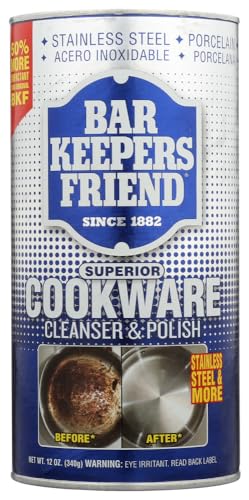
Bar Keepers Friend Cookware Cleanser and Polish Powder
For the line above about using a stainless steel cleaner on stubborn discolouration. This is the cookware formula rather than the general-purpose powder.

Scotch-Brite Zero Scratch Scrub Sponge, 6 pack
For the two lines above about non-abrasive sponges and keeping steel wool off a polished surface. Non-scratch is the whole point of this one.
Affiliate links — we may earn a commission if you buy through them, at no extra cost to you.
Stainless Steel vs Other Cookware Materials

Stainless steel is popular because it is durable, versatile, and suitable for many cooking methods. But it is not perfect for every task. Here is how it compares with other common cookware materials.
| Material | Best For | Main Advantage | Main Limitation |
|---|---|---|---|
| Stainless Steel | Searing, boiling, sautéing, sauces | Durable, non-coated, versatile | Food can stick without proper technique |
| Non-Stick | Eggs, pancakes, delicate foods | Easy food release | Coating can wear over time |
| Cast Iron | Searing, frying, baking | Excellent heat retention | Heavy and needs seasoning |
| Ceramic-Coated | Lower-stick everyday cooking | Smooth surface and easy cleaning | Coating durability varies |
| Granite-Coated | Easy-clean home cooking | Convenient non-stick style surface | Quality depends heavily on coating and brand |
Related Stainless Steel Guides
This guide explains stainless steel grades. For deeper help on safety, sticking, stock pots, and cookware comparisons, continue with these related Cupindy guides:
FAQ: Stainless Steel Cookware Grades
Is 18/10 stainless steel the same as 304?
Yes. 18/10 is 304 stainless steel. The numbers describe the alloy's approximate chromium and nickel content — about 18% chromium and about 10% nickel — which falls inside the 304 specification. 18/8 is the same alloy with nickel nearer the bottom of that range. None of the three is a separate grade, so compare cookware on construction, thickness and core material instead.
Is stainless steel cookware safe?
Yes, high-quality stainless steel cookware is generally considered safe for everyday cooking. For best results, choose cookware with a 304 or 316 stainless steel cooking surface and avoid damaged or unknown-grade cookware.
Is 18/8 stainless steel safe for cooking?
Yes, 18/8 stainless steel is commonly used in cookware, utensils, and food containers. It usually refers to stainless steel with about 18% chromium and 8% nickel, commonly associated with 304 stainless steel.
Is 18/10 stainless steel better than 18/8?
Not in any way you would notice at the stove. Both are 304 stainless steel. The extra nickel in 18/10 gives a slightly brighter finish, but corrosion resistance is equivalent in practice. Construction is what actually separates two stainless pans: a well-made 18/8 fully clad pan outperforms a thin 18/10 disc-bottom pan every time.
Is 304 or 316 stainless steel better for cookware?
304 stainless steel is the best choice for most home cooks because it is durable, corrosion-resistant, and widely available. 316 stainless steel offers stronger corrosion resistance and can be better for premium cookware or frequent salty and acidic cooking.
What is food grade stainless steel?
Food grade stainless steel usually refers to stainless steel that is suitable for food-contact use because it is durable, corrosion-resistant, smooth, and cleanable. Common examples include 304 and 316 stainless steel.
What stainless steel grade should I avoid for cookware?
Be careful with unknown-grade cookware, very thin cookware, and budget cookware made mainly from lower-corrosion-resistant grades such as 201 or 430. For long-term cooking performance, 304 or 316 is usually better.
Final Verdict: Which Stainless Steel Grade Is Best?
For most home cooks, the best stainless steel cookware grade is 304 stainless steel, especially when labeled as 18/8 or 18/10. It is durable, widely available, corrosion-resistant, and suitable for everyday cooking.
If you want a premium upgrade, 316 stainless steel offers stronger corrosion resistance and can be useful for frequent acidic or salty cooking. If you are buying budget cookware, check the grade carefully, avoid very thin construction, and be cautious with unknown-grade stainless steel.
Simple Buying Rule
Choose 304 or 316 stainless steel cookware with solid construction, a stable base, and a heat-conductive core. For most kitchens, that combination matters more than choosing the most expensive cookware set.
The three pans that meet it, with the drawback named on each, are in what we would buy.


