
About the writer: Lara researches cookware materials and food-contact safety for Cupindy, reading manufacturer filings rather than marketing pages.
Last reviewed: September 2026 — Reviewed for: coating chemistry, published laboratory data, manufacturer disclosures, and current availability.
Disclosure: Cupindy is a participant in the Amazon Services LLC Associates Program. We earn a commission on qualifying purchases made through links on this page, at no extra cost to you. No brand has paid for a placement here, and no manufacturer reviewed this article before publication. As an Amazon Associate we earn from qualifying purchases.
The four picks, at a glance
Housing, plates, coating: which one touches your food
Why "PFOA-free" stopped meaning anything
Check any brand yourself in 60 seconds
Is ceramic nonstick safe, and how long does it last?
Are ceramic waffle makers worth it?
Do waffle makers get hot enough to matter?
The cast iron rating gap nobody warns you about
The four picks in full
1. Presto FlipSide · 2. GreenPan Elite · 3. Lehman's cast iron · 4. Aurionix cast iron
Two that are not what they look like
Why waffles stick, and how to stop it
Questions people actually ask
There's a phrase on the back of a lot of waffle makers that stopped meaning anything in 2024. Most people shopping for a non-toxic waffle maker are still buying based on it.
This guide is about what actually touches your batter. Not the housing, not the badge on the box, not the material in the product title.
We read the manufacturers' own chemical filings, checked what each brand will and won't put in writing, and pulled the published laboratory data comparing ceramic coatings against PTFE. Two of the most widely recommended "non-toxic" waffle irons on the internet didn't survive that.
The four picks, at a glance
In a hurry? These are the four we'd buy, and the honest catch on each. The reasoning for all of them is further down.
And two to skip: anything sold as a "stainless steel waffle maker" before you've checked what the plates are, and anything whose only safety claim is "PFOA-free." Both are explained here.
Housing, plates, coating: only one of them touches your food
Three parts get confused constantly.
- The housing. The shell you touch. Usually stainless steel or plastic. Never touches food.
- The plates. The metal holding the grid. Almost always cast aluminium, occasionally cast iron.
- The coating. The thin layer baked onto the plates. This is the only part your batter meets.

Three parts, and only the thin top layer ever meets your batter.
Amazon's "Material" field usually describes the housing. That's how a waffle iron can be listed as "Material: Stainless Steel" and still have a nonstick coating on aluminium plates.
It isn't a lie. It's answering a different question than the one you're asking.
We've hit this before. Going through non-toxic slow cookers, a well-known "Stainless Steel Slow Cooker" turned out to have a nonstick insert, with the stainless on the outside. The same pattern is alive in waffle makers, and there's a current example further down.
The rule: ignore the product title and the Material field. Find the sentence describing the plates or the grid. If no such sentence exists anywhere on the listing, that absence is your answer.
Why "PFOA-free" stopped meaning anything
PFOA is one chemical. It belongs to a much larger family called PFAS. PTFE, which is what most people mean when they say Teflon, is in that same family.
The EPA ran a stewardship programme that phased PFOA out of American manufacturing years ago. So "PFOA-free" describes a modern pan roughly the way "lead-free" describes a modern petrol pump. Accurate, and telling you nothing about today.
California went further than most people realise. The Safer Food Packaging and Cookware Act, known as AB 1200, doesn't only require cookware makers to publish what they intentionally add. It bans a particular shape of claim. A manufacturer may not say cookware is:
"free of any specific chemical if the chemical belongs to a chemical group or class identified on the designated list, unless no individual chemical from that chemical group or class is intentionally added to the cookware."
Read that twice. Advertising a pan as "PFOA-free" while intentionally adding a different PFAS to it is the shape of claim that sentence describes. The website restriction took effect 1 January 2023, the packaging restriction on 1 January 2024.
Enforcement is California's business, not ours, and we're not accusing anyone of anything. The practical point is simpler.
"PFOA-free" is a claim state law treats as potentially misleading. It's not a claim worth paying extra for. "PFAS-free," "PTFE-free" and "Teflon-free" are the phrases that carry information, and even those need checking.
We wrote separately about what PFOA-free actually means if you want the longer history.
Check any brand yourself in about 60 seconds
AB 1200 handed shoppers something genuinely useful that almost nobody uses. Since January 2023, cookware makers selling into California have had to publish, on their own site, the designated-list chemicals they intentionally add.
So you can check the manufacturer instead of the marketing.
- Search the brand name plus AB 1200.
- Open the disclosure page. Read the appliances section, not the cookware section. They're usually separate, and the appliance lists run longer.
- Look for PTFE, PFA or FEP. Those are fluoropolymers. If they appear against the product line you're considering, that coating is a PFAS coating whatever the box says.
- If the brand has no AB 1200 page at all, that's information too.
We ran this on every brand in this guide.
| Brand | AB 1200 page found? | What it tells a waffle buyer |
|---|---|---|
| GreenPan and GreenLife | Yes, appliances listed separately | The most detailed disclosure of any brand here. See below. |
| Presto | Not found | No published statement to check the ceramic claim against |
| Nordic Ware | Not found | Its stovetop waffle iron is coated, and the coating is never named |
| Lehman's, Aurionix | Not applicable | Bare cast iron. Nothing coated, nothing to disclose. |
"Not found" means we searched in September 2026 and couldn't locate a published page. It doesn't prove a company has no filing. It does mean you can't check, which is the position you're actually in as a buyer.
The GreenPan detail worth understanding before it scares you
GreenPan's disclosure is unusually granular, and skimming it will alarm you for no reason.
Their cookware category lists the metals you'd expect: aluminium, chromium, nickel, iron, manganese. Their appliances category, which is where a waffle maker sits, runs longer and includes lead and cadmium.
Seeing "lead" on a page about a waffle iron is alarming until you read the qualifier GreenPan puts beside it: "The food contact surface of our Thermolon Ceramic Nonstick does not contain any of these chemicals."
An appliance is a machine. It has solder, wiring, plating and screws, and AB 1200 asks about the whole product rather than only the cooking surface. This is what a thorough disclosure looks like. Brands with shorter lists aren't necessarily cleaner, and some of them simply publish less.
That inverts the usual instinct. A longer chemical list from a manufacturer is often a sign of more disclosure, not more chemicals.

Search the brand name plus AB 1200, and read the appliances section rather than the cookware section.
Is ceramic nonstick safe, and how long does it actually last?
This is where almost every non-toxic waffle maker guide stops thinking, so it's worth doing properly.
Ceramic nonstick isn't ceramic in the dinner-plate sense. It's applied by a sol-gel process: a liquid solution is cured into a thin, glass-like film. PPG, one of the coating manufacturers, describes it as a chemical process turning a solution into a solid gel that's heat-cured into a ceramic-like film, formulated without PFAS.
So on chemistry, a genuine sol-gel ceramic coating isn't a fluoropolymer. That part of the marketing holds up.
The part nobody tells you is what it costs you in durability, and there's now published research on exactly that.
A 2025 study in Results in Engineering by Guerrero-Vacas, Carrillo-Estepa and Rodríguez-Alabanda tested five sol-gel ceramic coatings against PTFE. They measured peel force with a model food, water droplet sliding angle, surface roughness and wear resistance under projected abrasives, across 90 cooking cycles.
What they found:
- PTFE held low, consistent release across the full 90 cycles, averaging up to three times lower peel force than the best ceramic tested
- PTFE also resisted severe abrasive wear better than any ceramic
- Two ceramic formulations came close on balance, holding peel stress in the 4 to 6 kPa range at 30 cycles, rising to 12.7 to 14.7 kPa by 60
- Those two lasted nearly twice as many cycles as the other ceramics before losing release
The authors' conclusion is measured: PTFE remains the standard under extreme conditions, while the better ceramics are a credible eco-friendly alternative where shear wear dominates.
Why this matters more for a waffle iron than for a frying pan
Here's the detail that makes the research specific to this product, and we haven't seen it made anywhere else.
PPG notes that the two coating types fail in different ways. PTFE fails from abrasions and scratches. Sol-gel ceramic is damaged primarily by thermal stress and chemicals.
Now think about what a waffle maker does. It heats from cold to full temperature, holds, cools completely, and does it again next weekend. It's a thermal-cycling machine in a way a frying pan on a hob is not.
That's the failure mode ceramic is weakest against.
None of this makes ceramic a bad choice. It makes the trade explicit, and it's a trade every other guide presents as free.
The honest summary: ceramic buys you a coating that isn't a fluoropolymer, and costs you release performance and replacement cycles. If that trade doesn't appeal, the answer isn't a better coating. It's no coating.
Are ceramic waffle makers worth it?
For most people, yes, with one condition attached.
A ceramic waffle maker gives you a genuinely Teflon-free cooking surface at a price that isn't punishing, and it does it without asking you to learn anything. That's the whole appeal, and it's real.
The condition is that you treat it as a consumable rather than an heirloom. On the evidence above, a ceramic waffle maker is a machine you'll replace, and the replacement clock runs faster than it would on a PTFE model. Buying one with removable plates is the single best hedge, because replacing plates costs a fraction of replacing the appliance.
Where a ceramic waffle maker stops being worth it is when you're paying a premium purely for the word. If the maker won't name the coating, publish a filing, or sell you spare plates, you're paying for a description rather than a documented material.
And if you cook waffles most weekends for years rather than occasionally, run the arithmetic on replacements before you buy. Two or three ceramic machines over a decade costs more than one cast iron iron that never needs replacing at all.
Do waffle makers get hot enough to matter?
This is the fear underneath most of the searching, and the answer is more reassuring than the internet suggests.
PTFE coatings start breaking down above roughly 500°F. America's Poison Centers describes what follows in people as polymer fume fever: chills, fever, headache, body aches, sometimes chest tightness, usually appearing within a few hours and resolving in one to two days. People with asthma or other lung conditions face more risk.
For pet birds the picture is far worse. Birds are extremely sensitive to these fumes, and the first sign of exposure can be sudden death.
Those temperatures come from an empty pan left on a hot burner, not from a thermostat-controlled breakfast appliance cooking wet batter at a set browning level. A forgotten skillet is the realistic candidate. A waffle iron is not.
Which is why we think fumes are largely the wrong question here.
The realistic problem with a coated waffle maker isn't fumes. It's the coating wearing away into your food over a few years — accelerated, as the lab data above shows, by exactly the thermal cycling this appliance does.

The realistic failure is not fumes. It is a coating that gives up after a few years of heating and cooling.
Deep grids get attacked with forks and knives by people levering out a stuck waffle, and that mechanical damage finishes the job. It's also what people are actually worried about: questions about surfaces that flake come up far more often than questions about fumes.
If you keep pet birds, treat that as its own consideration and lean uncoated regardless of everything else here.
The cast iron rating gap nobody warns you about
We found this while checking availability, and it'll save you a disappointing Sunday morning.
We pulled customer ratings for every uncoated cast iron waffle iron currently sold on Amazon and set them beside the established coated models. The pattern isn't subtle.
| Uncoated cast iron | Rating | Coated (electric and stovetop) | Rating |
|---|---|---|---|
| Aurionix 5-in-1 | 3.4 (56) | Presto FlipSide, electric | 4.6 (25,083) |
| Professional 8-inch | 3.7 (99) | Chefman Rotating, electric | 4.4 (16,300) |
| Lehman's | 3.8 (538) | Nordic Ware, stovetop | 4.4 (1,481) |
| Sircles 4-square | 3.8 (41) | ||
| Rome #1028 | 4.1 (224) |
Ratings recorded September 2026 and will drift. Comparison limited to models with 40 or more ratings. The GreenPan Elite is excluded because at 85 ratings it's too new to compare fairly.
Every uncoated iron lands between 3.4 and 4.1. Every established coated model sits at 4.4 or above.
That gap isn't a manufacturing quality gap. It's the seasoning learning curve arriving as one-star reviews, written by people whose first three batches welded themselves to the iron.
Which reframes the whole decision. You're choosing between a machine that works perfectly on day one and slowly degrades, and a piece of iron that fails on day one and slowly improves. Both are legitimate. Only one is a good idea with hungry children waiting.
The four picks
1. Presto 03510 Ceramic FlipSide: the one people actually buy
Grid: ceramic nonstick. Housing: stainless steel. PFAS statement: none we could find.
Twenty-five thousand ratings at 4.6 stars is rare for a kitchen appliance, and this one earns it. The flip design spreads batter evenly, which is the biggest single difference between a restaurant waffle and a sad flat one. It locks upright for storage and costs about what a normal waffle maker costs.
Presto calls the grid ceramic nonstick, and sol-gel ceramic coatings are silica-based rather than fluoropolymer. As a ceramic waffle maker at a mainstream price, nothing else here comes close on either performance or track record.
The drawback every other guide leaves out. Presto doesn't say PFAS, PTFE or PFOA anywhere on this listing, and we couldn't find an AB 1200 page for the company. "Ceramic" here is a description of a coating type, not a documented chemistry.
It's very probably fine. It isn't verified, and we won't call it verified because the word ceramic appears in the title.
Buy this if you want the best waffle maker here and can live with a claim you can't audit. Buy the GreenPan if documentation was the whole point of your search.

Check the Presto FlipSide on Amazon
2. GreenPan Elite 4-Square: the one with the paperwork
Plates: cast aluminium. Coating: Thermolon Volt ceramic. Their claim, their words: "free of PFAS, PFOA, lead or cadmium."
This is the pick if you want a claim someone can be held to. GreenPan names the coating, publishes an AB 1200 disclosure that separates appliances from cookware, and puts the food-contact qualifier in writing. Among electric waffle makers that combination is close to unique.
It's a good machine too. Two sets of removable plates for classic American and thicker Belgian waffles, adjustable browning, and a design built to resist overflow. Removable plates matter more than they sound: they let you wash without scraping, which is the main thing that kills a coating.
The drawbacks, plainly. It costs roughly five times a mainstream waffle maker. And it carries only 85 ratings at 4.1 stars, a thin evidence base for a premium appliance. We'd rather tell you that than let you discover it.

Check the GreenPan Elite on Amazon
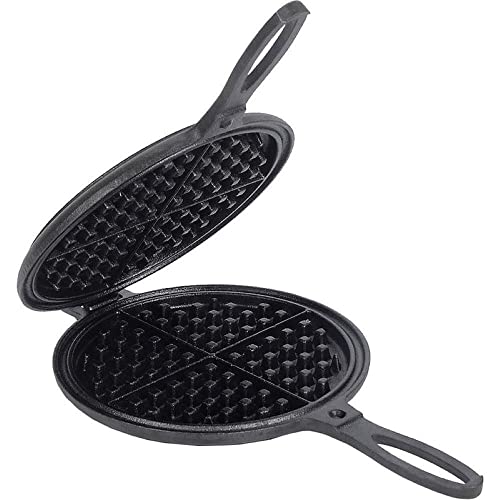
3. Lehman's Cast Iron Waffle Maker: nothing to wear off
Material: cast iron, both halves. Coating: none. Seasoning: pre-seasoned with soybean oil.
If your objection is to coatings as a category, this ends the argument. There's no layer to scratch, flake or replace. Season it properly and it outlives you.
Two-piece hinged design that separates for cleaning, 7-inch round waffle, and a double rim that stops batter dripping onto the burner. You'll appreciate that rim the first time you overfill it. Lehman's is a long-established Ohio company rather than an anonymous marketplace seller, and it ships and sells the product itself.
The drawbacks. Around 8 pounds, stovetop only, and it won't work on induction or smooth glass cooktops. Best over gas or open flame. No thermostat, so browning is a skill rather than a dial.
And Lehman's themselves recommend re-seasoning at home despite the factory seasoning, which tells you what that 3.8-star average is really made of.
Their own method: clean and dry, rub on oil, bake upside down at 400 to 500°F for an hour with a tray underneath, cool inside the oven, repeat. Do it twice before your first waffle and you'll skip the disappointment behind most of the negative reviews. Our guide to cleaning cast iron covers ongoing care.
Check the Lehman's iron on Amazon
4. Aurionix 5-in-1 Cast Iron: the cheapest way to go uncoated
Material: cast iron. Finish type, per the listing: non-coated. Shapes: five, including hearts and stars.
Same principle as the Lehman's for less money, more fun for children, and it works on induction as well as gas and electric, which the Lehman's doesn't. Pre-seasoned, and it handles a campfire.
The drawbacks, and they're real. It carries 3.4 stars from 56 ratings, the weakest showing of anything we're recommending. Aurionix isn't an established cookware brand with a history you can research.
The listing also makes a claim about the iron "supplementing iron minerals into your diet." We're not repeating that as fact. How much iron migrates from a seasoned surface into food varies enormously and isn't something a product listing can promise.
Buy it to try uncoated iron without committing much, or for the shapes. Buy the Lehman's if you want the one you keep.

Check the Aurionix iron on Amazon
Two categories we couldn't fill honestly
A non-toxic mini waffle maker. Demand for these has climbed sharply, and we looked. The popular minis are coated, and none of the makers publish a coating chemistry we could verify. If you want mini and uncoated, a small cast iron iron is currently the only honest answer.
An American-made premium cast iron iron. Appalachian Cast Iron makes one and people search for it by name, but it isn't sold on Amazon. Skeppshult makes a Swedish cast iron version. Both are worth knowing about if you're willing to buy direct.
Two that are not what they look like
The "stainless steel" waffle maker with a PTFE coating
All-Clad sells the Gourmet Stainless Steel Waffle Maker with Removable Plates. The stainless steel is the exterior. On All-Clad's own product page the coating is stated plainly: "The waffle maker has a PTFE nonstick coating to help ensure waffles slide right off."
To be fair to them, All-Clad isn't hiding it. They publish it, which is more than several brands manage.
The problem isn't the manufacturer. It's that a material appears in the product name, shoppers reasonably assume it's the cooking surface, and roundups repeat the name without opening the page.
If you're specifically avoiding fluoropolymers, this isn't your waffle maker, and no amount of stainless steel in the title changes it.
The stovetop iron with a coating nobody will name
The Nordic Ware 15040 stovetop Belgian waffle iron is a well-liked product with 1,481 ratings at 4.4 stars, and it appears constantly in both "non-toxic" and cast iron roundups. It belongs in neither.
Its own Amazon listing gives Material as Aluminum and Coating Description as Non-stick. The copy calls it a "premium non-stick coating" and stops. Not ceramic, not PTFE-free, no chemistry at all. We couldn't find an AB 1200 disclosure from Nordic Ware either.
There's no evidence of anything wrong with this product and plenty of people are happy with it. But it lands on cast iron lists because it's heavy and stovetop, then lands on non-toxic lists because it was on the cast iron lists. It's coated aluminium with an unnamed coating.
It also makes a broader point. Search "cast iron waffle iron" on Amazon and this is among the first results, marked as a top pick. The search box isn't doing your material check for you.
Why waffles stick, and how to stop it
Sticking is the most common complaint about waffle makers of every type, and the cause is different depending on what you own.

No coating means nothing to flake. It also means the first three sessions decide everything.
On a coated waffle maker, sticking usually means the coating has started to go. Once release fails it doesn't come back, and no amount of oil restores it permanently. Check whether your model takes replacement plates before you replace the whole machine.
On cast iron, sticking almost always means the seasoning is young or has been stripped. That's fixable, and the first three sessions decide whether you love the thing or shelve it.
- Re-season before first use, even if it arrived pre-seasoned. Thin coat of high-smoke-point oil on every surface, wipe back until it looks dry, then an hour upside down at 400 to 500°F with a tray underneath. Cool it in the oven. Do it twice.
- Preheat properly. Most sticking is impatience. A drop of water should dance across the surface, not sizzle in place.
- Oil the grid before every batch for the first several uses, and use a batter with real fat in it. Low-fat batter on young seasoning is the classic failure.
- Never lever a stuck waffle out with metal. You'll strip the seasoning you're building. Close the lid, give it another thirty seconds, and it usually releases on its own.
- Dry it fully and oil it lightly after washing. Black residue on the towel is seasoning, not dirt, and it belongs there.
Do that and the iron stops being difficult after about a month. That's the honest timeline, and it's why the ratings look the way they do.
Questions people actually ask
Is ceramic nonstick coating safe?
Sol-gel ceramic coatings are silica-based rather than fluoropolymer, so a genuine one isn't PFAS by composition. The trade is durability. Published testing found PTFE held release up to three times better across 90 cooking cycles than the best ceramic tested, and ceramic is damaged more by thermal stress than by scratching, which is what a waffle iron does to it. Safe by chemistry, shorter-lived in use.
Is a ceramic waffle maker better than a Teflon one?
Better on chemistry, worse on lifespan. If a Teflon-free surface is the goal, a ceramic waffle maker does that. If you want a surface that releases perfectly for a decade, PTFE still performs better and the research says so. There's no option that wins both, which is why uncoated cast iron exists.
What should I look for if I mainly want a surface that won't flake?
Removable plates, so you can wash without scraping and often replace them separately. Wider, shallower grids rather than narrow deep ones, because narrow grids are what make people reach for a knife. And realistically, uncoated cast iron, because a surface with no coating can't flake.
Which type is easiest to clean?
A flip-style electric with a ceramic grid, wiped while still warm, by a distance. Cast iron isn't hard but it is a routine: hot water, no soaking, dry immediately, thin coat of oil. If cleaning routines are the thing you resent, don't buy cast iron.
Do waffle makers get hot enough to release fumes?
PTFE begins breaking down above roughly 500°F, and that generally happens to empty pans on direct heat rather than thermostat-controlled appliances cooking wet batter. For most households the coating wearing away over years is the realistic concern. If you keep pet birds, treat it differently: birds are exceptionally sensitive to polymer fumes, and uncoated iron removes the question.
Belgian or classic thin waffle iron?
Belgian makes thicker waffles with deeper pockets and takes longer to cook through. Classic makes thinner, crisper waffles faster. It's a texture preference, not a quality difference. Deeper pockets are harder to clean, which loops back to the coating question.
How do I check a brand that isn't in this guide?
Search the brand name plus "AB 1200", open the disclosure, and read the appliances section rather than the cookware section. Look for PTFE, PFA or FEP. If there's no such page, you have no way to verify a coating claim and should price the product accordingly.
What we'd actually do
It comes down to one question: do you want a documented coating, or no coating?
Want the best breakfast machine at a sane price and can accept an unverified ceramic claim: Presto FlipSide. Want documentation and don't mind paying: GreenPan Elite. Want the coating question out of your kitchen permanently and you'll spend a month learning: Lehman's cast iron, or the Aurionix if you'd rather test the idea cheaply first.
What we wouldn't do is buy on the strength of "PFOA-free," a stainless steel product name, or a coating the manufacturer won't name.
Working through the rest of your kitchen on the same basis? Our guides to non-toxic cookware, non-toxic air fryers and silicone in cooking apply the same test. For features and everyday use rather than materials, see our waffle maker guide and best waffle maker for home use.
Sources reviewed
- California Assembly Bill 1200 (Safer Food Packaging and Cookware Act), statutory text, California Legislative Information. Website disclosure effective 1 January 2023; label requirement and the restriction on "free of" claims effective 1 January 2024.
- Guerrero-Vacas, G., Carrillo-Estepa, A., and Rodríguez-Alabanda, O., "Towards a greener kitchen: Can sol-gel ceramic non-stick coatings replace polytetrafluoroethylene?", Results in Engineering, June 2025. Peel force, sliding angle, roughness and abrasive wear across 90 cooking cycles.
- PPG Industrial Coatings, technical notes on sol-gel non-stick coatings: composition, cure process, and the distinction between abrasion failure in PTFE and thermal and chemical failure in sol-gel ceramic.
- GreenPan, California AB 1200 Disclosure, manufacturer's published filing. Cookware, bakeware and appliance categories, and the food-contact-surface qualifier.
- GreenPan Elite 4-Square Waffle Maker, manufacturer product listing. Thermolon Volt coating, cast plates, and the PFAS, PFOA, lead and cadmium statement.
- All-Clad, Gourmet Stainless Steel Waffle Maker with Removable Plates, manufacturer product page. PTFE nonstick coating description.
- America's Poison Centers, "Teflon Flu". PTFE breakdown above approximately 500°F, polymer fume fever symptoms and duration, and sensitivity in birds.
- United States Environmental Protection Agency, 2010/2015 PFOA Stewardship Program.
- Manufacturer product listings and customer rating counts for Presto 03510, Lehman's, Aurionix, Nordic Ware 15040, Rome #1028, Sircles and Chefman, recorded September 2026.


