
By Rawia Younis · Last reviewed November 2026
Chicken is done at 165°F (74°C), measured in the thickest part of the meat. That one number covers breasts, thighs, wings, drumsticks, ground chicken and the whole bird, according to the USDA's Food Safety and Inspection Service (FSIS).
Clear juices and white meat don't prove it. A thermometer does, and it takes a few seconds. The same 165°F (74°C) applies when you warm up last night's chicken, which our guide to reheating leftovers safely walks through for the oven, microwave and stovetop.
Where the tip goes, cut by cut
| Cut | Put the probe | Done at |
|---|---|---|
| Breast | Thickest middle, in from the side | 165°F (74°C) |
| Thigh, drumstick | Meatiest part, not touching bone | 165°F (74°C) |
| Wings | Plumpest wing, through the side | 165°F (74°C) |
| Whole bird | Inner thigh, inner wing and thickest breast | 165°F (74°C) |
| Ground chicken, leftovers | Center of the thickest patty or pile | 165°F (74°C) |
As an Amazon Associate we earn from qualifying purchases.

If you don't own a thermometer yet
A plain digital instant-read is all this job needs. The one we'd point you to is the Alpha Grillers probe: thin tip, a backlit screen you can read over a dark grill, and it rinses under the tap.
See the Alpha Grillers thermometer on AmazonIs chicken done at 145°F (63°C) or 165°F (74°C)?
165°F (74°C). The 145°F (63°C) you may have seen is the number for whole cuts of beef, pork, lamb and veal, with a 3-minute rest. FoodSafety.gov lists poultry on its own line, and every part of the bird sits at 165°F (74°C), with no rest time attached.
If an older cookbook told you 170°F (77°C) for breasts or 180°F (82°C) for a whole chicken, that was the advice before 2006. That spring the USDA settled on 165°F (74°C) as the single number for all poultry, after an expert committee found it destroys Salmonella. The higher numbers were safe too. You just don't need them.
A reading like 130°F (54°C) is well under the USDA number. In a pan, oven or air fryer, anything below 165°F (74°C) goes back on the heat.
Where to put the thermometer
The tip is the part that measures, so it has to sit in the slowest-cooking spot. FSIS says to place it in the thickest part, "away from bone, fat or gristle." Bone and fat throw the reading off.
For a flat breast or a wing, go in from the side rather than straight down. You get more of the probe inside the meat and the tip lands in the middle instead of poking out the bottom onto the hot pan.
A whole chicken needs three checks: the innermost part of the thigh, the innermost part of the wing and the thickest part of the breast. The thigh is often the last to get there. If one spot reads low, the bird isn't done, however good the others look.

Check the inner thigh before you carve. On a whole roast chicken it's often the last spot to reach 165°F (74°C).
For a whole chicken or a turkey, a leave-in probe saves you from opening the oven three times. The probe stays in the thickest part on a heat-proof cable, the display sits outside, and it beeps when the meat gets to the number you set.
As an Amazon Associate we earn from qualifying purchases.
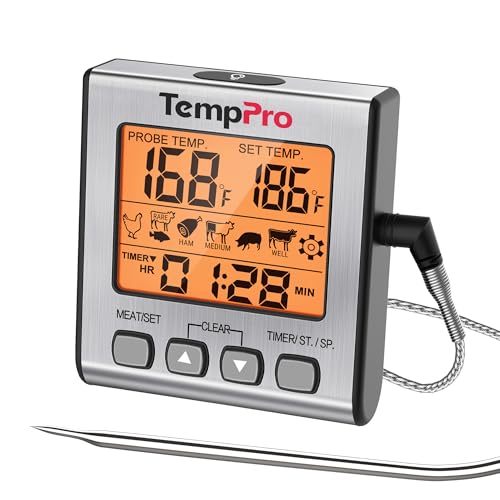
TempPro TempTrack leave-in probe thermometer
Why it fits: the listing gives it a 40-inch heat-resistant cable, a target-temperature alert, six preset meat settings and a countdown timer. A magnet and a built-in stand let the display sit on the oven door or the counter while you get on with the sides.
The drawback: the listing puts its accuracy at ±1.8°F (1°C), so if you want a margin, wait for a reading a degree or two over 165°F (74°C). Care is wipe-clean, not a soak in the sink, and the cable needs to run neatly through the oven door so it isn't pinched.
Check it on AmazonNot sure your thermometer is right? Fill a tall glass with ice, add water and stir. Put the probe at least 2 inches (5 cm) in, not touching the sides or bottom, wait 30 seconds or more, and it should read 32°F (0°C). That's the FSIS check, and it takes less time than preheating the oven.
Pink chicken: what the color can and can't tell you
Color fools people both ways. Chicken can turn white before it's safe, and fully cooked chicken can stay pink. As FSIS puts it, "The color of cooked chicken is not a sign of its safety."
FSIS says pink in properly cooked chicken may come from hemoglobin in the tissue, which can form a color that heat doesn't break down. Grilled and smoked chicken does something similar: FSIS notes that poultry cooked outdoors can carry a pink rim about half an inch (1.3 cm) wide, even at 165°F (74°C). FSIS also says smoked turkey is always pink.

A thin pink band under the surface is common on grilled and smoked chicken. The thermometer, not the color, tells you whether it's done.
Pink doesn't mean it's raw, and white doesn't mean it's safe. If you've cut into something that looks off and you don't have a reading, put it back on the heat and check it.
Can you pull chicken breast at 155°F (68°C)?
You'll see this advice online, and it isn't made up. FSIS publishes time-and-temperature tables for food plants that show chicken can reach the same Salmonella kill at lower temperatures if it's held there long enough. At 155°F (68°C), for example, a chicken product with around 7% fat needs about 49.5 seconds.
The key word is "held." Those tables assume every part of the piece stays at that temperature for that whole time, in controlled ovens with humidity and logged readings. A breast resting on a cutting board is cooling from the outside in, and a home thermometer can't tell you how long the center stayed where. That's why the home advice from FSIS is one number with no timer attached: 165°F (74°C).
If dry breast is the real problem, the fix is usually taking it off the heat the moment it reads 165°F (74°C) instead of leaving it in "to be sure", and pounding thick breasts to an even thickness so the thin end doesn't overcook while the fat end catches up.
Frozen chicken and leftovers: still 165°F (74°C)
You can cook chicken straight from frozen in the oven or on the stove. FSIS says to expect it to take about 50 percent longer, but the target is still 165°F (74°C) in the thickest part.
One thing FSIS rules out is half-cooking chicken to finish later. Don't brown it or part-cook it, refrigerate it, and come back to it tomorrow. Partly cooking it right before it goes onto a hot grill is fine; the gap is what causes trouble.
Cooked chicken keeps 3 to 4 days in the fridge and about 4 months in the freezer for best quality. Eat it cold or bring it back to 165°F (74°C). Our note on putting hot food in the fridge covers how to cool a big batch quickly.

Meal-prepped chicken lasts 3 to 4 days in the fridge. Reheat each box until the thickest slices read 165°F (74°C).
Checked it and it reads under 165°F (74°C)?
Nothing is ruined. Put it back in the pan, oven or air fryer, give it a few more minutes and check again in the same spot. Wash the probe in hot, soapy water between checks so you aren't carrying raw juice from one piece to the next.
With a batch of wings or a tray of mixed pieces, check the biggest one first. Pieces cook at different speeds, and the plumpest wing or the thickest bone-in breast is the one that decides when the tray is done. Pull smaller pieces as they reach 165°F (74°C) and leave the big ones in.

In a full basket of wings, test the plumpest one. If it's at 165°F (74°C), the smaller ones got there first.
The thermometer we'd buy for this
Any digital instant-read that you'll actually reach for does the job. FSIS says thermocouple models read in about 2 to 5 seconds and thermistor models in around 10, so even the slower kind beats cutting into the meat.
As an Amazon Associate we earn from qualifying purchases.
Alpha Grillers instant-read thermometer
Why it fits: a thin steel probe, a backlit screen, and a listing that says it arrives pre-calibrated and can be recalibrated, so you can fix it if the ice test reads off. It's rated waterproof (IP67) for rinsing.
The drawback: it's hand wash only and the body is plastic, and it's an instant-read, so it can't stay in the oven with a roasting chicken. You open the door and check. For a whole bird that's three quick readings rather than one glance at a screen.
Check it on AmazonThe two thermometers on this page
As an Amazon Associate we earn from qualifying purchases.
| Thermometer | Best for | Watch out for | |
|---|---|---|---|
| Alpha Grillers instant-read | Breasts, thighs, wings, leftovers: quick checks in the pan | Can't stay in the oven; hand wash only | See it |
| TempPro TempTrack leave-in | Whole chickens and turkeys roasting in the oven | ±1.8°F listed accuracy; wipe-clean only | See it |
Questions people ask
Is chicken overcooked at 170°F (77°C)?
It's safe, and FSIS says you can cook poultry hotter for personal preference. Breast meat starts to dry out past 165°F (74°C). Thighs and drumsticks have more connective tissue, so plenty of cooks keep going past 165°F (74°C) for a softer bite.
What happens if chicken doesn't reach 165°F (74°C)?
It hasn't met the USDA's safe minimum, so keep cooking it. Return it to the heat and check the same spot again until it reads 165°F (74°C).
Can you eat slightly pink chicken?
If it measured 165°F (74°C) in the thickest part, yes. Pink near the bone or under grilled skin can stay after the meat is fully cooked. If you have no reading, cook it further and check.
Why is rotisserie chicken sometimes pink near the bone?
The same reasons as home-cooked chicken: pigment in the meat can stay pink after cooking. If you're unsure, or you're eating it the next day, warm it until it reads 165°F (74°C).
How can you tell if chicken is done without a thermometer?
You can't be sure. Clear juices and white meat are hints, but FSIS is clear that color doesn't show safety. A basic digital thermometer is the only reliable check.
Does chicken need to rest after cooking?
Not for safety. The USDA chart lists a 3-minute rest for whole cuts of beef and pork, not for poultry. Resting a few minutes before slicing still keeps more juice in the meat.
Is the temperature different for ground chicken?
No. Ground chicken and turkey are 165°F (74°C), the same as whole pieces. Check the middle of the thickest burger or meatball.
How we checked
On 7 November 2026 we read the cooking-temperature, thermometer and color pages from the USDA's Food Safety and Inspection Service (FSIS), the FoodSafety.gov chart, an FSIS training module on cooking lethality, and CIDRAP's report on the 2006 USDA change. Product details come from the Amazon listings and Amazon's product data on the same date. None of the FSIS pages showed an update date.
Written by Rawia Younis. Rawia writes Cupindy's cooking guides. This page is general food-safety information, not medical advice.
Sources
- FSIS: Safe Minimum Internal Temperature Chart (read 7 Nov 2026)
- FoodSafety.gov: Cook to a Safe Minimum Internal Temperature (read 7 Nov 2026)
- FSIS: Chicken from Farm to Table (read 7 Nov 2026)
- FSIS: Kitchen Thermometers (read 7 Nov 2026)
- FSIS: Is Pink Turkey Meat Safe? (read 7 Nov 2026)
- FSIS: Lethality, Stabilization and Multiple Hurdles (training module, 27 Oct 2021)
- CIDRAP News: USDA: 165 degrees is magic number for safe poultry (5 Apr 2006)
As an Amazon Associate we earn from qualifying purchases. Cupindy earns a commission if you buy through the Amazon links on this page, at no extra cost to you. No brand paid to be included.


