
By Lara Yehia · Last reviewed November 2026
Roast prime rib on a rack in a shallow, uncovered pan at 325°F (163°C), and take it out when the coolest spot in the center reads 145°F (62.8°C), the USDA minimum for beef roasts. Then rest it at least 3 minutes. Go by that reading, not the clock: minutes per pound only tell you when to start checking.
- Keep the raw roast at 40°F (4°C) or colder until you cook it. If you salt it ahead, leave it uncovered on a rack over a tray on the bottom fridge shelf.
- Heat the oven to 325°F (163°C). Stand the roast bones down on a rack in a shallow, uncovered pan.
- Start checking at the low end of your time range. For a 4 to 8 pound (1.8 to 3.6 kg) bone-in roast, FSIS's chart gives 23 to 30 minutes per pound, so check at 23.
- Push the thermometer midway into the thickest part, away from bone and fat. Check two or three spots and go by the lowest reading.
- Take it out when the coolest spot reads 145°F (62.8°C). Pulling it lower for medium rare puts it below USDA guidance; the table below shows those temperatures.
- Rest it 20 to 30 minutes under loose foil (the USDA minimum is 3), cut the bones away, then slice across the grain.
As an Amazon Associate we earn from qualifying purchases.

The one tool this roast needs
A digital instant-read thermometer you push into the center when the clock says you're close. We'd start with the Alpha Grillers: its maker's page (read 15 November 2026) lists a 1 to 2 second reading and says it ships calibrated, with a recalibrate function. FSIS lists instant-reads as not designed to stay in food while it cooks, so it comes out of the meat before the oven door closes. Want a probe that stays in? The leave-in option is in the thermometer section below.
See the Alpha Grillers thermometer on AmazonWhat many prime rib recipes don't say: the classic medium rare roast comes out of the oven well below that 145°F (62.8°C) line. If you cook it that way, know where the line is. The table below shows both. Still need a pan with a rack? Our best roasting pan guide compares them.
Prime rib temperature: when to take it out
Two kinds of number turn up in prime rib advice, and they get mixed up all the time. One is the USDA's food safety minimum. The other is a set of doneness levels that cooks use for taste.
| Doneness | Take it out at | After the rest | Against USDA guidance |
|---|---|---|---|
| USDA minimum | 145°F (62.8°C) |
Rest at least 3 minutes | This is the guideline |
| Medium well | 140-145°F (60-62.8°C) |
About 150°F (66°C) |
Meets it only if it reads 145°F (62.8°C) before it comes out |
| Medium | 130-135°F (54-57°C) |
About 140°F (60°C) |
Below it |
| Medium rare | 120-125°F (49-52°C) |
About 130-135°F (54-57°C) |
Below it |
| Rare | 115-120°F (46-49°C) |
About 125°F (52°C) |
Below it |
USDA row: FSIS safe minimum chart. Doneness rows: Safeway's prime rib roasting guide, updated 9 November 2026. Celsius figures are our conversions.
Read the USDA wording closely. FSIS says to cook beef roasts to 145°F (62.8°C) "before removing food from the heat source," then rest them at least 3 minutes. Our reading of that wording: the rise during the rest doesn't count toward the 145. Rare, medium rare and medium are all below that guideline, and we won't call them safe. Plenty of people choose them anyway. If you want to cook to the USDA standard, take the roast out when the coolest spot you can find reads 145°F (62.8°C).
Why pull early at all? A big roast keeps cooking for a while after it leaves the oven, which cooks call carryover. Sources put it at different figures. ThermoWorks gives 5 to 8°F (about 3 to 4°C), depending on the size of the roast. Snake River Farms says about 5°F (3°C) for its main method and about 10°F (6°C) for its reverse sear. Pull targets differ too: ThermoWorks pulls at 125°F (52°C) for medium rare, and Snake River Farms lists 120°F (49°C). Treat any single pull number as a rough target. Cooking steaks instead? Our steak doneness temperature chart covers those.
How long to cook prime rib, per pound
Every time chart for prime rib is an estimate, and the charts don't agree with each other. That's normal. The time depends on the oven temperature, the shape of the roast, the bone, and how cold the meat was when it went in. Four sources, side by side:
| Oven and roast | Time | Source |
|---|---|---|
| 325°F (163°C), bone-in rib roast, 4 to 8 lb (1.8 to 3.6 kg) | 23 to 30 min per lb | FSIS roasting chart |
| 325°F (163°C), boneless rib roast, 4 lb (1.8 kg) | 39 to 43 min per lb | FSIS roasting chart |
| 450°F (232°C) for 15 to 20 min, then 325°F (163°C) | About 13 to 15 min per lb at 325°F (163°C) after the sear, medium rare | Safeway |
| 350°F (177°C) | About 15 to 20 min per lb | Snake River Farms |
| 225°F (107°C), below FSIS oven advice | No per-pound figure; 3 to 5 hours in all | ThermoWorks |
FSIS calls its chart approximate times for meal planning. Full source list at the end of the page.
Look at the spread. By our arithmetic, a 6 pound (2.7 kg) bone-in roast takes roughly 2 hours 20 minutes to 3 hours on the FSIS chart, and about 1½ to 2 hours with the hot start, sear included. Safeway's own total for a 6 to 9 pound (2.7 to 4.1 kg) roast is about 1¾ to 2¼ hours. That's why the clock can't tell you when it's done.
Our own rule of thumb, not from any chart: find the row that matches your oven, work out the shortest time it gives, and start checking the temperature then. After that, check every 15 to 20 minutes, and more often once you're within about 10°F (6°C) of your target. Plan your dinner around the longest time plus the rest, so a slow roast never leaves people waiting, and a fast one simply rests a little longer under loose foil.
Bone-in or boneless prime rib
Both are the same cut. ThermoWorks says boneless roasts are easy to cook and easy to carve but cost more per pound, while bone-in usually costs less per pound. Snake River Farms cites tests showing the two taste nearly identical, and gives different shrink: boneless loses about 20% of its weight, bone-in about 30%.
What changes is the check. Snake River Farms notes that the bone slows cooking, which it says keeps the meat near it extra juicy. With bone-in, keep the probe tip in the center of the eye and clear of bone, as FSIS advises. FSIS's chart also lists the two separately, with very different minutes per pound, another reason not to cook by the chart.
How much prime rib per person
Safeway's guide says about 1 pound (450 g) bone-in or ¾ pound (340 g) boneless per person, with one rib feeding about two people. Snake River Farms puts a serving at 8 ounces (225 g) of cooked roast. Here's that rule worked out by guest count. The arithmetic is ours, and real roasts vary in weight per rib.
| Guests | Bone-in | Boneless |
|---|---|---|
| 4 | 2 ribs, about 4 lb (1.8 kg) | About 3 lb (1.4 kg) |
| 6 | 3 ribs, about 6 lb (2.7 kg) | About 4½ lb (2 kg) |
| 8 | 4 ribs, about 8 lb (3.6 kg) | About 6 lb (2.7 kg) |
| 12 | 6 ribs, about 12 lb (5.4 kg) | About 9 lb (4.1 kg) |
Want leftovers, or feeding big eaters? Go up one rib.
The thermometer rule: where the probe goes
For beef roasts, the FSIS thermometer page says to place the thermometer midway in the roast, in the thickest part, "avoiding the bone, fat and gristle." It also says that for a large or irregular piece like a beef roast, you should check in several places. A tip resting on bone or sitting in fat can give you a misleading number.
Go in from the side or the end so the tip sits in the center. Then do what ThermoWorks suggests: draw the probe back slowly and watch for the lowest reading on the way. That lowest number is how done the roast is. Check two or three spots across the roast, including the middle and each end.

In from the side, tip in the center of the eye, clear of the bones.
You have two kinds of digital thermometer to choose from. An instant-read is a spot-check tool: you open the oven, take a reading, take it out. FSIS lists those types as not designed to stay in food while it cooks. A leave-in probe has a heat-rated cable and a display that sits outside the oven, so you watch the number climb without opening the door. FSIS notes that cord-style oven thermometers can't be calibrated, so if you rely on one, confirm it now and then with an instant-read.
Whichever you use, check it before the big day. FSIS says most food thermometers read within 2 to 4°F (about 1 to 2°C), and its ice water test is simple: a glass packed with ice and topped up with water should read 32°F (0°C).
As an Amazon Associate we earn from qualifying purchases.
| Thermometer | Type | What the maker states (read 15 Nov 2026) | Trade-off | Amazon |
|---|---|---|---|---|
| Alpha Grillers instant-read | Spot check, comes out of the meat | 1 to 2 second reading; calibrated, with a recalibrate function | You open the oven for every reading | See it |
| TempPro TempTrack (TP16S) leave-in probe | Stays in the roast, display outside the oven | ±1.8°F (±1.0°C) from 14 to 572°F (-10 to 300°C); probe and cable heat-rated to 716°F (380°C) | Reads one spot only; hand wash, not waterproof | See it |
Alpha Grillers instant-read thermometer
Why it fits: checking several spots is the FSIS advice for a roast, and a quick reading keeps the oven door open for less time. The maker's page (read 15 November 2026) lists a 1 to 2 second reading, says it ships calibrated with a recalibrate function, and rates it IP67 waterproof.
The drawback: it doesn't stay in the meat, so every reading means opening the oven. The maker's page we read does not state an accuracy figure in degrees, so give it the ice water check before you cook.
Check it on Amazon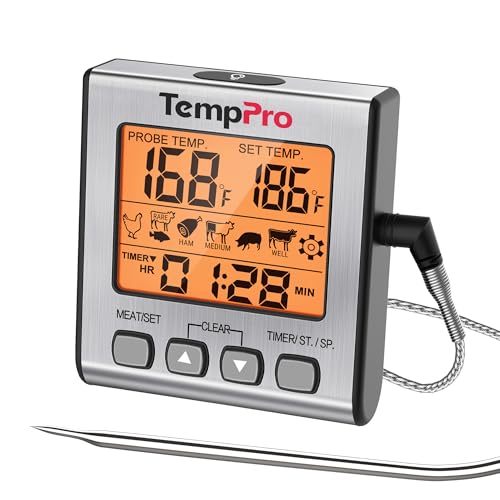
TempPro TempTrack (TP16S) leave-in probe thermometer
Why it fits: a prime rib can roast for hours, and a probe that stays in lets you watch it climb with the door shut. The maker's TP16S page and manual (read 15 November 2026) give ±1.8°F (±1.0°C) across a 14 to 572°F (-10 to 300°C) measuring range, rate the probe and cable to withstand 716°F (380°C), and say the display stays outside the oven. The manual says to push the probe in at least 2 inches (5 cm), away from bone. You can set a custom alarm, which matters here: its lowest beef preset is 145°F (62.8°C).
The drawback: one probe reads one spot, so check the ends with an instant-read too. The manual says the probe and cable aren't dishwasher safe and shouldn't be submerged, and the unit itself isn't waterproof.
Check it on AmazonBefore the oven: fridge, dry brine and the counter
Keep the roast cold until you cook it. The FSIS danger zone page puts the line at 40°F (4°C) or below for cold food, and calls 40 to 140°F (4 to 60°C) the range where bacteria grow fastest. A fridge thermometer tells you whether yours actually holds that, and we compare them in our refrigerator thermometer guide.
Many cooks salt a prime rib a day or more ahead and leave it uncovered in the fridge, a step often called dry brining. The FSIS roasting page we read does not mention salting ahead or dry brining, so this part is our own advice: set the roast on a rack over a tray on the bottom shelf, so any drips land in the tray and not on food below it. Keep it clear of anything that won't be cooked, like salad or cheese.

On a rack over a tray, bottom shelf, nothing ready-to-eat below or beside it.
Should it sit out first? Advice varies: Snake River Farms takes it out 1 to 2 hours ahead, and Safeway says 30 minutes to an hour and not to expect much from it. Whatever you choose, FSIS says never to leave food out of refrigeration for more than 2 hours, or 1 hour above 90°F (32°C). Counter time counts toward that limit.
The pan matters less than the rack. FSIS describes roasting as meat set on a rack in a shallow, uncovered pan, cooked by the dry heat of the oven. The rack lifts the roast out of its drippings so hot air reaches the bottom. A bone-in roast can stand on its own bones, which ThermoWorks says is where the name standing rib roast comes from, but a rack still makes it easier to lift out. Set it bones down. If you're buying a pan for this and for the turkey, we compare pans with racks in our roasting pan buying guide.
As an Amazon Associate we earn from qualifying purchases.

Cuisinart MultiClad Pro 16 inch (41 cm) roasting pan with rack
Why it fits: it's a stainless pan that comes with its own stainless rack, so the roast sits up out of the drippings. Cuisinart's product page (read 15 November 2026) says it holds a turkey up to 18 pounds (8.2 kg), which by our reckoning leaves room for a large standing rib roast, and lists it as induction suitable.
The drawback: it's big. Cuisinart's section of the Amazon listing (read 15 November 2026) gives it 19.3 inches (49 cm) long with the handles, more pan than a two-rib roast needs. The same listing puts the oven limit at 500°F (260°C), which covers a 450°F (232°C) start, and recommends hand washing to keep the polish.
Check it on AmazonOven temperature: 325°F (163°C), a hot start, or low and slow
The FSIS page on roasting holiday meats uses 325°F (163°C) for rib roasts. It says the USDA does not recommend oven temperatures below 325°F, because the meat could stay in the 40 to 140°F (4 to 60°C) danger zone too long.
A hot start stays inside that advice. Safeway's guide browns the roast at 450°F (232°C) for 15 to 20 minutes, then drops the oven to 325°F (163°C) to finish. The oven never goes below 325°F, and you get a darker crust early.
Reverse sear prime rib and other low-oven methods
Many popular recipes do the opposite: roast at a low oven setting until the center is nearly there, then blast the outside at high heat. That's the reverse sear, and Snake River Farms gives a 275°F (135°C) version. ThermoWorks also roasts low, at 225°F (107°C), but it sears first and finishes in the low oven. Fans of low-oven methods like the even pink from edge to center.
Every one of those oven settings is below the 325°F (163°C) the USDA recommends for roasting meat. We won't call that fine: the agency does not recommend it. If you use a low oven anyway, use a leave-in probe so you know how the center is moving, and don't leave the roast unwatched for hours.
Rest it, then carve
FSIS sets the floor at 3 minutes of rest. Roast guides go much longer for prime rib: ThermoWorks rests it for 30 minutes, and both Snake River Farms and Safeway say 20 to 30 minutes, tented loosely with foil. A loose tent holds some heat without steaming the crust soft.
Move the cooked roast to a clean board. Not the one the raw roast sat on, and not the tray from the fridge. For a bone-in roast, run the knife along the curve of the bones to cut them away in one piece, then slice the boneless eye across the grain. A long, sharp blade makes it easier. If you don't own a carving knife, a well-sharpened chef's knife works, and our best chef knife guide has options.

Rested, on a clean board, sliced across the grain. Cutting the bones away first makes the slicing easier.
What goes wrong with prime rib
It's pulled on time, not on temperature. The chart said 2 hours, so it came out at 2 hours. Depending on the roast, that's either gray to the center or raw in the middle. Read the center every time.
One reading was trusted. A single spot near the end or against a bone said it was done while the center wasn't. Check several spots in solid meat and go by the lowest.
The center was still cold when it went in. A roast straight from a very cold fridge takes longer, and the outside can overcook while the middle catches up. That's a reason to start checking by temperature, not to leave it out past the 2 hour limit.
It was carved straight away. Cut it with no rest and you lose the carryover rise your pull temperature counted on. Give it the full rest.
Prime rib leftovers
Get the leftovers into the fridge within 2 hours of cooking. The FSIS leftovers page says to slice or cut whole roasts into smaller parts so they cool fast, and to use shallow containers. It gives 3 to 4 days in the fridge and 3 to 4 months in the freezer, and says to reheat leftovers to 165°F (74°C). Our guide on putting hot food in the fridge covers the cooling step, and how to reheat food covers the rest.

Sliced and spread out in shallow containers so it cools quickly.
Questions people ask
How long does it take to cook a prime rib?
It depends on the oven. The FSIS chart gives 23 to 30 minutes per pound (about 51 to 66 minutes per kg) for a 4 to 8 pound (1.8 to 3.6 kg) bone-in roast at 325°F (163°C). After a hot start at 450°F (232°C), Safeway's guide gives about 13 to 15 minutes per pound at 325°F (163°C) for medium rare. Start checking the temperature at the shortest time for your method.
Should I cook prime rib at 325 or 350?
Either is at or above the 325°F (163°C) floor that FSIS uses for roasting meat. FSIS's own chart is built on 325°F (163°C). At 350°F (177°C) the roast cooks a little faster, so start checking sooner.
What is the 500 rule for prime rib?
It's a closed-oven method that Snake River Farms lists in its prime rib guide: roast at 500°F (260°C) for 5 minutes per pound, then turn the oven off and leave the roast inside with the door shut for 2 hours. The same guide notes you can't check the center without a leave-in thermometer, and says it prefers the reverse sear. Our reasoning: once the oven is off, it falls below 325°F (163°C), the lowest oven temperature FSIS recommends for roasting meat. A leave-in probe is the only way to know where the center ended up.
Do you cover prime rib when cooking, or add water to the pan?
FSIS describes roasting as meat on a rack in a shallow, uncovered pan, cooked by dry oven heat. The FSIS page we read doesn't call for water in the pan. Foil comes in afterward, as a loose tent while the roast rests.
How long should prime rib rest?
FSIS sets a minimum of 3 minutes. The roast guides we read go longer for a cut this size: 20 to 30 minutes loosely tented with foil, and ThermoWorks uses 30 minutes. The center keeps rising for part of that time.
Is medium rare prime rib below USDA guidance?
Yes. FSIS says beef roasts should reach 145°F (62.8°C) before they leave the heat, then rest at least 3 minutes. Safeway's guide pulls medium rare at 120 to 125°F (49 to 52°C) and has it end around 130 to 135°F (54 to 57°C), so it sits below that guideline.
Does prime rib have to be USDA Prime grade?
No. ThermoWorks points to the USDA labeling policy book, which says prime rib does not have to come from USDA Prime grade beef.
How do you reheat prime rib?
FSIS says to reheat leftovers to 165°F (74°C). That will take the pink out of a medium rare slice, so reheat only what you'll eat, in thin slices, which also warm through faster.
How we checked
On 15 November 2026 we read five FSIS pages (safe minimum temperatures, the danger zone, leftovers, roasting holiday meats and food thermometers), three prime rib roasting guides, and the maker pages and manual for the products above. We also compared the prime rib guides that rank in US search. We did not cook or test anything for this page: the times and temperatures come from the sources below. We searched the CPSC recall list on 15 November 2026 and found no recall for these three products. The images are illustrations made with an AI image tool, including the main image at the top.
Written by Lara Yehia. Lara researches home and kitchen products for Cupindy. This page is general cooking and food-safety information.
Sources
- FSIS: Safe Minimum Internal Temperature Chart (updated 14 Apr 2025, read 15 Nov 2026)
- FSIS: Roasting Those "Other" Holiday Meats (updated 5 Dec 2024, read 15 Nov 2026)
- FSIS: Food Thermometers (updated 21 Mar 2025, read 15 Nov 2026)
- FSIS: "Danger Zone" (40°F - 140°F) (updated 28 Jun 2023, read 15 Nov 2026)
- FSIS: Leftovers and Food Safety (updated 31 Jul 2020, read 15 Nov 2026)
- Safeway: Prime Rib Roast, How to Buy It and Roast It Right (updated 9 Nov 2026, read 15 Nov 2026)
- ThermoWorks: Perfect Prime Rib Roast (read 15 Nov 2026)
- Snake River Farms: Guide, How to Cook Prime Rib (7 Aug 2024, read 15 Nov 2026)
- CPSC: Recalls and Product Safety Warnings (searched 15 Nov 2026)
As an Amazon Associate we earn from qualifying purchases. Cupindy earns a commission if you buy through the Amazon links on this page, at no extra cost to you. No brand paid to be included.


