
Written by Sara Ibrahim. Sara researches home and kitchen products for Cupindy.
Published October 2026 · Last reviewed October 24, 2026
Granite, marble, porcelain, wood and lava rock grind and clean differently, and each has one weak spot. We read the listings of Amazon's best-selling mortars on October 24, 2026 and kept seven, one per material or size.
As an Amazon Associate we earn from qualifying purchases.

Our quick pick for most kitchens
ChefSofi Granite Mortar and Pestle, 2 Cups
ChefSofi's granite line was number one in Amazon's Mortar & Pestles category on October 24, 2026. The listing calls this one “Unpolished Heavy Natural Granite - 6 inch”. It takes dry spices and wet pastes alike.
See the ChefSofi on AmazonThe drawback: about 7 pounds, and gritty until you season it with rice. Buyers keep repeating one tip: do the rice step first.
The short answer
For most people, unpolished granite. It is heavy enough to stay put, rough enough to grind, and fine with wet food once seasoned. Marble etches with lemon or vinegar, so keep it for dry spices. Porcelain suits small dry jobs, wood is for dry spices only, and lava rock is for guacamole and salsa.
Granite, Marble, Porcelain, Wood or Lava Rock?

Granite
Granite is dense and heavy, so the bowl stays put while you pound. ChefSofi and Gorilla Grip both list an unpolished granite inside, and that rough surface does the grinding. Tasting Table counts granite among the porous mortars that need seasoning before first use: you grind white rice in it until no more grit comes out. Cole & Mason adds a practical point: “If you plan on using ingredients like turmeric, which can stain, you may wish to go for a darker material such as granite.” If you only buy one mortar, buy a 2-cup granite one like the ChefSofi.
As an Amazon Associate we earn from qualifying purchases.

If you want a lighter granite bowl
Gorilla Grip Granite Mortar and Pestle, 1.5 Cups
Unpolished granite, 5.2 inches across and 3.9 pounds, about half the weight of the ChefSofi. The listing says it “holds up to 1.5 cups of ingredients” and comes with an “optional foam bottom underside” to protect the counter.
Good for: Smaller kitchens, daily spice grinding
The drawback: The listing contradicts itself on finish. The product details say unpolished, while one bullet says the granite is cut, shaped and polished.
See the Gorilla Grip on AmazonMarble
Marble is the pretty one, and MasterClass calls it nonporous. Its weak spot is acid. Marble contains calcite, and acid dissolves it. Stone Doctor, a stone-care company, says the result is damage, not a stain: a dull patch that has to be re-polished, and sealing does not prevent it. It names lemon juice and vinegar among the culprits. So treat a marble mortar as a dry spice and herb tool, and make the lime-and-tomato salsa somewhere else.
As an Amazon Associate we earn from qualifying purchases.

Marble for herbs and spices
HIC Carrara Marble Mortar and Pestle, 3.8 Inch
“Solid Carrara Marble”, a 3.8-inch mortar. The maker says to “hand wash in warm, soapy water and dry thoroughly”.
Good for: Dried herbs, whole spices, sea salt
The drawback: Marble etches with acid, so lemon, lime, vinegar and tomato stay out of it.
See the HIC on AmazonCeramic and porcelain
Porcelain mortars are light, small and easy to wipe clean. LEETOYI's listing says “The porcelain mortar interior is unpolished and rough for better grinding.” Cole & Mason calls ceramic the lighter choice. Light also means it can shift if you pound hard, so we would grind in it rather than bash.
Glazed ceramic raises the lead question. California's Department of Public Health says “You cannot tell for sure whether a dish has lead just by looking at it.” FDA guidance says ceramicware with extractable lead in FDA's test “should not be labeled as "Lead Free."” The porcelain mortar on this page makes no lead or glaze statement at all, and we did not test it. Our dinnerware guide explains FDA's lead limits for ceramic food ware.
Wood
Wood is light and quiet on the counter, but it cannot soak in water. The maker of our wood pick writes “We recommend not to wash this product with water.” Its listing still suggests small batches of puréed garlic. In our view a mortar you can only wipe is a dry-spice tool. Our guide to wooden kitchenware covers how wood holds up over time.
As an Amazon Associate we earn from qualifying purchases.

Wood for dry spices
Samhita Acacia Wood Mortar and Pestle
Acacia wood, a 4-inch mortar with a 5.5-inch pestle, about a pound in all. The maker says to wipe it with a damp cloth and “periodically apply oil”.
Good for: Dry spices, dried herbs, a mortar to leave out
The drawback: No washing with water, per the maker.
See the Samhita on AmazonLava rock
Lava rock is the stone of the Mexican molcajete. It is porous and needs the longest seasoning, and it is the traditional bowl for guacamole and salsa. More in the molcajete section below.
Is a Mortar and Pestle Safe? Grit, Glaze and Fakes
The real risks are grit, glaze and fake stone.
Grit. A new granite or lava rock mortar sheds fine stone dust until it is seasoned. Cole & Mason has you grind white rice with a little water, then “Rinse and repeat a few times until there is no longer any loose debris.” Skip it and the dust ends up in your food. The steps are in the questions below, and our granite guide has more on caring for stone.

Glaze. FDA tells people to take care with pottery that is “handmade with a crude appearance or irregular shape”, antique, “damaged or excessively worn”, or brightly decorated in orange, red or yellow. Those are the ceramic mortars to look at twice.
Fake stone. Some molcajetes are cast from cement instead of carved from volcanic stone. Food Republic and The Daily Meal give similar home tests. A real one has irregular pores and is a little lopsided, because it is carved by hand, while a molded one looks too even. Pour in a little water and wait a few minutes. Real stone usually holds some of it, and cement soaks it up. A knife scratch leaves a lasting mark on cement. If yours fails, Food Republic says not to use it for food and to send it back.
Our Mortar and Pestle Picks at a Glance
All seven sit in Amazon's Mortar & Pestles category. Sizes are each listing's own.
As an Amazon Associate we earn from qualifying purchases.
| Mortar | Material, size, drawback | Amazon |
|---|---|---|
|
ChefSofi 2 cups Best for most kitchens |
Unpolished granite, 6 in, about 2 cups; 7 lb, season first | See it |
|
Gorilla Grip 1.5 cups Lighter granite |
Unpolished granite, 5.2 in; finish described two ways | See it |
|
Priority Chef 4 cups Big batches |
Black granite, 7 in; about 11.7 lb | See it |
|
HIC marble Dry spices, herbs |
Carrara marble, 3.8 in; acid etches it | See it |
|
Cuitáxi molcajete Guacamole, salsa |
Lava rock, 8 in, handmade; cure guide sent by email | See it |
|
LEETOYI porcelain A pinch at a time |
Porcelain, 3.3 in; no lead or glaze statement | See it |
|
Samhita acacia Dry spices, display |
Acacia wood, 4 in; not to be washed with water | See it |
Best Large Mortar and Pestle
A bigger bowl lets you make more at once and gives the pestle room to work. The trade-off is weight. Granite this size lives on the counter, not in a cupboard.

As an Amazon Associate we earn from qualifying purchases.
Priority Chef's own size guide puts 4 cups at 2-3 servings of guacamole or pesto. If you like the ChefSofi, the same granite comes as an 8-inch, 5-cup set with two pestles, but it weighs 18 pounds by the brand's own chart.

For big batches
Priority Chef Large Granite Mortar and Pestle, 4 Cups
Black granite, 4 cups, 7 inches across, with a 7.2-inch pestle and two anti-slip pads. The listing calls it “Ideal for making 2-3 servings of guacamole, pesto, or crushing whole spices in a single batch”.
Good for: Guacamole, pesto, curry paste for several people
The drawback: Heavy. The spec sheet gives 5.3 kg, about 11.7 pounds. One bullet says 7 pounds, which looks copied from the 2-cup version, so plan on the heavier figure.
See the Priority Chef on AmazonMolcajete vs Granite Mortar and Pestle
A molcajete is the traditional Mexican mortar, carved from volcanic stone and usually set on three short legs. The Daily Meal traces it back to the Aztecs and Mayans. It is porous, and MasterClass uses it as its example of a mortar that needs seasoning. For salsa and guacamole the molcajete wins in our view, and you can serve straight from it. Granite is easier for fine spice powder and quicker to clean.

Handmade stone varies from piece to piece. Run the water test above before the first use.
As an Amazon Associate we earn from qualifying purchases.

The real-stone option
Cuitáxi 8-Inch Lava Rock Molcajete
An 8-inch molcajete, about 5 inches tall and 7 to 8.8 pounds, that the seller says is carved from “lava rock from the Popocatepetl Volcan in Puebla México”. The title adds “Not Concrete”. That is the seller's claim, so use the water test.
Good for: Guacamole, salsa, serving at the table
The drawback: The curing guide arrives by email, not in the box.
See the molcajete on AmazonWhat to Buy for Spices, Pesto and Guacamole
Match the bowl to what you grind most. This is our own matching, based on what each material can take.
| You mostly make | Our pick of material |
|---|---|
| Whole spices, peppercorns, cumin | Granite, or marble or wood for dry spice only |
| Pesto, garlic paste, curry paste | Granite, 2 cups or more |
| Guacamole and salsa | Lava rock molcajete or large granite |
| A pinch of saffron or a few seeds | Small porcelain |
As an Amazon Associate we earn from qualifying purchases.
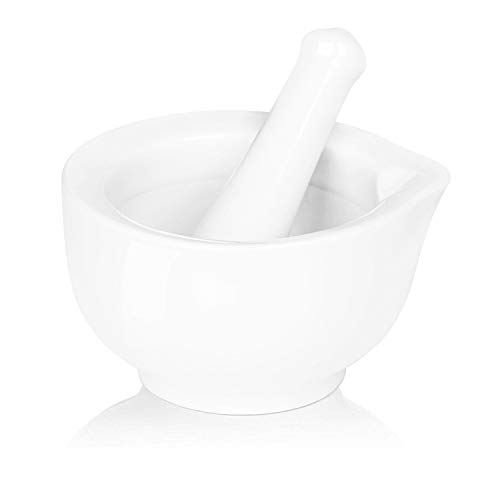
Small and light
LEETOYI Porcelain Mortar and Pestle, 3.3 Inch
A 3.3-inch white porcelain mortar with a small pouring notch for tipping out powder. The inside is left rough for grinding.
Good for: Saffron, a teaspoon of seeds, a small kitchen
The drawback: The listing says nothing about lead or the glaze.
See the LEETOYI on AmazonWhich Is the Mortar and Which Is the Pestle?
The mortar is the bowl. The pestle is the heavy, club-shaped tool you hold. In Cole & Mason's words, “A mortar is a bowl used to hold ingredients crushed by the pestle.”
Questions People Ask
How do I season a new mortar and pestle?
Rinse it with warm water, no soap. Grind about three tablespoons of white rice with a tablespoon of water for five to eight minutes, rinse, and repeat until the rice stays white. Then let it air dry. That is MasterClass's method, and Cole & Mason's is the same in fewer words. Granite and lava rock need it. MasterClass says porous mortars need seasoning and calls marble nonporous.
How do I clean a mortar and pestle? Can it go in the dishwasher?
Rinse stone with warm water and a brush. Tasting Table and MasterClass both warn against soap on porous stone, because it lingers and leaves a taste. HIC says its marble can be hand-washed in warm, soapy water. None of the stone mortars on this page lists the dishwasher. See our list of things to keep out of the dishwasher.
What can I use instead of a mortar and pestle?
Use an electric spice grinder for dry spices. For garlic or a few seeds, press down with the flat of a heavy knife on a cutting board. You lose the paste texture, but it works in a pinch.
How do you use a mortar and pestle?
Cole & Mason describes two moves. Bash with large strokes to crack seeds and whole spices, covering the opening with your hand so nothing flies out. Then twist the pestle so the food grinds against the bottom and sides. The longer you twist, the finer it gets.
What about stainless steel, cast iron or agate?
You will also find mortars in stainless steel, cast iron, agate, onyx and soapstone. We did not review them for this page. The seven above cover the materials most home cooks buy.
What are the downsides of a mortar and pestle?
They are heavy and slow. The granite mortars here weigh from about 4 to 18 pounds, and a new one needs several rounds of rice before first use. For large amounts, a grinder is faster.
Is polished or unpolished granite better?
For grinding, unpolished. ChefSofi says its unpolished inside gives natural friction for crushing, and LEETOYI leaves its porcelain rough “for better grinding.”
What is a mortar and pestle called in Mexico?
A molcajete. It is carved from volcanic stone and used for salsas and guacamole.
How We Chose
On October 24, 2026 we read Amazon's Best Sellers in Mortar & Pestles and each listing in full for a New York address. We kept highly rated listings, one per material or size, and made the top-selling line our quick pick. The molcajete and the wood mortar have fewer ratings than we usually ask for, but no lava rock or wood listing with more passed our checks that day. We did not test these mortars or their glazes. Cupindy is not affiliated with any brand here, and no brand saw this page before it went up.
Sources (opened October 24, 2026). Product facts come from each Amazon listing on the same date.
- Tasting Table: Why It's Important To Season Your Mortar And Pestle
- MasterClass: How to Season a Mortar and Pestle
- Cole & Mason: Useful Tips: Using a Pestle and Mortar
- Stone Doctor: What is acid etching on marble?
- Food Republic: How To Test The Authenticity Of Your Molcajete
- The Daily Meal: The Telltale Sign That Your Molcajete Is The Real Deal
- FDA: Questions and Answers on Lead-Glazed Traditional Pottery
- California Department of Public Health: Questions and Answers About Lead in Tableware
- FDA: Guidance for Industry on imported traditional pottery and the term "Lead Free" (November 2010)
ChefSofi, Gorilla Grip, Priority Chef, HIC, Cuitáxi, LEETOYI, Samhita and Cole & Mason are trademarks of their owners and are named here only to identify their products. Listings change; check the listing before you buy.


