
Written by: Lara Yehia, Cupindy Home & Kitchen Team
Last reviewed: September 2026 — Reviewed for: bakeware materials, coating disclosures, glass thermal-shock guidance, and current set recommendations.
Editorial note — what this guide is, and what it isn’t.
We don’t run a testing kitchen, and we haven’t baked in these pans. What we do instead is read the paperwork: the chemical disclosures manufacturers are required to publish under California law, FDA regulations and safety alerts, published research on how glass fails, and recall notices. Where a question can only be settled by baking, we say so rather than pretending otherwise.
Every set below has a drawback named in the same breath as the recommendation. If we couldn’t verify something, we’ve left it out rather than guessed.
Advertising disclosure: Cupindy is reader-supported. This article contains paid affiliate links — if you buy through one we earn a commission at no extra cost to you. As an Amazon Associate we earn from qualifying purchases.
Whether you are baking simple cupcakes or artisan sourdough, the bakeware you use can make the difference between a perfect result and a kitchen disaster. In this guide, we’ll walk through the most important types of bakeware, compare materials, explain non stick bakeware safety, and help you choose the best bakeware sets for your kitchen and budget.
The short version
- If the coating is what worries you, don’t go hunting for a safe one. Buy uncoated aluminium or aluminised steel and keep parchment in the drawer. The question stops being a question.
- “PFOA-free” tells you almost nothing in 2026. PFOA left US manufacturing years ago. Whatever replaced it is the thing you’re actually buying.
- Glass isn’t one material. Borosilicate handles roughly a 330°F swing. Tempered soda-lime handles about 100°F. Most American glass bakeware, Pyrex included, is soda-lime. For the oven rules Pyrex itself publishes, see is Pyrex oven safe.
- A brand’s California disclosure page is a legal filing. Its Amazon bullet points aren’t. Search the brand plus “AB 1200” before you trust a safety claim.
- Piece counts are marketing. One popular twelve-piece set counts 120 paper muffin liners.
What Is Bakeware?
Bakeware is the group of pans, trays, molds, and dishes designed for use in the oven. It includes everything from cookie sheets and muffin tins to loaf pans, cake pans, and specialty pieces like pizza stones and Bundt molds. Good bakeware distributes heat evenly, releases food easily, and is durable enough to handle frequent use and cleaning.

Main Types of Bakeware You Need in Your Kitchen
A complete bakeware collection doesn’t have to be huge, but a few core pieces cover most recipes. When comparing the best bakeware sets, look for these essentials:
- Baking sheets / cookie sheets: Flat trays for cookies, vegetables, and pastries.
- Cake pans: Round, square, or rectangular pans for layered and sheet cakes.
- Loaf pans: For bread, pound cake, and meatloaf (see how loaf pan materials compare).
- Muffin or cupcake pans: Standard 6 or 12-cup pans for muffins and cupcakes.
- Pie and tart pans: Shallow dishes with or without removable bottoms.
- Roasting / casserole dishes: Deep dishes for lasagna, gratins, and baked pasta.
About piece counts. The number on the box is the least reliable figure in this category. One well-reviewed twelve-piece set includes 120 paper muffin liners in that total. Count the pans and ignore the headline.

Bundt Cake Bakeware for Show-Stopping Cakes
Bundt cake bakeware is a special category of pans with a central tube and decorative sides. These pans create high, ring-shaped cakes with beautiful patterns. Choose heavy-gauge aluminum or cast aluminum Bundt pans with a high-quality non-stick coating so intricate designs release cleanly without breaking.
Comparing Bakeware Materials: Which One Is Best?
When people search for the best bakeware set, what they’re really asking is: “Which material should I buy?” Each option has pros and cons for performance, durability, and safety. Below, every material is followed by the coating question answered for that material specifically — because the answer changes a lot between them, and most guides give one blanket reassurance covering all six.

First, the rule that decides everything below
Since 1 January 2023, California’s Safer Food Packaging and Cookware Act has required cookware makers to publish, on their own website, the intentionally added chemicals in the food-contact surface and the handles that appear on California’s designated chemical lists. From 1 January 2024 the same information has had to appear on the product label. Bakeware sits inside the scope: USA Pan, for one, files its disclosure specifically for its “Aluminized Steel Bakeware Products” line.
The part that rarely gets quoted is the marketing clause. California Health and Safety Code section 109013 reads, in full:
“Commencing on January 1, 2023, on the internet website for the cookware, and on January 1, 2024, on the cookware package, a manufacturer shall not make a claim that the cookware is free of any specific chemical if the chemical belongs to a chemical group or class identified on the designated list, unless no individual chemical from that chemical group or class is intentionally added to the cookware.”
That single sentence reframes the whole category. “PFOA-free” printed on a pan whose coating is still a fluoropolymer is the exact claim the legislature wrote this to stop. And it means the disclosure page carries legal weight while the bullet points on a retail listing carry none.
Your check, and it takes about fifteen seconds: search the brand name plus “AB 1200”. If a disclosure page exists, read what’s actually on it. If nothing comes up, all you have is a marketing bullet, and you should weigh it accordingly. The California Attorney General has issued an enforcement advisory on this law, with civil penalties and injunctive relief available, which is why the brands that comply tend to publish clearly.
Where we say below that we couldn’t find a brand’s disclosure, we’re describing the result of our own search in September 2026. It isn’t a finding of non-compliance, and a page may exist that we didn’t locate.
Non-Stick Metal Bakeware
Non-stick aluminum or steel pans are extremely popular because they make food release easy and reduce the need for extra oil or parchment paper. They heat quickly and evenly, and are ideal for cookies, muffins, and cakes. This is also where nearly all the coating anxiety lives.
The coating question, answered: most inexpensive non-stick bakeware uses a fluoropolymer coating — PTFE and its relatives, which belong to the PFAS class. A second family, sold as “ceramic” or “granite”, is a silica-based sol-gel coating that isn’t a fluoropolymer, though it wears out faster and usually sits on the same aluminium or carbon steel body. So: “PFOA-free” can’t distinguish between them, because PFOA is absent from both. “PTFE-free” is narrower and more useful, but it’s still a class-level claim worth checking against a filing. And when a listing describes a coating only by what it lacks and never says what it is, that omission is itself information.
Non Stick Bakeware Safety: How to Use It Correctly
Searches for non stick bakeware safety are increasing because home bakers are worried about coatings and chemicals. Modern non-stick coatings are generally safe when used properly. Here are key safety tips:
- Do not exceed the manufacturer’s maximum oven temperature (often 230–260°C / 450–500°F). Some budget sets are rated only to 446°F, below a standard roasting temperature — check before you buy.
- Avoid preheating empty non-stick pans for long periods.
- Use wooden, silicone, or nylon utensils to prevent scratching the surface.
- Hand-wash when possible; harsh dishwasher cycles can damage the coating over time.
- Replace pans if the coating is badly scratched, peeling, or flaking.
Aluminised Steel Bakeware
Aluminised steel is a steel core with aluminium bonded to it. It’s what most commercial bakeries use, because it holds its shape through repeated heating in a way thin aluminium doesn’t, and it browns evenly.
The coating question, answered: this material has the cleanest paper trail available to a home buyer. USA Pan’s AB 1200 disclosure for its aluminised steel bakeware lists metals and nothing else — iron, manganese, nickel, aluminium, phosphorus, chromium, copper, vanadium. No fluoropolymer or PFAS compound appears on it. That’s the manufacturer’s own filing under a law with penalties attached, which is a stronger document than any product bullet. If the coating is why you’re reading this guide, here the answer is written down.
Uncoated Aluminium Bakeware
Bare commercial aluminium sheet pans are what restaurant kitchens use. No coating, so nothing to fail, nothing to check, and no disclosure to go and read.
The coating question, answered: it doesn’t arise. The trade you make instead is real. Bare aluminium darkens and stains within a few months and never looks new again, it reacts with acidic foods like tomato and lemon so you shouldn’t store food in it, and nothing releases without parchment or a silicone mat. One clarification worth making: the FDA’s August 2025 lead warning about imported cookware concerned aluminium and brass cooking pots — pots, pans, kadais and milk pans from named importers — and did not cover baking pans or sheet pans. Several sites have folded that warning into bakeware advice, where it doesn’t belong.
Carbon Steel Bakeware
Carbon steel is the body under most affordable non-stick sets. Heavier than aluminium, slower to heat, and good at holding heat once it gets there.
The coating question, answered: carbon steel bakeware is essentially never sold bare, because bare carbon steel rusts. Buying carbon steel means buying whatever coating the maker put on it, so the coating is the entire safety question. Judge these sets on the disclosure, not on the words “carbon steel”, which describe the one part of the pan your food never touches.
Stainless Steel Bakeware
Stainless steel is durable, rust-resistant, and visually attractive. It is excellent for roasting pans and some cookie sheets, but less common for delicate cakes because it doesn’t conduct heat quite as evenly as aluminum. If you choose stainless steel, look for heavy-gauge construction and, ideally, an aluminum core or base for better heat distribution.
The coating question, answered: uncoated stainless has no coating and no PFAS question. What replaces it is nickel, since 18/8 and 18/10 stainless run roughly 8–10% nickel and a minority of people react to it on skin contact — a much smaller issue for bakeware than for flatware, because contact is brief and indirect. We went looking for a stainless set worth naming in this price range and came back without one: every candidate had a review history in the low hundreds, below the bar we use. That’s a gap in the market rather than a mark against the material.

Borosilicate Glass Bakeware
Borosilicate glass bakeware is a favorite for casseroles and desserts because it is non-reactive and allows you to see browning through the sides. Borosilicate glass is more resistant to thermal shock than ordinary glass, meaning it can better handle temperature changes.
- Perfect for lasagna, baked pasta, brownies, and cobblers.
- Retains heat well and can go from oven to table for serving.
- Stain-resistant and doesn’t absorb odors or flavors.
The coating question, answered — plus a bigger one most guides skip: glass has no coating, nothing to flake, nothing to disclose. The hazard with glass bakeware is mechanical rather than chemical, and the numbers are stark. Published thermal-stress work on glass cookware puts borosilicate’s tolerance at roughly a 330°F temperature differential before fracture, and tempered soda-lime at roughly 100°F. A Consumer Reports investigation summarised in that literature found soda-lime cookware prone to failure in ordinary kitchen conditions — a dish taken from a 450°F oven and set on a damp countertop is enough to do it.
Which brings us to the thing most buyers don’t know: American Pyrex isn’t borosilicate glass. Corning changed the US cookware formulation to tempered soda-lime before licensing the brand onward, and Pyrex-branded bakeware sold in the United States today is soda-lime. The borosilicate reputation belongs to the older glass and to European Pyrex, made by a separate company. Neither is unsafe. But “used correctly” means a much narrower temperature swing than most people think they’re buying.
Four rules for any glass dish: nothing straight from fridge or freezer into a hot oven; no hot dish onto a wet, cold or stone surface; never add liquid to a hot dish; dry the outside before it goes in. Follow those and soda-lime is fine. Ignore them and borosilicate simply buys you more room before the same thing happens.
Ceramic and Stoneware Bakeware
Ceramic and stoneware pieces heat more slowly but hold heat for longer, making them ideal for gratins, cobblers, and baked pasta dishes. They are often beautifully decorated and can double as serving dishes. Because they are heavier and take time to heat up, you may need to slightly increase baking times or preheat thoroughly. For single-serve dishes, our best ramekins guide covers sizes, oven limits and what each maker says about lead.
The coating question, answered: the coating here is the glaze, and the concern is lead and cadmium rather than PFAS. FDA Compliance Policy Guide 545.450 sets lead action levels by vessel shape rather than one blanket figure — 3.0 micrograms per millilitre for flatware, 2.0 for small hollowware, 1.0 for large hollowware, and 0.5 for cups, mugs and pitchers. A casserole dish counts as large hollowware. Proposition 65 works on a different basis and is often misquoted alongside these numbers: it sets daily doses (lead no-significant-risk level 15 micrograms per day, maximum allowable dose level 0.5 micrograms per day), not glaze concentrations. Any article that compares “the Prop 65 limit” directly against “the FDA limit” is comparing a dose to a concentration, and the comparison means nothing.
In practice, mainstream ceramic bakeware sold through established US retailers is tested against those FDA levels. The risk sits with decorative, imported, artisanal or vintage glazed pieces, particularly brightly coloured ones and anything decorated on the inside surface. Use those for serving, not for baking.
Silicone Bakeware
Silicone molds and mats are flexible, non-stick, and easy to store. They are especially popular for muffins, mini cakes, and chocolate or candy molds. Place silicone pans on a metal baking sheet for stability in the oven and always check that your silicone bakeware is food-grade and heat-safe to at least 220–230°C (425–450°F).
The coating question, answered: silicone isn’t coated, it’s the material itself. The standard that matters is FDA 21 CFR 177.2600, covering rubber articles intended for repeated food contact, which sets extraction limits a compliant product must meet — no more than 20 mg/in² of water extractives in the first seven hours of reflux extraction and no more than 1 mg/in² in the two hours after, with a parallel n-hexane test for fatty foods. The regulation sets no universal maximum use temperature, so the number printed on the packaging is the manufacturer’s claim rather than a regulatory limit. Buy silicone that cites 177.2600 or an equivalent standard, and treat unbranded silicone that cites nothing as unknown. As with stainless, we haven’t named a silicone pick below, for the same reason: the sets in this price range have review histories in the dozens, and we won’t recommend on that.
Bakeware materials at a glance
| Material | Is there a coating question? | Best for | The drawback |
|---|---|---|---|
| Uncoated aluminium | None. There’s no coating. | Cookies, roasting vegetables, closing the question | Stains permanently, reacts with acid, needs parchment |
| Aluminised steel | Yes, but answerable — the best filings are here | Bread, sheet baking, buyers who want a document | Sold mostly as single pans and pairs, not full sets |
| Non-stick carbon steel | Yes, and it’s the whole question | Muffins, cakes, easy release, best value per pan | Coating often described only by what it lacks |
| Borosilicate glass | None. The risk is thermal | Casseroles, lasagna, oven-to-table | Heavy, slow to heat, and uncommon in the US |
| Tempered soda-lime glass | None. The risk is thermal | The same jobs, more cheaply | ~100°F swing tolerance against 330°F — the four rules matter |
| Ceramic / stoneware | Yes — lead and cadmium in the glaze, not PFAS | Gratins, cobblers, serving at the table | Heavy, chips, glaze results rarely published |
| Stainless steel | None. Nickel instead, and a minor issue here | Roasting pans, durability above all | Uneven browning; no set here clears our evidence bar |
| Silicone | None. Look for FDA 21 CFR 177.2600 | Muffins, mini cakes, candy moulds | Floppy without a frame, browns poorly, standards often unstated |
Related reading: what the evidence says about silicone in the oven, and why “PFOA-free” stopped meaning anything.
What We’d Buy
Five sets we’d put in our own kitchen, sorted by how confident we are rather than by brand or by material. The rest of the shortlist sits in the table below them — decent sets that lost out on evidence, not on quality. Prices move constantly, so the button is the only reliable source for what any of these costs today.
How we chose: a strong position in the bakeware category, a rating average of 4.5 or better, a review history deep enough to mean something, sets rather than single pans, and a coating story we could either verify or describe honestly as unverified. We passed over sets whose complaints centre on rust, delamination or “not as advertised”. Complaints about sticking, browning and technique we treat as normal, and often useful.
Buy without hesitating

Nordic Ware Naturals Half Sheet, 2-Pack
Best overall for most kitchens
Uncoated commercial aluminium, made in the USA, with an encapsulated galvanised steel rim that stops the warping cheap sheets are known for. It carries by far the deepest review history of anything in this category and it’s what professional kitchens buy by the dozen. There’s no coating, so nothing to scratch and nothing to look up. If coating anxiety is what brought you here, this pan ends the conversation instead of answering it.
The honest trade: bare aluminium discolours within months and never looks new again, it reacts with tomato and citrus so you can’t store food in it, and nothing releases without parchment. It’s also two sheet pans rather than a set — you’ll still want cake and loaf pans.
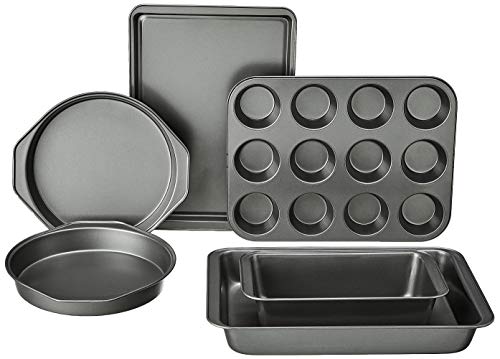
Amazon Basics 6-Piece Nonstick Carbon Steel Bakeware Set
Best first set
Cake, muffin, cookie and loaf pans in one box, with the deepest review history of any full set in the category by a wide margin. If you’re equipping a kitchen from nothing and don’t yet know which shapes you’ll reach for, this is the cheapest way to find out. Spend more later, once you know what you bake.
The honest trade: the listing never says what the coating is. It’s described by what it does, not what it’s made of, and we couldn’t find a published AB 1200 disclosure for the line. So you can’t tell a fluoropolymer from a ceramic sol-gel before you buy. If that distinction is the reason you’re reading, buy the Nordic Ware or the USA Pan instead.

USA Pan Bakeware Half Sheet Pan, Set of 2, Aluminized Steel
Best when you want the coating answered in writing
The only pick here where you can read the manufacturer’s own legal filing before you buy. USA Pan’s California AB 1200 disclosure covers its aluminised steel bakeware line and lists metals only — iron, manganese, nickel, aluminium, phosphorus, chromium, copper, vanadium. No fluoropolymer, no PFAS compound. That’s a document filed under a law with civil penalties behind it, which puts it in a different category of evidence from a bullet point.
The honest trade: two pans, not a set, and noticeably more per pan than the multi-piece sets. The release surface is still a surface — it simply isn’t a fluoropolymer according to the filing.
Good, with one caveat
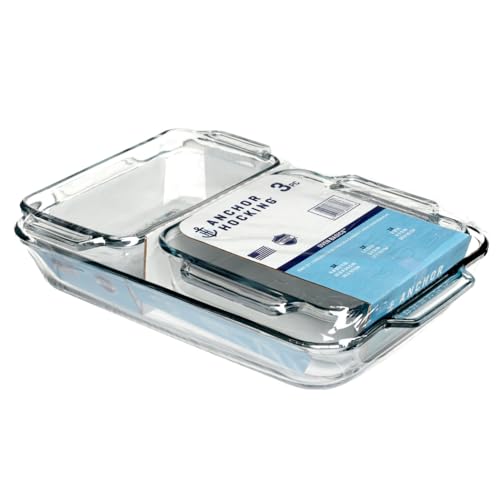
Anchor Hocking Glass Baking Dishes, 3-Piece Set
Best glass set for everyday casseroles
A 3-quart casserole, a cake pan and a bread pan — the three glass shapes households actually use — from a maker with a long American manufacturing history and a deep, stable review record. Non-reactive, no coating, oven to table, dishwasher-safe without any of the caveats coated metal comes with.
The honest trade: tempered soda-lime, not borosilicate. The roughly 100°F differential applies, and it applies strictly. No fridge-to-hot-oven, no hot dish onto a wet or stone counter, no cold liquid into a hot dish. Treated that way it lasts decades. Treated carelessly, this is the category that fails loudly.

MALACASA Ceramic Baking Dishes, Set of 4
Best ceramic set for gratins and serving
Four graduated rectangular dishes with proper handles, plain white, with no decoration on the inside surface — which is the detail we’d look for, since decorative pigment on a food surface is where glaze concerns actually sit. Ceramic heats slowly and holds heat long after it leaves the oven, so a gratin reaches the table still bubbling.
The honest trade: we couldn’t find published lead or cadmium test results from the brand, so you’re relying on the FDA import limits rather than a disclosure. That’s the norm across mainstream ceramic bakeware rather than a mark against this set, but it’s a thinner paper trail than the USA Pan has. They’re also heavy, they chip at the rim if you stack them carelessly, and they take longer to preheat than metal.
The full shortlist, side by side
The five above, plus the others we considered. Everything here met our rating threshold; the ones we didn’t write up have shallower review histories or a specific limitation, noted in the last column.
| The set | Material | Best for | The honest trade | |
|---|---|---|---|---|
| Nordic Ware Naturals Half Sheet, 2-Pack | Uncoated aluminium | Most kitchens; no coating question | Stains, reacts with acid, needs parchment | Check price |
| Amazon Basics 6-Piece | Non-stick carbon steel | A first set | Coating never named; no filing found | Check price |
| USA Pan Half Sheet Pan, Set of 2 | Aluminised steel | A coating answer you can read | Two pans, not a set; costs more per pan | Check price |
| Anchor Hocking Glass 3-Piece | Tempered soda-lime glass | Everyday casseroles | ~100°F differential rule applies strictly | Check price |
| MALACASA Ceramic, Set of 4 | Glazed stoneware | Gratins, lasagna, oven-to-table | No published glaze results; heavy; chips | Check price |
| Bakken 6-Piece | Non-stick carbon steel | Budget set stating PFOA, PFOS and PTFE free | A listing claim, not a filing; no cooling rack | Check price |
| CAROTE 7-Piece | Non-stick carbon steel | Buyers who want a PFAS-free label | 446°F ceiling, below some recipes; no filing found | Check price |
| NutriChef 8-Piece Stackable | Non-stick carbon steel | Small kitchens, shallow cupboards | Stacking means lighter gauge than the sheet pans | Check price |
| HONGBAKE 12-Piece | Non-stick carbon steel | Widest shape coverage in one purchase | 120 of the “pieces” are paper muffin liners | Check price |
| KITESSENSU 19-Piece Compact | Non-stick carbon steel | Toaster ovens and small ovens | Compact by design — too small for a full roast | Check price |
| Amazon Basics Glass 6-Piece | Borosilicate glass | The widest thermal-shock margin | Shallower review history; lids aren’t oven-safe | Check price |
Specifications and availability were checked in September 2026. Coatings, oven ratings and disclosures can change without a listing changing, so re-check the manufacturer’s AB 1200 page before relying on a safety claim.
What we wouldn’t buy
- Any set whose only safety statement is “PFOA-free”. PFOA left US non-stick manufacturing years ago. Advertising its absence in 2026 means advertising the absence of something nobody was going to add.
- Headline piece counts above about fifteen in this price range. The count is padded with liners, spatulas and racks, and the money that should have gone into metal went into filler.
- Brightly glazed or decorated imported ceramic bought as bakeware. Decoration on a food surface is where lead and cadmium concerns actually live. Use those pieces for serving.
- Any glass dish you plan to move from the fridge into a preheated oven. That isn’t a brand issue. It applies to every glass dish you own.
- Unbranded silicone that names no standard. A manufacturer who won’t cite FDA 21 CFR 177.2600 or an equivalent is telling you something by leaving it out.
Popular Bakeware Brands and Affordable Alternatives
Plenty of bakeware searches start with a brand seen on social media rather than with a material. That’s a reasonable place to start and a poor place to finish, because the brand tells you about the finish and the marketing while the material and the disclosure tell you about the pan. Here’s how the most-searched names compare, and what to buy instead when price is the obstacle.
Staub Bakeware and Cast-Iron Alternatives
Staub bakeware is enameled cast iron, and its reputation for heat retention is deserved — it’s the right material for a cobbler crust or a loaf with a hard bottom. It also costs several times anything on our list. The property doing the work is thermal mass rather than the badge, so heavy enameled cast iron from any established maker, or thick-walled stoneware, gets you most of the way there. Enamel is a glass glaze, so the ceramic guidance above applies. The drawback for all of it is weight, plus enamel that chips if you knock it against a tap.
Caraway Bakeware and Ceramic-Coated Alternatives
Caraway bakeware is popular for its ceramic non-stick coating and its colours. One thing to understand before paying the premium: ceramic sol-gel coatings are not more durable than fluoropolymer ones. As a class they tend to lose their release properties sooner. What the premium buys is a coating outside the PFAS class, not a coating that lasts longer. If that’s what you want and the price is the obstacle, the CAROTE and Bakken sets in our table make comparable class-level claims for far less — with the caveat, noted in the table, that a claim on a listing is weaker evidence than a filing.
Rachael Ray and Other Colourful Non-Stick Ranges
Rachael Ray cookware & bakeware and similar branded ranges are attractive, widely stocked, and priced above generic sets that share their construction. Compare them on the three things that actually differ: metal gauge, since thicker resists warping; the stated oven-safe temperature, because 446°F against 500°F is a real difference in what you can cook; and whether the brand publishes an AB 1200 disclosure. On those three, several sets in our table do better than ranges that cost more.
How to check any brand in fifteen seconds
This works for every brand in the category, including ones we haven’t named. Search the brand plus “AB 1200”. Three outcomes:
- A disclosure page listing only metals. The strongest result available. The manufacturer has stated, in a document with penalties attached, that no fluoropolymer is intentionally added.
- A disclosure page listing PTFE, PFA, FEP or “fluoropolymers”. Also useful, because now you know. Some brands file one blanket sentence covering the whole catalogue, which is compliant but tells you nothing model by model.
- Nothing. Either the brand sits outside the law’s reach, or a page exists that you haven’t found, or it hasn’t published one. Either way the retail listing is all you have to go on.
How to Choose the Best Bakeware Set for Your Kitchen
With so many materials, shapes, and brands, choosing the best bakeware set can feel overwhelming. Use these criteria to make a smart decision:
- Your oven size: Measure interior width and depth to avoid pans that don’t fit side by side.
- Your favorite recipes: If you bake more bread than cookies, prioritize loaf pans and Dutch ovens.
- Heat distribution: For even browning, look for heavy-gauge aluminum or aluminized steel.
- Non-stick vs. uncoated: Non-stick is easier to use and clean; uncoated metal tolerates higher heat and is better for crisp edges.
- Cleaning routine: If you rely on the dishwasher, choose dishwasher-safe materials like stainless steel or borosilicate glass.
- Budget and durability: A mid-range set with a few specialty pieces is often better than a huge low-quality set.
- The stated oven temperature: Check it before you buy. A 446°F ceiling quietly removes a number of bread and roasting recipes from your options.
For beginners, a simple starter kit of one baking sheet, one muffin pan, one loaf pan, and two cake pans is enough. As your skills grow, you can add Bundt cake bakeware, tart pans, and specialty molds. If you’d rather have this broken down step by step than by product, our walkthrough of choosing bakeware piece by piece covers shapes, sizes and gauges in more detail.

Care and Maintenance Tips to Extend the Life of Your Bakeware
Proper care keeps your bakeware performing like new and protects your investment. Follow these best practices:
- Cool pans slightly before washing to avoid warping.
- Soak baked-on residue in warm, soapy water instead of scraping with metal tools.
- Use gentle sponges; avoid steel wool on non-stick or enameled surfaces.
- Line baking sheets with parchment or silicone mats to reduce staining and sticking.
- Store glass and ceramic bakeware with a soft cloth or paper between pieces to prevent chipping.
- With glass, dry the outside of the dish before it goes into the oven, and never set a hot dish on a wet, cold or stone surface.
Non-stick pans have a service life rather than a lifetime. Our guide to cleaning non-stick surfaces without wrecking them covers what actually shortens a coating’s life.
Frequently Asked Questions About Bakeware
Is non-stick bakeware safe?
Yes, modern non-stick bakeware is considered safe when used within the recommended temperature range and when the coating is intact. Avoid overheating empty pans, and replace bakeware with badly scratched or peeling surfaces. The more useful question isn’t whether it’s safe but what the coating actually is — check the manufacturer’s AB 1200 disclosure rather than the “PFOA-free” bullet.
What is the safest bakeware material?
Uncoated aluminium and uncoated stainless steel remove the coating question entirely, and glass and ceramic have no coating to fail. Among coated pans, aluminised steel from a manufacturer that publishes an AB 1200 disclosure listing only metals gives you the strongest documentation available to a home buyer. In practice “safest” means the material whose risk you can verify, which is why we weigh documentation alongside chemistry.
Does “PFOA-free” mean a pan has no PFAS?
No, and it’s the most common misunderstanding in the category. PFOA is one compound inside the much larger PFAS class, and it was phased out of US non-stick manufacturing years ago. A pan can be truthfully PFOA-free while its coating is still a fluoropolymer, which is a PFAS. Since 2023, California law has restricted claims that cookware is free of a chemical when other chemicals from the same class have been intentionally added — which tells you how routinely the claim was being used.
Is Pyrex borosilicate glass?
Not in the United States. The US formulation was changed to tempered soda-lime before the brand was licensed to its current manufacturer, so American Pyrex bakeware is soda-lime. European Pyrex, made by a different company, is borosilicate. The practical consequence is margin: published work on glass cookware puts borosilicate at roughly a 330°F tolerable temperature differential and soda-lime at roughly 100°F. Soda-lime is safe used correctly, it just leaves less room for error than the reputation suggests.
Do I really need Bundt cake bakeware?
You can bake cakes in regular round or loaf pans, but Bundt cake bakeware creates tall, decorative cakes with great presentation for celebrations. If you regularly bake for special occasions, owning at least one Bundt pan is worth it.
How many pieces should the best bakeware set include?
A compact but versatile best bakeware set typically includes 8–10 pieces: two baking sheets, two cake pans, one loaf pan, one muffin pan, one roasting pan, and one or two specialty pans. It’s better to invest in a smaller high-quality set than a large set of thin, low-performing pieces. Count pans, not pieces.
Does the FDA lead warning about cookware apply to bakeware?
No. The FDA’s warning, first issued in August 2025 and updated since, concerns imported aluminium, brass and aluminium-alloy cooking pots — pots, pans, kadais, topes and milk pans from named importers, mostly sourced from India and Pakistan. It doesn’t cover baking pans, sheet pans or bakeware sets. Several articles have blended the two. They’re separate issues and the advice doesn’t transfer.
Is silicone bakeware safe in the oven?
Food-grade silicone meeting FDA 21 CFR 177.2600 is intended for repeated food contact and is fine within the manufacturer’s stated temperature range. Two practical points. The regulation sets extraction limits rather than a universal maximum temperature, so the number on the box is the manufacturer’s claim. And silicone should sit on a metal sheet in the oven, because a full flexible pan is awkward to move safely. Treat unbranded silicone citing no standard as unknown rather than equivalent.
Sources Reviewed
- California Health and Safety Code section 109013 (added by Stats. 2021, Ch. 503, Sec. 1 — AB 1200), on claims that cookware is free of a chemical.
- California Assembly Bill 1200 (2021), Safer Food Packaging and Cookware Act — statutory text, California Legislative Information.
- California Department of Toxic Substances Control — Chemical Disclosures for Cookware guidance.
- California Attorney General — AB 1200 Enforcement Advisory (1 January 2023 for website disclosure, 1 January 2024 for product labels).
- USA Pan — California AB 1200 Regulation Information, disclosure for Aluminized Steel Bakeware Products.
- US FDA — Compliance Policy Guide 545.450, lead action levels for ceramic hollowware by vessel type.
- US FDA — “FDA Issues Warning About Imported Cookware That May Leach Lead”, August 2025, updated December 2025.
- eCFR — 21 CFR 177.2600, Rubber articles intended for repeated use.
- OEHHA / Proposition 65 — lead no-significant-risk level and maximum allowable dose level.
- The American Ceramic Society — thermal stress and glass cookware that shatters, including the borosilicate and soda-lime differential thresholds and the Consumer Reports investigation summarised there.
- Manufacturer product documentation and current retail listings for each set named, checked September 2026.
Choosing Well Once, Instead of Replacing Cheaply Twice
Choosing bakeware doesn’t have to be complicated. Decide first whether you want a coating at all, because that one decision removes most of the market and all of the anxiety. If you do want one, buy from a brand that publishes what’s in it. If you don’t, buy uncoated aluminium or aluminised steel, keep parchment in the drawer, and accept that your pans will look used. Either route gives you bakeware still working in ten years, which no piece count can promise.
Keep reading
- How to choose bakeware piece by piece — shapes, sizes and gauges, if you want the decision rather than the products.
- Non-toxic bakeware: safe materials and what to avoid — the safety question on its own, in more depth.
- What “PFOA-free” actually means — the label that misleads more buyers than any other.
- Is silicone safe for cooking?
- Which cookware can actually go in the oven
- The non-toxic cookware guide — the same questions, applied to the stovetop.


