
Written by Lara Yehia. Lara researches home and kitchen products for Cupindy.
Published November 2026 · Last reviewed November 6, 2026
Short answer: if you will own one big knife, buy a chef's knife (here are the six we checked). Buy a santoku if you mostly cut vegetables, boneless meat and fish, and you chop straight down instead of rocking the blade.
As an Amazon Associate we earn from qualifying purchases.
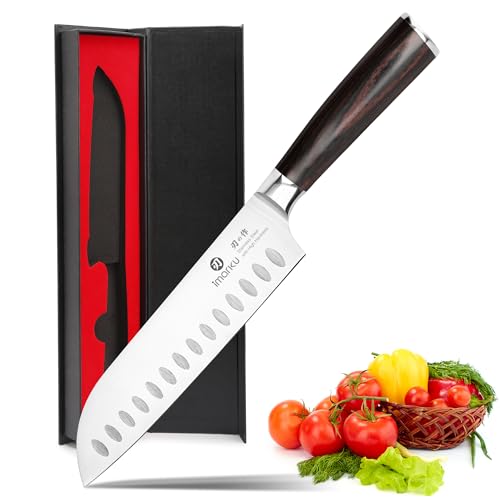
Our quick pick
imarku 7-Inch Santoku Knife
A forged santoku in high-carbon stainless steel with a hollow edge and a Pakkawood handle. The listing gives the edge as 15 to 18 degrees per side.
See the imarku on AmazonThe drawback: imarku names no steel grade, only Japanese high-carbon stainless steel, and the listing says old and new versions will ship at random.
How we put this together: on November 6, 2026 we read each knife's Amazon listing and its maker's care and sharpening pages. We did not test these knives. Cupindy is not affiliated with any of these brands.
Santoku vs Chef Knife at a Glance
Both are all-purpose knives. They differ in length, in the shape of the edge, and in how you move the blade through food.
| Chef's knife | Santoku | |
|---|---|---|
| Usual blade length | 8 inches, sometimes 10 | 5 to 7 inches |
| Edge | Curves from heel to tip | Nearly flat, lifting only near the tip |
| Tip | Pointed | Rounded, with the spine dropping down to meet the edge |
| Cutting motion | Rocking, plus push and pull cuts | Straight down, or down and forward |
| Edge angle (Wüsthof FAQ) | 14° per side | 10° per side |
| Best at | Big or hard food, carving, rocking through herbs | Vegetables, boneless meat, fish, thin slices |
Other makers grind their santokus differently, so the edge angle section below matters more than the label on the box.
The Best Santoku Knives: 6 We Checked
Each one is a santoku sold on Amazon in the US, shown with what its maker says about washing it. We list no prices because they change daily; the buttons open the listing.
As an Amazon Associate we earn from qualifying purchases.
| Knife | Maker's wash rule | Buy |
|---|---|---|
|
imarku 7-inch Our quick pick. Forged, hollow edge, 15 to 18° |
Avoid the dishwasher when you can | See it |
|
Mercer Millennia 7-inch Budget pick. Stamped, high-carbon Japanese steel |
Never in the dishwasher | See it |
|
Victorinox Swiss Classic 7-inch Stamped, fluted edge, 6.7 in |
Dishwasher safe | See it |
|
Wüsthof Gourmet 5-inch Shortest blade. Stamped, hollow edge |
Hand wash only | See it |
|
Babish 6.5-inch Forged, Granton edge, 1.4116 steel |
Dishwasher not recommended | See it |
|
Henckels Classic 7-inch Forged, hollow edge, triple rivet handle |
Henckels advises against the dishwasher | See it |
Blade Shape: Flat Edge vs Curved Belly
A chef's knife curves from heel to tip. You keep the tip on the board and rock the heel up and down, which is how most people mince parsley or a pile of garlic.
A santoku's edge runs nearly flat for most of its length and lifts only near the end, where the spine drops down to meet it in a rounded tip, often called a sheepsfoot.

The chef's knife curves along its whole edge. The santoku stays almost flat until just before the tip.
Rocking a santoku is awkward, because only a short stretch of edge touches the board at a time. So you lift the whole knife and cut straight down, or push it down and forward through the food. That push cut is quick and tidy on a heap of green onions or sliced mushrooms.
The tip matters too. A chef's knife has a point for scoring, piercing and working around a joint. A santoku's rounded tip does that work poorly. Some makers sell santokus with extra curve, marketed as rocking santokus, if you want both.

A push cut: down and forward in one stroke, the knife lifted clear between cuts.
What Is a Santoku Knife Used For?
Mercer's listing names the everyday jobs well: dicing onions, mincing shallots, chopping herbs, crushing garlic and shredding cabbage. Wüsthof points it at fine work such as mincing garlic and slicing fish and meat. A thin blade and a flat edge make even, thin slices easy, which is why cooks who prep a lot of vegetables like one.
Skip it for bones, joints and frozen food. Shun tells owners not to use its knives on them, and Babish says its knives are not made for bones or frozen food. A big squash or a watermelon is easier with the length and weight of a chef's knife, and so is carving a roast.
As an Amazon Associate we earn from qualifying purchases.

Budget pick
Mercer Culinary Millennia 7-Inch Santoku Knife
A light, stamped 7-inch blade of high-carbon Japanese steel, by Mercer's description, with a textured grip.
Good for: a first santoku, or a second knife next to a chef's knife
The drawback: Mercer names no steel grade, and its warranty excludes damage from dishwasher use. The listing title says Granton edge but the spec box says plain, so check the photos.
See the Mercer on AmazonIs a Santoku Sharper? Edge Angles by Maker
You will often read that a santoku is sharper than a chef's knife. That holds for some brands and is not a rule. The edge angle is the slope ground on each side of the edge. A lower number means a thinner, keener edge that also chips more easily.
| Maker | Santoku, per side | Chef's knife, per side |
|---|---|---|
| Wüsthof | 10° | 14° (its blog says 14.5°) |
|
Zwilling the company behind Henckels |
9 to 12° on a honing steel | About 15° on a honing steel |
| Shun | 16°, its general angle (no santoku figure) | 22° on its Classic Western cook's knife |
| imarku Amazon listing |
15 to 18° | Not compared |
| Mercer, Victorinox, Babish | Not stated on the pages we read |
So a Wüsthof santoku is ground 4 degrees finer than a Wüsthof chef's knife, while Shun's general 16 degrees and imarku's stated 15 to 18 are both wider than that Wüsthof chef's knife. Compare within one brand, not across the whole category.
A fine edge asks for gentle use: no twisting through hard food, no scraping food across the board with the edge, and a wood or soft plastic board, which is what Babish asks for. Our cutting board guide covers which boards are kind to an edge.
As an Amazon Associate we earn from qualifying purchases.

The finest stated edge here
WÜSTHOF Gourmet 5-Inch Hollow Edge Santoku
A laser-cut stamped 5-inch blade of high-carbon stainless steel with a hollow edge. The listing describes a 10-degree cutting edge, which matches the 10 degrees per side Wüsthof gives for its santokus, and says hand wash only.
Good for: small hands, a small board, quick prep for one or two
The drawback: Five inches is short for a cabbage, a squash or a big batch of onions, so you make more cuts.
See the Wüsthof on AmazonDo the Dimples (Granton Edge) Stop Food Sticking?
Most of our six have a row of shallow scallops above the edge, sold as a hollow, fluted or Granton edge.
Every maker that explains the scallops makes the same claim. Wüsthof says the scallops “create small air pockets between the blade and the food”. Henckels says they “prevent food from sticking while cutting”, and Victorinox describes a fluted edge “to reduce sticking and friction”.
We did not test this, and none of the pages we read cites a test. Even if the scallops work as claimed, they matter on wet, flat slices such as potato, cucumber or zucchini, and not at all for herbs or a fine onion dice. A sharp edge does more. If you want them anyway, our quick pick has them, and so does the Henckels Classic hollow edge santoku.

Granton scallops on a santoku, cutting potato, the kind of wet slice they are meant for.
Which Steel Each Knife Uses
Only one listing here names a steel grade. Babish says 1.4116 German steel, the German material number for X50CrMoV15, a stainless steel found in many German kitchen knives. Mercer says high-carbon Japanese steel, Henckels says German stainless steel, and imarku says Japanese high-carbon stainless steel. The Victorinox and Wüsthof listings say stainless steel or high-carbon stainless steel.
High-carbon on a stainless knife means a little more carbon for hardness, not a rust-prone carbon steel blade. Our guide to stainless steel grades explains how the numbers work, and the steak knife guide shows how loosely listings use words like German steel and Japanese steel.
As an Amazon Associate we earn from qualifying purchases.

The only one that names its steel
Babish 6.5-Inch Santoku Knife
A forged, full-tang 6.5-inch santoku in 1.4116 German steel with a Granton edge, which Babish says is tempered and hand-ground.
Good for: a cook who wants a forged, German-style santoku
The drawback: The spec box contradicts itself: it lists the blade as both 1.4116 German steel and carbon steel, and the handle as both stainless steel and black ABS.
See the Babish on AmazonCan a Santoku Go in the Dishwasher? What Each Maker Says
Wash it by hand. Two of these six listings allow the dishwasher, the Victorinox and the Henckels, yet both makers steer you to the sink on their own care pages. The other four say hand wash.
| Knife | The Amazon listing | The maker's own care page |
|---|---|---|
| Victorinox Swiss Classic | Dishwasher safe | Synthetic-handle household knives are dishwasher-safe, but Victorinox recommends washing all large knives by hand |
| Henckels Classic | In the dishwasher or by hand | Most Henckels knives are dishwasher safe, but Henckels does not recommend it |
| Mercer Millennia | Do not place in the dishwasher; the warranty excludes dishwasher damage | Cutlery should never go in a dishwasher |
| imarku | Not stated | Avoid the dishwasher whenever possible |
| Wüsthof Gourmet | Hand wash only | Its FAQ does not cover it |
| Babish | Dishwashers not recommended; do not soak | No separate care page read |
Henckels says banging against other cutlery will nick the edge, and that heat and detergent are not good for the handle. Mercer warns that heat and sudden temperature changes can make a handle deteriorate.
Wash by hand in warm, soapy water, dry the knife at once and put it away. Do not leave it to soak; Mercer and Babish both warn against that.

Hand washing: a soft sponge, the edge facing away from your hand, and a dry towel straight after.
As an Amazon Associate we earn from qualifying purchases.

If it will go in the dishwasher anyway
Victorinox Swiss Classic 7-Inch Santoku Knife
A light, stamped 6.7-inch Swiss Classic with a fluted edge and a synthetic handle. Its listing says dishwasher safe, and Victorinox's care page agrees for knives with synthetic handles.
Good for: a busy kitchen where someone will load it into the dishwasher regardless
The drawback: Victorinox still recommends hand washing large knives, and at 3.84 ounces on the listing it has little weight to help it through a hard squash or a sweet potato.
See the Victorinox on Amazon
Forged, with a traditional handle
HENCKELS Classic 7-Inch Hollow Edge Santoku
A forged 7-inch hollow edge santoku in German stainless steel with a triple rivet handle. Henckels' listing says it is made in Spain.
Good for: a cook who likes the weight and look of a classic German knife
The drawback: At 6.4 ounces by the listing it is one of the heavier knives here, which can tire your hand over a long chopping session. Wash it by hand, as Henckels' own care page advises.
See the Henckels on AmazonSo Which Should You Buy?
- One knife for everything: a chef's knife. Start with the chef knives we checked.
- You already own a chef's knife and cut a lot of vegetables: a 7-inch santoku. The imarku is our pick, and the Mercer Millennia is the budget pick.
- A small board or quick jobs: the Wüsthof Gourmet 5-inch.
- It will go in the dishwasher no matter what: the Victorinox Swiss Classic, knowing the edge will dull sooner.
- The third knife: a paring knife for peeling and small work. See our paring knife picks.
As an Amazon Associate we earn from qualifying purchases.
Our quick pick
imarku 7-Inch Santoku Knife
Forged, with a hollow edge, a Pakkawood handle and a stated edge of 15 to 18 degrees per side. That is closer to a German chef's knife than to the finest santoku edges, so it gives up a little keenness for a sturdier edge.
Good for: most cooks adding a santoku next to a chef's knife
The drawback: imarku names no steel grade, and its own FAQ says to keep the knife out of the dishwasher.
See the imarku on AmazonQuestions People Ask
What does santoku mean?
It is usually translated as "three virtues", the reading Wüsthof and Henckels both give, and the three are often explained as slicing, dicing and mincing. It is a Japanese all-purpose home knife.
Are santoku knives good?
Yes, for what they are built for: vegetables, boneless meat and fish, cut with a straight-down or push motion. They suit you less if you rock-chop, carve roasts or cut big squash. As an only knife, a chef's knife covers more jobs.
What is the difference between a santoku and a gyuto?
A gyuto is the Japanese take on the chef's knife: longer, with a curved edge and a pointed tip, so it can rock. A santoku is shorter and flatter, with a rounded tip. Most gyutos are 8 inches or longer; most santokus are 7 inches or under.
Santoku vs nakiri: which is better for vegetables?
A nakiri is a vegetable knife with a straight edge, a square end and no tip, made for chopping straight down. A santoku keeps a usable tip and handles meat and fish too. Wüsthof grinds both to the same angle.
What is the difference between a kiritsuke and a santoku?
A kiritsuke is longer, with a flat edge and an angled, pointed tip. Traditional ones are single-bevel slicers for experienced cooks, though many sold in the US are double-bevel. A santoku is easier to control and more forgiving.
Is a santoku single or double bevel? Can left-handed cooks use one?
Most santokus sold in the US are double-bevel, ground on both sides, so they work in either hand. A single-bevel santoku is ground on one side and made for one hand; the listing will say so. If you are left-handed, check for that line before you buy.
Should I get a 5-inch or a 7-inch santoku?
Seven inches is the usual size and handles a cabbage or a chicken breast without fuss; four of our six are about 7 inches and the Babish is 6.5. A 5-inch santoku, like the Wüsthof Gourmet, suits small hands, small boards and quick jobs.
How do you sharpen a santoku?
Hone often and sharpen at the maker's angle. Wüsthof sharpens its santokus at 10 degrees per side, and Zwilling says to hold a santoku at 9 to 12 degrees on the honing steel, finer than its other knives. A sharpener set for German knives, at about 14 or 15 degrees, slowly turns a 10-degree edge into a wider one. Our chef knife guide covers honing and sharpening step by step.
Sources (opened November 6, 2026; the six Amazon listings were read the same day from the US store)
- WÜSTHOF: FAQ (sharpening angles)
- WÜSTHOF: The right knife for the job, santoku
- ZWILLING: Knife sharpening
- Henckels: Use and care
- Shun: Sharpening vs honing
- Shun: Use and care
- Victorinox: Knife care tips
- Mercer Culinary: Use and care
- imarku: FAQ
Brand names belong to their owners. Product details and listings change; check the listing and the maker's care guide before you buy.


