

Choosing a non-toxic cutting board is not just about “wood vs plastic.” The safest option depends on the material, surface condition, cleaning routine, knife wear, raw-meat handling, and whether the board is still in good condition.
Quick Answer: What Is the Safest Cutting Board Material?
For most home kitchens, the safest cutting board material is a well-maintained solid hardwood board, such as maple, walnut, beech, or cherry. These woods are durable, knife-friendly, and suitable for everyday vegetables, fruit, bread, and general prep when cleaned and dried properly.
For raw meat, poultry, and seafood, many households benefit from using a separate dishwasher-safe plastic or composite board because it is easier to clean, sanitize, and replace once deeply grooved. The safest setup is usually not one perfect board, but a two-board system: one board for raw proteins and one board for ready-to-eat foods.
Best Choices at a Glance
- Best overall: solid hardwood such as maple, walnut, beech, or cherry.
- Best for raw meat: a separate dishwasher-safe plastic, composite, or rubber board that is replaced when worn.
- Best plastic-free option: hardwood or bamboo with a clearly food-safe finish.
- Best low-maintenance option: composite fiber board, if the manufacturer confirms food-contact use.
- Best knife-friendly option: hardwood or rubber, rather than glass, steel, titanium, or marble.
- Best to avoid: cracked wood, deeply grooved plastic, delaminated bamboo, unknown coatings, and decorative boards not made for food prep.
In This Guide
- Best non-toxic cutting board options by use case
- How we evaluated cutting board safety
- Safest cutting board materials compared
- Material comparison table
- Titanium boards and the knife question
- Composite and wood-fibre boards
- Most hygienic material, compared
- What we’d buy
- What to avoid
- Safest cutting board for raw meat
- Microplastics and non-plastic boards
- Most hygienic cutting board setup
- Cleaning, maintenance, and replacement signs
- FAQ
Best Non-Toxic Cutting Board Options by Use Case
If you are searching for the best non-toxic cutting board, the smartest answer is to choose by use case. A board that is excellent for vegetables may not be the easiest option for raw chicken, and a board that is very hygienic may be harsh on knives.
Note: This guide compares material types and use cases first. The named picks further down are chosen from published manufacturer information, specification fields and listing data — not from lab testing.
| Use case | Best material type | Why it works | Main caution |
|---|---|---|---|
| Best overall | Solid hardwood | Durable, knife-friendly, long-lasting, and suitable for daily prep. | Needs proper drying and occasional oiling. |
| Best plastic-free option | Hardwood, bamboo, or quality composite | Avoids a plastic cutting surface while still offering practical daily use. | Check finish, adhesive quality, and manufacturer food-contact claims. |
| Best for raw meat | Separate dishwasher-safe plastic, composite, or rubber board | Easier to clean, sanitize, and replace once heavily worn. | Replace when deeply grooved, warped, stained, or odor-retaining. |
| Best low-maintenance board | Composite fiber | Often thin, durable, and easier to clean than traditional wood. | Follow the manufacturer’s dishwasher and heat guidance. |
| Best to reduce plastic cutting-surface exposure | Wood, bamboo, glass, stainless steel, or titanium | Uses a non-plastic cutting surface. | Glass, steel, and titanium can be very hard on knives. |
| Most non-porous surface | Stainless steel or titanium | Easy to wipe clean and does not absorb juices. | Can feel slippery, noisy, and damaging to knife edges. |
Bottom line: for most households, the best setup is a solid hardwood board for everyday prep plus a separate, easy-to-clean board for raw meat, poultry, and seafood.

How We Evaluated Cutting Board Safety
We evaluated cutting board materials as a practical home-kitchen safety guide, not as medical advice or a product certification test. The goal is to help you choose a board that is realistic, durable, cleanable, and suitable for everyday cooking.
What This Guide Does Not Claim
This guide does not claim that any cutting board material is completely risk-free, permanently sanitary, or suitable for every household. Cutting board safety depends on the material, food-contact finish, cleaning habits, surface condition, and replacement timing.
We do not rank brands by lab testing, because product construction, adhesives, finishes, and dishwasher guidance vary by manufacturer and we do not run a testing lab. Where we name a specific board, we say what the recommendation is based on and what its drawback is. Always check the product label and care instructions before using a board for food preparation.
Best Everyday Choice
Solid hardwood is usually the best balance of safety, durability, knife comfort, and long-term value.
Best Raw-Meat Setup
Use a separate board for raw meat, poultry, and seafood to reduce cross-contamination risk.
Replace Immediately
Discard boards with deep grooves, cracks, delamination, odor retention, or heavy staining.
Safest Cutting Board Materials Compared
The safest cutting board material depends on how you use it. Below is a practical breakdown of the most common non-toxic cutting board options and where each one fits best.
1. Solid Hardwood Cutting Boards
Solid hardwood boards made from maple, walnut, beech, cherry, or similar dense woods are among the best everyday choices. They are strong, knife-friendly, and can last for years when cleaned, dried, and oiled properly.
Hardwood works especially well for vegetables, fruit, bread, herbs, and general prep. It is also a good plastic-free option for households trying to reduce plastic contact in the kitchen.
- Best for: everyday prep, vegetables, fruit, bread, herbs, and serving.
- Main caution: do not soak it, put it in the dishwasher, or leave it wet.
- Replace or repair when: the board cracks, warps, smells, or develops deep splits.
For broader wooden kitchen tools, read Cupindy’s wooden kitchenware pros and cons guide.
Wood Grain and Finish Matter
For wooden cutting boards, the wood type is only part of the safety picture. Grain style and finish also matter.
- End-grain boards: often more premium, gentler on knives, and better at hiding knife marks, but they need more maintenance and careful drying.
- Edge-grain boards: common, durable, usually more affordable, and easier for many households to maintain.
- Food-safe finishes: look for food-safe mineral oil, beeswax, or board conditioner when appropriate.
- Avoid: unknown stains, varnishes, decorative finishes, or antique boards with unclear coatings.
Does Wood Have Natural Antimicrobial Properties?
Some research suggests that certain hardwood surfaces may reduce recoverable bacteria compared with some worn plastic surfaces, especially when wood is cleaned and allowed to dry properly. However, this does not mean wood is automatically safe or self-cleaning.
For home kitchens, the safest rule is still simple: wash the board after use, dry it fully, avoid deep cracks, and use separate boards for raw proteins and ready-to-eat foods.
2. Food-Grade Plastic Cutting Boards
Food-grade plastic cutting boards are common because they are affordable, lightweight, and often dishwasher-safe. They can be practical for raw meat, poultry, and seafood because they are easy to wash and replace.
The main issue is wear. As plastic boards become deeply scored, they may trap residue and become harder to clean. Heavy knife use can also create small plastic particles, so replacement timing matters.
- Best for: raw meat, poultry, seafood, and quick dishwasher cleaning.
- Main caution: do not keep using deeply grooved or rough-textured plastic boards.
- Replace when: deep grooves, fuzzy texture, warping, odor, or discoloration appear.
3. Bamboo Cutting Boards
Bamboo is a popular non-plastic cutting board option. It is lightweight, attractive, and generally more moisture-resistant than many softer woods. However, bamboo is technically a grass-based material and is often made with adhesives, so quality matters.
Bamboo can also be harder on knives than many hardwood boards. It may be a good option for light prep, but it is not always the most knife-friendly choice for heavy daily chopping.
- Best for: light prep, serving, and plastic-free kitchens.
- Main caution: choose boards with clear food-safe finish and adhesive claims.
- Avoid when: the board cracks, splinters, separates, or feels overly rough.
4. Composite Fiber Cutting Boards
Composite fiber boards are usually made from compressed paper, wood fiber, or similar materials bonded with resin. They can offer a useful middle ground between wood and plastic: thin, durable, and often easier to clean than traditional hardwood.
Because composite boards vary by manufacturer, always check whether the board is intended for food contact and whether it is dishwasher-safe.
- Best for: low-maintenance kitchens, thin storage, and multi-purpose prep.
- Main caution: heat and dishwasher guidance depends on the manufacturer.
- Replace when: the surface chips, delaminates, smells, or becomes deeply worn.
5. Rubber and Synthetic Rubber Cutting Boards
Rubber and synthetic rubber cutting boards are used in some professional-style kitchens because they can be stable, knife-friendly, and easier to clean than damaged wood. They may be a strong option for serious home cooks who want a durable board without using a very hard glass, steel, or titanium surface.
The main caution is material transparency. Choose boards clearly intended for food preparation, follow the manufacturer’s cleaning instructions, and replace the board if it becomes deeply cut, sticky, cracked, warped, or difficult to clean.
- Best for: serious home cooks, knife-friendly prep, and stable chopping.
- Main caution: quality, material details, and cleaning instructions vary by manufacturer.
- Replace when: deeply scored, cracked, sticky, warped, or odor-retaining.
6. Stainless Steel and Titanium Cutting Boards
Stainless steel and titanium cutting boards are getting attention because they are non-porous, easy to wipe clean, and do not absorb juices like damaged porous surfaces can. For hygiene-focused users, that can sound appealing.
However, they are very hard cutting surfaces. They may dull knives faster than wood, bamboo, plastic, or composite boards. They can also feel slippery and noisy during chopping.
- Best for: light prep, hygiene-focused tasks, and users who prioritize non-porous surfaces.
- Main caution: not ideal as the only daily chopping board if knife protection matters.
- Better use: slicing, serving, or specific raw-meat prep—not heavy chopping.
7. Glass and Marble Cutting Boards
Glass and marble are non-porous and easy to clean, but they are usually poor daily cutting surfaces. They are extremely hard on knives and may make chopping less controlled.
Use glass or marble boards mainly for serving, pastry work, or presentation rather than heavy chopping.
Cutting Board Material Comparison
This table summarizes the safest cutting board materials by use case, hygiene, maintenance, and replacement risk.
| Material | Best use | Main safety advantage | Main caution | Replace or avoid when |
|---|---|---|---|---|
| Solid hardwood | Everyday prep | Durable, knife-friendly, plastic-free surface | Needs drying and oiling | Cracked, warped, split, or odor-retaining |
| Plastic | Raw meat and quick cleaning | Affordable, replaceable, often dishwasher-safe | Deep grooves and wear over time | Heavily scored, rough, warped, or stained |
| Bamboo | Light prep and plastic-free use | Lightweight and moisture-resistant | Can be hard on knives; adhesive quality matters | Cracked, splintered, or delaminated |
| Composite fiber | Low-maintenance prep | Durable, thin, and often easier to clean | Material and heat tolerance vary | Chipped, delaminated, or deeply worn |
| Rubber / synthetic rubber | Serious prep and knife-friendly chopping | Stable surface, often gentler on knives than glass or metal | Material details and cleaning rules vary by manufacturer | Deeply scored, sticky, cracked, warped, or odor-retaining |
| Stainless steel / titanium | Light prep and hygiene-focused use | Non-porous and easy to clean | Hard on knives and can be slippery | If it damages knives or makes prep unsafe |
| Glass / marble | Serving or pastry work | Non-porous and easy to wipe clean | Very hard on knives | For heavy daily chopping |

Titanium Cutting Boards: What You Are Actually Buying
Titanium boards are the newest thing in this category and the least documented. Before the knife question, the more useful question is what the board is made of, because the answer is often not what the product name says.
Most "titanium" boards are not solid titanium
Read the material fields rather than the titles. Across the titanium boards we read on Amazon, the common construction is a titanium sheet bonded to a plastic backing, with the two faces meant for different jobs: metal for raw protein, plastic for produce. The board we link below is described by its own seller as Pure Titanium/PP — titanium on one side, polypropylene on the other. That is a reasonable product. It is not a titanium board in the way most buyers picture one, and roughly half of it is a plastic cutting surface with every property a plastic cutting surface has.
Others are vaguer. One listing we read gave its material field as "Rubber, Titanium" while its title said titanium and PP. Another was sold under the brand name "Generic" with two customer ratings. In a category this young, the specification field and the title disagreeing is the single most common warning sign.
Do titanium cutting boards dull knives?
This is the question the category is searched on, and the honest answer has three parts.
- It depends which face you use. On a two-sided titanium and plastic board, half your cutting happens on polypropylene, which is softer than your knife and behaves like any other plastic board.
- Hardness alone does not support the "it will wreck your edge like glass" claim. Published hardness figures put commercially pure titanium well below hardened kitchen-knife steel, and below soda-lime glass. On the numbers, a pure titanium surface is softer than the blade crossing it — which is why these boards scratch and scuff with use. Glass and marble are a genuinely different case.
- Hardness is the wrong measure anyway. What a knife edge wants is give. Wood, rubber, plastic and composite all yield a fraction of a millimetre and let the edge sink in. A rigid metal sheet does not, so the edge absorbs the impact instead. The failure mode is rolling and micro-chipping rather than abrasive wear. It is a different way to lose an edge, but it is still losing an edge, and it is worse with heavy chopping than with slicing.
What nobody has published: a controlled edge-retention test of a titanium board against wood, plastic and composite. We have not run one, and we could not find one from anyone else. Every confident claim you will read on this question in either direction — including the ones saying titanium is gentle on knives — is reasoning from material properties, not from a measured result. Treat it that way.
The rest of the trade-off
- Genuinely non-porous. Nothing soaks in, nothing stains, and there is no groove for residue to sit in. This is the real reason to buy one.
- Loud and slippery. Metal under a knife is noisy, and food slides on it. Boards with non-slip feet and a juice groove help; boards without them are unpleasant.
- No chemical disclosure to check. None of the titanium listings we read named a chemical filing or a food-contact standard. See the note on disclosure below.
- Thin market history. Wood, plastic and bamboo boards have twenty years of customer reports behind them. Most titanium listings have months.
Titanium is a reasonable second board for raw protein if hygiene is your priority and you are willing to accept a hard surface. It is a poor choice as your only board, for the same reason the stainless steel and glass sections above give.
Composite and Wood-Fibre Cutting Boards: What They Are Made Of
Composite boards get recommended constantly as the sensible middle ground, and they often are. What almost nobody explains is what is actually in one, which matters if you are buying it specifically to avoid plastic.
How they are made
A paper or wood-fibre composite board is built from many layers of paper or wood fibre, infused with a thermosetting resin, stacked in alternating directions and pressed under heat and pressure until the resin cures into a solid sheet. Epicurean, the longest-established maker in this category, describes its own material as layers of "high-quality custom craft paper" put through exactly that process.
What the makers do not tell you
They do not name the resin. Epicurean’s own material page describes the process in detail and never says which thermosetting resin is used. The budget composite boards we read do not name it either — their listings say "composite fiber wood" and stop there. This class of material is conventionally made with a phenolic resin, but since none of these manufacturers states it, treat that as unstated rather than confirmed, and do not repeat it as fact.
This is worth being clear about, because composite boards are frequently sold to people who are trying to get away from plastic. A composite board is not wood. It is fibre plus a cured polymer binder, and the food-contact safety case rests on the binder being fully cured and inert — and, for Epicurean, on an NSF listing — not on there being no polymer in the board. Anyone describing a composite board as "just wood" has not read the material page.
Are wood-fibre cutting boards safe?
On the published evidence, the established ones have a stronger documentation trail than most wooden boards do: Epicurean states NSF certification for food contact, plus FSC and GREENGUARD Gold certifications, and its listing gives a 350°F heat limit. That is more than any bamboo board we read discloses about its own adhesive. The weaker cases are the cheap composites, which claim the same benefits with no certification named and, in the ones we looked at, fewer than a thousand customer ratings.
The real drawbacks
- They are thin and hard. A quarter of an inch of cured composite has no give and no heft. It will not feel like wood, and it slides unless it has feet.
- You cannot resurface them. A wooden board can be sanded and re-oiled for years. When a composite board is worn, it is finished.
- Knife marks show. They appear as pale lines against the darker surface. Cosmetic, but people mistake them for damage.
- Heat limits are real. The listing says 350°F and doubles as a trivet. A pan straight off a hot burner is well above that.
For related material questions in wooden kitchen tools, see Cupindy’s wooden kitchenware pros and cons guide.
Which Cutting Board Material Is Most Hygienic? A Direct Comparison
The section above makes the practical point that hygiene is mostly about your habits. This section answers the narrower question people actually search for: if you hold the habits constant, do the materials differ?
What the research found
The most-cited work here is Ak, Cliver and Kaspar, published in the Journal of Food Protection in 1994. They contaminated wooden and plastic blocks with bacteria and tried to recover them. On plastic, the bacteria were readily recovered for minutes to hours and multiplied if the block was held overnight. Recoveries from wood were generally lower, whether the wood was new or used, and the gap widened the longer the blocks were held. Treating the wood with mineral oil made little difference. Their own conclusion was that the results did not support what they called the often-heard assertion that plastic boards are more sanitary than wood.
Two honest caveats, because this study gets over-quoted. It is from 1994, it used blocks under laboratory conditions rather than boards in kitchens, and it predates the modern dishwasher-safe plastic and composite boards most people now own. It is evidence that wood is not the hygiene liability it was assumed to be. It is not evidence that a wooden board beats a plastic board that goes through a dishwasher.
The comparison that actually decides it
Ranked by the things that determine hygiene in a real kitchen rather than by material folklore:
| Material | Dishwasher sanitising | Condition when worn | Can it be resurfaced? | Painless to replace? |
|---|---|---|---|---|
| Plastic | Yes, if labelled dishwasher-safe | Worst case here: deep grooves and a fuzzy surface that will not clean | No | Yes — cheapest to replace of any material |
| Composite / wood fibre | Yes on the established brands | Chips and delaminates rather than grooving | No | Yes |
| Solid hardwood | No — hand wash only | Cracks and splits, which hold moisture | Yes — sand and re-oil | No — and this is the problem |
| Bamboo | No on every board we read | Splinters and separates at the glue lines | Barely — the laminations limit how much you can remove | Yes |
| Titanium / stainless steel | Varies by board; wipes clean regardless | Scuffs and scratches without becoming porous | No, and it does not need it | No — expensive per board |
| Glass | Yes | Stays non-porous; can chip | No | Yes |
The answer, plainly: on a new board, the non-porous materials — titanium, stainless steel, glass and unworn plastic — are the easiest to get clean. But no board stays new. Over a board’s life the material that keeps you safest is the one you will actually throw away on time, and that is decided by price, not by physics. A worn plastic board costs almost nothing to replace and gets replaced. A hardwood board that cost as much as a good knife is the one people keep using with a crack in it for another two years. If you buy one expensive board, commit to sanding and re-oiling it. If you will not do that, buy the cheap board and replace it.
A note on chemical disclosure
California’s AB 1200 requires cookware makers to publish intentionally added chemicals from a candidate list, and it defines cookware as durable houseware items used to prepare, dispense or store food. A cutting board fits that wording on its face. In practice, none of the twelve boards we read for this guide — wood, bamboo, composite, plastic or titanium — carries an AB 1200 disclosure, a candidate-chemical list or a QR code to one. Whether the statute was intended to reach cutting boards has not, as far as we can find, been tested. The practical consequence for a buyer is simple: unlike a frying pan, a cutting board gives you no filing to look up, so the material field and the care instructions on the listing are all you have. Read them, and treat a listing whose title and specification field disagree as a listing you cannot verify.
What We’d Buy
Advertising disclosure: Cupindy is a participant in the Amazon Services LLC Associates Program. If you buy through the links below, we may earn a commission at no extra cost to you. As an Amazon Associate we earn from qualifying purchases.
How these were chosen: from published listing information, manufacturer material pages, specification fields and category sales rank. We do not run a testing lab and we did not test these boards. Where a maker does not publish something — an adhesive, a resin, a certification — we say so rather than filling the gap. Every pick below names a real drawback.
| Board | Material | Best for | The drawback | Link |
|---|---|---|---|---|
| ROYAL CRAFT WOOD 3-piece set | Bamboo | Best overall starting point | Marketed as easy-clean; the care field says hand wash only | Check on Amazon |
| Epicurean Kitchen Series | Paper composite | Best documented board here | The maker never names the resin | Check on Amazon |
| GORILLA GRIP 3-piece set | Plastic | Best raw-meat board | Thin; will groove. "3rd party tested" names no standard or lab | Check on Amazon |
| Sumzzz titanium board | Titanium and PP | Best non-porous option | Half of it is a plastic board | Check on Amazon |
| John Boos Chop-N-Slice | Edge-grain maple | Best small hardwood prep board | 10 by 10 inches; oil sold separately; lowest rating of the wood boards | Check on Amazon |
| Teakhaus carving board | FSC teak | Best carving and serving board | Not dishwasher safe; heavy to lift wet | Check on Amazon |
| Mevell black walnut | American walnut | Best plastic-free board for life | The maker itself says the grain lifts after the first wash and you must sand it | Check on Amazon |
| SMIRLY 3-piece set with stand | Bamboo | Best if counter storage is the problem | Hand wash only; the stand permanently occupies counter space | Check on Amazon |
| Kikcoin 17-inch bamboo board | Bamboo | Cheapest credible entry point | Thin single board; no adhesive named on the listing | Check on Amazon |
| OXO Good Grips 2-piece set | Plastic | Best small-kitchen plastic set | The larger board is small for a whole chicken; brand premium per square inch | Check on Amazon |
| Empune 3-piece XL set | Plastic | Best large plastic set | Dark grey hides exactly the staining that tells you to replace it | Check on Amazon |
| Belwares composite board | Wood-fibre composite | Budget composite | Under a thousand ratings and no resin or certification named | Check on Amazon |
Bamboo and wood-look boards

Best overall starting point
ROYAL CRAFT WOOD Bamboo Cutting Board Set, 3 Piece
The best-selling chopping board set on Amazon, in three sizes, with side handles and a juice groove. If you are replacing one tired board, three sizes for the price of one good hardwood board is the sensible move, and it lets you keep a dedicated board for raw protein without buying twice.
The drawback: the listing sells it on being easy to clean, but the care instruction field says hand wash only — so it does not solve the maintenance problem the way a dishwasher-safe board does. And carbonized bamboo is bamboo strips plus an adhesive. The listing does not name the adhesive.
Check price on Amazon
Best if counter storage is the problem
SMIRLY 3-Piece Bamboo Cutting Board Set with Stand
Same idea as the set above, with an upright stand. That matters more than it sounds: boards stored flat and stacked while still damp are how bamboo boards crack and separate, and a stand forces them to dry on edge.
The drawback: hand wash only, and the stand takes counter space permanently, which is the opposite of what a small kitchen wants. The boards are also thinner than the photography suggests.
Check price on Amazon
Cheapest credible entry point
Kikcoin 17" x 11" Bamboo Cutting Board
One large board rather than a set, with thousands of ratings behind it. If you already own boards and only need a second one to keep raw meat off the main board, this is the least you can spend without dropping into unrated listings.
The drawback: at 0.6 inch it is a light board, so it moves on the counter unless you put a cloth under it, and like every bamboo board here the listing does not say what the strips are bonded with.
Check price on AmazonSolid hardwood boards

Best small hardwood prep board
John Boos Chop-N-Slice Maple Cutting Board, 10" x 10"
American hard maple, edge grain, one inch thick, oil finish, reversible. John Boos has been making these since 1887 and the construction is the benchmark other hardwood boards are described against. The square 10-inch is the cheapest way into the family; the same series runs up to full butcher blocks.
The drawback: ten inches square is a prep board, not a carving board — you will still want something bigger for a roast. It is hand wash only, the maker’s own oil is sold separately, and its customer rating is the lowest of the wooden boards here, with complaints clustering on boards that cracked when they were not oiled.
Check price on Amazon
Best carving and serving board
Teakhaus Carving Board with Juice Groove, Medium 18" x 14"
FSC-certified teak with a beeswax oil finish and a deep juice well. Teak’s natural oils make it more forgiving about moisture than maple, which is why it survives households that are not diligent about drying. The certification is stated on the listing, which is more than most wooden boards manage.
The drawback: not dishwasher safe, and the maker sells the conditioning oil separately, so the real cost is higher than the sticker. At four pounds it is awkward to lift one-handed when it is wet and loaded.
Check price on Amazon
Best plastic-free board to keep for life
Mevell Large American Black Walnut Cutting Board
Cut and finished in Ohio from American black walnut, edge-glued with the grain alternating so the board resists cupping, and reversible with a juice groove on one face. The colour is the wood, not a stain. This is the pick if the goal is one board you sand, re-oil and keep for twenty years.
The drawback: the maker states on its own listing that the grain can lift after the first wash and that you should sand it with 150 grit and re-oil. That is unusually honest, and it is also a job you have to do. It is the most expensive board here, and it is hand wash only.
Check price on AmazonComposite and wood-fibre boards

Best documented board on this page
Epicurean Kitchen Series Cutting Board, 14.5" x 11.25"
Made in the USA from paper composite, dishwasher safe, no oiling, NSF certified for food contact, FSC and GREENGUARD Gold certified, heat rated to 350°F so it doubles as a trivet. The commercial kitchens that use this material have been using it for decades. On published documentation, nothing else here comes close.
The drawback: the maker describes its process in detail and never names the thermosetting resin holding the board together, which is the one thing a buyer avoiding plastics most wants to know. It is also only a quarter of an inch thick, so it has no heft, and knife marks show as pale lines almost immediately.
Check price on Amazon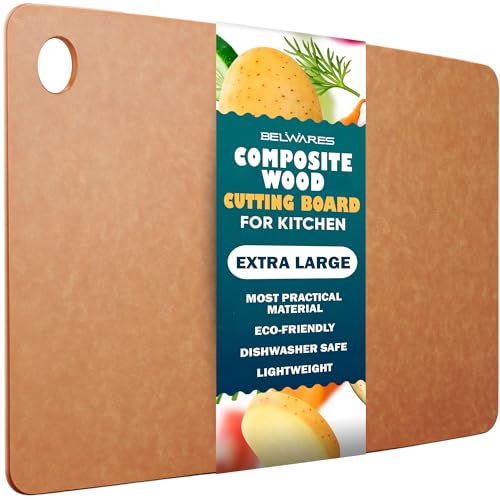
Budget composite, with a caveat
Belwares Extra Large Composite Wood Cutting Board, 18" x 12"
The same idea as the Epicurean and noticeably larger, dishwasher safe with no oiling. If you want composite in a carving size without paying the certified brand’s price, this is the realistic option.
The drawback: we are including it with reservations. It has fewer than a thousand customer ratings, well below the threshold we normally want, and its listing names neither the resin nor any food-contact certification — it says "composite fiber wood" and stops. Buy the certified one if the documentation is why you wanted composite in the first place.
Check price on AmazonPlastic boards for raw meat

Best raw-meat board
GORILLA GRIP Reversible Cutting Board Set, 3 Piece
Dishwasher safe, BPA free, rubber-bordered so it does not slide, in three sizes with juice grooves. This is the board that makes the two-board system work: cheap enough that you will genuinely bin it when it grooves, which is the whole point of using plastic for raw protein.
The drawback: at 0.37 inch these are thin, and they will score with heavy use — plan on replacing them, not keeping them. The listing also says the boards are "3rd Party Tested" without naming the standard, the lab or what was tested, which is a claim you cannot check.
Check price on Amazon
Best small-kitchen plastic set
OXO Good Grips 2-Piece Plastic Cutting Board Set
Two double-sided boards with non-slip feet, drip catchers and soft tapered edges that work as handles. The small prep board is the one that gets used daily for one onion and a bit of garlic, which is where most people are actually reaching for a board.
The drawback: the larger board is 9 by 12.9 inches, which is tight for breaking down a whole chicken, and you pay a clear brand premium per square inch against the set above. Buy it for the feet and the handling, not for the size.
Check price on Amazon
Best large plastic set
Empune Extra Large Plastic Cutting Board Set, 3 Piece
Three dishwasher-safe boards, the largest 17 by 11.8 inches, with grooves on all sides and grip handles. This is the set to buy if the reason your raw chicken ends up on the wooden board is that the plastic one is too small.
The drawback: they are dark grey. Staining and surface wear are precisely the signals that tell you a plastic board is finished, and a dark board hides both. If you buy these, replace them on a schedule rather than on appearance.
Check price on AmazonTitanium

Best non-porous option
Sumzzz Titanium Cutting Board, 16" x 11"
The only titanium board we found with a customer-rating base large enough to judge. Titanium on one face for raw protein, polypropylene on the other for produce, with a juice groove, a grinding area and a hanging hole. Nothing soaks into the metal side and there is no groove for residue to sit in, which is the entire case for the category.
The drawback: half of it is a plastic board. The seller’s own description is "Pure Titanium/PP", and the PP face has the same wear and grooving behaviour as any other plastic board while carrying a titanium board’s price. The metal face is also loud, food slides on it, and it is hand wash only.
Check price on AmazonBoards we looked at and did not link
Naming what failed is more useful than another pick.
- A four-piece "100% pure titanium" set sold under the brand name "Generic" with two customer ratings. No way to judge it, and no brand to hold responsible.
- A titanium board whose specification field read "Rubber, Titanium" while its own title said titanium and PP. When a listing contradicts itself about what the food touches, that is disqualifying regardless of the rating.
- Two solid maple boards from established names, each with fewer than a hundred customer ratings. Good specifications on paper, too new to know whether they crack.
- Novelty and charcuterie boards that dominate the wood cutting board search results. Engraved gift boards, state-shaped boards and licensed-character boards are serving pieces. Several do not say they are intended for cutting at all.
Buying cutlery to go with the board? The same disclosure question — what the manufacturer actually states about the metal touching your food — applies there too, and it is covered in Cupindy’s non-toxic flatware guide.
What to Avoid When Choosing a Cutting Board
The least safe cutting board is often not a specific material. It is a board that is damaged, poorly documented, difficult to clean, or no longer suitable for food preparation.
- Deeply grooved plastic boards: grooves can trap food residue and make cleaning harder.
- Cracked wood or bamboo boards: cracks can hold moisture and food debris.
- Unknown coatings or decorative finishes: avoid boards that do not clearly say they are intended for food preparation.
- Soft woods: they may scar deeply and wear out faster than dense hardwoods.
- Delaminated composite or bamboo boards: separation means the board is breaking down.
- Glass boards for daily chopping: easy to clean but usually too harsh on knives.
- Steel or titanium as your only chopping board: hygienic, but not ideal if you care about knife edges and cutting comfort.
- Boards that retain odor after cleaning: odor retention is a practical sign that replacement may be needed.
What Is the Safest Cutting Board for Raw Meat?
The safest cutting board for raw meat is usually a separate board used only for raw meat, poultry, and seafood. This matters more than choosing one perfect material.
For many homes, a dishwasher-safe plastic or composite board is practical for raw proteins because it is easy to clean and replace. A wooden board can also be used safely when properly cleaned and dried, but many households prefer keeping raw meat on a separate, replaceable board to reduce cross-contamination risk.
| Raw-meat question | Best practical answer |
|---|---|
| Should I use the same board for raw chicken and vegetables? | No. Use separate boards or wash thoroughly between tasks. |
| Is plastic better for raw meat? | It can be practical because it is often dishwasher-safe and easy to replace. |
| Can wood be used for meat? | Yes, if cleaned and dried properly, but separate boards are safer for routine home use. |
| When should a meat board be replaced? | When it has deep grooves, odor, cracks, warping, or heavy staining. |
Practical rule: keep one board for raw meat, poultry, and seafood, and another board for vegetables, fruit, bread, and ready-to-eat foods.
What Cutting Boards Do Not Have Microplastics?
If your goal is to reduce plastic cutting-surface exposure, choose a non-plastic board such as solid wood, bamboo, glass, stainless steel, or titanium. Composite boards depend on their material blend and resin, so check the manufacturer’s details.
Plastic cutting boards can become rough and deeply scored over time. Heavy knife contact may contribute to small particle release, especially when boards are worn. Research on cutting-board microparticles is still developing, so the best practical approach is to avoid heavily worn boards, use moderate cutting pressure, and replace plastic boards when they show deep scoring.
Lower-plastic options
- Solid hardwood
- Bamboo
- Stainless steel
- Titanium
- Glass or marble for serving/light tasks
Use caution with
- Very scratched plastic boards
- Unknown composite materials
- Acrylic boards without food-contact information
- Decorative boards not made for cutting
Do not think of “microplastic-free” as a guaranteed safety claim. A better, more accurate goal is to reduce unnecessary plastic cutting-surface wear and replace boards before they become heavily damaged.
Which Cutting Board Is Most Hygienic?
The most hygienic cutting board is not automatically wood, plastic, bamboo, or steel. Hygiene depends on cleaning, drying, separation of food types, and surface condition.
A new plastic board may be easier to sanitize than a cracked wooden board. A well-maintained hardwood board may be safer than a deeply grooved plastic board. A steel or titanium board may be very easy to wipe clean, but it may not be the best daily cutting surface for knives.
How to Clean, Maintain, and Replace Cutting Boards Safely
Cleaning rule: wash cutting boards with hot soapy water after use, dry fully before storage, and follow the manufacturer’s sanitizing instructions. Use the dishwasher only when the board is labeled dishwasher-safe. Do not soak wooden or bamboo boards.
Wood Boards
- Wash with mild dish soap and warm water after use.
- Dry immediately and store upright when possible.
- Oil periodically with a food-safe board oil if the surface looks dry.
- Do not soak, boil, or place in the dishwasher.
- Replace or repair if cracked, split, warped, or odor-retaining.
Plastic Boards
- Wash after every use and use the dishwasher if the board is dishwasher-safe.
- Use a separate board for raw meat, poultry, and seafood.
- Replace when deeply grooved, fuzzy, stained, warped, or smelly.
- Avoid high heat if the manufacturer does not recommend it.
Bamboo Boards
- Wash by hand unless the manufacturer says otherwise.
- Dry fully to reduce cracking and separation.
- Check for splintering, rough edges, or delamination.
- Choose boards with clear food-safe finish information.
Composite Boards
- Follow the manufacturer’s cleaning and dishwasher instructions.
- Avoid extreme heat if not recommended.
- Replace if the board chips, peels, delaminates, or retains odor.

What to Look for Before Buying a Non-Toxic Cutting Board
Before buying a non-toxic cutting board, check these points:
- Clear food-contact use: the board should be made for food preparation, not decoration only.
- Material transparency: check whether it is solid hardwood, bamboo, rubber, HDPE/PP plastic, or composite fiber.
- Safe finish: for wood and bamboo, look for food-safe oil, wax, or finish information.
- Replaceability: raw-meat boards should be easy to replace once deeply grooved.
- Knife friendliness: avoid glass, marble, steel, or titanium as your only daily chopping board if knife protection matters.
- Cleaning fit: choose dishwasher-safe only when the manufacturer clearly allows it.
- Realistic maintenance: do not buy a board that needs more care than you will actually give it.
For broader kitchen material safety, read Cupindy’s non-toxic cookware guide. For food storage material decisions, see the plastic grades and food storage safety guide.
Frequently Asked Questions
What is the safest non-toxic cutting board material?
For most home kitchens, solid hardwood such as maple, walnut, beech, or cherry is one of the safest everyday choices when cleaned, dried, and maintained properly. For raw meat, a separate dishwasher-safe plastic or composite board can be more practical because it is easier to sanitize and replace when worn.
What is the best non-toxic cutting board?
The best non-toxic cutting board depends on your use. Solid hardwood is usually best overall, bamboo can work for light plastic-free prep, composite boards can be convenient for low-maintenance kitchens, and a separate washable board is useful for raw meat.
What is the most sanitary cutting board for meat?
The most sanitary setup is a separate board used only for raw meat, poultry, and seafood. Dishwasher-safe plastic or composite boards are practical for many homes because they can be cleaned easily and replaced once deeply grooved.
What cutting boards do not have microplastics?
Solid wood, bamboo, glass, stainless steel, and titanium are non-plastic cutting surfaces. Composite boards vary by material. If avoiding plastic surface wear is your goal, choose a non-plastic board and replace any board that becomes damaged.
Are bamboo cutting boards non-toxic?
Bamboo cutting boards can be a good non-plastic option, but quality matters. Choose bamboo boards that clearly state they are made for food preparation and use food-safe finishes or adhesives.
Are stainless steel and titanium cutting boards safe?
Stainless steel and titanium boards are non-porous and easy to clean, but they are very hard on knives. They can be useful for light prep or hygiene-focused tasks, but they are not the best daily chopping surface for everyone.
Are plastic cutting boards safe?
Food-grade plastic cutting boards can be safe when kept clean and replaced when worn. The main risk is continuing to use plastic boards after they become deeply grooved, rough, warped, stained, or odor-retaining.
Is glass a good cutting board?
Glass is easy to clean, but it is usually not a good daily cutting board because it can dull knives quickly and make chopping less comfortable. It is better for serving or light tasks.
Is wood or plastic safer for cutting boards?
Both wood and plastic can be safe when cleaned and maintained properly. Wood is often better for everyday prep and knife comfort, while plastic can be practical for raw meat because it is easy to wash and replace. A cracked wooden board or deeply grooved plastic board should be replaced.
What do professional chefs use for cutting boards?
Professional kitchens may use plastic, rubber, wood, or composite boards depending on the task and local food-safety rules. At home, the safer approach is to copy the system, not one exact material: use separate boards for raw proteins and ready-to-eat foods, clean them well, and replace worn boards.
What oil is safe for wooden cutting boards?
Food-safe mineral oil, beeswax-based board conditioner, or products clearly labeled for cutting boards are commonly used. Avoid cooking oils that can turn rancid and avoid unknown stains, varnishes, or decorative finishes.
When should you replace a cutting board?
Replace a cutting board when it has deep grooves, cracks, warping, delamination, persistent odors, heavy staining, or a rough surface that no longer cleans well.
Sources and Safety Notes
This guide is a consumer kitchen safety and buying guide. It is not medical advice and does not replace manufacturer instructions, local food-safety rules, or professional food-service requirements.
Final Verdict
The safest non-toxic cutting board is not one single material for every kitchen. For most homes, the best system is a solid hardwood board for everyday prep plus a separate washable board for raw meat, poultry, and seafood.
Choose boards made for food contact, avoid unknown coatings, replace damaged surfaces, and keep raw foods separate from ready-to-eat foods. A well-maintained board is safer than a neglected one, regardless of material.
Back to top ↑


