
Experience note Sara covers kitchen materials and product safety for Cupindy, working from what manufacturers publish about their own products rather than from marketing copy.
Last reviewed September 2026 — Reviewed for blade steel designations, tang construction, manufacturer care and warranty language, and live retail listings at the date of review.
Ask whether a steak knife is dishwasher safe and you are really asking two questions at once. Will it survive? And will it still cut?
Those have different answers. A set can come through two hundred cycles looking immaculate and slice like a butter spreader. Manufacturers know it. Their product pages tend to answer the first question and their care pages answer the second, and reading only one of them is how people end up disappointed three years later.
So this guide separates survival from sharpness. We checked the blade steel and the tang construction on eight sets, put each maker's own care instruction next to what the retail listing claims, and priced every set on the day of review. Where the two disagree, you get both, quoted.
Editorial note
This is a guide to construction, materials and published guidance, not a cutting test. We have not put every set through a kitchen. What we have done is read the steel designations, the tang descriptions and the care and warranty language, then set them against the live listings. Every quotation below comes from a manufacturer's own page or from the listing itself. Nothing here suggests any brand has misled anyone, and nothing here is a safety warning.
The short answer, in thirty seconds
Construction decides whether a knife survives the dishwasher. Steel decides how long the edge lasts.
Construction is cheap. A one-piece steel knife has no wood, no glued scales and nothing for a dishwasher to pull apart. Steel is what you are paying for — hard enough to hold an edge for years, from a maker willing to print the hardness number. Almost every recommendation below follows from those two sentences.
Dishwasher, every time
One-piece steel, nothing bonded. The most-reviewed set here and the cheapest.
Check price on AmazonDishwasher, straight edge
Full tang, ABS handles. The most machine-tolerant material in this lineup.
Check price on AmazonHand wash, best steel
One of only three sets here that publishes a Rockwell figure, and the cheapest of them.
Check price on AmazonIf those three cover you, stop reading and go and buy something. The rest of this page is for people who want to know why.
All eight, at a glance
Cheapest first. Every set gets a named drawback further down, because every one of them has one. The price band is there so nobody clicks through to a shock.
| Set | Build | Dishwasher | Price |
|---|---|---|---|
|
Bellemain Most people, most of the time |
Serrated Steel, one piece |
Survives Edge still dulls |
Lowest here |
|
CoquusAid Straight edge, small budget |
Straight ABS |
Most tolerant handle here | Low |
|
SYOKAMI Published HRC 56+ |
Straight Wenge wood |
No (wood) | Mid |
|
Victorinox Swiss Classic Answered in writing |
Serrated Synthetic |
Yes, maker confirms | Mid, stock permitting |
|
Messermeister Avanta Full tang, not top price |
Straight Pakkawood or POM |
No, emphatically | Upper mid |
|
HOSHANHO with block Middle edge, plus storage |
Semi-serrated Pakkawood |
No (wood) | High |
|
ZWILLING Gourmet Nothing to come unglued |
Straight Steel, one piece |
Survives Edge still dulls |
High |
|
Wüsthof Classic If you genuinely sharpen |
Straight Polypropylene |
No, hand wash only | Highest by far |
On a narrow screen, swipe the table sideways. “Dishwasher” reflects each manufacturer's own published guidance where they give it, and the handle material where they do not. Price bands are relative to each other and were checked on the date of review.
On this page
What the dishwasher actually does to a knife
Four things go on in there, and only one of them is the thing people worry about.
The chemistry is harsh. Machine detergent is strongly alkaline, far more so than anything you would use at the sink. Add the chlorides that come in with salty food residue and, in many areas, with the tap water itself, and you have the specific enemy of stainless steel. Chloride attacks the thin passive chromium oxide film that makes the steel stainless in the first place. Once that film breaks in one spot, corrosion starts there and stays there. That is why dishwasher damage shows up as pinpricks and dark speckles rather than an even rust.

Here is the bit nobody explains. Your forks come out fine. Your knife comes out spotted. Same basket, same cycle. It is not luck.
Flatware is usually 18/10 or 18/0 austenitic stainless, built for corrosion resistance and not much else. A knife blade cannot be made of that, for reasons we come to below. It has to be a harder, higher-carbon martensitic stainless, and in that kind of steel some of the chromium binds with carbon inside the metal instead of staying free to protect the surface. So the blade is less rust-resistant than the fork lying next to it. Deliberately. That is the price of being hard enough to cut.
Hardness and corrosion resistance pull in opposite directions. A knife has to choose hardness. Your fork never had to.
Heat and cycle length work on the handle. A dishwasher runs hot for hours at a stretch. Zwilling puts a number on it: their own steel is dishwasher-safe, they say, “but only at temperatures of 55 °C and lower.” That is 131 °F, and a great many household machines run their main wash above it. Meanwhile wood, and wood-resin laminates like pakkawood, swell and dry over and over. Adhesives soften. On any knife where the blade is bonded into a handle rather than running all the way through it, that bond is where the knife eventually fails, and it fails slowly enough that most people blame the knife instead of the machine.
And things knock into each other. Edges bang against other cutlery for the whole cycle. Least interesting mechanism of the four, and the one manufacturers mention first, because it is the one they can put on you.
Put those together and the picture is clear. An all-steel, one-piece knife has no glue and no wood, so two of the four cannot touch it. It survives. Its edge still dulls faster than it would by hand, because the chemistry and the knocking do not care how the handle was attached.
Go and look at your own knives first
Before you buy anything, spend thirty seconds on what you already own. Pull one steak knife out of the drawer and check four things.
01
Look along the spine of the handle. Can you see a strip of steel running between the two scales? That is a full tang. A smooth closed shape with a seam down it is hollow.
02
Tilt the blade under a light. Fine dark specks, dull grey cloudiness, tiny pits? That is the dishwasher, and it does not reverse.
03
Grip the handle and twist gently. Any give at all where the blade meets the handle and the bond has started to go. A year or two left, no more.
04
Run a fingernail across the edge, sideways, carefully. A sharp edge catches. A dull one glides. Most people are surprised here.
Three or four going the wrong way and the rest of this page is worth your time. All four coming back clean and you own good knives — keep washing them however you have been washing them.
What the manufacturers say, side by side
We went to each maker's own published care guidance rather than the retail page. The gap between the two is the most useful thing in this guide.
| Brand | The retail listing | The maker's own care page |
|---|---|---|
| Victorinox | “Dishwasher safe” in the feature list, alongside a recommendation to hand wash in the description | “All of our household knives with synthetic handles are dishwasher-safe.” Wooden-handled models “definitely should not go in the dishwasher.” Adds that hand washing “can also help to keep the knives sharper longer.” |
| ZWILLING | “Dishwasher Safe” appears in the product title itself | Dishwasher-safe “but only at temperatures of 55 °C and lower,” and the machine “can shorten their lifespan and reduce their edge retention.” Recommends hand washing. |
| Wüsthof | “WÜSTHOF kitchen knives are Hand Wash Only,” stated in the listing bullets | Agrees. Hand wash, dry immediately. |
| Messermeister | Silent. No dishwasher claim either way. | “Do not place in dishwasher... Seriously, don't even think about it! Hand-wash only.” |
| Cutco | Dishwasher safe | “Although Cutco Cutlery is dishwasher safe, we recommend you carefully hand-wash your products.” Adds that cutlery “can fall through the rack and become damaged resting on the heating element.” |
Quotations taken from each manufacturer's published care guidance and product listings, reviewed September 2026. Care pages get updated; check the current version before relying on it.
Read that table again and notice that nobody has said anything false.
Zwilling's steak knives really are forged from one piece with a steel handle. There is nothing in them to come apart, and “dishwasher safe” is a fair description of survival. Their care page is talking about the edge. Both statements hold. They answer different questions, and only one of them is printed where you are standing when you decide.
Victorinox is closest to saying the same thing in both places, and the condition they attach — synthetic handle yes, wood no — is exactly the mechanism described above. They are not pretending the machine is free, either: the same page says hand washing keeps knives sharper for longer. Every maker on that list ends up in the same position once you read far enough. Survival and sharpness are separate, and only Victorinox will tell you the survival part without hedging it.
Blade steel, and why your flatware set cannot include a real knife
If you have shopped for flatware you have met 18/10, 18/8 and 18/0. They describe chromium and nickel content and they are a decent guide to how well a fork resists corrosion. We go through them properly in our guide to non-toxic flatware.
Those numbers describe austenitic stainless, the 300 series. Austenitic stainless has a property that matters enormously here and gets mentioned almost nowhere: it cannot be hardened by heat treatment. Its structure stays stable right through the quenching and tempering that make a blade hard, so it never transforms into anything harder. No heat treatment turns a fork into a knife.
Hardness, and the line nothing crosses
18/10 and 18/0 flatware
Austenitic. Cannot be hardened by heat treatment at all.
Hardened knife steels
Martensitic. Typically HRC 56 to 58 in a steak knife.
Steels you will see named on the hard side: 5Cr15MoV and 1.4116 at the budget end, X50CrMoV15 in the German forged sets, 10Cr15CoMoV and VG-10 higher up.
There is no heat treatment that turns a fork into a knife.
So if a steak knife listing describes its blade as 18/10 or 18/0, one of two things is happening. Either the number belongs to the handle and has drifted up into the blade description, or the blade really is austenitic stainless — in which case it will arrive sharp, lose it quickly, and never hold an edge no matter what you do.
The one spec worth hunting for
HRC — Rockwell hardness on the C scale.
It tells you how hard the blade was actually taken, and that governs how long the edge survives. A maker who prints it has committed to a heat treatment you can hold them to. A maker who writes “surgical grade stainless steel” and stops has committed to nothing, because that phrase has no standardised meaning in cutlery. Of the eight sets below, three publish a figure: SYOKAMI at HRC 56+, HOSHANHO at 58 ± 2, and Lamson at 58. SYOKAMI is much the cheapest of the three.
For the wider version of this, applied to pots and pans rather than knives, see stainless steel grades in cookware.
Tang: the claim that cannot be true
There are three ways to attach a blade to a handle, and they fail differently.
Three ways a handle holds a blade
Full tang
Steel runs the whole length between two riveted scales. Nothing glued, nothing to soften. Best in a dishwasher.
Partial or stick tang
A narrower tongue of steel enters part way and is pinned or bonded. The orange band is adhesive, and it is the failure point under heat and moisture.
Hollow handle
An empty stamped steel tube with the blade cemented at the bolster. Feels substantial because the shape is generous, not because anything is inside it. The faint vertical line is the seam where the tube was closed.
Full tang and hollow handle cannot both be true. One means the steel fills the handle. The other means the handle is empty.
We came across a twelve-piece set with over a thousand ratings whose title reads, in this order, “Ergonomic Full Tang Hollow Handle.” Its own description then explains that “the hollow stainless steel handle makes you feel more comfortable.” We are not naming it. One seller is not the point. The point is that the phrase is common enough that you should treat “full tang” in a title as a marketing word rather than a specification, and go and look at the photographs instead. On a real full tang you see a strip of steel running along the spine between the scales. On a hollow handle you see a seam.
Four of the eight sets below state full tang construction and show the rivets to back it up: CoquusAid, SYOKAMI, Messermeister Avanta and ZWILLING Gourmet.
Serrated or straight: the drawback nobody prints
Serrated steak knives are sold on the promise that they never need sharpening. That promise is half true, in a way that costs people money.
A serrated edge does keep working far longer than a straight one, because the points do the cutting and the valleys between them shelter the points. What it does not do is stay sharp forever. It dulls slowly and invisibly, and because the teeth still tear through meat you tend not to notice until you are sawing at a ribeye and blaming the beef.

By then you cannot fix it at home. A straight edge comes back on a stone or a pull-through in a couple of minutes. A serration has to be worked one tooth at a time with a tapered rod, and on the fine serrations used for steak knives that usually cannot be done at all without wrecking the geometry.
You do not have to take our word for it. Cutco, whose serrated Double-D edge is one of the best known in the category, instructs owners in writing:
“When they do need sharpening, DO NOT use the Cutco Sharpener or any other sharpening service. It will ruin the special edge. Send them back to the Cutco factory.”
Cutco will do it free and you cover shipping, which is a good arrangement and more than most brands offer. But look at what it concedes. That edge cannot be maintained by you, by your local sharpener, or by the brand's own sharpening tool. It goes back to the factory or it stays dull.
So the honest framing is not “serrated never needs sharpening.” It is this: a serrated steak knife is a consumable with a very long life. A straight-edged one is a tool you maintain. Which you want comes down to whether you will ever actually sharpen anything. Most people will not, and for them serrated is the right call. It just has an end date, and the listing will not mention it.
There is a middle option worth knowing about. Semi-serrated blades put teeth along part of the edge and leave the rest plain, so you can maintain the straight section while the serrated section does the heavy work. A sensible compromise, rarely explained as one, and the HOSHANHO set is the one here that does it.
One last thing, since it ties back to the dishwasher. A serrated knife hides dishwasher damage better than a straight one does. An edge you cannot inspect is an edge you cannot tell has gone.
Decided already?
If you know you will never sharpen anything and the knives are going in the machine, the Bellemain serrated set is the one to buy. One-piece steel, no adhesive, and it costs less than any other set on this page.
Check current price on AmazonWhat “German steel” and “Japanese steel” actually mean
This is the pattern we were not looking for, and once you have seen it you cannot stop. Here is what the listings say across the price range, and what those designations are.
| Tier | The listing says | What the designation is |
|---|---|---|
| Budget | “5Cr15MoV German high-carbon stainless steel” | 5Cr15MoV is a Chinese standard designation for an alloy closely comparable to German 1.4116 |
| Mid | “German X50 stainless steel” | A German alloy. The maker's own product page for this set says the knives are handcrafted in China. |
| Upper | “Japanese 10Cr15CoMoV high carbon stainless steel” | 10Cr15CoMoV is a Chinese standard designation for an alloy closely mirroring Japanese VG-10 |
Designations as printed in the listings, reviewed September 2026.
The nationality in a steak knife listing describes the recipe. Not the kitchen. The same goes for chef's knives: our chef knife guide puts each maker's stated hardness and edge angle side by side.
Nobody in that table has claimed to be German or Japanese. The alloys are real equivalents, and naming a steel after the tradition it came from is ordinary industry language. The problem sits on the reading side: buyers see “Japanese steel,” conclude “Japanese knife,” and the listing never has to correct them because it never made that claim. So the test is simple. A country name attached to a steel designation is telling you about metallurgy. Country of manufacture is a separate statement. Look for the words “Made in” and treat their absence as information.
The same move, with “Damascus”
Two of the sets here describe their blades as “Damascus Pattern.” Read that second word. Genuine Damascus is layered steel, forge-welded and folded, and the swirls are the edges of the layers. A Damascus pattern is that appearance etched or rolled onto a single-piece blade. Decoration.
Both listings are accurate. Neither says “Damascus steel.” But at a glance, in a photograph, on a phone, the distinction vanishes. A patterned single-piece blade is not worse than a plain one. It is just not the thing the picture implies. If the price looks low for Damascus, the word “pattern” is usually why.
Why the spec table lies to you
One finding here is worth more than any single recommendation. That tidy specification grid on the retail page, the one listing Blade Material and Handle Material and Blade Edge, was wrong or useless on nearly every set we looked at.
All of these come from the Handle Material field, and all of them are live right now:
- Victorinox: “Stainless Steel.” The handles are synthetic. That distinction is the exact thing Victorinox's own dishwasher guidance depends on.
- Wüsthof: “Stainless, Stainless Steel, Polypropylene, High-carbon, Steel.” Five entries, and several are not handle materials at all.
- SYOKAMI: “Stainless, Stainless Steel, Steel, Wood Handle.” The handle is wenge, a hardwood, and that is what decides you cannot machine wash it.
- On one bundle the bullets described “rounded, stainless steel handles” while the spec block correctly said pakkawood.
These fields are often supplied by sellers and merged by automated systems. They are not a manufacturer statement and should not be read as one. Which gives us the rule we would keep even if you ignored everything else on this page:
Decide on the manufacturer's care page, not the retailer's spec table. Search the brand name plus “care” or “warranty.” Thirty seconds, it is the only version the maker is accountable for, and on the dishwasher question it is frequently the opposite of what the product page implies.
The eight sets
Two questions decide this, and neither is about brand.
Question one
Will these ever go in the dishwasher?
If yes, you want a synthetic, ABS or all-steel handle. Every wooden and pakkawood set is out, whatever else it has going for it.
Question two
Have you ever sharpened a knife?
If no, buy serrated and accept it has an end date. If yes, buy straight and it will outlive several serrated sets.
We have not ranked these one to eight. We have split them by the first question, because that is the one that rules sets out rather than merely ordering them. Within each group they run cheapest first. Each set gets its real drawback, not a softened one.
If they are going in the dishwasher
Four sets with synthetic, ABS or one-piece steel handles. Nothing here has a bonded joint or a wooden scale to swell. All four survive the machine. Their edges still dull faster than they would by hand, and that is true of every knife ever made.
Our pick for most kitchens
Bellemain 8-Piece Serrated Steak Knife Set

Eight knives, one-piece steel, steel handles, nothing bonded. No glue to soften and no wood to swell, which is why the dishwasher-safe claim here is structurally sound rather than optimistic. It is also the most-reviewed set on this page by a wide margin — over eight thousand ratings at a 4.8 average — and the cheapest, at a little under forty dollars for eight at the time of writing. It is easy to assume the cheap set must be the fragile one. On the dishwasher question specifically, it is not.
The drawback: it names no steel and no hardness figure. “Surgical Grade Stainless Steel” has no standardised meaning in cutlery, so there is nothing here you can compare against anything else. That is the trade at this price and it is a fair one. Notice too that the listing's “the last knife you'll ever need to buy” sits directly beside a serrated edge. Hold those two thoughts together.
Check current price on AmazonA straight edge on a small budget
CoquusAid 6-Piece Non-Serrated Set with Rests

A straight edge at this price is unusual, and this one comes full tang with triple-riveted ABS handles. ABS is the most dishwasher-tolerant handle material in the whole lineup: it does not absorb water, does not swell, and never needs oiling, which is more than you can say for the wood on sets costing four times as much. The included knife rests sound like packaging filler and turn out to be genuinely useful if you serve at the table. It comes in four-, six- and eight-piece versions, so you can size it to how many people you actually seat.
The drawback: no steel designation, no hardness figure, and a listing that claims the blades stay “durable, corrosion-resistant, and sharp for over 30 years” without offering anything to support it. “German Stainless Steel Damascus Pattern” is doing both of the jobs described earlier — naming a steel tradition rather than an origin, and an etched finish rather than layered steel. Take it as a good-looking budget straight edge, not an heirloom.
Check current price on AmazonIf you want one answer to the headline
Victorinox Swiss Classic 6-Piece Steak Knife Set

Serrated, round tip, synthetic handle, made in Switzerland, with a lifetime guarantee against defects in material and workmanship. This is the only set here whose manufacturer says dishwasher-safe on its own care page as well as in the listing, with the condition spelled out across the whole range: synthetic handles yes, wooden handles no. If the question that brought you here was literally which ones you can put in the machine without argument, this is the set that answers it in the maker's own words.
The drawback, and there are three. It is serrated, so it is on the clock — it will outlast a straight edge by years, and when it finally goes you replace rather than sharpen. The retail spec block lists the handle as stainless steel, which is wrong, and the synthetic handle is the entire reason the answer is yes. And availability is patchy: at the time of review this set showed no featured offer on Amazon, so check that it is actually in stock before you set your heart on it.
Check availability on AmazonNothing in it to come unglued
ZWILLING Gourmet 6-Piece Steak Knife Set
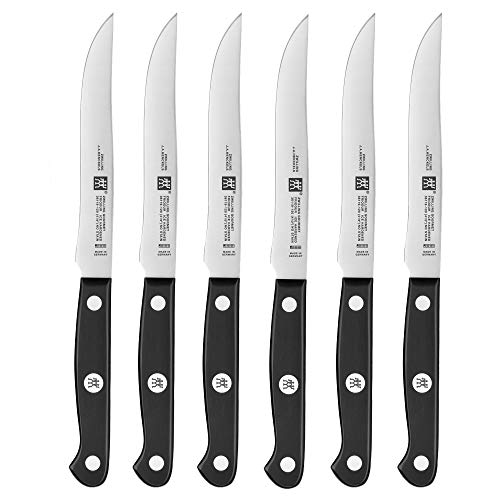
Precision-forged from a single piece, full tang, straight edge, steel handle, FRIODUR ice-hardened, made in a company-owned German factory. Structurally there is less to go wrong here in a dishwasher than in anything else on this page. No wood, no scales, no adhesive, nothing that can delaminate. That is an engineering answer to the survival question rather than a marketing one, and it is the only straight edge in this group.
The drawback: “Dishwasher Safe” sits in the product title while Zwilling's own care page puts a ceiling on it — 55 °C — and warns that the machine “can shorten their lifespan and reduce their edge retention.” Both statements are true; you are sold on survival and charged for the edge. It also costs roughly four times the Bellemain set for two fewer knives, and an all-steel handle runs cold and can feel slippery next to wood or synthetic. Worth holding in your hand first if you get the chance.
Check current price on AmazonIf you will wash them by hand
Four sets with wood, pakkawood or forged construction that their makers say to keep out of the machine. In exchange you get better steel, published hardness figures in two cases, and edges you can maintain for as long as you own them.
Published hardness, below the German names
SYOKAMI 6-Piece Non-Serrated Steak Knife Set

Single-piece forged full tang, triple-riveted wenge handles from FSC-certified wood, hand-sharpened to 15 degrees a side, and the thing that matters most, a published hardness of HRC 56+. That is a real commitment, and it puts this set in the same hardness conversation as knives costing several times more. The blade sits raised off the table by design, which keeps the edge off the tablecloth — a small thing you appreciate at the second dinner party. It runs from a two-piece box up to an eight-piece with an organiser, so it scales without you overbuying.
The drawback: the listing says “Japanese Style” and “Japanese high carbon stainless steel,” which describes a steel tradition, and it does not state where the knives are made. The blades are “Damascus Pattern,” meaning etched decoration rather than layered steel. And the wenge handle makes this hand wash only, which the listing never says anywhere. That omission is the one we would most like fixed.
Check current price on AmazonFull tang without the top price
Messermeister Avanta 4-Piece Fine Edge, Pakkawood

German X50 stainless, solid bolsters, stated full tang, triple-riveted pakkawood handles, plain edge. Developed for one of the leading culinary schools in North America, and the finish reflects that. There is a black POM version at the same price if you would rather have synthetic than wood, and a set of eight if four is not enough.
The drawback, and there are two. The listing leads with “German X50 Stainless Steel” and never states a country of manufacture; Messermeister's own product page for this set says the knives are handcrafted in China. And the listing makes no dishwasher claim at all, while their care instruction is emphatic: “Do not place in dishwasher... Seriously, don't even think about it!” Pakkawood is wood impregnated with resin, and it is still wood. The POM version carries the same instruction, so swapping the handle does not change the answer.
Check current price on AmazonThe compromise edge, plus storage
HOSHANHO 6-Piece Steak Knife Set with Block

Semi-serrated, which is the sensible middle answer hardly anyone explains: the toothed section does the work and the plain section stays maintainable. Published hardness of 58 ± 2 HRC, a 15-degree edge, pakkawood handles, and a storage block. That block matters more than it sounds, because loose steak knives in a drawer dull against each other faster than they ever dull on a plate.
The drawback: the price. This costs roughly four times the Bellemain set for six knives and a block, which is a lot to pay for a hardness figure and some storage. “Japanese 10Cr15CoMoV” is a Chinese steel designation mirroring Japanese VG-10, and the listing does not state where the knives are made. Pakkawood handles mean hand wash despite that price. And the list price moves around a great deal, so check what it actually costs on the day rather than trusting the discount on display.
Check current price on AmazonThe forged benchmark
Wüsthof Classic 4-Piece Steak Knife Set

Precision-forged high-carbon stainless, straight edge, triple-riveted polypropylene handles, made in Solingen, limited lifetime warranty. This is the reference point everything else gets measured against, and the straight edge means it stays maintainable indefinitely. Wüsthof also puts “Hand Wash Only” in its own sales copy rather than burying it in a care page, which makes this the most forthcoming listing in the group.
The drawback: the price is in a different category altogether. At the time of review this set cost roughly eight times the Bellemain set per knife, and a forged straight edge only earns that premium if you sharpen it. Buy this, never sharpen it, and in three years you will own an expensive set that cuts worse than a serrated one costing a fraction as much. It is also thinly reviewed for its price, at a few hundred ratings.
Check current price on AmazonOne benchmark we are not linking
Lamson, in Massachusetts, publishes exactly the figures most of this category will not: knives cut, ground, polished and sharpened in the United States, full tang with double brass or nickel-silver rivets, tempered to a stated Rockwell 58, a lifetime warranty against manufacturing defects, and complimentary professional sharpening for as long as you own them. Hand wash only, and they say so plainly — the dishwasher is “NEVER recommended.” We mention it because it sets the standard for disclosure. When a maker tells you the hardness, the tang, the rivet material and where the work happened, you can make a decision. Most of this category tells you a steel's nationality and leaves you to fill in the rest.
What to avoid
Three things, in order of how much money they cost people.
A blade described as 18/10 or 18/0. Those are flatware numbers. Austenitic stainless cannot be hardened by heat treatment, so a blade genuinely made of it cannot hold an edge, and a serration will disguise that for a year or so. If the blade and the handle are described with the same number, look harder at the listing.
A hollow handle sold as full tang. Covered above. Check the photographs for a steel spine between the scales rather than trusting the wording in the title.
A mid-price or premium set that names no steel and no hardness. At the bottom of the market, “high carbon stainless steel” is a fair summary of what you are getting and there is no point demanding more. Once you are paying real money, a maker who will not publish an HRC figure while their competitors do has made a choice, and you are entitled to read it.
One more that is not a defect, but catches people out. “Laguiole” on a box does not tell you who made the knives. It names a traditional French knife pattern rather than a single maker or workshop, and sets carrying it are produced around the world at every quality level. It is a style, not a guarantee. Judge those sets on the same things as any other: steel, hardness, tang.
If you are going to use the dishwasher anyway
Most people will, and pretending otherwise is not much use to anyone. So:
- Rinse the blades before they go in. Salt and acid sitting on steel through a delay-start cycle does more harm than the wash itself.
- Keep them clear of other metal, and never let blade touch blade.
- Use less detergent rather than more, and a gentler formulation if you have the choice.
- Run a cooler cycle if your machine offers one. Zwilling's own 55 °C ceiling is a useful number to aim under, whatever brand you own.
- Open the door when the cycle ends instead of letting them steam. Condensation sitting on a blade is where the speckling comes from.
- Take them out and dry them rather than leaving them overnight.
- If the handle is wood or a wood laminate, ignore all of the above and wash it by hand. There is no version of this that works.
And if wooden handles, boards and utensils are a running question in your kitchen, the maintenance side is covered in wooden kitchenware, pros and cons.
Questions people actually ask
Are any steak knives really dishwasher safe?
Yes, if you mean will they survive. One-piece steel knives with synthetic or steel handles and no bonded joint come through it fine, and Victorinox says so about its synthetic-handled range without qualification. What no manufacturer claims is that the edge is unaffected. Zwilling says the opposite in writing about their own dishwasher-safe models, and caps the claim at 55 degrees Celsius.
Which steak knife set is best if I want to use the dishwasher?
Look for a one-piece steel handle or a synthetic one, and rule out anything with wood or pakkawood. Of the eight sets reviewed here, the Bellemain 8-piece is the one we would buy for a household that uses the machine every time: one-piece steel, nothing bonded, over eight thousand ratings, and the lowest price on the page. Victorinox is the set whose manufacturer confirms dishwasher safety in writing, if you can find it in stock.
Can serrated steak knives be sharpened?
Not practically, at home, on the fine serrations used for steak knives. A tapered rod can work on coarse serrations, one tooth at a time. Cutco instructs owners not to use any sharpening service, including Cutco's own sharpener, and to send knives back to the factory instead. Treat a serrated steak knife as very long-lived rather than permanent.
Is 18/10 stainless steel good for a steak knife?
Excellent for the handle, unsuitable for the blade. 18/10 is austenitic and cannot be hardened by heat treatment, so a blade made from it will not hold an edge. Plenty of good sets pair an 18/10 handle with a hardened martensitic blade, and that is the correct arrangement rather than a compromise.
Why does my steak knife rust when my forks don't?
Because the blade steel is deliberately less corrosion-resistant. Hardening a stainless steel means adding carbon, and some of the chromium then binds with that carbon inside the metal rather than staying available to form the protective surface film. Your fork is optimised for not rusting. Your knife is optimised for cutting. Same basket, different metal, different outcome.
Are Japanese steak knives worth it?
Work out what “Japanese” is describing first. In most listings in this range it refers to the steel specification, and the designations used are often Chinese standards mirroring Japanese alloys. Knives actually made in Japan are a different purchase at a considerably higher price; Shun and Miyabi are the names to search, both produced in Seki. That may well be worth it to you, but nothing in this guide is offering it, and no listing here claims to.
How many steak knives do I need?
Six covers most households and most dinner parties. Four is plenty if you rarely have guests and you would sooner put the difference into the steel. Eight is worth it when the per-knife price drops, which it usually does. Check the per-knife figure rather than the headline price, because larger boxes are not always the better deal.
Straight or serrated, if I have to pick one?
Ask yourself honestly whether you have ever sharpened a knife. If you have not, buy serrated and accept you will replace them one day. If you own a stone or a pull-through and actually use it, buy straight, and it will outlive several serrated sets.
The point of all this
Nearly every disappointing steak knife purchase comes from answering the wrong question. Someone asks whether a set is dishwasher safe, gets told yes, and is baffled three years later when the knives look immaculate and cut like spoons. They were told the truth. They just were not told the other half of it.
So settle the handle question on the manufacturer's care page, settle the edge question on whether you will ever sharpen anything, and treat a published hardness figure as the single most informative thing on any listing. Everything else on that page was written to be read quickly.

If you would rather just be told
Dishwasher every time, and you will never sharpen anything.
Bellemain 8-Piece — one-piece steel, most-reviewed set here, lowest price on the page.
Dishwasher, but you want a straight edge.
CoquusAid 6-Piece — full tang, ABS handles, the most machine-tolerant material here.
You want the maker's written confirmation, stock allowing.
Victorinox Swiss Classic — the only set whose care page says dishwasher-safe outright.
You will hand wash, and you want a hardness figure.
SYOKAMI — HRC 56+, full tang, and the cheapest set here that publishes one.
You genuinely sharpen knives and price is not the issue.
Wüsthof Classic for the benchmark, or Messermeister Avanta for most of the knife at a fraction of the outlay.
And if you are setting a table rather than just replacing knives, the same logic applies one drawer over. Our guide to choosing non-toxic flatware covers what 18/10, 18/8 and 18/0 mean for the forks and spoons that sit beside these.
Sources reviewed
- Victorinox, “Knife Care Tips” — manufacturer care guidance, including handle-material conditions.
- ZWILLING, “How to Clean and Care for Your Knife” — manufacturer care guidance, including the 55 °C dishwasher limit.
- Wüsthof Classic steak knife set product listing — “Hand Wash Only” stated in the manufacturer's own bullets.
- Messermeister, product care instructions — dishwasher and hand-wash guidance.
- Cutco, “Product Care: Kitchen Knives” — care guidance and Double-D edge sharpening instruction.
- Lamson, Vintage steak knife product page — stated Rockwell hardness, tang and rivet construction, warranty terms, Sharp for Life sharpening programme.
- Published metallurgical references on the non-hardenability of austenitic stainless steels by heat treatment.
- Live retail product listings for each set discussed, reviewed September 2026.
Manufacturer care pages, specifications, pricing and availability change without notice. Everything above reflects what was published at the date of review. Where a claim mattered to a recommendation we have quoted the source rather than paraphrased it, so you can check it yourself.


