
Written by Lara Yehia. Lara researches home and kitchen products for Cupindy.
Published October 2026 · Last reviewed October 22, 2026
Short answer: the best chef knife for most home cooks is an 8-inch one with a grip that holds when wet, washed by hand, dried and honed often. That matters more than German or Japanese, forged or stamped. The Victorinox Fibrox Pro, Amazon's #1 seller in Chef's Knives, fits that description, and it is our quick pick.
As an Amazon Associate we earn from qualifying purchases.

Our quick pick
Victorinox Fibrox Pro 8-Inch Chef's Knife
Amazon's #1 best seller in Chef's Knives on October 22, 2026. A stamped, Swiss-made blade, 6.4 ounces by Victorinox's count, with a rubbery TPE grip made not to slip when wet.
See the Victorinox on AmazonThe drawback: the title says dishwasher safe, but Victorinox's own care page recommends washing large knives by hand.
How we put this together: on October 22, 2026 we read each knife's Amazon listing and its maker's product and care pages, plus sharpening guides where the maker publishes one. We did not test these knives. Cupindy is not affiliated with any of these brands.
All Six Chef Knives at a Glance
All six are 8-inch chef's knives. The middle column shows what the maker states, and says so where it states nothing.
As an Amazon Associate we earn from qualifying purchases.
| Knife | Steel and hardness, as the maker states it | Buy |
|---|---|---|
|
Victorinox Fibrox Pro Best overall: our quick pick |
No grade or hardness on any page we could read | See it |
|
Mercer Millennia Best budget knife |
High-carbon Japanese steel, HRC 53-54 | See it |
|
Mercer Genesis Forged, easy to sharpen |
High-carbon German steel, HRC 56 +/- 1 | See it |
|
imarku Wood (pakkawood) handle |
7Cr17MoV, HRC 56-58 (imarku's site) | See it |
|
WÜSTHOF Classic Premium German knife |
X50CrMoV15, 58 HRC | See it |
|
Global G-2 All-steel handle |
CROMOVA 18. No hardness stated | See it |
Blade Steel: What Each Maker Actually Names
Almost every chef's knife is stainless steel. "High-carbon stainless" means a little more carbon for a harder edge, with enough chromium left to resist rust. Hardness is measured on the Rockwell C scale (HRC): higher holds an edge longer but can chip, lower is easier to sharpen but dulls sooner.
| Knife | Steel as named | Hardness | Where it is stated |
|---|---|---|---|
| Victorinox Fibrox Pro | Not named by Victorinox | Not stated | Amazon's spec row says stainless steel; only the brand panel on Amazon says high-carbon. The product page names no blade material |
| Mercer Millennia | High-Carbon Japanese Steel | HRC 53-54 | Mercer product page |
| Mercer Genesis | High-Carbon German Steel | HRC 56 +/- 1 | Mercer product page |
| imarku | 7Cr17MoV | HRC 56-58 | imarku site, on what appears to be the same 8-inch knife; the Amazon listing gives the same HRC |
| WÜSTHOF Classic | X50CrMoV15 | 58 HRC | Wüsthof FAQ and product page |
| Global G-2 | CROMOVA 18 | Not stated | Global's care page and its Amazon brand panel |
| Shun Classic (text only) | VG-MAX core | 60-61 | Steel on the Shun product page; hardness only on Shun's Amazon brand panel |
Wüsthof is the only German-style maker here that names a standard alloy, and its FAQ spells it out: “What is X50 Cr MoV 15?” “This is our steel formula.” Victorinox, maker of the best seller, names no grade or hardness on any page we could read.
Mercer's care page warns that “Chlorine and bleach products discolor and pit high-carbon steel” (Mercer).
As an Amazon Associate we earn from qualifying purchases.
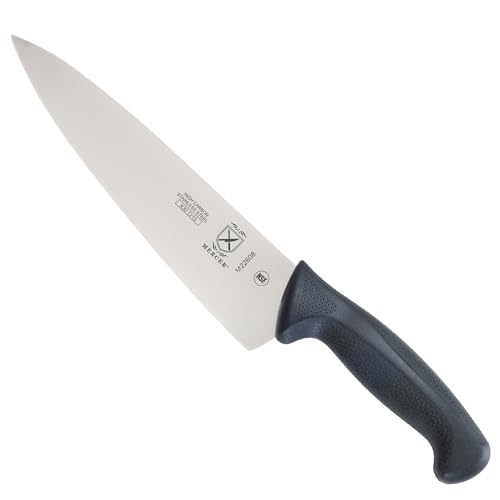
Best budget chef's knife
Mercer Culinary Millennia 8-Inch Chef's Knife
A stamped 8-inch blade of what Mercer calls high-carbon Japanese steel, ground to a 15-degree edge, with a handle of Santoprene for comfort and polypropylene for durability. It is NSF certified, and Mercer's product page says “It is not recommended to wash your knife in a dishwasher.”
Good for: Beginners, a student kitchen or a second knife
The drawback: the lowest hardness of any knife here that publishes one (HRC 53-54), so expect to hone it more often.
See the Millennia on AmazonGerman vs Japanese Chef Knives: Hardness and Edge Angle, Not the Flag
German-style chef's knives are usually heavier, softer and sharpened at a wider angle, with a curved edge for rocking. Japanese-style knives are usually lighter, harder and finer, and chip more easily. But the label is a style, not a spec, and the numbers each maker publishes tell you more.
| Knife | Sold as | Edge angle (maker) | Hardness (maker) |
|---|---|---|---|
| WÜSTHOF Classic | German, made in Solingen | 14° per side | 58 HRC |
| Mercer Genesis | German steel | 15° | 56 +/- 1 |
| Mercer Millennia | Japanese steel | 15° | 53-54 |
| imarku | Japanese style | 12.5° (imarku site, likely the same knife) | 56-58 |
| Shun Classic | Made in Seki City, Japan | 16° per side | 60-61 (Amazon panel) |
| Global G-2 | Made in Japan | 10-15° | Not stated |
The German Wüsthof is sharpened finer than the Japanese Shun: “Our sharpening angle for standard blades is 14˚ per side” (Wüsthof) against Shun's “16° edge each side” (Shun). And the lowest hardness belongs to Mercer's "Japanese steel" knife.
A German name does not always mean a German factory. The brand text on the HENCKELS Classic chef's knife's Amazon listing says “Fabricated from high-quality German stainless steel. Manufactured in Spain”. Our guide to steak knives and blade steel goes further into how listings use German and Japanese steel names.
The harder, thinner edge does need more care. A softer German-style blade bends back into line on a honing steel and forgives a careless cook.
As an Amazon Associate we earn from qualifying purchases.
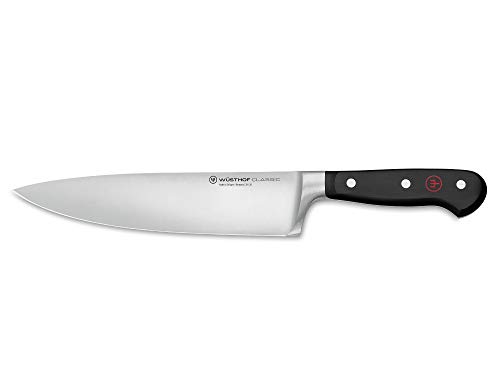
The premium German pick
WÜSTHOF Classic 8-Inch Chef's Knife
Forged in Solingen with a full tang, a full bolster and a riveted synthetic handle. Wüsthof publishes the alloy (X50CrMoV15), the hardness (58 HRC) and the edge angle, the only German-style maker here to give all three. Wüsthof's care line is “Wash by hand and immediately towel-dry.” (Wüsthof)
Good for: Cooks who want one knife for decades and will hone it
The drawback: the full bolster runs down to the heel, so the back of the edge gets harder to sharpen as the blade wears.
See the Wüsthof on AmazonAs an Amazon Associate we earn from qualifying purchases.

Japanese style, wood handle, best seller
imarku 8-Inch Japanese-Style Chef's Knife
Amazon's #1 in Gyutou Knives on October 22, 2026, with a pakkawood handle. imarku's site, on what appears to be the same 8-inch knife, lists 7Cr17MoV steel at HRC 56-58, a full tang and a 12.5-degree edge. That hardness sits in the German range, so think of it as a Japanese-shaped knife rather than a hard Japanese blade.
Good for: A wood handle and a Japanese-style shape without the premium price
The drawback: imarku's own pages disagree on the warranty. Its warranty policy covers “one year from the date you receive your order”, its FAQ promises a limited lifetime warranty, and the Amazon listing says “a lifetime warranty on these knives”.
See the imarku on AmazonForged vs Stamped (and Whether the Bolster Matters)
A forged blade is shaped from heated steel; a stamped blade is cut from a sheet. Forged knives are usually heavier, and Wüsthof's product FAQ notes that forged knives include a bolster, the thick collar where blade meets handle. Stamped knives are lighter and cheaper. Neither is automatically sharper.
Victorinox's product page lists the Fibrox Pro as “Forged: No”, and its sharpening guide says “Stamped knives are made of softer steel and are easy to hone with a standard honing steel.” (Victorinox). A softer stamped edge needs honing more often but comes back quickly.
For a home cook, the bolster matters more than the forging. A full bolster runs down to the edge, so the heel gets harder to sharpen as the blade wears. Mercer gave its Genesis a short bolster for that reason: “Shortened bolster exposes full blade edge, allowing for easier sharpening” (Mercer). The Global has none at all; Amazon's product description says Global dropped bolsters to save weight. Full tang, the steel running the whole length of the handle, is stated by Wüsthof and on imarku's site.
As an Amazon Associate we earn from qualifying purchases.

Forged, without the premium price
Mercer Culinary Genesis 8-Inch Short Bolster Chef's Knife
A precision-forged blade of high-carbon German steel, in Mercer's words, HRC 56 +/- 1, with a 15-degree edge, a short bolster and a Santoprene handle. NSF certified. The Amazon listing's care line reads “Do not place in dishwasher or submerge for long periods of time”.
Good for: A forged German-style knife you can still sharpen to the heel
The drawback: at 8.48 ounces on its Amazon listing, it is about two ounces heavier than the Victorinox, which can tire a small hand.
See the Genesis on AmazonHandle Material: Plastic, Wood or Steel
A rubbery synthetic handle is made to grip when wet and shrugs off water. Wood, usually pakkawood (a resin-soaked wood laminate), looks warmer but wants drying. An all-steel handle has no seams to trap food, but it can feel slick.
- TPE (Victorinox). The listing describes thermoplastic elastomer “for a non-slip grip - even when wet”.
- Santoprene and polypropylene (Mercer). Mercer warns that in a dishwasher “the intense heat and radical temperature changes may cause the handle to deteriorate” (Mercer).
- Pakkawood (imarku, Shun). Shun describes “D-shaped ebony-finished Pakkawood handles” that suit left and right hands (Shun).
- Stainless steel (Global). Hollow and balanced with sand, according to Amazon's product description.
As an Amazon Associate we earn from qualifying purchases.

The all-steel handle
Global G-2 8-Inch Chef's Knife
Blade and handle in stainless steel, no bolster, made in Japan. Global factory-sharpens its knives at “an angle between 10 and 15 degrees”, a range that starts finer than any other knife here, and asks you to hone with its ceramic or diamond rod: “DON'T use traditional steels made from other materials as they are likely to damage your GLOBAL knives.” (Global)
Good for: Cooks who want a thin edge and a handle with no seams
The drawback: a fine edge can chip, and the warranty does not cover it. Global's FAQ says “Small chips in the blade can occur through regular use of the knife” and that chips are not covered (Global FAQ), which is narrower than the Amazon listing's "lifetime warranty against defects and breakage".
See the Global on AmazonSantoku vs Chef Knife: Which One Do You Need?
A chef's knife is usually longer, often 8 inches, with a curved edge you rock through herbs and onions and a pointed tip. A santoku is usually shorter, with a flatter edge and a rounded tip for straight up-and-down chopping. If you only buy one, buy the chef's knife: it covers the santoku's jobs and bigger ones.
| Chef's knife | Santoku | |
|---|---|---|
| Length | Usually longer, often 8 in | Usually shorter |
| Edge | Curved belly for rocking | Flatter, for push-cuts |
| Tip | Pointed, for piercing | Rounded, dropping to the edge |
| Sharpening (Wüsthof) | 14° per side | 10° per side |
The last row is from Wüsthof's FAQ, which gives 10 degrees for Asian-style blades like santokus and nakiris (Wüsthof). The narrower angle cuts more finely but needs gentler handling.

Dishwasher and Sharpening: What Each Maker Says, Side by Side
Are chef knives dishwasher safe? Only one of these six Amazon listings, the Victorinox, calls its knife dishwasher safe. Every maker's own care advice says wash by hand, and Mercer, Wüsthof and Global say never to use the dishwasher. Wash, dry right away and hone often.
| Knife | What the Amazon listing says | What the maker says |
|---|---|---|
| Victorinox | Title: "Dishwasher Safe" | Product page: dishwasher safe. Care page: “We would however recommend that you wash all large knives by hand” |
| Mercer Millennia, Genesis | Do not place in dishwasher | “Cutlery should never be washed in a dishwasher” (use and care); the warranty excludes dishwasher damage |
| imarku | No dishwasher line | “Avoid putting knives in the dishwasher whenever possible, even though they are dishwasher-safe” (FAQ) |
| WÜSTHOF | No dishwasher line | “do not place knives in the dishwasher” (cleaning guide) |
| Global | Product description: hand wash | “GLOBAL knives should NOT be placed in the dishwasher” (care page); its FAQ says dishwashers void the warranty |
| Shun (text only) | Brand panel: “Never put your Shun knife in the dishwasher.” | Hand wash with gentle dish soap, towel dry (use and care) |
Victorinox's care page says its synthetic-handled knives can go in the dishwasher, then recommends hand-washing large knives anyway, because dishwasher steam “can also cause stains and corrosion on the blades” (Victorinox).
How each maker says to hone and sharpen
| Knife | Hone | Sharpen |
|---|---|---|
| Victorinox | “ideally before or after each cooking session”, at 20° to the steel | About once or twice a year (guide) |
| Mercer | A honing video on its sharpening page | 15° edge |
| imarku | Hone as needed | Keep the angle that suits your knife (FAQ) |
| WÜSTHOF | Honing steel for regular upkeep | Pull-through coarse slot only once or twice a year (blog) |
| Global | Ceramic or diamond rod, not a steel | Waterstone or ceramic stone at 10-15° |
| Shun | On the 16° guide of its steel | Free sharpening by Shun (guide) |
Honing pushes a rolled edge back into line in seconds; sharpening grinds new metal and is needed far less often. Wüsthof's blog: “We recommend using a honing steel for regular maintenance and a sharpening steel when your knife needs an edge reset.” (Wüsthof)
Shun says “Tile, ceramic, synthetic, marble, granite, or any kind of glass cutting boards are not recommended” (Shun), while Henckels names “wooden or bamboo cutting boards or quality polyethylene boards” (Henckels). Our guide to knife-friendly cutting boards compares wood, rubber and plastic.

As an Amazon Associate we earn from qualifying purchases.
Our quick pick, in context
Victorinox Fibrox Pro 8-Inch Chef's Knife
Stamped, Swiss-made, with a straight edge, a TPE grip and a lifetime warranty against defects. Hone it before you cook, wash and dry it after, and sharpen it once or twice a year, as Victorinox suggests.
Good for: Most home cooks, and anyone replacing a dull knife from a block set
The drawback: Victorinox itself says stamped knives “are made of softer steel”, so plan on honing it more often than a forged knife.
See the Victorinox on AmazonQuestions People Ask
What size chef's knife should I buy?
Eight inches suits most home cooks, and every knife on this list comes in that size. A 6-inch knife is easier in a small kitchen or a small hand; a 10-inch knife covers more board but takes more control. Victorinox measures its 8-inch blade at 7.9 inches.
What is a chef's knife used for?
Nearly all everyday cutting: chopping onions and herbs, dicing vegetables, slicing meat and crushing garlic. It is not the tool for bread (use a serrated knife), small peeling work (a paring knife) or bones and frozen food, which Shun and Global both rule out.
What are the main types of chef knives?
A German-style chef's knife (curved, heavier), a French-style one (a straighter edge and a pointed tip), a gyuto (the Japanese version, usually lighter and harder), a santoku (shorter, flatter) and a nakiri (a square-ended vegetable knife). For one knife, pick the chef's knife or gyuto.
Is a Damascus chef knife better?
Not by itself. On a knife like the Shun Classic, the Damascus layers are cladding around a harder core; Shun describes “34 layers of stainless Damascus cladding each side (68 total)” around its VG-MAX core. The core does the cutting. Many cheap "Damascus" knives only have the pattern; our guide to steak knife steel explains how to tell.
What knives do most chefs use?
The Amazon listing for the Victorinox Fibrox Pro says it “has been the top choice of both home chefs and professionals alike”, and both Mercer knives here carry NSF certification, the food-equipment standard used in commercial kitchens.
How do you sharpen a chef's knife?
Hone first, often, at the maker's angle: Victorinox says 20 degrees to the steel, and Shun uses a 16-degree guide. When honing stops working, sharpen on a whetstone, a pull-through sharpener or through a service. Shun sharpens its knives for free; Global asks for a waterstone or ceramic stone at 10-15 degrees (Global).
Sources (opened October 22, 2026; Amazon listings read the same day for a New York address)
- Victorinox: Fibrox Chef's Knife Extra Wide, 8 in (5.2063.20)
- Victorinox: Knife care tips
- Victorinox: How to sharpen your kitchen knife
- Mercer Culinary: Millennia Chef's Knife 8 in (M22608)
- Mercer Culinary: Genesis Short Bolster Chef's Knife 8 in (M21078)
- Mercer Culinary: Use and care
- Mercer Culinary: Sharpening
- imarku: 8-inch chef knife (Phantom series)
- imarku: FAQ
- imarku: Warranty policy
- WÜSTHOF: FAQ
- WÜSTHOF: Classic 8 in Cook's Knife (1040100120)
- WÜSTHOF: How to clean your knives
- WÜSTHOF: How to sharpen your knives
- Global (US): Knife care
- Global (US): FAQ
- Shun: Classic Chef's 8 in (DM0706)
- Shun: Use and care
- Shun: Sharpening vs honing
- Henckels: Use and care
Brand names belong to their owners. Product details and listings change; check the listing and the maker's care guide before you buy.


