

Written by Lara Yehia. Lara researches home and kitchen products for Cupindy. · Published October 2026 · Last reviewed October 3, 2026
Most "best wok" advice is written for a restaurant burner. At home you probably have a flat glass top, an induction cooktop or a gas range with modest burners, and that changes which wok you should buy far more than the brand does.
It also matters what is on the wok when it arrives. "Carbon steel" on a listing can mean bare steel with a factory oil to wash off, steel that is already seasoned, steel that has been hardened by nitriding, or steel hiding under a nonstick coating. Below are the four woks we would buy for a home stove, what is really on each one, and how to match one to your cooktop.
How we put this together: we have not cooked with these woks. We read Amazon's wok listings with a US delivery address on October 3, 2026, the makers' own care pages, and the wok reviews from America's Test Kitchen, The Woks of Life and others listed at the end. Drawbacks come from the listings, the makers' instructions and buyer reviews, and we say which is which.
The short answer
- Best wok for most home stoves: a flat-bottomed carbon steel wok, 12 to 14 inches across, with no nonstick coating. It works on gas, electric, glass and induction.
- Our pick: the Souped Up Recipes 12.5-inch. It arrives pre-seasoned, has a flat base, and comes with a lid and a spatula.
- Cooking for four or more: the Babish 14-inch, flat-bottomed and sold by Amazon.
- Strong gas burner: a round-bottomed, hand-hammered Craft Wok. It will not work on a flat electric or induction top.
- Is it non-toxic? Bare carbon steel is iron with a little carbon and no PTFE or other PFAS. Just check the listing for the word "coating".
As an Amazon Associate we earn from qualifying purchases. This does not change which products we recommend.

The wok we would buy first
Souped Up Recipes Carbon Steel Wok, 12.5 inch
Flat bottom for gas, electric and induction. Pre-seasoned, no Teflon coating, lid and spatula included.
See the wok on AmazonIs a carbon steel wok non-toxic?
Yes, if it really is bare carbon steel. Carbon steel is iron with a small amount of carbon in it. There is no PTFE (Teflon) or other PFAS layer, and the dark, slick surface it builds up is cooking oil that has been heated until it bonds to the metal. That is the same "seasoning" you get on cast iron.
The catch is the word "carbon steel" on a listing. It describes the metal, not what touches your food. When we went through Amazon's best-selling woks, we found four very different surfaces sold under that name.

Four surfaces sold as "carbon steel". The first three are steel you season; the fourth is a coated pan.
- Raw steel with a factory oil or lacquer. Traditional woks such as Craft Wok ship with a protective film against rust. Craft Wok tells you to scrub it off with hot water, a little detergent and a steel scrubber, then season the bare steel.
- Pre-seasoned. The maker has already baked oil onto the steel, so you can cook sooner. Yosukata's listing says its wok is pre-seasoned at over 600°F with no synthetic coating. Most listings do not say which oil was used.
- Nitrided. The steel surface is hardened with nitrogen at high heat. It is a treatment of the steel itself, not a layer on top, and it helps the wok resist rust.
- "Nonstick carbon steel". Carbon steel underneath a nonstick coating. These are a different product: the coating, not the steel, is what touches the food. The Woks of Life point out that nonstick woks are generally rated only up to about 500°F, which is below real stir-fry heat.
How to spot a coated one on a listing: look for "nonstick coating", "PFOA-free" (that usually means a PTFE coating made without PFOA), "granite" or "ceramic", and warnings such as "do not heat empty". A bare carbon steel wok is happy to be heated empty; that is how you season it. One of the best-selling "carbon steel" woks on Amazon when we checked in October 2026 tells buyers that dry or empty heating is forbidden, and its buyers mention the coating flaking. That is not the kind of wok this page recommends.
Two honest caveats. Iron cookware adds some iron to food, and more with acidic, wet and long-cooked dishes; a study of iron utensils in the Journal of the American Dietetic Association found exactly that pattern. For most people that is harmless, but if you have been told to limit iron, ask your doctor. Long tomato or vinegar simmers also strip seasoning, so do those in stainless steel. We cover the same questions for skillets in our carbon steel pan guide, and the wider picture in our non-toxic cookware guide.
Which wok fits your stove: flat or round bottom
This is the decision that matters most. A round-bottomed wok is the traditional shape: food slides to the hot center and you can toss it. But it only works where flame can wrap around it. A flat-bottomed wok keeps the sloped sides and sits level on a flat burner, which is what most American kitchens have.
| Your stove | Wok bottom | What to know |
|---|---|---|
| Gas | Flat or round | Flat sits steady on the grate. Round needs a wok ring, which lifts it a little further from the flame. |
| Electric coil | Flat | A round wok never touches the coil properly, so it heats slowly. |
| Glass or ceramic top | Flat | Lift the wok to toss; do not slide it across the glass. |
| Induction | Flat only | Only the flat base touching the glass heats. Carbon steel is magnetic, so it works. Heat it up gradually. |
| Outdoor or high-output wok burner | Round | This is what round woks are made for. |

Flat bottoms work almost everywhere; round bottoms need a flame.
The Woks of Life say the same in plain terms: for an electric range, buy a flat-bottomed carbon steel wok, and if you have gas and want a round one, buy a wok ring. Our Place adds that induction needs direct magnetic contact, so only a flat bottom will work. Wok rings are mostly sold as replacement parts for specific stove brands, so check your range model before buying one. New to induction? Our induction cooktop guide explains how it heats.
One more thing for induction: thin steel heated fast on a strong induction zone can warp. Craft Wok tells induction owners to warm a flat-bottomed wok on medium rather than starting on high. Pre-seasoned woks help here too. America's Test Kitchen notes that a carbon steel wok can be hard to season fully on an electric or induction range, which is why it values pre-seasoning for those cooks.

A flat base sits level on glass and induction. Lift it to toss; do not slide it.
For a glass top, induction or electric stove
A flat-bottomed wok with a wide flat area. America's Test Kitchen's testers preferred the woks with the widest flat surfaces, about 6 to 7 inches across, because that is where food sears.
As an Amazon Associate we earn from qualifying purchases.
Best wok for most home stoves
Souped Up Recipes Carbon Steel Wok, 12.5 inch
Made for flat stoves: the listing says it works on electric, induction and gas. It arrives pre-seasoned and states it has no Teflon coating, so you can cook in it after a wash. A wooden lid and a steel spatula come in the box, and Amazon ships it. The listing gives about 5 pounds for the set.
Good: one-handed stir-frying for two to four people on an ordinary home stove, with a lid for steaming and braising.
The drawback: the factory seasoning is a starting coat. Some buyers report patches chipping or food sticking in the first weeks until their own seasoning builds up. The listing does not say which oil was used, and the wooden lid is not for the oven.
See the Souped Up wok on Amazon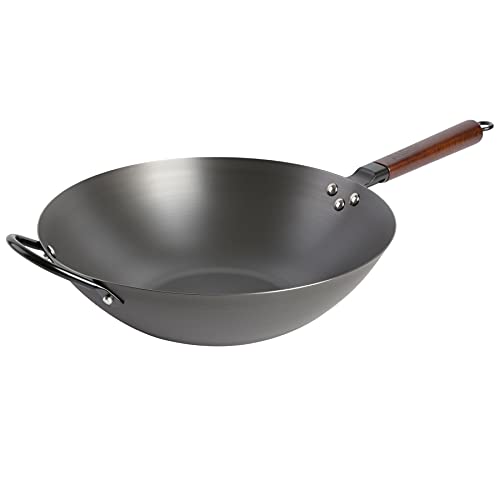
Bigger flat wok, sold by Amazon
Babish Carbon Steel Wok, 14 inch
14 inches rim to rim with a 6-inch flat base, a riveted wooden handle and a small helper handle for lifting it full. The listing says it works on gas, electric, ceramic, glass and induction, and on the grill. Sold and shipped by Amazon.
Good: families, and anyone who wants the full 14-inch size The Woks of Life recommend for cooking for two to five people.
The drawback: it is not sold as pre-seasoned, so plan an evening to season it (our seasoning guide covers woks). Buyers are split on how well the first seasoning takes, a few report holes developing over time, and the rivets inside the bowl collect grease.
See the Babish wok on AmazonFor a gas stove with a strong burner
Here a traditional round-bottomed wok earns its place. Food falls back to the hottest point, the sides stay cooler for pushing things out of the way, and you can toss.

A round wok needs a ring on a home gas range, and a burner strong enough to heat the curve.

Traditional round wok for gas
Craft Wok Hand-Hammered Carbon Steel Wok, 14 inch, round bottom
15-gauge (1.8 mm) steel, hand-hammered in Guangzhou, with a long wooden handle and a steel helper handle; about 4.6 pounds. It arrives raw with a protective factory coating that you scrub off before seasoning. Ships from Amazon.
Good: gas ranges, outdoor wok burners and cooks who want the classic shape. Its 1.8 mm steel sits right in the 1.5 to 2 mm range The Woks of Life recommend.
The drawback: Craft Wok says plainly it is not suitable for flat electric or induction stoves. Bare steel rusts fast until it is seasoned and kept oiled, it costs more than our other picks, and some buyers say the wooden handle can work loose.
See the round Craft Wok on AmazonLike the hammered steel but cook on a flat stove? Craft Wok also makes a flat-bottomed version. Craft Wok notes its base is not perfectly flat (hand hammering leaves a slight bulge), so it can rock a little on glass or induction at first.
The five woks compared
Four are our picks. The fifth, Yosukata, is the wok you will see recommended most often online, so we included it with an honest note.
As an Amazon Associate we earn from qualifying purchases.
| Wok | Bottom and stoves | Arrives | Size and weight | One real drawback |
|---|---|---|---|---|
|
Souped Up Recipes Best for: most home stoves See it |
Flat: gas, electric, induction | Pre-seasoned; lid and spatula included | 12.5 in; about 5 lb with lid (listing) | Factory seasoning can chip early on |
|
Babish Best for: families, flat stoves See it |
Flat, 6 in base: gas, electric, glass, induction | Bare; you season it | 14 in; about 5 lb (listing) | Rivets inside the bowl collect grease |
|
Craft Wok, round Best for: gas and outdoor burners See it |
Round: gas only (with a ring) | Raw with factory coating to scrub off | 14 in; 4.6 lb | Not for flat electric or induction stoves |
|
Lodge cast iron Best for: electric coil, slow and steady heat See it |
Flat: all stoves, oven, grill | Pre-seasoned with vegetable oil | 14 in; about 11.5 lb (listing) | Too heavy to toss |
|
Yosukata, black Best for: the online favorite, flat stoves See it |
Flat: gas, electric, induction | Pre-seasoned | 13.5 in | Mixed buyer reviews on the factory seasoning, sticking and rust; below the rating bar we use for our picks |
Swipe the table sideways on a phone.
Size, thickness and handles
- Size. The Woks of Life recommend a 14-inch wok for two to five people and note that most Chinese woks are 13 to 14 inches. A 12 to 12.5-inch wok is easier to lift and store and is plenty for one to three. Go above 14 inches only if you have a big burner; a home flame cannot heat the edges of a huge wok.
- Thickness. The Woks of Life suggest 14- to 16-gauge carbon steel, about 1.5 to 2 mm: sturdy, but not too heavy to handle. Very thin woks heat fast but warp more easily; thick ones are slow and heavy.
- Handles. A long handle lets you tilt and toss; a short helper handle on the other side lets you carry a full wok. America's Test Kitchen's testers liked long wooden handles angled only slightly. Two loop handles, like on the Lodge, are fine for steaming and braising but not for tossing.
- Oven. Wooden handles rule out the oven. If you want to finish dishes in the oven, choose an all-metal wok like the Lodge, and check the maker's limit. Our oven-safe cookware guide explains the handle rules.
- Lid. Useful for steaming dumplings, braising and stopping splatter. The Souped Up wok includes one; for the others, a domed lid of the same diameter works.
Carbon steel or cast iron wok?
Cast iron woks sell well, and they suit some kitchens. They hold a lot of heat, which helps on an electric coil that cannot react quickly, and they are naturally seasoned like a cast iron skillet. But they are heavy and slow. America's Test Kitchen preferred carbon steel because it is lighter and responds faster when you turn the heat up or down, and The Woks of Life note that cast iron is slow to recover after you add food.
If you want to braise, deep-fry and stir-fry gently on an electric stove, and you never plan to toss, cast iron is a reasonable choice. For quick, high-heat stir-frying, pick carbon steel. Our carbon steel vs cast iron guide compares the two metals in more detail.
As an Amazon Associate we earn from qualifying purchases.

If you want cast iron
Lodge Pre-Seasoned Cast Iron Wok, 14 inch
Made in the USA from iron and vegetable-oil seasoning, according to Lodge. It has a flat base and two loop handles, and it works on glass tops, induction, the grill and in the oven. Sold and shipped by Amazon.
Good: electric coil stoves, braising, deep-frying and anyone who already loves cast iron.
The drawback: it weighs about 11.5 pounds on its listing, so you will not toss food in it, and it takes a long time to heat up and cool down.
See the Lodge wok on AmazonOther wok materials, in one line each:
- Stainless steel: no seasoning and dishwasher-friendly, but food sticks more and The Woks of Life call it "not ideal for stir-frying". See our stainless steel grades guide.
- Hybrid stainless and nonstick (HexClad style): a patterned coating on stainless. See is HexClad non-toxic?.
- Titanium: light, but "titanium" often describes a coating. See our titanium cookware guide.
- Granite and ceramic-coated woks: nonstick coatings with a heat ceiling. See our granite cookware guide and ceramic cookware guide.
First use: burn off, season, cook
A new carbon steel wok needs about an hour of setup. The short version:
- Scrub off the factory coating with hot water, a little dish soap and a scrubber, unless the wok is sold pre-seasoned (then just wash and dry it).
- Heat it empty. On gas, tilt and turn it over high heat until the steel turns blue, gold and brown. On electric or induction, heat it gradually on medium.
- Oil it thinly (Craft Wok uses about 1 1/2 teaspoons for the whole inside), keep heating until it smokes and darkens, and repeat two or three times.
- Cook something fatty first: stir-fried greens with plenty of oil, or deep-frying.
- After every use: rinse with hot water and a brush, dry it on the heat, and wipe on a thin film of oil. Craft Wok warns a bare wok can rust very quickly if you skip this.

Bluing: the bare steel changes color as the factory film burns off.
Our guide to seasoning carbon steel covers each step, the oven method and how to fix rust or sticky spots, with a section just for woks. The usual mistakes: soaking it, the dishwasher, putting it away damp, cold water on a hot wok (which can warp it), and long simmers of tomato or vinegar.
The honest downsides of a carbon steel wok
- It needs looking after. Dry it on the heat and oil it after every wash. Left wet, it can rust overnight. Light rust scrubs off, but it is a chore.
- It looks patchy for weeks. Brown, black and bronze blotches are normal. It evens out with cooking.
- It is not a nonstick pan on day one. Eggs and noodles can stick until the seasoning builds up. Use a little more oil than you would in nonstick, and heat the wok before the oil goes in.
- Your stove sets the limit. A home burner will not give you the smoky "wok hei" of a restaurant range. Cook in smaller batches so the wok stays hot.
- Flat bottoms toss less freely than round ones, and wooden handles can loosen over time.
Why some popular woks are not on our list
We only pick woks with a long rating history on Amazon: at least 4.4 out of 5 from more than a thousand buyers for this page. That rules out some woks that reviewers like:
- Yosukata. It is the wok many review sites and search results name first, and it is a best-seller. Its buyer reviews are mixed on the factory seasoning, sticking and rust, so it is in our table but not a pick.
- Taylor and Ng. America's Test Kitchen's winner in its February 2026 wok review. On Amazon it has only a handful of ratings.
- Joyce Chen Classic and IMUSA. America's Test Kitchen's two best buys. Both are low-priced, uncoated and well liked by testers, but on Amazon their ratings sit below the bar we use.
- Made In and Misen. Well-made, premium carbon steel woks, but each has only a small number of Amazon ratings so far, and they cost several times more than our picks.
- "Nonstick carbon steel" woks. Several of the best-selling "carbon steel" woks are coated. If you want a nonstick wok, buy one knowingly; if you want bare steel, read the listing first.
Wirecutter recommends the Sur La Table Professional Carbon Steel Wok. We stuck to woks we could check on Amazon with a long rating history.
Questions people ask
Is carbon steel good for a wok?
Yes. It is the material Chinese chefs most often recommend: light enough to lift and toss, quick to heat, and it builds a natural nonstick seasoning. The Woks of Life say a Chinese chef asked for the best wok would always answer carbon steel.
Are carbon steel woks worth it?
For stir-frying, yes. It has no coating to wear out, and it gets better the more you cook in it. The trade-off is a minute of care after each wash: dry it on the heat and oil it.
What is the healthiest material for a wok?
Uncoated carbon steel or cast iron. Neither has a PTFE or other PFAS coating. Both add a little iron to food, more with acidic dishes. If you have been told to limit iron, ask your doctor.
What are the common problems with carbon steel woks?
Rust if they are left wet, patchy color while the seasoning builds, food sticking in the first weeks, and warping if a thin wok is heated too fast on induction or cooled under cold water.
What should you not cook in a carbon steel wok?
Long simmers of acidic food such as tomato sauce, vinegar braises or citrus. They strip the seasoning and can taste metallic. A splash of vinegar or wine in a stir-fry is fine.
Which wok do Chinese chefs use?
In restaurants, mostly round-bottomed woks of carbon steel or thin cast iron over very powerful gas burners. At home, flat-bottomed carbon steel woks are the practical choice for electric, glass and induction stoves.
Can you use a wok on an induction or glass-top stove?
Yes, if it has a flat bottom and, for induction, is magnetic. Carbon steel and cast iron both are. Heat it gradually and lift it to toss rather than sliding it across the glass.
Can a wok go in the oven?
The steel can, but most carbon steel woks have wooden handles that cannot. All-metal woks such as the Lodge cast iron wok can go in the oven.
Do I need a lid for my wok?
It helps for steaming, braising and controlling splatter. The Souped Up Recipes wok includes one. For other woks, a domed lid of the same diameter works.
Wok or frying pan: which should I buy?
If you stir-fry often, a wok: its sloped sides let you push food away from the heat and toss without spilling. If you mostly sear and fry eggs, a carbon steel skillet is easier. Our carbon steel pan guide covers skillets.
Keep reading
- Best carbon steel pan
- How to season a carbon steel pan or wok
- Carbon steel vs cast iron
- Cast iron cookware guide
- Non-toxic cookware guide
- Types of stoves
About this guide: Written by Lara Yehia. We did not cook with these woks. Listings, stock and ratings change, so check the one you buy. As an Amazon Associate we earn from qualifying purchases.
Sources reviewed
- America's Test Kitchen: the best woks (February 2026)
- The Woks of Life: what is the best wok to buy?
- Our Place: flat vs round bottom wok
- Craft Wok: how to season a carbon steel wok
- Wirecutter: wok recommendation (December 2024)
- Nitriding: definition of the heat treatment
- Brittin HC, Nossaman CE. Iron content of food cooked in iron utensils. Journal of the American Dietetic Association. 1986;86(7):897-901.
- Amazon listings and buyer review summaries for B07RJ39JVL, B09GRXQGRN, B00PUZT9MU, B0922Y11HX, B00063RXQK and B084DQYNNM, the Woks & Stir-Fry Pans best-seller list, and Amazon search results for Joyce Chen, IMUSA, Taylor and Ng, Made In and Misen woks (checked October 3, 2026).


