
By Lara Yehia · Last reviewed November 2026
Boneless chicken breast takes about 20 to 25 minutes in a 400°F (204°C) oven. A large or thick one can take longer. It's done when the thickest part reads 165°F (74°C), so check it with a thermometer, not the clock.
- At 350°F (177°C), the USDA lists 20 to 30 minutes for a boneless breast half and 30 to 40 for bone-in.
- The thick end sets the time. Even out the thickness and every piece finishes together.
- Pat it dry, oil it lightly and leave space between the pieces.
- Straight from the freezer? Plan on about half as long again.
- Pink inside at 165°F (74°C) can still be safe. Color isn't the test.
A wire rack set inside a rimmed sheet pan (baking tray) helps with the last three. Our best baking racks guide compares racks that fit a standard half sheet pan.
As an Amazon Associate we earn from qualifying purchases.

The tool that ends the guessing
An instant-read thermometer answers “is it done?” in a couple of seconds, so the oven door stays open for less time. We'd start with the Alpha Grillers instant-read: the listing gives a 1 to 2 second reading, a thin probe and a backlit screen. Good to know: it reads up to 300°F (149°C) and is hand wash only, so it checks the chicken and comes out. It doesn't stay in the oven.
See the Alpha Grillers thermometer on AmazonHow long to bake chicken breast: the time chart
These are the oven times we could check against a government or university source. The 350°F times come from FSIS, the USDA's food safety agency. The 400°F time comes from a University of Florida IFAS Extension recipe, which says the time depends on how thick the breasts are.
| Chicken breast | 350°F (177°C) | 400°F (204°C) |
|---|---|---|
| Boneless breast half | 20 to 30 min | 20 to 25 min |
| Bone-in breast half | 30 to 40 min | No verified time. Go by the thermometer |
| Boneless, from frozen | About 30 to 45 min | About 30 to 38 min |
Sources: FSIS chicken cooking times (350°F) and UF/IFAS Extension (400°F). The frozen row is the FSIS rule of about 50 percent longer applied to the fresh times, our arithmetic. These are published ranges, not tested by us, and the 400°F recipe gives no breast weight. Use them to plan, then check the temperature.
A second extension recipe lands in the same place. Mississippi State University Extension bakes seasoned breasts at 400°F for 10 minutes, flips them, then gives them 15 more. That's about 25 minutes in all.
One catch with the 350°F row: in its Kitchen Companion handbook, FSIS pins that 20 to 30 minutes to a 4 ounce (113 g) boneless breast. Supermarket breasts are often heavier. Start checking at the low end of the range and expect a big one to need the top of it, or a few minutes more.
The thickness rule
Thickness matters more than weight. Heat works its way in from the outside, and a chicken breast is thick at one end and thin at the other. By the time the thick end reaches 165°F (74°C), the thin end has been past it for a while. That's where dry chicken starts.
Fix the shape and the clock becomes reliable. Lay the breast between two sheets of parchment or plastic wrap (cling film) and tap the thick end with a rolling pin or the bottom of a heavy pan until it matches the thin end. A very thick breast can be sliced in half horizontally into two thinner cutlets instead. Thinner pieces cook faster, so start checking earlier.

Tap the thick end down until the whole breast is one even thickness.
When to take it out of the oven
Go by temperature, not color. FSIS says all poultry, breasts included, is safe at 165°F (73.9°C), measured with a food thermometer before it comes off the heat. Push the probe into the thickest part of the breast. On a thin piece, going in from the side is easier, so the tip sits in the center, as a University of Nebraska–Lincoln Extension guide suggests. Keep the tip away from bone.
- Reads 165°F (74°C) or more: it's done. Take it out.
- Reads under 165°F: put it back and check again in 3 to 5 minutes, sooner if it was close.
- Thin end done, thick end not: lay a small piece of foil over the thin end and keep going.
- Still pink inside at 165°F: it can be safe. FSIS explains that gases in a hot oven react with the meat and can leave cooked poultry with a pink tinge.
- Juices running clear, or pink: not a test either way. FSIS says color isn't a reliable sign of doneness. Only a thermometer tells you.
Our chicken internal temp guide has the full doneness chart, where to put the probe in every cut, and what to do when you overshoot.
Bone-in and skin-on chicken breast
The bone slows things down. FSIS lists 30 to 40 minutes for a bone-in breast half at 350°F (177°C), against 20 to 30 for boneless. We couldn't find a government or university time for bone-in breasts at 400°F, so we're not giving one. At 350°F, start checking at 30 minutes.
Probe the thickest part and keep the tip off the bone. The Nebraska Extension guide says to steer clear of bone, fat and gristle when you take the reading.
Skin-on breasts brown best skin side up, patted very dry before they go in. The finish line doesn't move: 165°F (74°C) in the thickest part.
Baking chicken breast from frozen
You can skip the thaw. FSIS says chicken can go into the oven frozen. It takes about 50 percent longer, and it still has to reach 165°F (74°C) on a thermometer. For a boneless breast half at 350°F (177°C), that turns 20 to 30 minutes into roughly 30 to 45. That's arithmetic on the FSIS rule, not a tested time, so check early.
Frozen breasts often come stuck together. Pull them apart as soon as they loosen so the heat reaches every side. Season them once the surface has thawed enough to hold it.
If you'd rather thaw it first
FSIS gives three safe ways. In the fridge, a package of chicken parts can take 1 to 2 days or longer, and it keeps another day or two after that before you cook it. In cold water, a package of parts should thaw in 2 to 3 hours if you change the water every 30 minutes. In the microwave, cook it right after it thaws.
How to keep baked chicken breast juicy
Most dry chicken is overcooked chicken. These steps keep it from running far past 165°F (74°C), and keep it browning instead of steaming.
Skip the rinse and pat it dry
Don't wash raw chicken. USDA research found that washing or rinsing poultry raises the risk of spreading bacteria around the kitchen. Pat it with paper towels (kitchen roll) instead and throw them away. Then wash your hands, and clean the board, knife and counter with hot soapy water, as FSIS advises after handling raw meat. A dry surface also browns faster. A thin coat of oil helps it along.

Paper towels, not the tap. A dry surface browns faster.
Salt, brine or marinate
A light salting just before it goes in is enough for a weeknight. If you brine or marinate, do it in the fridge. For poultry, FSIS advises refrigerating for up to 2 days. Pat it dry before it goes in so it browns.
Pan, rack and space
A rimmed sheet pan lets hot air reach every piece. A glass or ceramic baking dish works too, but its tall sides hold in more steam, so it may brown less. Glass and dark metal pans brown faster. For baked goods, Kansas State University Extension advises setting the oven 25°F (about 14°C) lower in those pans. With chicken, you can do that, or keep the temperature and start checking a few minutes early.
Leave space between the pieces. Crowded chicken sits in its own juice and steams. A wire rack set inside the sheet pan lifts it out of that juice and lets heat reach the underside, so there's no need to flip. It's the same setup the FSIS handbook describes for roasting: meat on a rack in a shallow, uncovered pan.
Lining the pan with parchment makes cleanup easier. Check the box rating against your oven temperature first. Our guide on whether parchment paper can go in the oven covers the limits.

Space between the pieces and a rack underneath: the chicken browns instead of steaming.
As an Amazon Associate we earn from qualifying purchases.
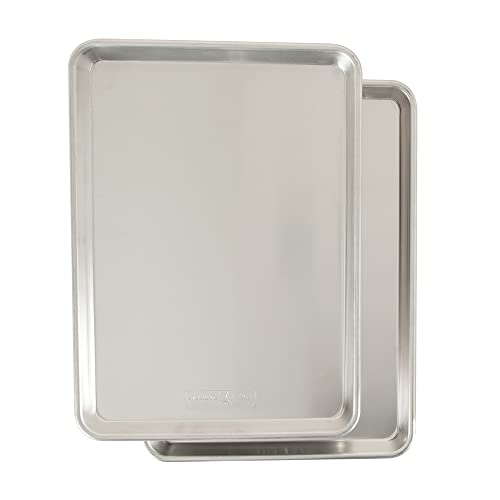
Nordic Ware Naturals half sheet pan, 2-pack
Why it fits: uncoated aluminum half sheets with a 1 inch (2.5 cm) rim and a steel-reinforced edge, per the listing. The inside measures 17.1 x 12.1 inches (43 x 31 cm), the standard half sheet size most racks are made for.
Good to know: the listing says to hand wash, since dishwasher detergent discolors the aluminum. It also notes that acidic foods like vinegar or tomato can darken or pit the pan over time, so line it with parchment for a lemony marinade.
Check it on Amazon
Ultra Cuisine stainless baking rack, set of 2
Why it fits: 304 (18/8) stainless steel wire racks, 16.5 x 11.5 x 1 inches (42 x 29 x 2.5 cm), made to sit inside a 13 x 18 inch (33 x 46 cm) half sheet pan. The listing rates them oven safe to 575°F (302°C) and dishwasher safe.
Good to know: you get two racks and no pan. The listing says they don't stack for storage.
Check it on AmazonRest it before you slice
Resting isn't a safety step. The FSIS chart lists no rest time for poultry, and the chicken is safe once it reads 165°F (74°C). A short rest of about 5 minutes on a board before slicing is common practice, and it makes the slices neater. Cover it loosely if you want it to stay warm.

Slice across the grain after a short rest.
Why baked chicken breast comes out dry or rubbery
It went past 165°F (74°C). Lean breast meat tightens and dries the further it goes. Fix: start checking at the low end of the time range and take it out as soon as the thickest part reads 165°F.
One end was thick, the other thin. The thin end overcooks while the thick end catches up. Fix: flatten it to an even thickness, or cut it into two cutlets.
The oven was cold, or set too low. Chicken that goes into an oven that hasn't reached temperature sits there drying before it browns, and a low setting isn't safer: FSIS says meat and poultry shouldn't be roasted below 325°F (163°C). Wait for the preheat, then bake at 350 to 400°F (177 to 204°C).
The pan was crowded. The pieces steam in their own juice and turn pale and rubbery. Fix: leave space around each one, or use a second pan.
And if it was sliced the second it came out, some of that juice simply ended up on the board. Five minutes of rest takes care of it.
Questions people ask
How long do you bake chicken breast at 350°F?
FSIS lists 20 to 30 minutes for a boneless breast half at 350°F (177°C), and 30 to 40 minutes for bone-in. Its handbook ties the boneless time to a 4 ounce (113 g) breast, so a bigger one can take longer. It's done at 165°F (74°C) in the thickest part.
How long do you bake chicken breast at 400°F?
About 20 to 25 minutes for boneless breasts, according to a University of Florida IFAS Extension recipe, which adds that the time depends on thickness. Check the thickest part for 165°F (74°C).
What about 375°F or 425°F?
We couldn't find a government or university time for either, and published recipes don't agree. A hotter oven cooks faster, so at 425°F (218°C) start checking a few minutes before the 400°F (204°C) range, and at 375°F (191°C) expect it to run a little past it. Either way, 165°F (74°C) in the thickest part is the finish line.
Should you bake chicken breast covered or uncovered?
Uncovered, if you want it to brown. The FSIS handbook describes roasting in a shallow, uncovered pan. A foil cover traps steam, so the chicken comes out paler. Our guide on putting aluminum foil in the oven covers how to use foil safely.
Does a convection oven change the time?
Usually, yes. Convection moves hot air around with a fan, and a Lincoln Land Community College guide gives the common rule of setting it 25°F (about 14°C) lower than a regular oven. Some ovens make that cut for you in convection mode, so check your manual first. Whatever you set, check for 165°F (74°C).
What is 180°C or gas mark 4 in Fahrenheit?
Both are about 350°F (177°C). 180°C works out to 356°F, so use the 350°F times: 20 to 30 minutes for a boneless breast half.
How long does baked chicken breast keep in the fridge?
FSIS gives 3 to 4 days for cooked chicken leftovers, and 1 to 2 days for raw chicken parts. Get leftovers into the fridge within 2 hours of cooking, or within 1 hour when it's above 90°F (32°C). Our guide to reheating food covers warming it back up, and there's more on putting hot food in the fridge.
Can you bake chicken breast from frozen?
Yes. FSIS says frozen chicken can go straight into the oven. Plan on about 50 percent longer than fresh and check for 165°F (74°C) in the thickest part.
Do you need to flip chicken breast when baking?
Not on a wire rack, because heat reaches the underside. On a flat pan, one flip helps it brown evenly. Mississippi State University Extension's recipe flips it after the first 10 minutes at 400°F (204°C).
How we checked
On 17 November 2026 we read the FSIS pages and handbooks listed below on safe cooking temperatures, cooking times, thawing, washing, color and leftovers, plus oven times and tips from four university extension services and one college guide. We also compared the baked chicken breast guides that rank in US search for this topic. We did not cook and time chicken for this page: every time comes from the sources below. The images are illustrations made with an AI image tool, including the main image at the top. Product details come from the product listings linked above, checked on 17 November 2026.
Written by Lara Yehia. Lara researches home and kitchen products for Cupindy. This page is general cooking and food-safety information.
Sources
- FSIS: Safe Minimum Internal Temperature Chart (read 17 Nov 2026)
- FSIS: Chicken from Farm to Table (cooking times, frozen, thawing, storage) (read 17 Nov 2026)
- FSIS: Kitchen Companion, Your Safe Food Handbook (PDF) (read 17 Nov 2026)
- FSIS: Doneness Versus Safety (read 17 Nov 2026)
- FSIS: The Color of Meat and Poultry (read 17 Nov 2026)
- FSIS: Washing Food, Does it Promote Food Safety? (read 17 Nov 2026)
- FSIS: Poultry, Basting, Brining, and Marinating (read 17 Nov 2026)
- FSIS: How Temperatures Affect Food (read 17 Nov 2026)
- FSIS: Leftovers and Food Safety (read 17 Nov 2026)
- FSIS: Food Safety, A Need-to-Know Guide for Those at Risk (PDF) (read 17 Nov 2026)
- University of Florida IFAS Extension: Garlic Herb Chicken (400°F time) (read 17 Nov 2026)
- Mississippi State University Extension: 14-Day Shopping and Meal Plan (read 17 Nov 2026)
- University of Nebraska–Lincoln Extension (Alice Henneman): Use a Thermometer! (PDF, hosted by Oklahoma State 4-H) (read 17 Nov 2026)
- Kansas State University Extension: Cooking Basics, Reducing a Recipe (PDF) (read 17 Nov 2026)
- Lincoln Land Community College: Convection Ovens Demystified (read 17 Nov 2026)
As an Amazon Associate we earn from qualifying purchases. Cupindy earns a commission if you buy through the Amazon links on this page, at no extra cost to you. No brand paid to be included.


