

Written by Lara Yehia. Lara researches home and kitchen products for Cupindy. · Published October 2026 · Last reviewed October 3, 2026
A new carbon steel pan is either bare grey steel or a pan with a thin factory coat, and neither one is nonstick yet. Seasoning is how you get there: a few very thin layers of oil, baked onto the steel with heat, then built up every time you cook. The first seasoning takes under an hour, and the rest happens in normal cooking.
Below is the method in four steps, which oil to use, how to clean the pan without undoing the work, what normal looks like, and how to fix the usual problems, from sticky patches to rust. A short section covers woks.
How we put this together: we have not seasoned these pans ourselves for this article. We read the care instructions published by the people who make carbon steel pans and woks (Lodge, de Buyer, Matfer Bourgeat, Made In, Misen, OXO, Yosukata and Craft Wok), America's Test Kitchen's method, and two research sources on what seasoning is, all on October 3, 2026. Where the makers disagree, we say so. Sources are listed at the end.
The short answer
To season a carbon steel pan on the stove: wash off the factory coating and dry the pan on low heat. Wipe in a few drops of a neutral, high smoke point oil, then wipe it back off until the pan looks dry. Heat it on medium-high until it smokes and darkens, about 5 to 10 minutes, let it cool, and repeat two or three times.
The mistake almost everyone makes is too much oil. A thick coat turns sticky instead of hard. If you can see oil pooling, wipe more off.

As an Amazon Associate we earn from qualifying purchases. This does not change which products we recommend.
What you need
- A carbon steel pan. Still choosing one? Our best carbon steel pans guide compares three, and says what each one arrives coated with.
- A neutral oil with a high smoke point, such as canola, vegetable, grapeseed or sunflower. The bottle in your cupboard is fine. If you prefer a can or a stick, Lodge's seasoning spray is plain canola oil, and Stik's seasoning is grapeseed oil with beeswax.
- Paper towels, lint-free.
- For cleaning later: a pan scraper and a chain mail pad for stuck-on food.
Before you season: what is on your pan out of the box
Every carbon steel pan ships with something on it, because bare steel rusts in a damp warehouse. What you do first depends on what that is. Our carbon steel pan guide lists it brand by brand; here is what to do with each kind.
- Already seasoned at the factory (Lodge, for example, seasons with soybean oil). Do not strip it. Wash it, dry it, wipe on a thin layer of oil, and you can cook. A round or two of the method below still helps, because factory seasoning is a starting coat.
- Beeswax (de Buyer Mineral B). Wash it off with hot water. de Buyer says it is fine if some stays behind, because the wax helps the first seasoning.
- A thick plant-oil coating (Matfer Bourgeat). Matfer says to scrub it off with hot, soapy water and an abrasive pad, and to keep going until the surface no longer feels slick. Its test: your finger should squeak on the steel.
- Woks usually arrive with a factory oil. Wash it off with hot soapy water, then burn off what is left on high heat (see the wok section below).

Bare steel, washed and dry: this is the starting point for the first coat.
Whatever it came with, finish the same way: dry the pan completely, then set it on a low burner for a minute or two to drive off any water you cannot see.
How to season a carbon steel pan on the stove
The stovetop is the method most makers give first, and it works for any pan whatever its handle. Open a window and turn the range hood on: this step makes smoke on purpose.
You need: a carbon steel pan, a neutral high smoke point oil and paper towels.
Wash and dry it. Remove the factory wax or oil as described above, towel the pan dry, then warm it on low heat for a minute or two until every trace of water is gone.
Wipe on a very thin coat of oil. Add a few drops of oil, about a quarter of a teaspoon for a 10-inch pan (Misen suggests 4 to 5 drops). Rub it over the whole cooking surface with a paper towel, then take a clean towel and wipe as if you were trying to remove it all. What stays behind is the right amount.
Heat it until it smokes and darkens. Put the pan on medium-high heat. After a few minutes it will start to smoke and the steel will turn gold, then bronze or brown. Keep it there until the smoking slows, usually 5 to 10 minutes; de Buyer says about 10. Move the pan around if your burner is smaller than its base so the edges color too.
Let it cool, then repeat. Turn off the heat and let the pan cool until you can handle it. Repeat steps 2 and 3 two or three more times. de Buyer suggests one to three rounds and Misen three or four more; after that, start cooking. Cooking with fat builds the rest.

Wipe it on, then wipe it back off. The pan should look almost dry before it goes on the heat.
How thin is thin? Thinner than feels right. Oil that is left thick does not harden into seasoning; it turns into a tacky, brownish film that food sticks to. If you would rather not measure drops, a spray such as Lodge's canola seasoning spray makes a thin coat easy, but you still wipe it back.
The potato-peel method
Matfer and America's Test Kitchen both use a different first seasoning: fry potato peels with a lot of salt in a shallow layer of oil, stirring so it reaches the sides, then throw it all away and wipe the pan. ATK's version is 1/3 cup oil, 2/3 cup salt and the peels of two potatoes over medium heat for 8 to 10 minutes. It gives a quick, even first color on a bare pan. Matfer's own instructions do not agree on the amounts, so treat it as a starting coat and keep wiping on thin layers after cooking.
On an induction or electric stove
Induction heats only the part of the pan touching the glass, so the sides stay pale. Misen tells induction owners to use the oven method instead. On any flat-top stove, heat the pan up gradually rather than starting on high, because Lodge warns that fast heating can warp carbon steel, and a warped base wobbles on glass.
Seasoning in the oven (only if your handle allows it)
The oven colors the whole pan evenly, including the outside and the sides. But oven seasoning runs for an hour, so the handle decides whether you can use it. Check before you try:
| Your pan | Oven seasoning? | What the maker says |
|---|---|---|
| All-steel handle (Matfer, Lodge carbon steel) | Yes | Matfer pans go in the oven and over open fire; Lodge says its carbon steel can go in the oven. |
| de Buyer Mineral B (coated handle) | No, use the stove | Oven use is limited to 400°F for less than 10 minutes because of the handle coating. |
| de Buyer Mineral B PRO or Blue Carbon Steel | Yes | de Buyer gives an oven method for these lines: 375°F for 1 hour. |
| Wooden, plastic or silicone-sleeved handle | No, use the stove | Check the maker's oven limit; most of these handles are not made for an hour at seasoning heat. |
If yours passes, the method is the same everywhere:
- Heat the oven. de Buyer uses 375°F; Made In says to use your oil's smoke point. Put a foil-lined tray on the lower rack to catch drips.
- Wipe a very thin coat of oil over the whole pan, inside and out, then wipe it back off.
- Set the pan upside down on the middle rack so extra oil drips off instead of pooling.
- Bake for one hour, turn the oven off and let the pan cool inside. Repeat once or twice if you want a darker start.

Upside down, with foil underneath: any extra oil drips onto the tray instead of pooling in the pan.
Which oil to use (and which to skip)
There is no magic oil. The makers recommend ordinary, neutral oils that can take high heat: Lodge reaches for vegetable or canola oil; de Buyer lists grapeseed, avocado, canola, peanut and sunflower; Misen lists soybean, corn, sunflower, vegetable and canola. A thin coat and the right heat matter far more than the bottle.
Where it gets confusing is the oils the makers argue about:
| Oil or fat | Makers that use or allow it | Makers that say skip it |
|---|---|---|
| Flaxseed | Vollrath uses it; Yosukata lists it | de Buyer (sticky, uneven layers) and Misen (can flake) |
| Olive oil, butter, bacon fat | Yosukata lists olive oil | Misen (can contain sugars and burn) |
| Lard, tallow, shortening | Matfer lists tallow; Yosukata lists lard and Crisco | Lodge does not recommend animal fats for seasoning because they can go rancid |
| "Vegetable oil" | Lodge, Misen | de Buyer's rust guide says to avoid it |
Our reading: pick a cheap, refined, neutral oil you already cook with and use it thinly. If a flaxseed or animal-fat seasoning has worked for you, the makers who allow it are not wrong; it is just not where we would start.
What seasoning actually is
Heat turns a thin film of oil into a hard, plastic-like layer that bonds to the steel, which is why thin coats and enough heat matter. Research on iron cooking pans has found more going on: a 2023 study in Nano Materials Science reported that repeated oil-and-heat cycles formed tiny iron oxide (magnetite) structures on the pan surface, which change how the surface handles water. And the popular claim that the oil layer itself makes the pan nonstick is less settled than it sounds: chemistry magazine C&EN noted in 2024 that researchers "have not definitively proved this." In practice, cooking with fat over time is what makes a pan release food.
As an Amazon Associate we earn from qualifying purchases. This does not change which products we recommend.

If you want a thin coat without measuring
Lodge Seasoning Spray, 100% canola oil, 8 oz
What the listing says: "100% canola oil – no additives or propellants." Lodge's directions: spray a thin layer, then wipe until no oil residue remains. Sold and shipped by Amazon.
The catch: it is canola oil in a can. Amazon's summary of customer reviews says some buyers find it overpriced for that, and some say it does not spray properly. Any neutral oil from your cupboard does the same job.
See the Lodge spray on Amazon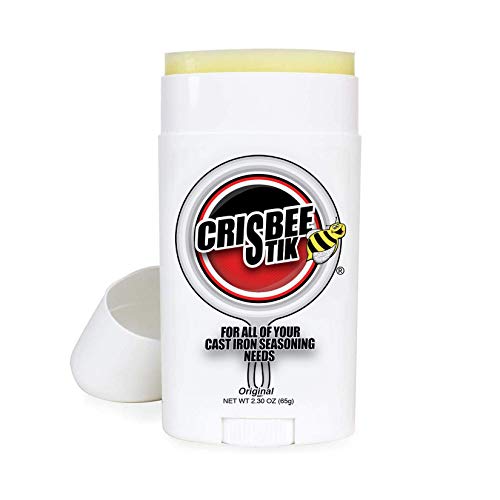
If you like a solid seasoning you rub on
Stik Cast Iron and Carbon Steel Seasoning
What the listing says: made with grapeseed oil and beeswax; "a little goes a long way." Ships from Amazon, sold by Crisbee.
The catch: it is oil plus wax, a convenience rather than a stronger seasoning. Amazon's review summary is mixed on the smell (some buyers call it rancid) and on texture (some say it melts easily).
See Stik on AmazonWhat normal looks like (and when to worry)
This is the part that worries new owners most, and the honest answer is that a well-used carbon steel pan rarely looks even. America's Test Kitchen warns that a new pan can look "brown, blotchy, and streaky for months." Made In says the colors and patterns change, darken and slowly even out. Matfer calls brown, spotty patches part of a developing patina.

The usual path goes from silver-grey steel to gold, then bronze and brown in the first rounds, then patchy black with regular use. Uneven patches are not a fault: they are where the pan has had more contact with heat and fat.

Patchy, uneven seasoning like this is normal.
Black residue on your paper towel? Also normal. Made In says it is the baked-on oil layer coming away, often after acidic cooking or soap, that it is not rust, and that the pan is "perfectly safe" to cook with. Re-season or cook something fatty and it settles down.
When to worry: orange spots (rust), a surface that feels tacky, or flakes coming off in pieces. All three are fixable, below.
How to clean a carbon steel pan without stripping the seasoning
Start with the gentlest thing that works, and let the pan cool a little first. OXO and de Buyer both warn against running cold water over a hot pan, because the sudden change can warp the steel.
- Just oil and crumbs: wipe it out with a paper towel. Often that is all it needs.
- Normal cooking mess: rinse with hot water and use a brush or a pan scraper. Lodge's carbon steel care page recommends a nylon brush or a pan scraper.
- Stuck-on food: pour in some water, simmer it for 3 to 5 minutes (Lodge's tip), then scrape.
- Stubborn spots: scrub with coarse salt and a little oil on a paper towel. de Buyer and Made In both suggest it.
- Still stuck: a chain mail pad, with light pressure. Made In includes one in its own carbon steel cleaning kit; de Buyer warns against steel wool and harsh abrasives, so go easy, especially on a seasoning that is only days old.
Then always finish the same way: dry it with a towel, put it on low heat for a minute or two until it is completely dry, and wipe in a few drops of oil. Never leave it to drip-dry in a rack; de Buyer says that is how rust starts.
What about soap? The makers do not agree, and both camps make good pans:
| A little dish soap is fine | No soap |
|---|---|
| Lodge ("warm, soapy water"), OXO ("a drizzle of dish soap... if necessary"), de Buyer's US care blog ("a small amount" if needed) | Matfer, Made In, Misen, Yosukata after the first wash, and de Buyer's Mineral B product page |
What matters more than soap is what comes after it: no soaking, no dishwasher, and dry it on the heat. A drop of soap on a well-seasoned pan does less harm than a pan left wet overnight.

Chain mail lifts stuck-on bits; use it with light pressure and hot water, then dry the pan on the heat.
As an Amazon Associate we earn from qualifying purchases. This does not change which products we recommend.
For everyday cleaning
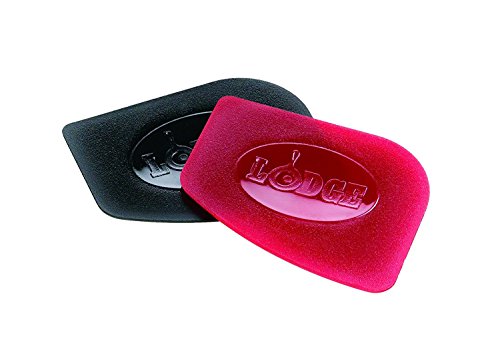
Lodge Pan Scrapers, 2-pack
What the listing says: two hard polycarbonate scrapers with corners shaped for the inside of a pan. Lodge's own carbon steel care page recommends a pan scraper for stuck food. Sold and shipped by Amazon.
The catch: the plastic edge only lifts loose food. It will not touch rust or a sticky, over-oiled patch; that is what the chain mail is for.
See the Lodge scrapers on Amazon
For stuck-on food and light rust
Lodge Chainmail Scrubbing Pad
What the listing says: stainless steel chain mail around a silicone core, dishwasher safe. Sold and shipped by Amazon.
The catch: it is abrasive. de Buyer warns against abrasive scrubbers on carbon steel, so use light pressure and hot water, and keep it away from a seasoning that is only a few days old.
See the Lodge chain mail pad on AmazonFix it: sticky, flaking, rust and stuck eggs
Sticky or tacky seasoning
Too much oil, almost every time. Misen, Made In and Blanc Creatives all give the same cause. Scrub the tacky patch under hot water (a chain mail pad helps), dry the pan on the heat, and season again with a properly thin coat. Made In notes that mild stickiness often evens out with cooking.
Flaking or black bits coming off
Loose seasoning lifting away, often after acidic food, soaking or a thick coat that never bonded. Scrub off whatever is loose, dry the pan and give it one or two thin rounds of seasoning. It does not need a full strip unless the flaking is everywhere.
Dull, dry or grey patches
Blanc Creatives says a dry, ashy look means the pan got too hot for the oil. Lower the heat and add another thin coat. If the pan simply will not change color, it is the opposite: the oil never reached its smoke point, so heat it longer.
Light rust
Orange spots after a pan was left wet are a cleaning job, not the end of the pan. Scrub them off with coarse salt and a little oil (de Buyer) or a bit of steel wool or chain mail (Misen), rinse, dry the pan on the heat and wipe in oil. If you scrubbed down to bare steel, give that area a round of seasoning.

Light surface rust: scrub with salt and oil, dry on the heat, re-oil.
Heavy rust
For rust across the whole pan, de Buyer describes a soak in equal parts water and distilled white vinegar, then baking soda to neutralize the acid and a metal scouring pad. de Buyer gives one to five hours for the soak; other guides say 30 minutes at most. We would start short and check every 30 minutes, because vinegar keeps working on the steel once the rust is gone. Vinegar strips all the seasoning, so rinse well, dry the pan on the heat straight away (bare steel can rust again quickly) and season it from scratch. The same soak, or steel wool, is also how you start over if the seasoning has become a sticky, flaking mess.
Eggs still stick
Usually the seasoning is still young, the pan is not hot enough or there is too little fat. Cook bacon, potatoes and shallow-fried food for the first couple of weeks, and see why eggs stick in carbon steel for the full answer.
How to season a carbon steel wok
A wok is seasoned the same way as a pan, with one extra step. Wash off the factory oil with hot soapy water, dry it, then put the empty wok on your highest gas burner and tilt and turn it so every part of the inside gets very hot. The Woks of Life and Craft Wok describe the steel changing color to blue, gold and brown as the last of the factory oil burns off. That is called "bluing".

Bluing: the bare steel changes color as the factory oil burns off.
Then add a thin film of oil (Craft Wok uses about 1 1/2 teaspoons for the whole inside) and keep heating and tilting until it smokes and darkens. Repeat about three times.
- Electric or induction: a flat-bottomed wok works best. Heat it gradually on medium; Craft Wok warns that fast heating on induction can warp it. If the handle allows, Yosukata gives an oven option: upside down at 350 to 400°F for about an hour.
- After cooking: scrub with hot water. The Woks of Life uses dish soap for heavy, oily residue. Dry it on the heat and wipe in a little oil.
- Keep it oiled: Craft Wok warns a bare wok can rust very quickly.
Mistakes that ruin seasoning
- Too much oil, the number one cause of sticky seasoning.
- Seasoning over the factory wax or oil instead of washing it off first.
- Cold water on a hot pan, which can warp it.
- The dishwasher or a long soak. Lodge, OXO and Misen all rule out the dishwasher; standing water means rust.
- An hour of tomato sauce. A splash of wine is fine; long acidic simmers strip seasoning, so use stainless or enameled cookware for those.
- Drip-drying or stacking a damp pan. de Buyer also says not to store pans touching each other, because they scratch.
Questions people ask
What is the best oil to season a carbon steel pan?
A neutral oil that takes high heat: canola, vegetable, grapeseed, sunflower or peanut are all on the makers' lists. A thin coat matters more than which of them you choose.
Can I use olive oil to season carbon steel?
It is not the best choice. Misen advises against olive oil and butter for seasoning because they can burn, while Yosukata lists olive oil as fine. Use olive oil for cooking once the pan is seasoned, and a refined neutral oil for the seasoning rounds.
Can I use avocado oil to season a carbon steel pan or wok?
Yes. de Buyer lists avocado oil and Blanc Creatives uses it. Its only real downside is price, since cheaper neutral oils do the same job.
Does a carbon steel pan need seasoning? What happens if you do not season it?
Yes, it needs it. Unseasoned carbon steel rusts quickly once it gets wet, and food sticks. A pre-seasoned pan such as Lodge's can be used straight away, but a thin coat of oil after each wash keeps it that way. Cooking with plenty of fat will season a bare pan slowly; a few rounds at the start save a lot of frustration.
How many times should you season a carbon steel pan?
Two or three thin rounds before you first cook is enough for most pans. de Buyer suggests one to three, Misen three or four. After that, everyday cooking does the work.
Do carbon steel pans need to be oiled after every use?
Most makers say yes: dry the pan on the heat and wipe in a few drops of oil. de Buyer's care blog calls it optional, but it is the easiest way to prevent rust.
Can carbon steel go in the oven?
The steel can; the handle decides. All-steel handles such as Matfer's and Lodge's are oven safe. de Buyer's Mineral B is limited to 400°F for under 10 minutes because of its coated handle.
Why is everything sticking to my carbon steel pan?
Usually the seasoning is still thin, the pan is not hot enough, or there is too little fat. A sticky film is different: that is too much oil in the seasoning, fixed by scrubbing it back and re-seasoning thinly.
Is it normal for carbon steel to rust?
Yes, if it stays wet. Light rust scrubs off with salt and oil; dry the pan on the heat and re-oil. Do not use WD-40 or other rust sprays on a cooking surface.
Why is there black residue on my carbon steel pan?
It is seasoning or baked-on factory oil coming loose, often after soap or acidic food. Made In says it is not rust and the pan is safe to cook with. A round of seasoning settles it.
Keep reading: the best carbon steel pans and what is on each one, carbon steel vs cast iron, how to tell if a pan is oven safe and why food sticks to stainless steel. Seasoning cast iron instead? See our cast iron care guide and how to clean a cast iron pan.
Sources reviewed
- Lodge: cleaning and care, carbon steel
- Lodge: oils for cooking and seasoning
- de Buyer USA: carbon steel seasoning instructions
- de Buyer USA: how to clean carbon steel pans
- de Buyer USA: carbon steel pan rust
- de Buyer USA: Mineral B fry pan (handle and oven limit, care)
- Matfer Bourgeat: the black carbon steel guide
- Made In: carbon steel care guide
- Made In: why is black coming off my carbon steel pan
- Misen: carbon steel care
- OXO: how to clean and care for a carbon steel pan
- America's Test Kitchen: how to season carbon-steel cookware (April 2020)
- Blanc Creatives: seasoning carbon steel
- Vollrath: how to season and maintain carbon steel cookware
- Yosukata: how to season
- Craft Wok: how to season a carbon steel wok
- The Woks of Life: how to season a wok
- Gao C. et al. Seasoning Chinese cooking pans: the nanoscience behind the Kitchen God's blessing. Nano Materials Science 5(1), 2023
- C&EN Periodic Graphics: the chemistry of cast-iron cookware (updated September 2024)
- Product wording quoted from the Lodge and Stik listings on Amazon.com and Amazon's summaries of customer reviews, read October 3, 2026.


