

The short answer
Yes, if you freeze meat in bulk, cook ahead or cook sous vide. A sealer pulls the air off your food, which slows freezer burn and stale flavors. It does not make food safe to keep out of the fridge, and it doesn't replace the freezer.
We didn't test these products. We chose them by type from their Amazon listings; the food-safety guidance comes from USDA, the FDA, the CDC and the National Center for Home Food Preservation.
✓ What vacuum sealing does
- ✓Pulls most of the air away from the food's surface, and air on the surface is what causes freezer burn, per USDA.
- ✓Slows the oxygen-driven changes that make fats go rancid and colors fade, which helps food keep its quality longer (NCHFP).
- ✓Lets you seal meat in flat portions that stack neatly once frozen.
✗ What it does not do
- ✗It doesn't make perishable food safe at room temperature. Sealed meat still goes in the fridge or freezer.
- ✗It isn't canning. A sealed bag of soup on the shelf is not preserved.
- ✗It can hide spoilage. The safety rules further down explain why.
Is a vacuum sealer worth it for you?
Freezer burn and waste are the two things a sealer fixes, so it pays off fastest in kitchens that freeze a lot.
It's usually worth it if you
- ✓Buy meat in family packs or bulk and split it into meal-size portions
- ✓Hunt or fish and freeze a season's worth at once
- ✓Cook big batches of soup, chili or sauce and freeze the extras
- ✓Cook sous vide, where the food has to sit tight in a sealed bag
- ✓Keep food in the freezer for months, not weeks
You can probably skip it if
Good containers might be all you need; our guide to non-toxic food storage containers covers glass, steel and the plastics worth trusting.
Which type of vacuum sealer fits your kitchen?
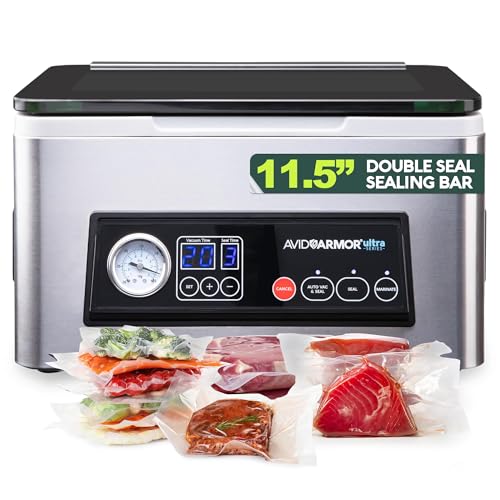
There are three kinds. Countertop edge sealers are the classic machine: you lay the open end of a bag in the slot, it pulls the air out and melts the bag shut. Handheld sealers are small battery pumps that draw air through a valve on a reusable zip bag. Chamber sealers put the whole bag inside a box, take the air out of the box, then seal the bag, so liquids stay put.

Left to right: a countertop edge sealer, a handheld pump on a zip bag, and a chamber sealer.
| Countertop edge sealer | Handheld + reusable zip bags | Chamber sealer | |
|---|---|---|---|
| How it works | Pulls air out of the bag through the open end, then heat-seals it | Battery pump draws air through a valve on a zip bag | Removes air from a closed chamber, then heat-seals the bag inside |
| Liquids and moist food | Freeze soups first; a moist setting and drip tray help | Freeze soups first | Built for them: soups, stews and marinades go in as they are |
| Bags | Heat-seal bags from rolls you cut to size, or pre-cut; some roll listings say they can be washed and reused | Zip bags you wash and reuse | Smooth pouches sized to the chamber |
| Cost per use | Low per bag | One bag spread over many uses | Low per pouch, high cost for the machine |
| Counter space | About 16 in (41 cm) long; stores in a cabinet | One listing compares it to a pepper grinder | Heavy box that needs its own spot |
| Sous vide | Yes, with bags rated for the heat | Yes, if the bag listing names sous vide and a heat limit | Yes |
| Best for | Bulk meat, game, long freezer storage | Small households, leftovers, weekly portions | Heavy batch cooks, liquids, sous vide every week |
Countertop edge sealers
This is the type to get if your freezer is full of meat. The bags are heat-sealed plastic with channels pressed into one side so air can escape, and you cut them from a roll to fit a pork shoulder or a single steak.

Handheld sealers with reusable bags
A handheld pump is the easy way in. You fill the zip bag, close it, press the pump to the valve and it stops when the air is out. There's nothing to cut, and it fits in a drawer.
What to look for on any listing
Seal bar width
A moist or pulse setting
A drip tray
Warranty length
Noise
Can you vacuum seal liquids, soups and marinades?
Yes, but with an edge sealer or a handheld pump you freeze the liquid first. Pour soup, stock or chili into a bag or a shallow container, lay it flat in the freezer, and seal it once it's solid. USDA says that, ideally, a food 2 inches (5 cm) thick should freeze completely in about 2 hours, and that new packages should be spread out in one layer and stacked only once they're frozen solid.

Freeze soup flat in a tray, then seal the solid slab.
For marinated meat, chill it first and use the moist or pulse setting so you can stop before the juices reach the seal. One compact sealer in our table lists a pulse mode for "soft food or moist food, such as bread or food with soup." Keep it in the fridge while it marinates; USDA says that a fridge at 40°F (4°C) or below protects most foods.
A chamber sealer skips the freezing step. The whole bag sits inside, the air comes out of the chamber around it, and the liquid has nowhere to be pulled.
Vacuum sealer bags: rolls, pre-cut or reusable?
You buy the machine once. Bags are the cost that keeps coming.
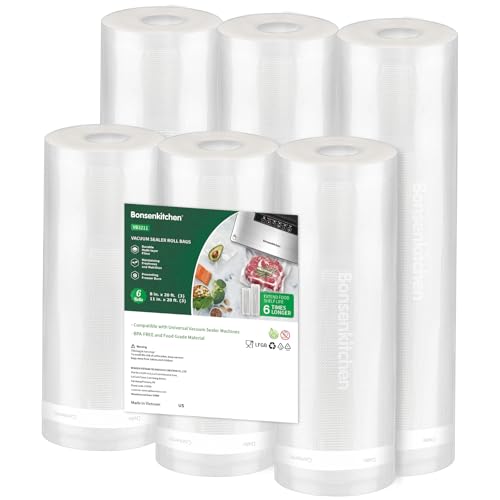
Rolls
Pre-cut bags
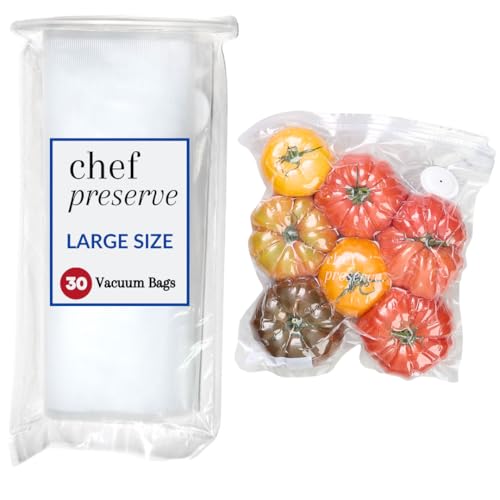
Reusable zip bags
To compare what you'll pay per bag: take the price on the listing today and divide by the number of bags. For reusable bags, divide by the number of times you expect to use each one. Prices move too often to print here, so run it on the day you buy.
The rolls in our table list nylon and polyethylene and say they're BPA free. For what those plastics are, see plastic grades for food storage.
Does vacuum sealing prevent freezer burn?
Yes, it slows it down a lot, because freezer burn starts with air. USDA describes freezer burn as grayish-brown leathery spots caused by air coming in contact with the surface of the food. It doesn't make food unsafe, just dry in spots. Take the air away from the surface and there's much less to dry it out.

Illustration: freezer burn shows up as gray, dry patches where air reaches the meat (left); a tight seal keeps air off the surface (right).
Wrap well
Freeze fast
Keep the freezer at 0°F (-18°C)
Already got some? Cut the dry spots off before or after cooking. USDA says heavily freezer-burned food may need to go for quality reasons, not safety.
If you freeze meat in bulk, start with the countertop edge sealer in our table.
How long does vacuum-sealed meat last in the fridge and freezer?
USDA doesn't give separate times for food you vacuum-seal at home.
| Food | Fridge, 40°F (4°C) or below | Freezer, 0°F (-18°C), best quality | Separate time for home vacuum-sealed? |
|---|---|---|---|
| Steaks, chops, roasts (beef, pork, lamb, veal) | 3 to 5 days | 4 to 12 months | None given by USDA |
| Ground meat | 1 to 2 days | 3 to 4 months | None given by USDA |
| Chicken or turkey parts | 1 to 2 days | 9 months | None given by USDA |
| Whole chicken or turkey | 1 to 2 days | 12 months | None given by USDA |
| Fresh fish and shellfish | 1 to 2 days | Not on USDA's freezer chart | None given by USDA |
| Cooked meat | 3 to 4 days | 2 to 3 months | None given by USDA |
| Soups and stews | 3 to 4 days | 2 to 3 months | None given by USDA |
| Wild game, uncooked | Not on USDA's fridge chart | 8 to 12 months | None given by USDA |
Fridge times from USDA FSIS, Refrigeration and Food Safety. Freezer times from USDA FSIS, Freezing and Food Safety; they are for quality only.
In the fridge, sealing doesn't buy you extra days on USDA's chart
In the freezer, the times are about quality, not safety

Labeled packs in a freezer drawer, with an appliance thermometer to check for 0°F (-18°C).
For cooked leftovers, see how long cooked chicken lasts in the fridge and how long Thanksgiving leftovers last.
Vacuum-sealed food safety: the cold-storage rules
Taking the air out changes which bacteria can grow. The NCHFP explains that the bacteria that make food smell, slime and change color, and so warn you it's going off, like oxygen and multiply slowly in a sealed bag. Some bacteria that cause illness like low oxygen and can grow well. So sealed food can become unsafe with no sign at all.
The best known is Clostridium botulinum, which causes botulism. According to the NCHFP, it grows at room temperature in low-acid, moist food when there's no oxygen. That's why the NCHFP calls refrigeration at 38 to 40°F (3 to 4°C) a critical step for sealed, low-acid food, and why it says perishable food being vacuum packaged shouldn't be out of the fridge more than 2 hours total above 40°F (4°C).
Handle these with care
Anything perishable on the counter or in the pantry
Source: NCHFP
Homemade garlic or herb oils
Source: CDC
Vacuum-packed fish
Thawing other sealed food
Source: USDA FSIS
Dry foods are the exception
Source: NCHFP
The FDA Food Code is a model that states use to write their own retail food rules. Under section 3-502.12, restaurants and stores that vacuum-pack perishable food must control the growth of botulism bacteria and Listeria monocytogenes.
Reusing, microwaving and sous vide: what the bag listings allow
Reusing bags
Microwaving
Sous vide
Mason jars and freezer containers
Jars and rigid containers work with some sealers too. For dry goods in glass, our guide to the best mason jar vacuum sealer covers jar lids and pumps. If you'd rather freeze in containers than bags, start with the best freezer-safe containers, and read can you freeze mason jars before glass goes in the freezer.
FAQ
Is freezer burn safe to eat?
Yes. USDA says it only dries food in spots; cut them off before or after cooking.
How long does vacuum-sealed chicken last in the freezer?
USDA's best-quality times are 9 months for chicken parts and 12 months for a whole bird at 0°F (-18°C). It gives no separate time for vacuum-sealed chicken, and frozen food kept at 0°F (-18°C) stays safe beyond those dates.
How long does vacuum-sealed meat last in the fridge?
Use USDA's normal times: 1 to 2 days for ground meat and poultry, 3 to 5 days for steaks, chops and roasts. USDA lists no longer time for home-sealed meat.
How can you tell if frozen vacuum-sealed meat has gone bad?
Thaw it in the fridge and smell it. USDA says a rancid or off odor means it should be thrown out. Smell is a quality check, though: it can't tell you whether sealed food was kept cold enough, so go by how it was stored and thawed. When in doubt, throw it out.
Can you vacuum seal bread?
Yes, gently. Use a pulse or gentle setting so the loaf doesn't crush, or freeze slices first and seal them firm. For everyday storage, see how to store bread so it stays fresh.
Is vacuum sealing better than freezer bags?
For long storage, usually, because less air means less freezer burn. If you freeze less, the NCHFP says careful wrapping with ordinary freezer packaging gives high-quality results too.
Do chamber sealers need special bags?
They use smooth pouches; the chamber sealer in our table takes pouches up to 11 x 10 in (28 x 25 cm). Edge sealers need bags with embossed channels so the air can get out.
How we checked
Written by Rawia Younis. Rawia researches home and kitchen products for Cupindy. Last reviewed November 2026.
We read every source below on November 23, 2026; the NCHFP article through its University of Georgia-credited republication by Oregon State University Extension, because the NCHFP page wasn't loading that day. We didn't test these products; product details come from their Amazon listings, read the same day. The bag-cost method and the "our own caution" line on reusing bags are our guidance, not an official rule. How-to photos are AI-made illustrations, and product images come from Amazon.
Sources
- National Center for Home Food Preservation (University of Georgia), Should I Vacuum Package Food at Home?
- Oregon State University Extension, Should I Vacuum Package Food at Home? (republished from the University of Georgia)
- USDA FSIS, Freezing and Food Safety
- USDA FSIS, Refrigeration and Food Safety
- USDA FSIS, Safe Minimum Internal Temperature Chart
- CDC, Botulism Prevention
- FDA, Controlling the Hazard of Clostridium botulinum Growth and Toxin Formation in Reduced Oxygen Packaged Fish
- FDA Food Code, section 3-502.12
As an Amazon Associate we earn from qualifying purchases. Products are shown by type. Cupindy isn't affiliated with their makers or endorsed by Amazon.


