
Written by: Sara Ibrahim, Cupindy Home & Kitchen Team
Experience note: Sara covers product-safety topics for Cupindy, with a focus on comparing what manufacturers publish in their own regulatory disclosures against what the marketing on the front of the bottle claims.
Last reviewed: September 2026 — Reviewed for: ingredient-disclosure accuracy, current US regulatory limits, and product availability.
The short version
- “Free & clear” means no added fragrance and no added dye. It says nothing about surfactants, enzymes or preservatives.
- Two detergents in that same category publish fourteen ingredients and six. Neither is the right answer — they are different trade-offs.
- Four checks let you read any panel: the surfactant, the enzymes, the preservative, and whatever is there purely for appearance.
- The one thing that worries people most, 1,4-dioxane, never appears on a panel at all — and is now capped by law at 1 ppm.
Editorial note
This guide teaches you to read a laundry detergent ingredient panel and shows you what two real, widely sold detergents publish about themselves. Every ingredient list quoted here comes from the manufacturer’s own published disclosure, and each one is linked at the end so you can check it yourself.
This guide does not rank detergents by how safe they are, and it is not medical advice. If your skin is reacting to something, that is a question for a doctor, not for an ingredient list. What we can help with is the question that comes after: understanding what is actually in the bottle.
Cupindy has not laboratory-tested any product named here. Everything in this guide is either a published ingredient disclosure, a published regulation, or clearly marked as our own reading of one.
“Free & clear” is a claim about two things, and only two
Walk down the laundry aisle and the calmest-looking bottles say some version of free and clear, free and gentle, or pure. The design does a lot of work: white bottle, blue text, no cartoon splashes. It reads as this one is the simple one.
What the phrase actually means is narrower than that. It means the product has no added fragrance and no added dye. That is the whole claim. It says nothing about the surfactants that do the cleaning, nothing about the enzymes, nothing about the preservatives, and nothing about what the formula leaves behind on your clothes.
Here is how big that gap can be. Two detergents that both sit in the “free and clear” category publish these lists:
Both products are fragrance-free and dye-free. Each list applies to the specific product and size named — pods, powders and other sizes in the same range are formulated differently, so check the disclosure for the bottle in your hand. Sources are listed at the end of this guide.
Neither list is the “right” one. They are two different engineering answers to the same problem, and once you can read them, you can tell which trade-offs each one made.

Unscented and fragrance-free are not the same word
This is the single most useful distinction on the shelf, and neither term is legally defined for laundry detergent in the US.
Fragrance-free
Normally used to mean no fragrance materials were added at all.
Unscented
Often means no noticeable smell — which can be achieved by adding a masking fragrance. A product can be unscented and still contain fragrance.
Because the words are not regulated, the panel is your only check. Under California’s Cleaning Product Right to Know Act, fragrance allergens present above 0.01% have to be disclosed, so a genuinely fragrance-free product shows none of them anywhere on its list. If you see allergen names, the word on the front has been doing some work.
How to read any laundry panel in about sixty seconds
You do not need chemistry for this. You need four questions, asked in order.

What is doing the cleaning, and is it ethoxylated?
Surfactants sit near the top of the list. Look at the spelling: names containing -eth- (as in Pareth, Laureth) or starting with PEG- have been through ethoxylation. That matters for a reason we come to below, and it is the single most useful pattern on the panel.
Are there enzymes?
They end in -ase: amylase, mannanase, lipase. Protease is often listed under its specific name, subtilisin. Enzymes are what let a detergent lift protein and starch stains at low temperatures.
What is the preservative?
Water-based detergents need one. Common names are phenoxyethanol, methylisothiazolinone and benzisothiazolinone. This is the part of the panel most people never look at, and on a “gentle” product it deserves a look.
What is here for appearance rather than cleaning?
Fragrance, dyes, and optical brighteners. None of them remove soil.
Four questions, and you can now do something the marketing cannot stop you from doing: compare two bottles on what they are rather than on how they look.
The two lists, read properly
Apply those four questions to the two lists above and the products separate cleanly.
Tide Free & Gentle is a full-strength conventional detergent with the fragrance and dye taken out. It carries two surfactant systems, a builder package, and three enzymes: subtilisin for protein, amylase for starch, and mannanase for the gums used as thickeners in food. That is a formula built to actually remove stains at low wash temperatures. It also contains sodium borate — which we will come back to, because it is not what most people expect to find in the sensitive-skin bottle.
ECOS Free & Clear takes the opposite approach: six ingredients, three plant-derived surfactants, and no enzymes at all. Fewer things on your clothes, and less stain-lifting power. That trade is real and you should expect it. A short ingredient list is not a free upgrade — it is a decision to do less.
Its preservative system is worth naming, because this is where the honest version of this article differs from most: ECOS uses methylisothiazolinone. That is a preservative widely used across household products, and it is also a recognised contact allergen: the American Contact Dermatitis Society named methylisothiazolinone its Contact Allergen of the Year in 2013. It is in the certified, plant-based, hypoallergenic-labelled bottle, and it is not in the Tide one.
That is not a reason to avoid the product. It is the point of the whole exercise: a certification, a plant-derived formula and a “hypoallergenic” label on the front do not tell you what is in the bottle. The panel does.
The thing the panel cannot show you
There is one substance that comes up constantly in discussions of laundry detergent and never appears on any ingredient list: 1,4-dioxane.
It never appears because it is not an ingredient. It is a trace by-product formed during ethoxylation — the same process that produces the -eth- surfactant names from question one. Nobody adds it. It arrives with the surfactant.

This is where most articles on this subject stop, having successfully alarmed you. Here is the part they tend to leave out.
New York State set a hard limit. Household cleansing products sold there may contain no more than 2 ppm of 1,4-dioxane from 31 December 2022, dropping to 1 ppm from 31 December 2023. Manufacturers could apply for waivers while they reformulated, and no waiver has been valid since 30 December 2025.
Whether that limit reaches past New York depends on the manufacturer, and it is worth being precise about what is actually known. Procter & Gamble has confirmed that its reformulated, reduced-dioxane products are sold throughout North America — that confirmation was reported in 2024 by Citizens Campaign for the Environment, an advocacy organisation that has commissioned testing for the compound. Equivalent public confirmation is not available from every brand. So: reformulated nationally where a manufacturer has said so, and unknown where none has.
California approaches it from the disclosure side: manufacturers must publish 1,4-dioxane online if it is present at 10 ppm or above.
One thing to be explicit about, because this is exactly where articles on this subject tend to blur. We have no test results for any product named in this guide, and none of these manufacturers publishes any. Pointing at an ethoxylated surfactant on a panel is not a statement that the product contains 1,4-dioxane. It identifies the chemistry in which the by-product can arise. Those are different claims and only the second one is ours.
So the practical position in 2026 is this. Ethoxylated surfactants are still the pathway, and the -eth- spelling is still the tell — Tide Free & Gentle’s C10-16 Pareth is one, while ECOS’s sodium coco-sulfate and its two betaines are not. But the residual amounts are now capped by law at a level far below what the older warnings were written about. Knowing the pattern is still useful. Losing sleep over it is not.
Freshness note: concentration limits and disclosure thresholds are set by state law and do change. The figures above were checked against the source agencies in September 2026 and are linked at the end. If you are reading this much later, check the source before relying on the number.
Optical brighteners: the ingredient that cleans nothing
Optical brighteners are fluorescent compounds that stay on your fabric on purpose. They absorb ultraviolet light and re-emit it as visible blue, which cancels the yellow cast that older white fabric picks up. The clothes are not cleaner. They look whiter under daylight.
By design, the effect only works if the compound remains on the fabric after rinsing. That is the whole mechanism, and it is why people with reactive skin often choose to avoid them — not because of any established hazard at these levels, but because the ingredient is on the fabric all day by intent rather than by accident.

Neither product in our comparison lists an optical brightener. Tide Free & Gentle’s published list contains none, and ECOS states that its laundry products are made without them. This is a case where the “free and clear” versions of a range genuinely do differ from the standard ones.
It is worth checking on the bottle you actually buy, because the mainstream option is different. The published label list for all Free Clear — the third detergent in our picks below — includes fluorescent brightener 28 sodium salt, alongside sodium laureth sulfate and C12-15 alcohols ethoxylated. That single bottle demonstrates both patterns from the four checks: an ethoxylated surfactant and an optical brightener, in a product whose front label says free and clear. That list is EWG’s transcription of the label rather than Henkel’s own filing, and Henkel publishes a separate disclosure for each size, so check the one on your bottle before relying on it.
There is one group of people who care about this intensely for a completely different reason: hunters. Deer are widely reported to see further into the short-wavelength and near-ultraviolet range than people do, which would make brightener-treated clothing more conspicuous to them. Hunting-specific detergents are sold on exactly this basis, which is a good reminder that “brightener-free” is sometimes a performance requirement rather than a safety one.
Enzymes: the reason short lists clean less
Enzymes are the most misunderstood entry on a laundry panel. They are proteins that break a specific class of stain into fragments small enough to rinse away, which is what lets a modern detergent work in cold water.
- Protease (often listed as subtilisin) — protein: blood, egg, grass, sweat.
- Amylase — starch: sauces, gravy, chocolate, baby food.
- Mannanase — the gums used to thicken food, which is why it turns up in detergents aimed at everyday family laundry.
- Lipase — fats and oils.

Tide Free & Gentle carries three of the four. ECOS Free & Clear carries none. If you have been disappointed by a gentle detergent on food or body-soil stains, this is almost always the reason, and no amount of extra product will substitute.
Worth knowing when you look at a full disclosure: on P&G’s published label, the three enzymes are flagged as appearing on a California designated list, as is the sodium borate. The flag means the ingredient appears on one of the lists the state tracks. It is a signal to go and read, not a verdict.
Borax, baking soda, and why “natural” is not a safety claim
A large amount of homemade-detergent advice online is built on borax and washing soda, on the reasoning that they are simple minerals rather than synthetic chemicals.
Set that against what we just read. Sodium borate — borax — is an ingredient in Tide Free & Gentle, the mainstream sensitive-skin detergent, and it is one of the entries P&G flags against a California designated list. The DIY advice treats it as the safe alternative to commercial detergent. The commercial detergent contains it and flags it.
Both cannot be the whole story, and the reason they conflict is that “natural” describes where a substance came from, not how it behaves. Naturally occurring minerals get assessed on the same evidence as anything synthesised in a plant. Sometimes they come out well and sometimes they do not, but the origin is not the answer.
The same logic applies across the house, which is why our guide to non-toxic kitchen cleaning works from what a product does rather than from whether it sounds like a plant.
Half the fragrance never came from the detergent
If you have switched to a fragrance-free detergent and your laundry still smells strongly of something, the dryer is the usual answer.
Fabric softener and dryer sheets are designed to deposit material onto fibres and leave it there. That is the entire function — softness and scent come from a coating that survives the rinse or the heat. A softener is not a rinse-off product in the way a detergent is; it is a leave-on one. So a household that carefully removes fragrance from the wash and keeps using scented sheets in the dryer has changed the smaller half of the problem.
Three ways to handle the dryer, in increasing order of how much they change:
- Fragrance-free dryer sheets — same coating mechanism, no added scent.
- Nothing at all — free, and works fine for towels and cottons. You will get more static in dry winter air.
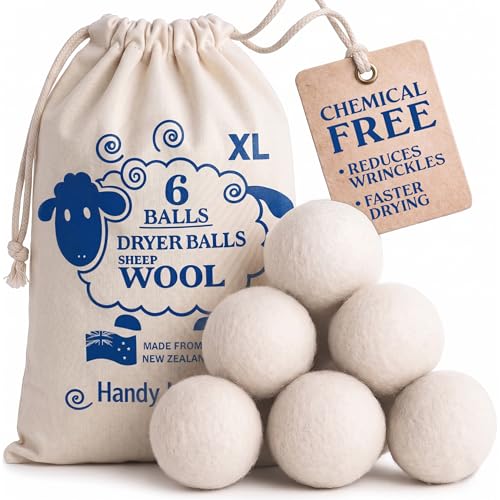
- Wool dryer balls — mechanical rather than chemical. They separate the load so hot air moves through it, and no softening coating is left behind. Two honest caveats: the drying-time saving is small and plenty of people never notice it, and wool balls shed fibres onto clothes as they age, which shows up most on dark fabrics.
For what is actually in a dryer sheet, what the safety research does and does not show, and which wool balls are worth buying, see our full comparison of dryer sheets and wool dryer balls.

If creasing is the thing you are actually trying to solve, dryer choice matters less than technique — our guide to getting wrinkles out without an iron covers that properly. And because a shorter dryer cycle is the single biggest energy line in most laundry rooms, it is worth reading alongside how to reduce household electricity use.
Two more things that change the result more than the brand does
Your water. Hard water binds up a portion of the surfactant before it reaches the fabric, which is why the same detergent performs differently in two houses. If your laundry has gone grey and stiff over months, suspect the water before the detergent — our water softener guide explains how to tell.
Your dose. Overdosing is the most common laundry mistake and it works against you twice: the excess does not rinse out, and residue on fabric is a frequent cause of the stiffness and irritation people blame on the formula. Cutting the dose is free, and it is the first thing to try. Extra detergent also builds up inside the machine; here is how to clean a washing machine. Washing temperature matters too, and getting it wrong shrinks things — see our notes on washing without shrinking.
For anyone washing baby clothes, the first-wash routine is its own topic and we cover it in washing new baby clothes before first wear.
What we would put in the cupboard
As an Amazon Associate, Cupindy earns from qualifying purchases. If you buy through the links below, we may earn a commission at no additional cost to you. This does not influence which products we include — we have named a real drawback for every one of them. As an Amazon Associate we earn from qualifying purchases.
Neither detergent here is “the safe one”. They are two different trade-offs, and which one suits you depends on what you wash.


Frequently asked questions
Is “free and clear” the same as non-toxic?
No. It means no added fragrance and no added dye. It makes no statement about the surfactants, enzymes or preservatives, and as the two lists above show, two “free and clear” products can be built completely differently.
Should I avoid detergents with 1,4-dioxane?
It is not listed on any panel because it is a trace by-product rather than an ingredient. Since 31 December 2023 New York has capped it at 1 ppm in household cleansing products, and no manufacturer waivers have been valid since 30 December 2025. Ethoxylated surfactants — the -eth- and PEG- names — are still the pathway if you prefer to avoid the category.
Are enzymes bad for sensitive skin?
Enzymes are what make a detergent work in cold water, and detergents marketed for sensitive skin frequently contain them — Tide Free & Gentle lists three. Whether any specific ingredient suits your skin is a question for a doctor, not for an article.
Is a shorter ingredient list better?
It is shorter. Fewer ingredients usually means less stain-removal capability, because most of what gets removed is the part that lifted stains. Choose the trade-off deliberately.
Do I need fabric softener at all?
No. It is the one product in the laundry cupboard with no cleaning function whatsoever. Wool dryer balls or nothing at all both work; you will notice more static in dry air.
Does a “hypoallergenic” label mean anything?
Not in any regulated sense for laundry detergent in the US. It is not a defined term with a testing standard behind it. Read the panel.
Sources reviewed
- P&G SmartLabel published ingredient disclosure, Tide Free & Gentle Liquid Laundry Detergent (UPC 37000885825), information last updated 17 December 2024 — smartlabel.pg.com
- ECOS published ingredient list, Hypoallergenic Laundry Detergent Free & Clear — ecos.com
- New York State Department of Environmental Conservation, 1,4-dioxane limits for household cleansing, personal care and cosmetic products — dec.ny.gov
- California Cleaning Product Right to Know Act of 2017 (SB 258): online ingredient disclosure required from 1 January 2020, label disclosure from 1 January 2021
- US EPA Safer Choice, standard and certified product database — epa.gov/saferchoice
- Castanedo-Tardana MP, Zug KA. “Methylisothiazolinone.” Dermatitis, 2013 — the American Contact Dermatitis Society’s Contact Allergen of the Year designation — pubmed.ncbi.nlm.nih.gov
- Citizens Campaign for the Environment, February 2024, reporting Procter & Gamble’s confirmation that reformulated reduced-dioxane products are sold throughout North America — citizenscampaign.org (advocacy organisation, not a regulator)
- EWG Guide to Healthy Cleaning, ingredient list transcribed from the all Free Clear liquid laundry detergent label — ewg.org (advocacy organisation; ingredients taken from the label, not from Henkel’s own filing). Henkel publishes a per-size disclosure at smartlabel.henkel-northamerica.com
- P&G, published explanation of laundry ingredient functions including optical brighteners — tide.com
Ingredient lists are reproduced as published by each manufacturer at the date shown. Formulations change without notice; check the current disclosure before relying on any list here.


