

Written by Lara Yehia. Lara researches home and kitchen products for Cupindy. · Published October 2026 · Last reviewed October 5, 2026
If your clothes need a second run to dry, or a load comes out hotter than usual, lint may be packed somewhere between the back of the machine and the outside wall. The lint screen catches what it can. The rest ends up in the duct, and that is the part people forget.
Below: how to clean the whole dryer vent yourself, how often fire-safety groups and dryer makers say to do it, and how to choose a cleaning kit that actually reaches the end of your duct.
How we put this together: we read the fire-safety guidance from the US Fire Administration, the NFPA and the Consumer Product Safety Commission, the dryer-exhaust section of the International Residential Code, and the venting instructions from Whirlpool, LG and Samsung, plus Amazon listings and buyer review summaries checked with a US delivery address on October 5, 2026. We have not tested these kits ourselves.
The short answer
- Lint screen: every load. Clean it before or after each cycle, as the CPSC and the NFPA both say.
- The whole vent: once a year. That is the NFPA's advice, and sooner if drying starts taking longer. Dryer makers say every one to two years.
- How: unplug the dryer (and turn off the gas on a gas model), pull it out, disconnect the duct, vacuum the lint slot and the dryer outlet, run a spinning brush on drill-driven rods through the whole duct, clear the outside vent cover, then reconnect with metal duct and test.
- Before you buy a kit, measure. The rods have to be longer than your duct. Short lint brushes clean the lint slot, not the vent.
As an Amazon Associate we earn from qualifying purchases.
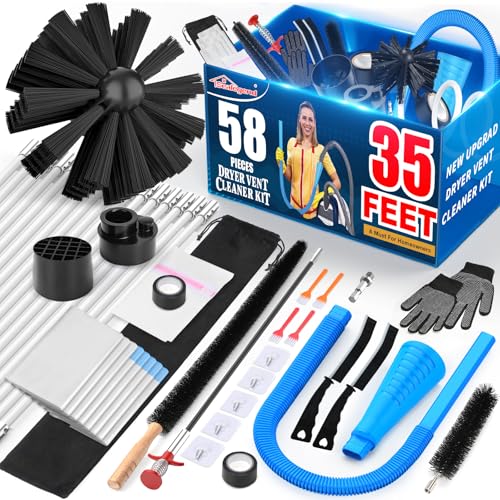
Our pick for most homes
Sealegend 35-Foot Dryer Vent Cleaner Kit
A spinning brush on flexible rods that join up to 35 feet and run on a cordless drill, plus a long vacuum hose and slim brush for the lint slot. One box covers both jobs.
See the kit on AmazonLonger run, or only the lint slot?
Long or roof runs: 52-foot sizeLint slot only: PetOde vacuum hoseWhy a clogged dryer vent is a fire risk
A dryer pushes hot, damp air and loose fibers out through the duct. When lint builds up, the air slows, the heat stays inside, and the lint itself is the fuel. The US Fire Administration's report on home dryer fires puts numbers on it:
- About 2,900 home dryer fires a year in its 2008-2010 data, with about 5 deaths, 100 injuries and $35 million in property loss each year.
- Failure to clean was the leading cause, behind 34% of those fires.
- Dust, fiber and lint were the first thing to catch fire in 28% of them.
- January is the worst month, with 11% of the year's dryer fires.
The NFPA, the fire-safety standards group, gives the same leading cause and adds a simple habit: do not leave the dryer running when you go out or go to bed.
Gas dryers have a second risk. The CPSC lists clothes dryers among the fuel-burning appliances that can produce carbon monoxide, and recommends a yearly professional check of their vents for blockage, plus at least one carbon monoxide alarm in every home (one that meets the UL 2034 standard).
Signs your dryer vent is clogged
- Clothes are still damp after a normal cycle, or drying takes longer than it used to. The CPSC names this as the sign of a blocked lint screen or exhaust duct.
- Clothes feel very hot at the end of a cycle, or there is a faint burning smell. Maytag lists both.
- The outside flap barely moves while the dryer runs. Go outside during a cycle: the NFPA and CPSC both say to check that air is coming out and the flap opens.
- Your dryer tells you. Many newer models measure airflow and show a warning.
Swipe the table sideways on a phone.
| Your dryer shows | What the maker says it means | What to do |
|---|---|---|
| Whirlpool: Check Vent light | Airflow is restricted | Check the duct behind the dryer is not crushed, then clean the vent and the outside cover |
| LG: Flow Sense bars, or d80, d90, d95 | The exhaust is about 80%, 90% or 95% restricted | Clean the duct; LG says long runs with several bends can hide blockages, so call a vent cleaner if it comes back |
| Samsung: vent test result C8 or C90 | The duct is about 80% or 90% clogged | Clean the exhaust vent, then run the test again |
How to clean a dryer vent, step by step
You need the kit, a cordless drill, a vacuum, a screwdriver or nut driver for the clamps, and a bag for the lint.
Step 1: Measure your vent run before you buy anything
Follow the duct from the back of the dryer to the cover on the outside wall or roof. Note roughly how long it is and how many bends it has. A tape measure along the wall inside and outside usually gets you close enough.
This decides which kit you need. The International Residential Code, the model code most US towns build on (local versions vary), allows up to 35 feet of duct by default and counts each sharp 90-degree bend as 5 feet of that. So most runs built to that rule are shorter than 35 feet of actual pipe, and a 35-foot kit reaches the far end. Longer runs are allowed only when the dryer maker's instructions (or a listed dryer-duct fan) permit them, and the code wants those labeled near the dryer.

Every part of the run, and the rule for each. The kit has to be longer than the pipe you are cleaning.
Step 2: Turn off the power, and the gas on a gas dryer
Unplug the dryer. On a gas dryer, also turn the gas valve off before you move it, and take care not to kink the gas line.
One warning from the CPSC: old, uncoated brass gas connectors can crack or break with slight movement. If your gas dryer has one, do not pull the dryer out. Have a professional replace the connector first.
Step 3: Pull the dryer out and disconnect the duct
Slide the dryer far enough from the wall to work behind it. Loosen the clamp at the dryer outlet and at the wall, and take the short connecting duct off.
Look at what it is made of. If it is white plastic or thin, crinkly foil, plan to replace it: see the duct section further down.
Step 4: Clean the lint screen and the slot it sits in
Pull the lint screen out and clear it. If you use dryer sheets or liquid softener, GE Appliances says to wash the screen now and then in warm soapy water, because a film builds up on the mesh. (More on that in our guide to wool dryer balls vs dryer sheets.)
Then vacuum the slot the screen sits in. Lint collects deep inside where your fingers cannot reach, so you need a long, narrow hose. The kit above includes one. If you only want this part, a stand-alone hose like PetOde's vacuum attachment does it, but it will not reach the duct.
Step 5: Brush the duct from the inside
Screw or snap the rods together one at a time, attach the brush, and fit the last rod into a cordless drill. Feed the brush into the wall duct from the inside, heading toward the outside.
Kit makers say to spin the rods clockwise only, move in and out slowly, and slow right down at bends. Every few feet, pull back and vacuum up what comes out. Some kits, the one below included, come with adapters so your dryer's own airflow or a shop vacuum can blow loose lint out while you brush. Keep going until the brush comes out at the outside cover.
As an Amazon Associate we earn from qualifying purchases.
Our pick for most homes
Sealegend 58-Piece Dryer Vent Cleaner Kit, 35 feet
Flexible nylon rods that join up to 35 feet, a spinning brush head and a drill fitting, plus a long vacuum hose, a slim lint-trap brush and adapters for blowing lint out. It was one of the best-selling dryer vent kits on Amazon when we checked in October 2026, and the same kit comes in a 52-foot size.
Good for: runs up to about 35 feet of pipe, and anyone who wants the lint slot and the duct done with one kit.
The drawback: reviews are mixed on how long the rods hold up and how they handle bends, so go slowly at corners. The listing says the vacuum hose does not fit some Dyson and Shark vacuums. It is sold by a third-party seller and shipped by Amazon.
See the 35-foot kit on AmazonLonger run, second floor or roof exit? The same Sealegend kit in the 52-foot size has more rods.
Step 6: Clear the outside vent cover
Go outside and pull lint out of the cover and its flap. With the dryer off, the flap should swing freely. On a long run, brush in from this end too.
Check what is on the cover. The code requires a backdraft flap and does not allow a screen at the outside end; a screen there traps lint. Whirlpool asks for at least 12 inches of space between the cover and the ground, plants or anything else that could block it.

The outside end is where lint packs in behind the flap.
Step 7: Vacuum the dryer outlet and the floor behind it
Vacuum inside the dryer's own exhaust outlet as far as the hose reaches, then the floor and wall behind the dryer. The CPSC also says to keep the area around the dryer clean and free of clutter.
Step 8: Reconnect without crushing the duct
Fit the connecting duct back on, or a new metal one. It should be a single piece, no longer than 8 feet, held with clamps. The code does not allow screws that stick more than 1/8 inch into the duct; screw tips catch lint. Whirlpool asks for at least 4 inches between the dryer and the wall so the duct is not squashed when you push the dryer back.
Step 9: Test it
Plug the dryer back in (and turn the gas on). Maytag suggests running it empty for about 15 minutes. Go outside while it runs: you should feel strong, warm air and see the flap open. If your dryer has a vent test or airflow light, check it again.
How often should you clean your dryer vent?
Search for this and you get different answers, often from companies that sell the cleaning. Here is who actually says what:
| Who | How often to clean the whole vent |
|---|---|
| NFPA (fire-safety standards group) | Once a year, or sooner if drying takes longer than normal |
| CPSC (US product-safety regulator) | Periodically, and check the outside vent while the dryer runs |
| Samsung | Once or twice a year, even if the vent test passes |
| Whirlpool | Every one to two years, or when drying slows down |
| Maytag | At least every two years |
The lint screen is simpler: the NFPA, the CPSC and Whirlpool all say to clean it every load.
Our call: once a year, in the fall, before the January peak the US Fire Administration sees in dryer fires. Do it sooner if drying slows, if your dryer shows a vent warning, or if your run is long or has several bends: Whirlpool says every bend cuts airflow, and LG says long, bent runs can hide blockages.
Foil, plastic or metal: check your dryer duct
Cleaning does not help much if the duct itself is the problem. The short, flexible piece behind the dryer is the part to check first.

Thin foil ducts sag, kink and crush behind the dryer, and lint collects in every fold.
- White plastic (vinyl) or thin foil accordion duct: replace it. The CPSC says to swap these for rigid or semi-rigid metal duct, and Whirlpool says not to use plastic or foil at all.
- Semi-rigid aluminum (the stiffer, ribbed kind): fine for the short connecting piece. Whirlpool accepts flexible metal only where you can reach it to clean, fully stretched out, and no longer than 7 3/4 feet.
- Rigid metal pipe: what the code requires inside walls and ceilings. It has to be smooth inside, 4 inches across, and at least 28-gauge metal. Whirlpool recommends it for the best drying.
- The code's rule for the connecting piece: one length, no longer than 8 feet, never hidden inside a wall, and listed to the UL 2158A standard for dryer transition ducts.
As an Amazon Associate we earn from qualifying purchases.

If your duct is foil or plastic
Eastman ArmorFlex Semi-Rigid Aluminum Dryer Duct, 4 in x 8 ft
Ribbed semi-rigid aluminum with two stainless clamps. Eastman says it holds its shape without kinking or crushing when you push the dryer back, describes it as rated Fire Class 0, and says dryer makers recommend semi-rigid aluminum over foil. Sold and shipped by Amazon.
Good for: replacing a crushed foil or plastic duct behind the dryer.
The drawback: no semi-rigid duct on Amazon met our usual rating bar when we checked, and this one sits just under it; buyers are mixed on durability, fit and installation. It only comes in 8 feet, which is also the most the code allows, so measure first. Eastman's pages do not mention a UL 2158A listing, so if your town enforces that rule, check the package label or ask your inspector.
See the duct on AmazonWhich dryer vent cleaning kit reaches your vent?
Search results and some best-kit lists mix 2-foot lint brushes with 35-foot rod kits. They do different jobs. Use this checklist:
- Longer than your run. Add a few feet over the pipe length you measured. Unused rods stay in the bag.
- Rods that lock. Screw-together or snap-lock rods both work; tape over the joints if your kit includes it, and always spin the way the maker says.
- A 4-inch brush. Home dryer ducts are 4 inches across, so the brush should fill the pipe.
- Drill or hand. Many kits run on a cordless drill and can also be turned by hand for short runs.
- A lint-slot hose included, so one kit does the whole job.
For a dryer on an outside wall with a short, straight run, a 12-foot kit is enough. For most other homes, 35 feet. For roof exits and long runs, 52 feet, or a professional.
The kits compared
As an Amazon Associate we earn from qualifying purchases.
Swipe the table sideways on a phone.
| Product | What it is | Best for | The catch |
|---|---|---|---|
|
Sealegend kit, 35 ft See it |
Drill-driven brush on rods, plus lint-slot hose and brush | Most homes | Rod durability mixed; hose does not fit some Dyson and Shark vacuums |
|
Sealegend kit, 52 ft See it |
The same kit with more rods | Long runs, second floor and roof exits | More rods to join and handle |
|
Holikme kit, 35 ft See it |
Drill-driven brush on rods, plus lint-slot tools | A second option at the same length | Rods coming apart and wearing out are the most common complaints |
|
Gardus LintEater, 12 ft See it |
Well-known rotary kit, four 3-foot rods and a self-feeding brush | Short, straight runs | Only 12 feet in the box; longer runs need extra rods sold separately |
|
PetOde vacuum hose and brush See it |
Long, narrow vacuum attachment | The lint slot inside the dryer | Does not reach the duct; fit varies by vacuum |
Not on the list: Holikme's 30-foot kit sells in big numbers but sat just under our rating bar when we checked.
When to call a dryer vent professional
- The vent exits on the roof or high up a wall and you would need a ladder to reach it.
- The run is longer than any kit, or runs through walls and ceilings you cannot follow.
- The duct is crushed or disconnected inside a wall.
- The airflow warning comes back after you clean. LG says long runs with bends can hide blockages a kit misses.
- You have a gas dryer with an old brass connector, or you smell gas. If you smell gas, leave the house and call your gas utility from outside.
What a service costs depends on how long the run is, whether someone has to go on the roof, and whether the duct needs repair. Ask for the price in writing before the work starts.
Questions people ask
Can I clean my dryer vent myself?
Yes, if you can reach both ends. A rod-and-brush kit, a drill and a vacuum are enough for most runs. Call a professional for roof exits, runs longer than your kit, ducts inside walls you cannot follow, or a gas dryer with an old brass connector.
Is it better to clean a dryer vent from the inside or the outside?
Start from the inside, with the duct off the dryer, and brush toward the outside so lint leaves the house. On long runs, brush from the outside end too.
Can I use a leaf blower to clean a dryer vent?
We found no fire-safety group or dryer maker that recommends it. Air moves loose lint but not lint stuck to the pipe, so brush first. If you use air afterwards, blow from the inside toward the outside with the duct disconnected from the dryer.
How do I clean a dryer vent without moving the dryer?
You can clear the lint slot and brush in from the outside cover. But the short duct behind the dryer is where kinks and crushing hide, so pull the dryer out at least once a year.
How do I clean a dryer vent on the roof?
A long kit can reach a roof exit from inside, but the cover itself needs clearing too, which means working on the roof. If you are not comfortable on a ladder, this is a job for a professional.
Do indoor dryer vent kits work?
We would not use one. The model code says dryer exhaust has to go outdoors, with an exception only for listed condensing (ductless) dryers, and a gas dryer must never vent indoors because its exhaust can carry carbon monoxide. If there is no way to vent outside, a condensing dryer is the option the code allows.
Can I use a shop vac to clean a dryer vent?
Yes, as a helper. A shop vac picks up what the brush loosens, and some kits include adapters to connect one. On its own it will not clear lint stuck along the pipe.
Do dryer sheets clog the dryer vent?
They leave a film on the lint screen that GE says to wash off with warm soapy water now and then. We found no study measuring how much they add to the duct. Our dryer balls vs dryer sheets guide covers the switch.
Should the outside dryer vent cover have a screen?
No. The code requires a backdraft flap and does not allow a screen, because screens catch lint and block the air. If yours has one, replace the cover.
How much does professional dryer vent cleaning cost?
It depends on the length of the run, roof access and whether the duct needs repair. Get the price in writing before the work starts.
Is dryer vent cleaning really necessary?
Failure to clean was the leading cause of home dryer fires in the US Fire Administration's data, so yes. Once a year is the NFPA's advice, and sooner if drying slows.
Keep reading
- Wool dryer balls vs dryer sheets: which is non-toxic
- Non-toxic laundry detergent: what free and clear really means
- How to lower your electric bill
- Fridge care, including cleaning the condenser coils
About this guide: Written by Lara Yehia. We did not test these kits. This guide is general information, not a substitute for your dryer's manual or your local building code. Listings change, so check the current ones before you buy. As an Amazon Associate we earn from qualifying purchases.
Sources reviewed
- US Fire Administration, Topical Fire Report: Clothes Dryer Fires in Residential Buildings (2008-2010), 2012
- NFPA: Clothes dryer and washing machine safety tips
- CPSC Publication 5022: Overheated Clothes Dryers Can Cause Fires
- CPSC: CPSC Recommends Carbon Monoxide Alarm for Every Home
- CPSC: Annual fuel-burning appliance inspection, including the warning on uncoated brass gas connectors
- International Code Council: 2021 International Residential Code, Section M1502 Clothes Dryer Exhaust
- Whirlpool: Electric dryer installation instructions W10617663 (venting requirements)
- Whirlpool Product Help: Check Vent light on dryer
- LG: Dryer error code list (Flow Sense, d80, d90, d95)
- Samsung: Run a vent blockage test on your Samsung dryer
- Maytag: How to clean a dryer vent
- GE Appliances: Dryer lint filters and how to clean them
- Eastman: ArmorFlex semi-rigid aluminum dryer duct
- Amazon product listings and buyer review summaries, checked with a US delivery address on October 5, 2026.


