
Written by Lara Yehia. Lara researches home and kitchen products for Cupindy. · Last updated September 28, 2026
A refrigerator has one core job: keeping food at 40°F or below, the limit the U.S. Food and Drug Administration (FDA) sets for safe cold storage, with the freezer at 0°F. At those temperatures the bacteria that spoil food and cause food poisoning grow slowly, so food stays safe and fresh for days or months instead of hours. Below we list the 10 everyday uses of a refrigerator, why it matters so much, its benefits and drawbacks, how the main fridge types compare, and the short care checklist that keeps one running for years.
Quick answer
- What a refrigerator is for: keeping perishable food at 40°F or below and frozen food at 0°F, so it stays safe and fresh longer.
- Main benefits: safer food, less waste, fewer shopping trips, and room for leftovers, meal prep and cold drinks.
- Main drawbacks: purchase price, it runs 24 hours a day, it needs floor space, and it eventually needs repairs or replacement.
- To keep it working: check the real temperature with a thermometer, clean the condenser coils every 6 to 12 months, keep the door seals clean, and do not pack it so full that air cannot move.
10 uses of a refrigerator
Most people think of a fridge as the place the milk goes. In practice it does ten different jobs in a typical kitchen.
- Keeping perishable food safe. Meat, poultry, fish, dairy and eggs are the foods most likely to carry bacteria. Holding them at 40°F or below slows that growth to a crawl.
- Making fresh produce last longer. Crisper drawers hold in humidity, so greens, herbs, carrots and berries stay crisp for days longer than they would on the counter.
- Storing leftovers. Cooked food that goes into the fridge within 2 hours can be eaten over the next few days instead of thrown out. We cover how to warm it back up without drying it out in our guide to reheating leftovers.
- Meal prep for the week. Cooking once and eating from the fridge for several days only works because the food stays cold. The right containers make a difference here, and we compared them in our meal prep container guide.
- Freezing food for months. The freezer turns a sale on chicken, a batch of soup or a loaf of bread into food you can use weeks or months later. According to the USDA, food kept constantly at 0°F stays safe indefinitely, and only its quality fades over time.
- Thawing food safely. The USDA lists thawing in the refrigerator as one of the three safe ways to defrost food, along with cold water and the microwave. It is the slowest of the three, but the food never sits in the temperature range where bacteria multiply fastest.
- Chilling drinks and making ice. Cold water, juice, milk and ice cubes on demand, and on many models, filtered water from the door.
- Storing medicines that say "refrigerate". Some medicines and insulin must be kept cold. Follow the label, and keep them on a shelf rather than in the door, where the temperature swings every time it opens.
- Marinating and slow-proofing dough. Meat should always marinate in the fridge, never on the counter. Bakers also use the cold to slow down pizza or bread dough overnight for more flavor.
- Keeping opened jars and sauces. Mayonnaise, jam, pickles, salsa and most sauces carry a "refrigerate after opening" line for a reason. The fridge keeps them usable for weeks instead of days.

Leftovers, marinades and slow-proofing dough: most of a fridge's daily work happens on one or two shelves.
Why is a refrigerator important?
Because it is the main thing standing between everyday food and food poisoning. The USDA calls 40°F to 140°F the "danger zone", the range where bacteria can multiply quickly. A refrigerator keeps perishable food below that range all day and all night, without anyone having to think about it. That is what lets a household shop once a week, cook ahead, keep leftovers and buy fresh fruit and vegetables without eating them the same day. It also cuts food waste: food that would spoil in a day on the counter lasts several days in the fridge and months in the freezer.
Benefits of a refrigerator
The first benefit is safety. Cold storage slows the bacteria behind most spoilage and many cases of foodborne illness. The second is money: produce, dairy and leftovers last days longer, the freezer rescues food you cannot finish in time, and you can shop once a week or buy in bulk when prices are good.
It also makes healthier eating easier, because fresh fruit, vegetables, yogurt and ready meals are there when you are hungry, along with cold drinks, ice and, on many models, filtered water. And newer models are cheaper to run. ENERGY STAR says certified refrigerators are about 9% more efficient than models that just meet the federal minimum, and that fridges more than 15 years old use about 20% more energy than a new certified model.
Drawbacks of a refrigerator
- Upfront cost. A basic top-freezer model is one of the cheaper major appliances. A large French-door fridge with a water and ice dispenser costs several times more.
- It never switches off. A fridge runs around the clock, so it is always on your electricity bill (our guide to lowering your electric bill covers the rest of the house). Features add to that: Virginia Cooperative Extension says automatic ice makers and through-the-door dispensers raise energy use by 14 to 20%.
- Space and noise. A full-size fridge takes a large block of floor space plus a few inches of breathing room, and it hums, clicks and gurgles as it cycles.
- Repairs and a limited lifespan. American Home Shield puts a typical refrigerator's life at 10 to 18 years. Compressors, fans, ice makers and control boards can fail before that.
- Some foods do worse in the cold. Tomatoes lose flavor and bread goes stale faster in the fridge, even though it molds more slowly. Our bread storage guide explains when the fridge or the freezer is the better choice.
- Disposal takes effort. An old fridge holds refrigerant and insulation foam that need proper recycling. ENERGY STAR notes that many appliance retailers will pick up and recycle the old one when you buy a new one.
Types of refrigerators: pros and cons
The layout you choose changes how you use the fridge every day, and how much energy it uses.
Top-freezer
Best for: Budgets and small households
Pros: Lowest price tier. Top-mount models use 10 to 25% less energy than side-by-side models, according to Virginia Cooperative Extension.
Cons: You bend down to reach the fresh-food drawers you use most.
Bottom-freezer
Best for: People who use fresh food more than frozen
Pros: Fresh food sits at eye level on wide shelves.
Cons: The freezer drawer means bending and digging, and it costs more than a top-freezer.
Side-by-side
Best for: Narrow kitchens and frequent freezer use
Pros: Narrow doors need little swing room, and frozen food is at eye level.
Cons: Narrow shelves will not take a pizza box or a wide platter, and it uses more energy than a top-freezer.
French door
Best for: Families, wide trays and platters
Pros: A full-width fridge shelf at eye level, with two narrow doors instead of one wide one.
Cons: The highest price tier, and many come with a water and ice dispenser that adds to energy use.
Compact / mini
Best for: Dorms, offices, bedrooms and bars
Pros: Small, portable and cheap to run.
Cons: A tiny freezer section or none at all. Check that it reaches 0°F before you store food in it long-term.
Smart models with cameras, screens and app alerts are a separate decision. We weighed whether they justify the extra cost in our smart fridge pros and cons.
Is a refrigerator worth it?
For a home kitchen, a full-size refrigerator is close to essential: without one, safe storage of meat, dairy and leftovers is not realistic. The real questions are which size and layout you need, and whether a second fridge earns its keep. A mini fridge is worth it for a dorm, office or bedroom, but not as a replacement for a full-size unit. For a second fridge in a garage or basement, ENERGY STAR's advice is clear: if you need it all year, replace an old one with a new certified model rather than keep an energy-hungry unit running.
Refrigerator care checklist
A refrigerator needs very little care, but the few jobs it does need are easy to forget for years. Set it to 40°F or below (FDA), or 35°F to 38°F if you follow ENERGY STAR's range, with the freezer at 0°F. One catch: the dial inside most fridges sets the cooling level, it does not tell you the temperature. That is why the first job on this list needs a cheap appliance thermometer, and it is the one tool most kitchens are missing.

This is what "clean the coils" means: the dust hiding under the front grille makes the compressor work harder.
As an Amazon Associate we earn from qualifying purchases. This does not change which products we recommend.

Our pick for checking the temperature
PECULA 4-Pack Refrigerator Thermometer
The FDA's advice is one thermometer for the fridge and one for the freezer. This pack covers both, with two left over for a garage fridge, a chest freezer or a cooler. They are stainless steel dials that hang or stand on a shelf, read from -20°F to 80°F, and need no battery. It was the best-selling refrigerator thermometer on Amazon when we checked in September 2026.
Worth knowing: four is more than most kitchens need, and it is a lesser-known brand. Like any dial, it can be off by a degree or two and has no memory, so it cannot tell you how warm the fridge got while you were out. If you want a brand name, the Rubbermaid Commercial dial is listed as NSF certified, but it is sold singly, so you would need two.
See the 4-pack on Amazon Rubbermaid alternativeAs an Amazon Associate we earn from qualifying purchases.
For the coil job
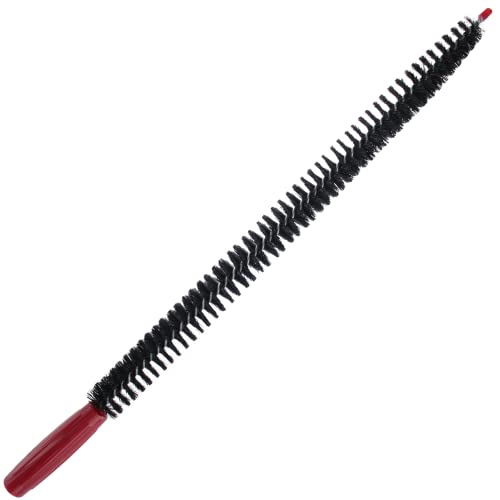
Vanitek 26-Inch Flexible Coil and Lint Brush
A long, bendable brush for the job most owners skip: pulling dust and lint off the condenser coils under or behind the fridge. The listing gives the brush as 26 inches long with nylon bristles on a bendable galvanized steel wire, so you can curve it to follow the coils. Use it with a vacuum to pick up what it loosens. It also cleans a dryer lint trap, which is what most buyers use it for.
Worth knowing: it is sold mainly as a dryer-vent brush, so it is not shaped for any one fridge model, and at 4.4 stars it sits just under the rating we usually look for. When we checked in September 2026, no dedicated fridge coil brush had both a 4.5-star rating and thousands of reviews, and this one had by far the most reviews of the brushes sold for coils.
See the brush on AmazonAs an Amazon Associate we earn from qualifying purchases.
How to clean the inside of a refrigerator

Hot water and baking soda, the mix the USDA suggests, is all the inside of a fridge needs.
- Move food to a cooler, and throw out anything past its date.
- Take out shelves and drawers and wash them in warm, soapy water. Let glass shelves warm up first so they do not crack.
- Wipe the walls and door with hot water and baking soda, the mix the USDA suggests. Equal parts vinegar and water also works for wiping down.
- To sanitize after spoiled food or a long power cut, the USDA suggests 1 tablespoon of unscented liquid chlorine bleach per gallon of water, then a clean-water rinse.
- Dry everything and put the food back, raw meat on the bottom shelf in a container so it cannot drip.
For lingering odors, the USDA suggests an open container of baking soda or fresh coffee grounds. We list more fragrance-free options in our guide to keeping the kitchen fresh naturally, and cleaners that are safe around food in our non-toxic kitchen cleaning guide.
Load it so the cold air can move
A packed fridge cools unevenly because cold air cannot circulate, and food pushed against the back wall can freeze. Keep the vents clear, store milk and eggs on the shelves rather than in the door (the warmest spot), and use covered containers for leftovers. If you are wondering whether stainless steel or plastic containers are fine for the fridge, our stainless steel container guide covers it.
Common refrigerator problems and quick fixes
- Not cooling enough: check the setting and confirm with a thermometer, make sure food is not blocking the vents, clean the coils, and test the door seal. If the compressor never runs or the fridge stays warm after all of that, call a technician.
- Freezing food in the fridge: the setting is too cold, or items are pressed against the cold-air vent at the back.
- Frost or ice building up: usually a door that is not sealing or is opened a lot. On a frost-free model, heavy frost can mean the defrost system needs repair.
- Water on the floor or under the drawers: often a clogged defrost drain or a loose water-line connection behind the fridge.
- Strange noises: humming, clicking and gurgling are normal. Loud grinding, rattling or buzzing that does not stop usually points to a fan or compressor problem and is a job for a professional.
Power outage: what to keep and what to toss

Keep the door shut: a closed fridge keeps food safe for about 4 hours without power.
FoodSafety.gov says a closed refrigerator keeps food safe for up to 4 hours without power. A full freezer holds its temperature for about 48 hours, and a half-full one for about 24, as long as the door stays closed. After 4 hours without power, throw out perishable refrigerated food such as meat, poultry, fish, eggs and leftovers. When power returns, check the thermometer: if the fridge is still at or below 40°F, the food is safe. If you do not know how long it was warm, throw it out.

If you want an alarm
AcuRite 00515M Wireless Fridge and Freezer Thermometer
Two wireless sensors, one for the fridge and one for the freezer, send readings to a display outside the door. It records the highest and lowest temperatures and sounds an alarm you set, so you find out about a door left open or a failing fridge, and after an outage you can see how warm it actually got.
Worth knowing: it takes seven AA batteries across the display and two sensors (per the listing), lists an accuracy of plus or minus 2°F, costs several times as much as a pair of dial thermometers, and the display needs a spot on the fridge door or a nearby wall.
See the AcuRite on AmazonAs an Amazon Associate we earn from qualifying purchases.
Check your fridge for recalls
Refrigerator recalls are less common than small-appliance recalls, but they happen. On July 30, 2026, the U.S. Consumer Product Safety Commission announced a recall of about 121,680 Galanz retro-style refrigerators. The notice says their internal electrical components can short circuit and ignite, and lists 34 fire incidents, including one death. The recall covers models BCD-215V-62H, GLR76TRDER, GLR76TBKER, GLR76TBEER and GLR76TWEER with date codes from December 2018 through December 2020, sold at Home Depot and on Amazon.com from January 2019 to September 2022. The CPSC tells owners to unplug them and stop using them until Galanz repairs them for free at home.
To check any fridge, find the model number on the label inside the fresh-food section or on the back, and search it on cpsc.gov.
Frequently asked questions
What is the purpose of a refrigerator?
To keep perishable food cold enough, 40°F or below, that bacteria grow slowly, so food stays safe and fresh for longer. The freezer does the same job for months at 0°F.
What temperature should a refrigerator be?
40°F or below for the fridge and 0°F for the freezer, according to the FDA. ENERGY STAR suggests 35°F to 38°F for the fridge. Use an appliance thermometer, because most dials do not show the real temperature. A set of dial thermometers covers the fridge and the freezer.
How long do refrigerators last?
American Home Shield puts the typical range at 10 to 18 years. Clean coils, good door seals and enough space around the unit help it reach the upper end.
How often should you clean refrigerator coils?
Every 6 to 12 months, according to the U.S. Department of Energy's Building America guide, and more often if you have pets that shed.
Is it worth replacing an old refrigerator?
If it is more than 15 years old, often yes. ENERGY STAR estimates that fridges that old use about 20% more energy than a new certified model, and older units are closer to the end of their lifespan anyway.
Which type of refrigerator uses the least energy?
Top-freezer models. Virginia Cooperative Extension says they use 10 to 25% less energy than side-by-side models, and that ice makers and door dispensers add 14 to 20%.
The bottom line
A refrigerator keeps food safe, cuts waste and makes everyday cooking possible, and its drawbacks come down to cost, energy use and space. Pick the layout that fits how you cook, keep it at 40°F or below, and spend ten minutes twice a year on the coils and door seals. A cheap set of fridge and freezer thermometers is the cheapest way to know it is doing its job.
As an Amazon Associate we earn from qualifying purchases.
Sources
- U.S. Food and Drug Administration, "Refrigerator Thermometers: Cold Facts about Food Safety".
- USDA Food Safety and Inspection Service, "Removing Odors from Refrigerators and Freezers".
- FoodSafety.gov, "Food Safety During Power Outage".
- ENERGY STAR, "Refrigerators" (energystar.gov).
- U.S. Department of Energy, Building America Solution Center, "Clean Refrigerator Condenser Coils".
- Virginia Cooperative Extension, "Energy Series: What about Refrigerators and Freezers?" (February 2020).
- American Home Shield, "A Guide to DIY Refrigerator Maintenance".
- U.S. Consumer Product Safety Commission, Galanz retro refrigerator recall (July 30, 2026).
- Manufacturer listings on Amazon for PECULA, Rubbermaid Commercial, AcuRite 00515M and Vanitek (checked September 28, 2026).