
Written by Sara Ibrahim. Sara researches home and kitchen products for Cupindy.
Last reviewed November 2026 · Cupindy is not affiliated with any brand on this page.
The short answer
The best paring knife for most kitchens is the 3.25-inch Victorinox Swiss Classic. Of the big knife brands on this page, only Victorinox and Henckels call their paring knives dishwasher safe. Rada, Mercer and Wüsthof all say hand wash.
As an Amazon Associate we earn from qualifying purchases.

Our quick pick
Victorinox Swiss Classic 3.25-Inch Paring Knife
Swiss made, about 20 grams, and its maker says you can put it in the dishwasher. A light knife is easier to steer when you peel in your hand.
See the Victorinox paring knife on AmazonDownside: Victorinox doesn't name the steel grade, and the blade is stamped, not forged, so it is much thinner and lighter than a forged knife.
Want a slightly longer blade that can also go in the dishwasher? Henckels Solution 4-inch. Want a knife made in the USA? Rada Peeling Paring 2-pack (hand wash only).
We read each maker's own product page and care notes, then checked every pick against its Amazon listing in November 2026. We haven't tested these knives in our kitchen, so every product claim below comes from the maker or the listing, and we say which. Where a retailer and a maker disagree, we go with the maker.
What a paring knife is for
A paring knife is the small one, usually with a 3 to 4 inch blade. It does the jobs a chef's knife is too big and clumsy for: peeling an apple in your hand, hulling strawberries, coring tomatoes, seeding a jalapeño, cutting the eyes out of a potato, deveining shrimp, scoring the skin on a sausage or a pie crust.
Most of that work happens off the board, with the food in one hand and the knife in the other. That's why a light knife with a short blade usually beats a heavy one here, even though heavy feels more “serious” in the shop. For chopping onions or slicing meat, reach for a chef's knife instead.

The 6 picks side by side
As an Amazon Associate we earn from qualifying purchases.
Blade and care details are the makers' words where a maker page exists. Prices change too often to print, so tap through for today's price on Amazon.
| Knife | Blade | Dishwasher? | |
|---|---|---|---|
|
Victorinox Swiss Classic Best for most people |
8 cm (about 3.1 in) per Victorinox; 3.25 in per Amazon. Stainless, stamped. | Yes, per Victorinox. It still prefers hand washing. | See it |
|
Henckels Solution 4-inch Best dishwasher-safe, longer blade |
4 in. Stainless, single-piece stamped. | Yes, per Henckels. | See it |
|
Rada Peeling Paring (2-pack) Best made in the USA |
2.5 in. T420 high-carbon stainless, cast aluminum handle. | No. Hand wash, per Rada. | See it |
|
Mercer Millennia 3.5-inch Best textured grip |
3.5 in. High-carbon Japanese steel, Santoprene handle. | No. Hand wash, per Mercer. | See it |
|
imarku 3.5-inch Best forged pick |
3.5 in. Forged, pakkawood handle. | No, per the imarku listing. | See it |
|
BYkooc 4 knives + 4 sheaths Best budget set with sheaths |
About 3.8 in per the listing. Stainless, plastic handles. | Listing says yes, but warns it shortens their life. | See it |
Two names you'll also see: the Wüsthof Classic 3.5-inch and the Cuisinart Triple Rivet 3.5-inch. Wüsthof says to keep its knives out of the dishwasher. Cuisinart's page for its paring knife doesn't give a care rule, so we left it out of the table.
What each maker says about the dishwasher
This is where paring knife advice gets muddled. Some US retailers list a knife as dishwasher safe when its maker says otherwise, and it's the maker who decides what the warranty covers. So here is each maker's own rule, read from its own pages.
| Maker | What the maker says | Where we read it |
|---|---|---|
| Victorinox | Its product page lists “Dishwasher safe: Yes.” Its care page adds that knives with plastic handles can go in, but it recommends washing by hand to protect the blade and handle and keep the edge longer. | Victorinox product page and knife care page |
| Henckels | Calls the Solution paring knife “Dishwasher safe.” | Henckels product page |
| Rada | “Rada recommends hand washing all fine cutlery.” Rada says its black resin handles cope with the dishwasher better than the silver aluminum ones, and still recommends hand washing both. | Rada product page |
| Mercer | Its page for the Millennia 3-inch sibling says it doesn't recommend a dishwasher. Mercer's own listing for the M22003 says not to put it in one, and its warranty excludes dishwasher damage. | Mercer page for the M23900P; Mercer listing for the M22003 |
| Wüsthof | Its care guide says to keep knives out of the dishwasher, because high heat and knives rubbing together in the cycle can damage them. Some US retailers, Dillard's among them, list the Classic as dishwasher safe. Wüsthof doesn't. | Wüsthof knife care guide |
| Cuisinart | Not stated on its paring knife page. | Cuisinart product page |
So if the maker says hand wash, hand wash, whatever the listing says. A minute at the sink is cheaper than a pitted blade or a refused warranty claim.
If you want a knife that can go in the dishwasher
Victorinox Swiss Classic 3.25-Inch Paring Knife
Victorinox says its knives with plastic handles, like this one, can go in the dishwasher, though it still prefers you wash them by hand. The blade has a pointed tip and a straight edge, the shape that works both in the hand and on a board. Victorinox covers it with its lifetime warranty.
Downside: At about 3 inches and 20 grams, it is not built for hard vegetables like squash. Use a chef's knife for those.
Check the Victorinox on Amazon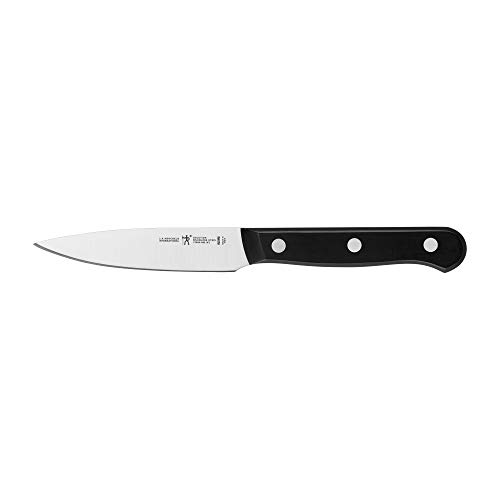
Henckels Solution 4-Inch Paring Knife
A little longer than the Victorinox, with a traditional three-rivet handle. Henckels makes the blade from one stamped piece of stainless steel and calls the knife dishwasher safe. The extra length helps with bigger fruit like mangoes and with work on the board.
Worth knowing: Henckels doesn't name the steel grade either, and a 4-inch blade is more than you need for peeling small fruit.
Check the Henckels on Amazon
BYkooc Paring Knives, 4 Knives and 4 Sheaths
Four small knives in different colors, each with its own sheath. Handy if you want one for fruit and one for raw meat, or a spare for the picnic bag. The listing calls them dishwasher safe.
Keep in mind: The same listing warns that frequent dishwasher use shortens their life, and it doesn't name the steel beyond stainless.
Check the BYkooc set on Amazon
If you don't mind washing by hand

Rada Peeling Paring Knife (R102), 2-Pack
Rada makes these in the USA with what it calls surgical-quality T420 high-carbon stainless steel and a cast aluminum handle. The blade is only 2.5 inches, which makes it a true peeling knife: easy to steer around an apple or a potato in your hand. You get two in the pack, and Rada backs them with a lifetime guarantee.
Downside: Rada recommends hand washing, and the Amazon listing calls the silver handle hand wash only. The short blade is not meant for cutting on a board.
Check the Rada 2-pack on Amazon
Mercer Millennia 3.5-Inch Paring Knife
Mercer pitches its Millennia line at professional chefs and home cooks. Its listing for this knife describes a one-piece blade of high-carbon Japanese steel and a Santoprene handle with textured finger points for a non-slip grip.
Worth knowing: Hand wash only, and Mercer's warranty doesn't cover dishwasher damage. Mercer doesn't name the steel grade.
Check the Mercer on Amazon
imarku 3.5-Inch Paring Knife
The only forged knife in the table. The handle is pakkawood, which is thin layers of wood bonded with resin. The listing describes a Japanese high-carbon stainless blade hardened to 58 on the Rockwell scale.
Downside: The steel and hardness figures are the seller's, not an independent test. It is the premium pick here, and it has to stay out of the dishwasher.
Check the imarku on AmazonSpear point, sheep's foot or bird's beak?
Paring knives come in a few blade shapes. The difference sounds fussy, but it changes what the knife is good at.
Spear point
Looks like: a straight edge with the spine and edge meeting at a centered point.
Good for: almost everything. It peels, cores and cuts on a board. Most of the picks above are this shape or close to it.
Sheep's foot
Looks like: a straight edge and a spine that curves down to meet it, so there is no sharp tip.
Good for: slicing small things flat on a board, like garlic or strawberries. Safer for beginners.
Bird's beak
Looks like: a short blade that curves down like a claw.
Good for: peeling round fruit and cutting decorative shapes. Awkward on a board.
If you only buy one, buy a spear point. It handles most of what the other two do.
Steel and blade length
Every pick here is some kind of stainless steel, so they resist rust far better than plain carbon steel. They can still spot or pit if left wet, so dry them. The labels differ more than the steel does. “High-carbon stainless” is a marketing term with no fixed standard. It usually means a stainless steel with a bit more carbon, so it can be made harder and hold an edge longer. Rada names its grade (T420). Victorinox and Henckels just say stainless steel. Mercer says Japanese steel but doesn't name the grade.
Knife blades are usually a harder, lower-nickel stainless than forks and spoons, which is why the knives in a cutlery set can spot first. We explain the grades in our guides to stainless steel grades and flatware materials.
For length, 3 to 4 inches suits most hands. Shorter, like the Rada's 2.5 inches, is easier for peeling in the hand. Longer, like the Henckels' 4 inches, is better for cutting on a board.

One paring knife or a set?
Plenty of cooks keep two. One lives in the drawer and one sits in the dish rack, so you're never waiting for the only knife to be washed. The Rada 2-pack does that, and Victorinox sells its Swiss Classic as a 2-piece set too. If you want color coding or sheaths for travel, the BYkooc four-pack gives you both.
What we would skip: big knife block sets bought just to get a paring knife. You pay for a lot of steel you won't use.

Do you need a serrated paring knife?
Usually not. A sharp plain edge cuts tomatoes and citrus fine. A serrated paring knife earns its place if you cut a lot of tough-skinned or stringy food. Rada, for example, suggests its serrated version for asparagus, broccoli and rhubarb. The trade-off is sharpening: a plain edge is easy to bring back at home, while a serrated edge is much harder to sharpen yourself.
What about Japanese paring knives?
Two picks here use the word Japanese: Mercer and imarku both describe their blades as Japanese steel on their Amazon listings. Both are still Western-style paring knives in shape. A Japanese-style small knife, often called a petty knife, is usually longer and thinner, closer to a small utility knife. If you already own a Japanese chef's knife and want the drawer to match, look for “petty” rather than “paring”.
Questions people ask
What is a paring knife used for?
Small, careful jobs: peeling fruit and vegetables in your hand, hulling strawberries, coring tomatoes and peppers, cutting out potato eyes and deveining shrimp. For chopping and slicing on a board, a chef's knife is the better tool.
Does a paring knife need a sheath?
If it lives loose in a drawer, yes. Knocking against other tools dulls the edge and is how fingers get cut. The BYkooc set comes with sheaths, and the Cuisinart comes with a blade guard. A knife block slot or a magnetic strip works just as well.
What is the difference between a paring knife and a utility knife?
Size. A paring knife has a blade of about 3 to 4 inches. A utility knife runs about 4 to 7 inches and sits between a paring knife and a chef's knife, good for sandwiches, cheese and small cuts on a board.
Can a paring knife replace a chef's knife?
No. It is great for small, careful jobs, but it is too short to chop an onion or slice a roast safely. Most kitchens need both. Our chef's knife guide covers the big one.
Is a steak knife the same as a paring knife?
They look close, but a steak knife is a table knife, often serrated, made for cutting cooked meat on a plate. A paring knife is a prep knife. See our steak knife guide if that is what you need.
Is a 3-inch or a 4-inch paring knife better?
3 inches for peeling and fine work in your hand, 4 inches if you do more cutting on a board. Between the two, 3.5 inches is a safe middle.
Is it a pairing knife or a paring knife?
Paring. To pare means to trim or peel the outside of something, which is exactly what the knife is for. “Pairing knife” is a common spelling mistake.
How do you hold a paring knife?
For peeling in your hand, hold the handle in your fingers and use your thumb on the food as a guide, pulling the blade toward the thumb slowly. On a board, pinch the blade just above the handle between thumb and finger, the same grip you would use on a chef's knife.
If you'd rather just be told
Get the Victorinox Swiss Classic. It is light, easy to steer for peeling, and its maker says it can go in the dishwasher.
See the Victorinox Swiss Classic on AmazonHow we put this together
We started with the paring knives US shoppers search for and buy most, then read each maker's product page and care guide in November 2026 and compared them with the Amazon listings. We checked stock through Amazon's product data the same week. We haven't tested these knives ourselves. For cutting surfaces that are kind to a small blade, see our cutting board guide.
Sources (read November 2026). Product facts also come from each Amazon listing.
- Victorinox: Swiss Classic Paring Knife 8 cm (6.7603)
- Victorinox: How to clean and sanitize your kitchen knives
- Henckels: Solution 4-inch Paring Knife
- Rada Cutlery: Peeling Paring Knife
- Rada Cutlery: Serrated Regular Paring Knife
- Mercer Culinary: Millennia Slim Paring Knife (M23900P)
- WÜSTHOF: How to clean your WÜSTHOF knives
- Cuisinart: 3.5-inch Paring Knife C77TR-3PR


