
Written by Sara Ibrahim. Sara researches home and kitchen products for Cupindy.
Published October 2026 · Last reviewed October 26, 2026 · Cupindy is not affiliated with any brand on this page.
As an Amazon Associate we earn from qualifying purchases.
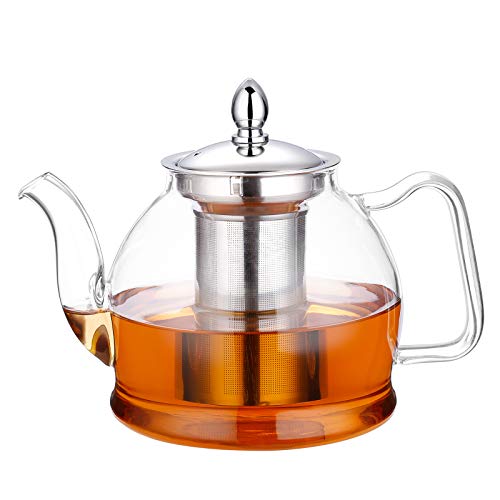
Our quick pick for most kitchens
HIWARE 1000 ml Glass Teapot with Removable Infuser
Borosilicate glass with an 18/10 stainless steel mesh infuser. The listing says it can go straight in the microwave or on a gas or electric stove at a medium heat setting, and that it is top-rack dishwasher safe. Glass has no glaze, and the listing says nothing about lead either way.
See the HIWARE teapot on AmazonThe drawback: it is glass. A knock on the counter or cold water into a hot pot can crack it, and the listing wants medium heat only.
PARACITY, one of the category's top sellers, is not our pick. Its listing calls the infuser glass in one line and 18/8 stainless steel in the next.
The short answer
- Most kitchens: the HIWARE glass pot above.
- Pouring for a crowd: the Ehugos glass pot.
- Worried about lead in porcelain: Sweejar, the only porcelain listing that says “free of lead and cadmium.”
- Induction cooktop: KIYOSHI, the only listing here that names induction.
- No glaze and no glass: Frieling stainless, with water heated somewhere else.
We read the listings of the best-selling teapots on Amazon on October 25, 2026, plus FDA and California lead guidance, and kept eight. We checked three things in each: can it go on a burner, what is the glaze or lining, and what does the seller say about lead. We did not test any of them.
Do Teapots Have Lead?
Some ceramic glazes and decorations contain lead, and you cannot see it. California's public health department says “You cannot tell for sure whether a dish has lead just by looking at it.” It also says lead is rarely found in plain white dishes, and that for most people tableware alone is not a significant source of lead.
Heat and acid make it worse. The same page says “Cooking or microwaving speeds the lead-leaching process,” and that acidic foods and drinks leach lead out of dishes much faster. We found no source that measures what a teapot of hot water does, so we will not guess.
The FDA names teapots in its guidance on lead in ceramics: “Depending on capacity, creamers, coffeepots and teapots will be considered small or large hollowware.” Each size has its own lab limit. Our dinnerware guide has the table. The limits apply to ceramic ware, and we found no FDA level written for glass or stainless pots.
The FDA also says ceramicware that releases lead in its test “should not be labeled as "Lead Free."” So a lead line on a listing is the seller's claim. None of the listings we read links to a lab report. The table below shows what each one says.
Teapots to Look at Twice
- Handmade pots with “a crude appearance or irregular shape,” the FDA says, and antiques.
- Pots bought from flea markets or street vendors.
- Bright orange, red or yellow glaze. The FDA says lead is often used in those colors.
- Decoration you can feel when you rub a finger over it, or a surface that is chipped, cracked or worn (California).
- A pot stamped “Not for Food Use—May Poison Food.” That one is for the shelf.
The FDA says “no amount of washing, boiling, or other process can remove lead from pottery.” It also says ware made in commercial factories for everyday use is much less likely to have lead problems. To check mugs and cups you already own, see our guide to non-toxic coffee mugs.

Can a Teapot Go on the Stove?
Not by default. A teapot holds hot water while tea steeps. Many are not made to sit on a burner at all. Sweese puts it bluntly: this is “NOT a kettle. It is a POT. Do not put it on a heating element.” Pots that do take a burner come with limits. This table has each listing's own rule, its lead wording, and a link to the listing itself.
| Teapot | Stove rule | Lead wording in listing | Amazon |
|---|---|---|---|
|
HIWARE glass 1000 ml |
Gas or electric, medium heat | None | See it |
|
Ehugos glass 1500 ml |
Gas or electric ceramic cooktop. Not induction | “no lead and other toxic chemicals” | See it |
|
Sweejar porcelain 30 oz |
No stove or heating parts | “free of lead and cadmium” | See it |
|
Sweese porcelain 27 oz |
Not a kettle. No heating element | None | See it |
|
FORLIFE Stump porcelain 18 oz |
No flame or heating element | None | See it |
|
Velaze cast iron 700 ml |
Fill to 500 ml at most. Pour water in after boiling | None | See it |
|
KIYOSHI cast iron 40 oz |
Gas, electric, ceramic, halogen, induction. Low to medium heat | None | See it |
|
Frieling stainless 34 oz |
Heat water in a separate carafe | None | See it |

Read the line for the exact pot you buy, even within one material. DOPUDO's 18 oz glass pot says direct-flame heating on gas burners is not recommended. HIWARE and Ehugos both allow gas. A stovetop kettle is a different product; our tea kettle guide covers those, and descaling an electric kettle is its own page.
Glass Teapots
Glass has no glaze, so the lead question mostly drops out. You also see the leaves open and the color come up. Borosilicate is the glass made for heat. Cuisinart's booklet for its glass air fryer, which uses borosilicate, still tells owners to “avoid sudden extreme temperature changes.” That is a different product. We would treat a glass teapot the same way: no cold water into a hot empty pot.
The HIWARE quick pick is above. For a crowd, the Ehugos holds 1500 ml.

If you pour for a crowd
Ehugos 1500 ml Glass Teapot with Removable Infuser
Borosilicate glass with a removable inner stainless steel strainer. The listing says it works on a gas or electric ceramic cooktop, in the microwave and in the dishwasher, and calls the glass “BPA-free, no lead and other toxic chemicals.” That is the seller's sentence.
Good for: Family pots, a table of friends, batches of iced tea
The drawback: Not for induction, and at 1500 ml it is a big pot to store.
See the Ehugos teapot on AmazonPorcelain Teapots
This is the classic teapot, and the one where the glaze matters. All three here are porcelain, and all three listings say to keep them off a burner. If you are shopping for something that goes on a stove, see our ceramic cookware page instead.

If lead is your worry
Sweejar Porcelain Teapot with Infuser, 30 oz
A 30 ounce pot with a deeper infuser. It is the only porcelain listing here with a lead sentence: “free of lead and cadmium.” The listing also says dishwasher, freezer and microwave safe.
Good for: Everyday loose leaf tea for a few people
The drawback: No stove, and the lead line is the seller's word with no report behind it.
See the Sweejar teapot on Amazon
If you want a simple pot
Sweese Porcelain Teapot with Removable Infuser, 27 oz
The listing says it holds two mugs or three teacups, and the lid has a silicone gasket that keeps it on when you pour. Dishwasher and microwave safe by the listing.
Good for: One or two drinkers
The drawback: The listing has no lead wording, and it says plainly this is not a kettle.
See the Sweese teapot on AmazonFORLIFE's 18 ounce Stump is the small one in the table. Its listing says dishwasher safe, no microwave or oven, and that baking soda dissolved in warm water takes out tea stains. It has no lead wording either.
Cast Iron Teapots With an Enamel Interior
The two cast iron teapots we kept have an enamel-coated inside, a stainless steel infuser and a trivet. Neither listing says anything about lead in that enamel. Both are serving pots first, with strict fill rules, so read them before you put one on a burner.

If you want cast iron
Velaze Cast Iron Teapot Set with Infuser, 700 ml
The listing calls the interior “fully enameled” and includes a trivet, two small cups and an easily detachable infuser.
Good for: Slow sipping and gift sets
The drawback: Do not fill past 500 ml and pour the water in after boiling, so treat it as a serving pot.
See the Velaze teapot on Amazon
If you cook on induction
KIYOSHI 40 oz Cast Iron Teapot With Enamel Interior
The only listing here that names induction, along with gas, electric, ceramic and halogen, over low to medium heat. It recommends about 28 oz of water before heating. The infuser is removable stainless steel.
Good for: Induction kitchens, serving several cups
The drawback: Low to medium heat only, and the listing has no lead wording for the enamel.
See the KIYOSHI teapot on AmazonStainless Steel Teapots
Stainless has no glaze or enamel, which is why it is worth a look. We found one stainless teapot we would send you to, the Frieling. The VeoHome is double-wall and keeps tea warm, but its listing says it is not suitable for stovetop or dishwasher use, so it is text only here.

If you want stainless
Frieling 18/8 Stainless Steel Teapot with Infuser, 34 oz
A single-wall, mirror-finished pot of 18/8 stainless steel with a micro-etched infuser. The listing says the teapot and infuser are dishwasher safe.
Good for: Anyone who wants no glaze and no glass
The drawback: You need a kettle too: the listing says heat the water in a separate carafe and pour it in.
See the Frieling teapot on AmazonWhat to Check on the Infuser
Ask four things. Can you lift it out so steeping stops when you want? Is it stainless? Does the lid fit with it in? Is there room for leaves to open? This is what the listings say:
- HIWARE: removable 18/10 stainless mesh. The lid fits with the basket in or out.
- Ehugos: removable inner stainless steel strainer.
- Sweese: removable stainless steel infuser.
- Velaze and KIYOSHI: detachable or removable stainless infusers.
- Sweejar: a deeper infuser. FORLIFE: an extra-fine 0.3 mm stainless infuser. Frieling: a micro-etched infuser.
A big basket in a small pot leaves leaves little room to open. If you drink large-leaf teas, pick the bigger pot.

Questions People Ask
What Is the Best Material for a Teapot?
Glass if you want to watch the tea and skip the glaze question. Porcelain for everyday steeping if the seller states lead and cadmium free. Stainless if you want nothing to chip. Cast iron is the serving pot that holds its heat. Brewing one mug at a time instead? Our tea infuser guide compares five infusers by material.
Is a Glass Teapot Safe on the Stove?
Only if the listing says so. HIWARE says gas or electric at a medium heat setting. Ehugos says gas or electric ceramic cooktops, not induction. DOPUDO says direct flame on gas is not recommended. Avoid sudden temperature swings with any of them.
Are Ceramic Teapots Safe? Do They Have Lead?
Some ceramic glazes and decorations contain lead, and California's health department says you cannot tell by looking. The FDA says everyday factory-made ware is much less likely to have problems. Sweejar's listing says free of lead and cadmium. We did not find a lab report in any listing.
Can You Put a Teapot in the Dishwasher?
The listings say yes for HIWARE (top rack), Ehugos, Sweejar, Sweese, FORLIFE and Frieling. We found no dishwasher line for the two cast iron pots, so wash those by hand until a maker says otherwise.
What Is the Difference Between a Teapot and a Kettle?
A kettle heats water. A teapot holds hot water and tea while it steeps, and many are not made for a burner. Our tea kettle guide covers the pot you boil in.
How Do I Get Tea Stains Out of a Teapot?
FORLIFE's listing says to use baking soda dissolved in warm water. We did not test that, and it is the only stain advice we have a source for.
Can I Use Tea Bags in a Teapot With an Infuser?
Yes. Put the bag in the infuser or straight into the pot and lift it out when the tea is strong enough.
How we chose. We read the best-selling teapot listings on Amazon on October 25, 2026. We kept pots that were in stock, well reviewed by buyers, and clear about what heat they take. FORLIFE is a table and text pick; the rest have a card. There are few good cast iron or stainless teapots on Amazon, so those picks come from a small field. We did not test the pots or their glazes, and no brand saw this page before it went up.
Sources (opened October 25, 2026). Product facts come from each Amazon listing on the same date.
- FDA: CPG Sec. 545.450, Pottery (Ceramics); Import and Domestic - Lead Contamination (PDF)
- FDA: Guidance for Industry on imported traditional pottery and the term "Lead Free" (November 2010)
- FDA: Questions and Answers on Lead-Glazed Traditional Pottery
- California Department of Public Health: Questions and Answers About Lead in Tableware
- Cuisinart: AFC-4 glass air fryer instruction booklet
HIWARE, Ehugos, Sweejar, Sweese, FORLIFE, Velaze, KIYOSHI, Frieling, DOPUDO, PARACITY, VeoHome and Cuisinart are trademarks of their owners and are named here only to identify their products. Listings change; check the listing before you buy.


