

Written by: Sara Ibrahim, Cupindy Home & Kitchen Team
Experience note: Sara writes practical kitchen and home appliance guides for Cupindy, focusing on safer material choices, product-care habits, and clear buying checklists for everyday households.
Last reviewed: September 2026 · Reviewed for: published manufacturer disclosures, recall history, water-contact materials, and practical buying guidance
THE SHORT ANSWER
A stovetop stainless kettle has the fewest non-steel parts of anything you can buy. No gasket, no sensor seal, no base connector, no window. If you want an electric kettle instead, the useful question is not whether it contains plastic. It is whether the manufacturer will tell you where.
And one more thing, which is the reason this article exists. The study that every "non-toxic kettle" guide quotes found that plastic release drops by around 96% as a kettle gets used. Which means the worst plastic kettle you can drink from is a brand-new one, and "throw yours out and buy a new one" is the single piece of advice the research does not support.
Disclosure: Cupindy earns an Amazon commission on qualifying purchases made through links in this article, at no extra cost to you. Our picks, our rejections, and our advice to keep the kettle you already own are unaffected by it. Full disclosure.
How we checked this. We read the underlying research paper rather than the press release about it, pulled every kettle brand’s California chemical disclosure we could find, searched the federal recall database, and compared what manufacturers publish on their own sites against what their listings claim. We did not lab-test anything, and we say so. Neither did any of the guides currently ranking above this one, though five of them use the word "tested."
JUMP TO
1 The study, read properly 2 If you already own one 3 The disclosure nobody mentions 4 The five plastic parts 5 What actually goes wrong 6 Cast iron, done right 7 The glass problem 8 Two to avoid 9 Our picks 10 FAQs
The study everyone quotes, and what it actually found
There is one genuinely new piece of research behind the current wave of kettle articles. In November 2025, a team at the University of Queensland published the first study to measure how much plastic a polypropylene kettle sheds into boiling water, and how that changes as the kettle gets used.
Almost every guide citing it quotes one number and stops there. The number is real. It is also the least representative measurement in the paper.
The number that gets repeated
The university’s press release describes a brand-new plastic kettle’s first boil and converts the result into particles per cup. It is a big, quotable figure, and it has been copied from article to article with the qualifier quietly dropped along the way. Read as written, it describes the first cup of water ever boiled in a kettle straight out of the box. It does not describe your Tuesday morning.
What the researchers measured next
They kept boiling. And they reported release as mass per unit of wetted surface, which is the figure to pay attention to, because it does not depend on how anyone chooses to count particles.
Between the first boils and the 150th, nanoplastic release fell by roughly 96%, and microplastic release by roughly 94%. If you boil twice a day, you pass 150 boils in about eleven weeks.
That one fact turns the category’s advice on its head. The riskiest plastic kettle in the study was a new one. Every article telling you to replace your three-year-old kettle is, on this evidence, telling you to swap a low-release kettle for a high-release one, then wait three months for it to settle down.
The finding nobody quotes at all
The same paper reported that boiling hard tap water reduced nanoplastic concentrations compared with ultrapure laboratory water. The mineral content appears to work against particle release rather than with it. So if you live somewhere with hard water, and you can tell because your kettle scales, the study suggests your real-world exposure is lower than the headline lab figure, not higher.
One more thing, said plainly because no guide citing this research says it: the authors did not recommend switching to stainless steel or glass. Their practical suggestion was to discard the early boils from a new kettle, and their stated position on health effects is that exposure and consequence are both still poorly understood. We think a stainless or glass kettle is a sensible purchase for other reasons, set out below. We are not going to claim the study says so, because it does not.
So what should you do with the kettle you already own?
Three honest cases, and only one of them calls for doing anything today.

You own a plastic kettle and have used it for months or years. The evidence does not support replacing it in a hurry. It is well past the steep part of the release curve. If you want to reduce what remains, two changes follow directly from the research: stop using the keep-warm function, because it holds hot water against the plastic for an hour instead of thirty seconds, and do not re-boil water that has been sitting in it all day. Then replace it when it wears out, and buy better at that point.
You bought a plastic kettle in the last few weeks. This is the one case where acting now is worth something. Boil and pour away several fills before you drink from it. That is the paper’s own suggestion, and it costs you nothing but a few minutes.
You are buying anyway. Then the question is not plastic or no plastic. It is which parts are plastic, and whether the manufacturer will tell you. That turns out to be a much shorter list of brands than the internet suggests.
The disclosure that exists for your air fryer and not for your kettle
Since 2023, California’s Safer Food Packaging and Cookware Act, better known as Assembly Bill 1200, has required cookware manufacturers selling into the state to publish on their own websites the intentionally added chemicals in their products that appear on a state-designated hazard list. It is a legal obligation rather than marketing copy, which makes it the most useful thing a buyer can look up.
The statute defines cookware as durable houseware items used to prepare, dispense or store food or beverages, and says the definition includes but is not limited to pots, pans, skillets, grills, baking sheets, moulds, trays, bowls and utensils. A kettle prepares and dispenses a beverage. On the face of it, it fits.
In practice, almost nobody discloses one. We checked the AB 1200 pages of more than twenty kettle-selling brands, and the pattern is consistent and slightly absurd.
| Brand | Has an AB 1200 page? | Are its kettles on it? |
|---|---|---|
| OXO | Yes | Yes, all three, by product name |
| All-Clad | Yes | Yes, but only as a category |
| DeLonghi | Yes — air fryers, deep fryers, slow cookers | No |
| Breville | Yes — ovens, fryers, pressure cookers | No |
| SharkNinja | Yes — even blenders and toasters | No |
| Fellow, Zwilling, Smeg, Bodum, Secura, Bonavita | None found | — |
So the same company will publish a chemical disclosure for the air fryer and not for the kettle sitting beside it on the shelf. We could not find any state guidance, enforcement advisory or compliance bulletin that draws a line either way on electric kettles. The statute is silent, the regulator is silent, and manufacturers have each drawn their own conclusion. The practical upshot for you: search the brand name plus "AB 1200" before you buy. For most kettles you will find nothing, and that absence is itself worth knowing.
What the most-recommended kettle brand publishes instead
Fellow’s Stagg EKG is the most recommended kettle in this category. We found it endorsed by six of the seven highest-ranking guides, and none of them mentions what follows.
Fellow has no AB 1200 page that we could locate. What it publishes instead is a PFAS disclosure, and that page states the product "contains PFAS, which are currently remnants of the manufacturing process." Fellow adds that it is working to minimise the amount and to find alternatives. The page does not specify which products it covers.
We are not going to pretend that sentence is disqualifying. It describes manufacturing residues, not a coating sitting in your water, and Fellow is the only brand in this category that publishes a proper part-by-part material breakdown naming the polymer in each location. In a real sense it is being penalised for being the one company that answers the question at all. But a guide that recommends this kettle and never mentions its maker’s own published statement is not giving you the full picture, and six of them do exactly that. If you want to understand why these labels are so slippery, our explainer on what "PFOA-free" actually means is the place to start.
The five plastic parts in an "all stainless" kettle
"100% stainless steel interior" is one of the most-repeated phrases in this category. In an electric kettle it is almost never the whole story, because five things other than the wall touch the water or the steam.

Silicone in these positions is a reasonable engineering choice, not an alarm. We go through what is and is not established about it in our guide to whether silicone is safe for cooking. The point here is narrower: a kettle sold on the promise of no plastic has five parts that are not steel, and the brands worth your money are the ones willing to say so.
What actually goes wrong with kettles
Not one of the guides we read mentions safety recalls, which is a strange omission, because the documented harm record for kettles is not chemical at all. It is scalding, and it is recorded in public detail.
| Date | Product | US units | Reported failure |
|---|---|---|---|
| May 2026 | ZWILLING Enfinigy 1.5 L and 1.5 L Pro | 113,440 | Handle can separate from a full kettle |
| June 2026 | Sekaer electric kettles (warning, not a recall) | not stated | Can pressurise and release hot liquid |
| Aug 2025 | Wolfgang Puck Petite tea kettle | 40,000 | Infuser basket lid can fall off in use |
| Oct 2022 | Target Hearth & Hand tea kettles | 12,800 | Handle can break, spout can leak |
| Apr 2020 | Lenox 2.5 qt whistling kettle | 87,000 | Can expel hot water during use |
Handles. Over and over, handles. Add the 2018 recall of roughly 40,200 KitchenAid kettles for the same failure and the pattern is hard to miss: the part most likely to hurt you is the one you hold.
The Sekaer case is the one worth knowing about. In June 2026 the Commission issued a unilateral warning rather than a recall, after 116 reports and 89 injuries including second- and third-degree burns, because the overseas seller would not cooperate. If you buy an unbranded kettle from a marketplace listing, there may be nobody to recall it. That is a better reason to avoid the cheapest listings than anything about the plastic.
Cast iron: the distinction that will crack your kettle
Guides in this category get cast iron wrong in both directions. One page ranking above us bans cast iron outright in a single unexplained line. Another recommends enamelled cast iron warmly. Neither draws the distinction that actually matters, and it is not a subtle one.
| Tetsubin | Cast iron teapot | |
|---|---|---|
| Interior | Bare, unlined iron | Enamel-coated |
| Purpose | Boiling water on a heat source | Steeping already-hot water |
| Strainer basket | None | Usually included — the giveaway |
| Put it on the stove? | Yes, that is what it is for | No. The makers say no. |

Iwachu, one of the Nanbu ironware houses in Morioka that has been making these for generations, puts it in four words on its own care page: "You can’t boil water." Heating an enamel-lined pot damages the coating, and once the enamel is crazed or flaking you have a rusting iron surface under a broken glass layer.
We went looking for a real one, and this is what we found
We searched the largest marketplace there is for an unlined tetsubin we could recommend with confidence. We could not identify one. What comes back instead, in volume, is a category of listing that contradicts itself inside a single page.
Here is a representative example, selling several hundred units a month. Its title calls it a tetsubin, a tea kettle, and stovetop safe. Its own bullet points then say the interior is "fully enameled," that it ships with a stainless steel infuser basket, and that you should "use small fire on stove top to prevent water from boiling and protect the coating from falling off."
Read that last line again. The seller is telling you not to let the water boil, in a listing that calls the product a kettle for your stove. The same page also promises the health benefit of iron released into your water, which a fully enamelled interior would prevent. Both claims cannot be true at once. The reliable tell is the strainer basket: if the listing photographs show a mesh basket inside, it is a teapot, and it should not go on your stove. If you want a cast iron vessel for boiling, buy from a specialist seller who states in writing that the interior is unlined, and read our cast iron care guide first, because unlined iron rusts if you store it damp and cannot be washed with detergent.
Glass, and why "borosilicate" is a word rather than a verification
Glass kettles get recommended everywhere on the strength of one word in the listing. There are two problems with that.
First, you cannot check it. No marking requirement forces a seller to declare glass type, and borosilicate and soda-lime look identical. The one reliable consumer-accessible test is optical: borosilicate has a refractive index of about 1.474, so submerged in a liquid of matching index, such as mineral oil or glycerol, it visually disappears. That is a real test you could run at home, and nobody is running it in a shop aisle. On an unbranded listing, "borosilicate" is a claim, not a fact. Among the glass kettles we checked, OXO and ZWILLING both state borosilicate on their own sites, while some other glass kettle pages never specify the glass at all.

Second, only the cylinder is glass. In every glass kettle we examined, the lid assembly, the handle, the base collar and the seals are plastic, and not one manufacturer names the polymer. The photography implies a plastic-free product. The specification describes something else.
Two that look like the answer and are not
1. The ZWILLING Enfinigy 1.5 L and 1.5 L Pro
A handsome kettle from a respected brand, and it still appears as a recommendation on guides that are live today. It was recalled in May 2026. Roughly 113,440 units in the United States and a further 44,000 in Canada, sold between December 2019 and February 2026. The reported failure is that the handle can loosen and separate while the kettle is full of boiling water. The Commission’s notice records 163 reports of the handle separating or loosening, five incidents, and one second-degree burn.
The remedy is a refund rather than a replacement, and owners are asked to disable the kettle before disposal. Both product pages now return a permanent "gone" status on the manufacturer’s own site.
Affected model numbers: 53101-200, 53101-201, and 53101-500 through 53101-504. If one of those is printed on the base of the kettle in your kitchen, stop using it and claim the refund. Zwilling’s other Enfinigy kettles, including the 1.7 L glass and the 1 L Cool Touch, are not part of this recall.
2. Any "cast iron kettle" that comes with a strainer basket
Covered above, and repeated here because it is the most common expensive mistake in this category. It is a teapot. Boiling in it damages the lining. The listing will not tell you clearly, because the listing calls it a kettle.
What we would actually buy
Ranked by how much the manufacturer is willing to tell you, because on this topic that is the only thing separating one stainless cylinder from another.
SIMPLEST ANSWER

All-Clad Stainless Steel Stovetop Tea Kettle, 2 qt
A stovetop kettle has no gasket, no sensor seal, no base connector and no electronics. There is nothing to disclose because there is nothing there. Heavy-gauge single-ply stainless, a bonded base for induction, and a stainless handle secured with stainless rivets. It is the only design in this article where "all stainless" comes close to being literally true.
It also solves the sight-window problem the honest way. Instead of a plastic strip set into the wall below the waterline, it uses a visible fill line marked on the steel. Same information, no polymer, nothing to perish. Worth noticing, because it shows the window is a design choice rather than a necessity.
The drawback: All-Clad publishes an AB 1200 disclosure page and still declines to state the steel grade on its own kettle page. The 18/10 figure circulating online comes from retailer listings, not from All-Clad. The whistle assembly at the spout is undocumented too, and it sits directly in the steam path. And a stovetop kettle gives you no temperature control at all, which matters if you drink green or white tea.
BEST VALUE, AND IT NAMES ITS GRADE

MAXCOOK Whistling Tea Kettle, 5 L
Here is a small thing that says a lot. This kettle states 304 stainless, prints 18/8 in its own title, and marks the grade on the body of the pot. The premium stovetop kettle above, at more than double the money, will not name a grade anywhere. Reward the manufacturer that tells you. It also uses an internal water level line rather than a window, so there is no plastic below the waterline, and it works on gas, induction and ceramic.
The drawback: 5 litres is a great deal of kettle, and it is the largest of six sizes on that listing, so check you are ordering the one you want. The handle is a phenolic composite rather than steel. It sits outside the water path, so it is not a contamination question, but it is not the all-metal object the photographs suggest. Build quality at this price is decent, not heirloom.
BEST ELECTRIC, ON DISCLOSURE
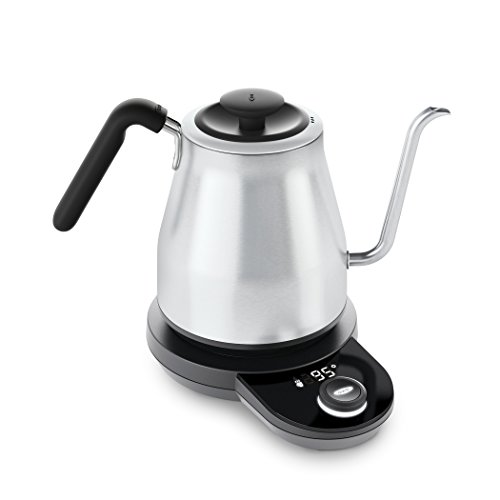
OXO Brew Pour-Over Gooseneck Electric Kettle
OXO is the only kettle brand we found listing its kettles by product name in a California AB 1200 disclosure, all three of them, with the disclosed substances being the constituents of stainless steel: chromium, iron, manganese and nickel. That is a legally-backed statement about what the metal is, which is more than any competitor offers. Stainless interior, concealed heating plate, one-degree temperature steps from 104°F to 212°F, and a built-in brew timer. The opaque steel body means there is no sight window, so that is one of the five plastic parts gone.
The drawback: the disclosure covers the metals and stops there. OXO names no stainless grade anywhere, not on the product page, not in the manual, not on the disclosure, not in the Amazon listing, and says nothing about the lid gasket or base seal beyond mentioning a silicone layer on the lid. It also sells no replacement gasket, so when the seal eventually degrades, the kettle is disposable. The keep-warm is capped at thirty minutes, which we count as a feature rather than a limitation.
BEST ELECTRIC UNDER A HUNDRED

Cosori Gooseneck Electric Kettle, 0.8 L
Cosori names a grade where OXO and All-Clad will not, stating food-grade 304 stainless for the interior, the lid and the spout. Five one-touch presets, and no sight window, so again one of the five parts is simply absent. For a lot less money than the OXO, you get a specification that is in some respects more precise.
The drawback: read the claim carefully rather than the headline. The listing leads with "no plastic contact with water," and the supporting bullet then specifies three components: interior, lid and spout. The lid gasket and the sensor seal are not addressed, and a five-preset variable-temperature kettle has both. That is a gap in the disclosure rather than evidence of a problem, but it is exactly the gap this article is about. Its hold function also runs for a full hour, the longest here, and holding hot water against seals is the habit we would drop first. At 0.8 L you are filling roughly two mugs, blind.
The 60-second check before you buy
1. Search the brand name plus "AB 1200". If a disclosure exists and names the kettle, that is the strongest signal available. If it names the air fryer and not the kettle, you have learned something too.
2. Search the brand name plus "recall" and check the Consumer Product Safety Commission site. Ten seconds, and it rules out the failure mode that actually sends people to hospital.
3. Look at the listing photographs for a water-level window. A window means plastic below the waterline.
4. Find the spout filter in the photographs. If there is a frame around the mesh, that frame is usually not steel, and it is usually removable.
5. If it says cast iron and you can see a mesh basket, it is a teapot. Do not boil in it.
6. If it is new and plastic, boil and pour away the first several fills before you drink any of it.
Frequently asked questions
Should I throw away my plastic kettle?
If you have used it for months or years, the research does not support replacing it in a hurry. The University of Queensland measurements show release dropping about 96% between a kettle’s first boils and its 150th, so an old plastic kettle is well past the steep part of that curve and a new one is not. Stop using the keep-warm function, avoid re-boiling water that has stood all day, and replace it when it wears out.
Where does the "millions of particles per cup" figure come from?
From the University of Queensland’s press release, describing a brand-new plastic kettle’s first boil. It is accurate for that measurement, and it is not what your kettle is doing today. The published paper expresses release as mass per square centimetre of wetted surface, which is the more useful figure and the one we have used above.
Does hard water make it worse?
The opposite, on this evidence. The same study found that boiling hard tap water significantly reduced nanoplastic concentrations compared with ultrapure water. It does mean your kettle scales, which is its own nuisance, but hard water is not making the plastic question worse.
Is there an FDA lead limit for kettles?
Not one written for kettles. The FDA action levels people quote come from Compliance Policy Guide 545.450, which governs pottery and ceramics: 1.0 microgram per millilitre for large hollowware of 1.1 litres or more, and 2.0 for smaller pieces. Applying those numbers to an enamelled metal kettle is an analogy rather than a regulation, and any article stating a firm FDA limit for a kettle is overstating the rule’s reach.
Is 201 stainless steel a problem in a kettle?
Several guides warn against 201 on the grounds that it rusts. The more relevant difference is compositional, since 201 substitutes manganese and nitrogen for some of the nickel in 304. The practical problem is that you cannot verify grade from a listing, and most kettle brands do not publish one. Advice to "avoid 201" is unactionable unless the seller states a grade, which is precisely why we weight published disclosure over marketing claims. Our guide to stainless steel grades in cookware goes through what the numbers mean.
Can I use a cast iron teapot to boil water?
Not if it is enamel-lined, and most of them are. Iwachu’s own care instructions for its cast iron kyusu say plainly that you cannot boil water in it and that the enamel will peel. Only an unlined tetsubin is made for boiling. An internal mesh strainer basket is the reliable sign that you are looking at a teapot.
How do I know if a glass kettle is really borosilicate?
From the manufacturer stating it, or not at all. Borosilicate and soda-lime look identical and no marking is required. The one usable test is optical, since borosilicate’s refractive index of about 1.474 means it nearly disappears in mineral oil or glycerol, which is fine at home and useless in a shop. OXO and ZWILLING state borosilicate on their own sites. Some other glass kettle pages never specify the glass at all.
Which is safer overall, electric or stovetop?
A stovetop stainless kettle has the fewest non-steel parts by a wide margin: no gasket, no sensor seal, no base connector, no window. If minimising contact materials is your only criterion, that is your answer. An electric kettle buys you temperature control and speed at the cost of five sealing components, and the question then becomes which manufacturer will tell you what they are made of. The same logic drives our non-toxic coffee maker guide, and if you brew with a Chemex or a pour-over cone, your kettle is the water path, which makes it the more important purchase of the two.
Sources reviewed
Shi K, Okoffo ED, Fu H, Bapp C, Jiang J, Rauert C, Thomas KV, "Release of nanoplastic from polypropylene kettles", npj Emerging Contaminants, 30 November 2025. DOI 10.1038/s44454-025-00018-w.
The University of Queensland, "Australians are drinking plastic particles in their tea, UQ research finds", December 2025.
California Legislature, Assembly Bill 1200, Safer Food Packaging and Cookware Act of 2021.
California Department of Justice, AB 1200 Enforcement Advisory, October 2023.
OXO, "Required Material Disclosures", accessed September 2026.
All-Clad, "California AB1200 and other chemical disclosures", accessed September 2026.
Fellow Products, "PFAS Disclosure", and "What materials do you use in your EKG kettles?", accessed September 2026.
US Consumer Product Safety Commission, ZWILLING J.A. Henckels recall of electric water kettles, 14 May 2026.
US Consumer Product Safety Commission, Warning on Sekaer electric kettles, 11 June 2026, and the electric kettle recall category listing.
US Food and Drug Administration, "Compliance Policy Guide Sec. 545.450 Pottery (Ceramics); Import and Domestic — Lead Contamination", issued 1980, updated 29 November 2005.
Iwachu, care instructions for cast iron kyusu, accessed September 2026.
Yale University Scientific Glassblowing Laboratory, helpful glass facts, accessed September 2026.
Freshness note: recall status, product availability and manufacturer disclosures all change without notice. Everything above was checked in September 2026. Before buying, re-check the brand’s own AB 1200 or materials page and the CPSC recall listing.


