

Cupindy is reader-supported. Some links on this page are affiliate links, which means we may earn a small commission if you buy through them, at no extra cost to you. As an Amazon Associate we earn from qualifying purchases. See our Affiliate Disclosure.
Written by Lara Yehia. Lara researches home and kitchen products for Cupindy.
Last reviewed: September 2026 · Reviewed for: lead and glaze safety, material comparison, product availability, and practical buying guidance
THE SHORT ANSWER
A slow cooker is safe if three things are true: the insert is stainless steel, unglazed clay, or ceramic from a manufacturer that will state a lead result; the glaze is uncracked; and nothing plastic sits in the hot zone.
The bigger point: almost every article telling you to panic about lead in slow cookers quotes a limit that does not exist. Below is what the rules actually say, and why that changes the answer.
Disclosure: Cupindy earns an Amazon commission on qualifying purchases made through links in this article, at no extra cost to you. Our picks and our two rejections are unaffected by it. Full disclosure.
The lead question, answered properly
Here is the claim you will find repeated across dozens of pages:
"The Prop 65 limit for lead is 0.1 ppm, which is ten times stricter than the FDA limit of 1.0 ppm."
That sentence is wrong twice, and it is worth understanding why, because the correction changes what you should actually check.
What the FDA rule actually is
The FDA does not have one lead limit for ceramics. Its Compliance Policy Guide 545.450 sets five different action levels depending on what the article is, measured in micrograms of lead per millilitre of leaching solution after a 24-hour acid soak:
| Category | Action level |
|---|---|
| Flatware (plates, depth 25 mm or less) | 3.0 µg/mL |
| Small hollowware, under 1.1 litre | 2.0 µg/mL |
|
Large hollowware, 1.1 litre or more ◀ this is your slow cooker |
1.0 µg/mL |
| Cups and mugs | 0.5 µg/mL |
| Pitchers | 0.5 µg/mL |
A slow cooker crock holds between about 3 and 8 quarts — roughly 2.8 to 7.6 litres. It is large hollowware. The number that applies to it is 1.0 microgram per millilitre, and the test is run on six units, with any single failing unit triggering action.
So the frequently quoted "FDA limit of 1.0 ppm" happens to land near the right number by accident, for the wrong reason. Most pages citing it are quoting a tableware figure and hoping it transfers.
The part that matters more
Action levels are enforcement thresholds. They tell an FDA investigator when to detain a shipment. They are not a declaration that some lead is fine.
THE FDA'S OWN WORDS
"There are no FDA regulations that authorize lead for use as a color additive or food additive (including as a component of foodware, cookware, or food contact surfaces)."
The same page states plainly that there is no known safe level of lead exposure. Lead in Food and Foodwares, current as of 6 January 2025.
Both things are true at once. Lead is not permitted as an intentional component of cookware, and the agency still publishes thresholds for when contamination becomes actionable. Understanding that gap is most of what you need.
What Proposition 65 actually measures
This is the error worth correcting, because it is repeated almost everywhere.
California's Proposition 65 does not set a concentration limit in parts per million. It sets daily exposure doses, in micrograms per day.
| OEHHA limit for lead | Value |
|---|---|
| Maximum Allowable Dose Level — reproductive toxicity | 0.5 µg/day |
| No Significant Risk Level — cancer, oral | 15 µg/day |
Those are not the same kind of measurement as the FDA's micrograms-per-millilitre action level. You cannot divide one by the other and announce that California is "ten times stricter." A dose depends on how much you consume; a concentration does not. Any article that compares the two directly has not read either rule.

Two different units. The FDA measures how much lead is in a millilitre of test solution; Proposition 65 measures how much a person takes in per day. Dividing one by the other produces a number that means nothing.
WHY THIS MATTERS PRACTICALLY
If a manufacturer tells you their crock "meets Prop 65," they are telling you it does not require a warning label under an exposure assumption they made. That is a meaningfully weaker statement than "we tested it and found no leachable lead," and the two are constantly presented as if they were the same.
For useful context on scale: the FDA's interim reference level — the benchmark it uses to judge whether dietary lead exposure is a concern — is 2.2 micrograms per day for children and 8.8 micrograms per day for women of childbearing age, and those figures already include a tenfold safety margin.
The three materials nobody asks about
Lead gets the attention. These get less, and two of them are more likely to affect you.
01 Non-stick coated inserts
A growing number of budget slow cookers use an aluminium insert with a non-stick coating rather than ceramic, because it is lighter and cheaper to ship. If the listing says "non-stick" and does not name the coating, you do not know what it is. Our guide to what PFOA-free actually means explains why that label reassures less than it appears to.
02 Bare aluminium
In December 2024 the FDA wrote to retailers and distributors of cookware warning that certain imported aluminium, brass and aluminium-alloy pots — sold under names like Hindalium or Indalium — can leach lead into food, and should not be distributed in the US market. The agency found this through testing by the Public Health Department of Seattle and King County, prompted by high blood lead levels in resettled refugee communities. The FDA placed one manufacturer, Rashko Baba Co. Ltd., on an import alert. This is the one documented, recent, government-confirmed lead-in-cookware problem, and it is not about slow cookers at all.
03 The lid and the seal
Slow cooker lids are usually tempered glass with a silicone or rubber gasket, which is fine. Programmable models sometimes place a plastic control housing where steam vents across it. Silicone at these temperatures is stable — see our guide to whether silicone is safe for cooking — but soft plastic that has gone cloudy or tacky should be replaced.

Only one of these five parts touches your food. The product title usually describes a different one.
WHAT EACH PART IS
Outer housing — often the "stainless steel" in the product name. It never touches your food.
Heating element — wraps the walls, which is why a dedicated slow cooker cooks more evenly than a multi-cooker that heats only from the base.
The insert — the only surface your food touches. This is the one to identify before you buy.
Lid and gasket — tempered glass with a silicone seal. Stable at these temperatures.
Control dial — replace the unit if the plastic housing has gone cloudy or tacky.
The disclosure most buyers do not know exists
Here is a tool worth more than any roundup, including this one.
Since 2023, California's Assembly Bill 1200 has required cookware manufacturers selling into the state to publish, on their own websites, a list of intentionally added chemicals in the food-contact surface that appear on designated hazard lists. It is a legal obligation, not a marketing choice, and it applies regardless of what the packaging says.
That means for most major brands you can stop reading claims and read a filing instead. SharkNinja's, for example, distinguishes products by manufacturing date: multi-cooker series made after 15 August 2024 list aluminium and stainless steel constituents and nothing else, while the same series made before that date — along with its pressure cookers, air fryers and waffle makers — list polytetrafluoroethylene (PTFE), annotated in the document itself as "This chemical provides a non-stick coating." The change was category-wide, not one product line.
HOW TO USE THIS
Search the brand name plus "AB 1200" or "Proposition 65 chemical disclosure." If a manufacturer publishes one, it will tell you more in thirty seconds than a week of reading product listings. If a brand sells in the US and you cannot find one at all, that absence is itself informative.
Not all disclosures are equally useful
Compliance and usefulness are not the same thing, and the difference is stark once you start reading them.
Instant Pot publishes a single statement covering its whole catalogue: its products contain a list of metals "and/or PFAS (including PTFE, PFA, and FEP)," with a note that chemicals in stainless steel, aluminium alloy, ceramic or plastic components may not meet the definition of intentionally added but are listed anyway. That satisfies the law. It also makes it impossible to tell whether any particular model has a coating, because one sentence has to cover air fryers, non-stick pans and bare steel pots at once.
SharkNinja's, by contrast, breaks the range down by SKU series and by manufacturing date, which is how you can see that its multi-cookers changed after August 2024 while its older pressure cookers still list PTFE.
Neither company is doing anything wrong. But when you are choosing between two products, the one whose maker will tell you specifically what is in that model has given you something the other has not.
The catch, in fairness: AB 1200 covers intentionally added chemicals appearing on specific lists. It is a disclosure requirement, not a test result, and it does not certify that nothing else is present. It is still the closest thing to a straight answer that exists in this category.
The risk that is actually yours
If you already own a slow cooker, the realistic hazard is not the glaze chemistry. It is crazing.
Crazing is the fine web of hairline cracks that develops in a glaze as it heats and cools over years. The glaze and the clay body underneath expand at slightly different rates, and eventually the surface fractures. Once it does, two things follow: food residue works into the cracks where washing cannot reach it, and whatever the glaze was covering is no longer fully covered.
A crock with visible crazing, a chip on an interior surface, or a repaired crack has stopped being a sealed food-contact surface. That is a reason to replace it, and it is a far better test than the brand name. The same principle applies to enamelled cast iron and to traditional clay pots.

What crazing looks like. The cracks form a fine irregular web rather than a single break, and they are usually invisible under normal kitchen lighting — tilt the empty insert toward a lamp at a low angle and they appear as a faint grid.
THE 30-SECOND CHECK ON THE COOKER YOU ALREADY OWN
1 Hold the empty insert under a bright light and tilt it. Fine crack networks show as a faint grid.
2 Run a fingernail across the interior base. Catching means a chip or a crack.
3 Check whether the interior has dulled unevenly, especially where you stir.
4 Look up your model for a recall — the base and cord fail far more often than the crock.
5 If it is unbranded, imported, hand-painted, or older than you can date, treat it as unknown rather than unsafe, and consider replacing it.
Passes all five? You have no evidence of a problem, and replacing it is a preference rather than a safety fix.
Two that look like the answer and are not
Before the picks, the two models we were asked about most while writing this. Both are widely recommended. Neither belongs in a non-toxic roundup, and the reason is the same in both cases: the material in the product name is not the material touching your food.
NOT RECOMMENDED
All-Clad 7-Quart Stainless Steel Slow Cooker (SD700350)
The listing says "Stainless Steel Electric Slow Cooker." The stainless steel is the outer housing and lid. All-Clad's own product page describes the insert as "a removable cast aluminum insert with nonstick ceramic coating." So the food-contact surface is coated aluminium, not steel.
Then read their AB 1200 filing next to it. All-Clad's chemical disclosure page lists "All-Clad Kitchen Electrics" — the category their own site files slow cookers under — as containing "Stainless Steel (...), Aluminum, and PFAS Chemicals." The same page explains that PTFE, PFA and FEP "are used for their non-stick properties."
Two documents from the same company, and they leave a gap. We are not going to tell you the coating on this specific insert is a fluoropolymer, because the disclosure is written at category level rather than per model and we have not tested it. What we will say is that a buyer choosing this cooker on the strength of the words "stainless steel" and "ceramic" has not been given the whole picture by the marketing, and can find that out in ninety seconds from the manufacturer's own compliance page. It is a capable cooker — the insert browns on the stovetop, which most cannot — and one of the priciest here. It is also, at the time of writing, the top pick in at least one guide ranking for "best non-toxic slow cooker."
NOT RECOMMENDED
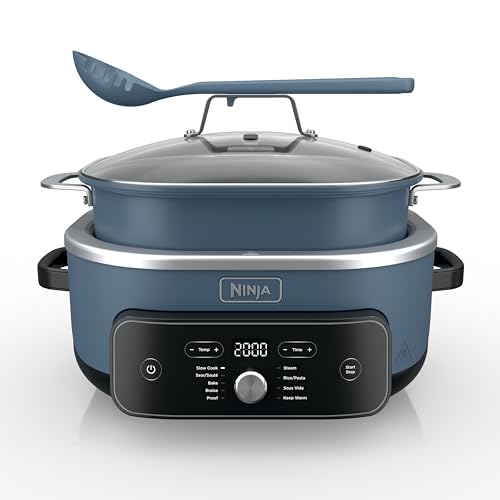
Ninja Everyday PossibleCooker Pro (MC1101)
Not to be confused with the newer Pro Plus recommended below. The MC1101's pot is ceramic-coated nonstick and is described as PFOA-free — a much narrower claim than PFAS-free. PFOA is one compound, phased out years ago. PFAS is the family it belongs to. A product can be entirely truthful in calling itself PFOA-free while still using a fluoropolymer coating.
THE RULE THIS GIVES YOU
On any slow cooker listing, ignore the product title and find the line that names the insert. If it says stainless, clay or stoneware, you know what you have. If it says nonstick, aluminium, or nothing at all, you do not — and neither does the person recommending it.
What we would actually buy
Disclosure: As an Amazon Associate we earn from qualifying purchases. Cupindy earns a commission on qualifying purchases made through the links below, at no extra cost to you. See our affiliate disclosure.

The four surfaces you will find inside a slow cooker, left to right: bare stainless steel, glazed ceramic, unglazed clay, and non-stick coated metal. The first three are what the picks below are made of. The fourth is what turns up when a listing says only "non-stick."

Is the Magnifique clay multi-cooker non-toxic?
Worth answering separately, because searching for a clay slow cooker now returns Magnifique before almost anything else, and the words "non-toxic" are printed in the product title itself. A phrase in a listing is a marketing claim, not a finding. So here is what the company publishes, and what we could not find.
WHAT THE MAKER PUBLISHES
Magnifique describes its claypot as "100% non-toxic kaolin clay" and as "pure clay, inside and out. No coatings, no plastic, nothing to leach into your food." On the glaze question specifically — the one this whole article turns on — the company says the pot is glazed with "the same material it is made out of: Kaolin Clay," and that the glaze is third-party tested and free from heavy metals including lead and cadmium. It names Light Labs as the laboratory, and states the pots are free of heavy metals and PFAS.
Those are more specific statements than most brands in this category make. A clay-on-clay glaze is a real answer to the glaze-chemistry and crazing problem described above, and naming a laboratory is more than a "meets Prop 65" line.
WHAT WE COULD NOT FIND
We could not locate a published test report. The claims describe a result; we did not find the document behind them, the test method, or which vessel category was tested. Naming a laboratory is not the same as publishing what it measured.
We also could not find an AB 1200 chemical disclosure on the company's own site when we checked in September 2026. A site search for "AB 1200," "chemical disclosure" and "Proposition 65" returned no results, and the usual page addresses were not there.
We are not drawing a conclusion from that, and neither should you. Whether a particular company is required to file, and whether a filing exists somewhere we did not look, are not things anyone can determine from the outside. What it means practically is narrower: the thirty-second check described above — read the filing instead of the claim — is one you cannot complete here the way you can with SharkNinja or Instant Pot. Ask the company directly for the test report and the disclosure, and judge the answer you get.
Why it is not a pick here. Two reasons, neither of them a safety judgement. It costs several times a mainstream ceramic cooker, and it is new enough that the rating pool is still small — we prefer to recommend products with enough history behind them that the failure modes have already surfaced. That may change. If the clay route is what you want, this is the one most readers will find, and the two questions above are the ones to ask before ordering.
THE OPTION THAT EARNS US NOTHING
If you own a working ceramic slow cooker: keep it
This is the recommendation that earns us nothing, and it is the right one for most readers. A major-brand ceramic crock with an intact glaze, bought new, from a manufacturer subject to FDA enforcement and Prop 65 warning requirements, has no demonstrated problem. Replacing it produces a landfill item and a purchase, and solves nothing you have evidence of.
Spend the money on the check instead: inspect it for crazing once a year, and replace it when the glaze fails rather than when an article makes you nervous.
Looking for a non-toxic crock pot specifically?
Worth separating two things people mean by this. "Crock-Pot" is a brand name that became the generic word for a slow cooker with a glazed stoneware insert — and that classic design is the one this article is least worried about, provided the glaze is intact.
If you want that traditional format rather than a multi-cooker, buy a glazed stoneware crock from a major manufacturer, new, from a retailer you can return to. That gives you a maker subject to FDA enforcement and Prop 65 warning obligations, and a traceable model number if a recall is ever issued. What you are avoiding is the opposite: unbranded, hand-painted, imported, or secondhand stoneware with no manufacturer to ask.
WHAT TO CHECK ON A CROCK POT LISTING
• The insert is described as stoneware or ceramic — not "non-stick"
• A model number is printed, so you can check recalls later
• It ships new and sealed, not open-box or reconditioned
• The brand publishes an AB 1200 disclosure you can read before buying
Be aware of one honest limit. Major crock pot brands generally state that their stoneware meets FDA and Prop 65 requirements. As covered above, "meets the limit" is a weaker statement than "we tested and found none," and we have not seen a published leachable-lead result from any mainstream slow cooker brand. That is not evidence of a problem — it is an absence of evidence either way, and you should know which one you are being offered.
What about a glass crock pot?
This comes up constantly, and it is usually a misunderstanding worth clearing up. The glass on a normal slow cooker is the lid. The part your food sits in is glazed stoneware. So when a listing photograph shows a lot of glass, that glass is almost never the cooking surface, and choosing a cooker for it does not change what touches your dinner.
Glass cooking pots are not imaginary. A small number of multi-cookers built around a borosilicate glass pot do now exist, sold on exactly this reasoning. But they are new, they are niche, and they cost several times a mainstream cooker. There is no glass-insert crock pot from a major manufacturer, and there has not been one for as long as we can trace.
If your reason for wanting glass is "nothing applied to the surface," the two established ways to get that are bare stainless steel and unglazed clay, both covered above. Glass would do the same job. It is simply not something you can yet buy from a brand with a long track record.
If your glaze has failed: what to replace it with
Everything above says the same thing: a sound glazed crock from a major manufacturer is not the problem. But if you ran the thirty-second check and it failed — crazing, a chip on an interior surface, a repaired crack — then the insert has stopped being a sealed food-contact surface, and it does need replacing.
This is the recommendation the whole crock pot section has been pointing at, so here it is as a product rather than a description. It is the conventional answer rather than the exotic one, and that is deliberate.
Disclosure: As an Amazon Associate we earn from qualifying purchases. Cupindy earns a commission on qualifying purchases made through the link below, at no extra cost to you. See our affiliate disclosure.

Slow cooker or pressure cooker?
Worth asking before you buy either. A multi-cooker with a stainless steel inner pot handles both jobs and removes the glaze question entirely, though its slow-cook mode is generally considered weaker than a dedicated slow cooker's because it heats from the base rather than the walls. We cover the safety side in are pressure cookers safe, and the wider material question in our non-toxic cookware guide. If it is grains rather than stews you are cooking, the same insert question comes round again in our guide to choosing a rice cooker without a coating.
Frequently asked questions
Do slow cookers leach lead?
A ceramic crock with an intact glaze from a mainstream manufacturer has no demonstrated leaching problem, and lead is not permitted as an intentional component of food-contact surfaces. The realistic risks are a crazed or chipped glaze, and unbranded or imported ceramics with no traceable manufacturer.
Is the Prop 65 lead limit 0.1 ppm?
No. Proposition 65 sets daily exposure doses, not concentrations: 0.5 micrograms per day for reproductive toxicity and 15 micrograms per day for cancer risk. The "0.1 ppm" figure circulates widely online but does not correspond to how the rule is written.
What FDA lead limit applies to a slow cooker crock?
1.0 microgram per millilitre. FDA Compliance Policy Guide 545.450 sets five different action levels by vessel type. A slow cooker crock holds roughly 2.8 to 7.6 litres, which makes it large hollowware at 1.0 µg/mL. Most articles quote a tableware figure instead. Action levels are enforcement thresholds for detaining shipments, not a statement that some lead is acceptable.
How do I check what is really in my cookware?
Search the brand name plus "AB 1200." Since 2023, California's Assembly Bill 1200 has required cookware manufacturers selling into the state to publish, on their own websites, the intentionally added chemicals in the food-contact surface that appear on designated hazard lists. It is a legal obligation rather than marketing, so it tells you more in thirty seconds than a week of reading product listings.
What is the safest slow cooker material?
Stainless steel, because it is non-porous, uncoated, and cannot craze. Unglazed clay avoids glaze questions but introduces porosity. Good ceramic is fine while the glaze is intact.
Are old Crock-Pots safe to use?
Age itself is not the issue; glaze condition is. An older crock has had more heat cycles and so is more likely to have crazed. Inspect it. If the glaze is intact and the cord and base are undamaged, there is no evidence-based reason to retire it.
Is the All-Clad slow cooker non-toxic?
The All-Clad SD700350 is marketed as a stainless steel slow cooker, but the stainless is the housing. All-Clad describes the insert as cast aluminium with a nonstick ceramic coating, and their AB 1200 chemical disclosure lists the All-Clad Kitchen Electrics category as containing aluminium and PFAS chemicals. Read both documents before deciding, and note the disclosure is category-level rather than model-specific.
Do slow cookers contain PFAS?
A traditional ceramic crock does not. Some budget models now use a coated aluminium insert instead, and if the coating is unnamed you cannot know what it is. Check whether the listing says ceramic, stoneware, or stainless — if it only says "non-stick," treat that as unanswered.
Can you use a slow cooker with a cracked crock?
No. A crack means the food-contact surface is no longer sealed, and a crazed or cracked crock can also fail under thermal stress during cooking. Replace the insert, or the cooker.
Is there such a thing as a glass crock pot?
Not in the mainstream. The glass on a normal slow cooker is the lid; the food sits in glazed stoneware. A small number of new multi-cookers are built around a borosilicate glass pot, but no major manufacturer sells a glass-insert crock pot, and the glass models cost several times a conventional one. If the goal is a surface with nothing applied to it, bare stainless steel and unglazed clay are the established ways to get there.
Is the Magnifique slow cooker non-toxic?
Magnifique states that its claypot is kaolin clay glazed with the same clay, third-party tested by a named laboratory, and free of heavy metals and PFAS. That is a more specific claim than most brands make, and a clay-on-clay glaze is a real answer to the glaze question. We could not find a published test report behind those statements, and we could not find an AB 1200 chemical disclosure on the company's site when we checked in September 2026 — which is not a finding about the company, only a note that the read-the-filing check is not available to you here. Ask for both documents before buying.
Is stoneware the same as ceramic?
Stoneware is a type of ceramic, fired at high temperature to a dense body. Most slow cooker crocks are glazed stoneware. The distinction that matters for safety is not the clay body but whether the glaze is intact and who made it.
Sources
US Food and Drug Administration, "Compliance Policy Guide Sec. 545.450 Pottery (Ceramics); Import and Domestic — Lead Contamination", issued 1980, last updated 29 November 2005.
US Food and Drug Administration, "Lead in Food and Foodwares", content current as of 6 January 2025.
US Food and Drug Administration, "Letter to Retailers and Distributors of Cookware", 12 December 2024.
California Office of Environmental Health Hazard Assessment, "Proposition 65 No Significant Risk Levels (NSRLs) and Maximum Allowable Dose Levels (MADLs)".
SharkNinja, California AB 1200 cookware chemical disclosure, last updated 18 June 2026.
All-Clad, "Stainless Steel Digital Slow Cooker; Nonstick Ceramic Coating; 7 quart (SD700350)", manufacturer product page.
All-Clad / Groupe SEB, "Cookware & Kitchen Electrics Chemicals Disclosure", California AB 1200 statement.
Instant Brands, "Cookware Chemical Disclosures", Instant Pot AB 1200 statement.
Magnifique, "Non-Toxic Clay Multi-Cooker", manufacturer product page; material and testing statements as published when checked in September 2026.
Material and grade claims for the products above are as stated by their manufacturers. Cupindy has not independently lab-verified them, and we have not tested these slow cookers. Product availability, and the results a retailer search returns, were checked in September 2026 and can change at any time.
ABOUT THE AUTHOR
Lara Yehia writes Cupindy's cookware materials coverage. She checks claims against manufacturer documentation and regulatory sources, and says so plainly when a claim cannot be verified.
Editorial note: This guide explains what US regulators actually publish about lead in ceramic foodware and how those rules apply to a slow cooker crock. It is general safety guidance, not a lab report on any specific product, and it does not replace the manual for your exact model.


