
Is silicone safe for cooking?
Written by Lara Yehia. Lara researches home and kitchen products for Cupindy.
Last reviewed: October 2026
TL;DR — Quick answer
Yes, food-grade silicone is generally safe to cook and bake with, as long as it is rated for the heat you use and you replace it once it turns sticky, cracked or keeps a chemical smell after washing. Two 2025 studies found measurable amounts of siloxanes and catalyst platinum moving from silicone into food. Siloxane release fell with repeated use, so buy carefully and wash before first use; there is no need to throw out what you own.
Our quick pick — reusable baking mat
Affiliate link. As an Amazon Associate we earn from qualifying purchases.
Amazon Basics Silicone Baking Mat, 2-pack
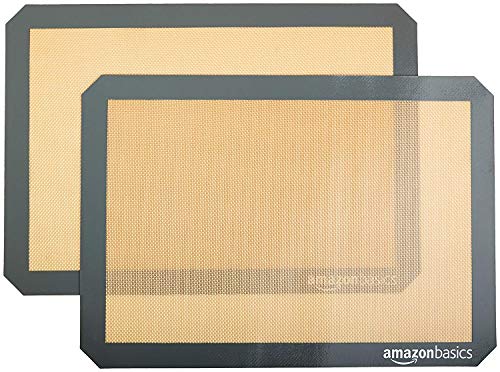
Food-safe silicone, heat resistant up to 480°F (listing).
✓Rated well above normal baking heat, and the listing says dishwasher safe.
✓The same mat our PFAS-free parchment guide suggests as the reusable swap.
The catch: an oily film builds up, you can never cut on it, and it must sit on a baking tray, not the oven rack. The listing says food-safe but names no standard and does not say how the silicone is cured.
How we chose: a widely bought silicone mat that Amazon itself sells and ships, whose listing states food-safe silicone and a heat limit (checked October 13, 2026).
You’ve probably seen silicone spatulas, baking mats, and muffin trays everywhere. They’re sold as the “safe” alternative to plastic. In 2025 two studies — one by Health Canada scientists, one by a university team in Madrid — measured what moves out of silicone when you cook with it. This guide explains what they found, adds what Health Canada and the FDA say, and gives you a calm way to decide for your own kitchen.
Why everyone is asking again in 2026
You may have noticed headlines in late 2025 asking whether silicone bakeware leaches chemicals into food. Two peer-reviewed papers from 2025 are behind them:
- Journal of Hazardous Materials (2025): the team analyzed 25 silicone bakeware products bought in Canada and baked an oil-and-sand food stand-in in silicone bakeware for an hour at 177°C (350°F). Cyclic siloxanes moved into the “food” and the kitchen air, with “a steady decline in migration and emissions” over repeated bakes.
- Food Packaging and Shelf Life (2025): platinum left over from the curing catalyst moved into food from a silicone cooking case, a muffin mold and a baby cup, at intakes the authors call “within tolerable limits.”
Neither paper says to stop using silicone, but both flag it as a source of exposure. Here is what that means for you.
How silicone cookware is made — and why it matters
To understand safety, you need to know there are two fundamentally different ways silicone is manufactured:
Platinum‑cured
Uses a platinum catalyst. More expensive, with fewer by-products. Tiny catalyst traces can remain in the finished product, which is what the 2025 platinum study measured.
Peroxide‑cured
Uses organic peroxides. Cheaper, and can leave breakdown products. The FDA’s rubber rule allows certain peroxide cross-linkers. Neither 2025 study compared the two cure types directly.
Most listings don’t say which cure was used. A named food-contact standard is the check you can actually make — see the checklist below.
The 2026 safe‑silicone decision checklist
Use this at the store or when sorting through your current drawer.
What the 2025 studies actually found — risks in context
Siloxanes (D4 to D16): In the Journal of Hazardous Materials study, baking moved siloxanes into the food stand-in and into room air, where levels “declined rapidly post-baking.” How much moved into the food depended on bakeware type, surface area and fat content, and it fell with every bake. Young children had the highest estimated exposure per kilogram of body weight. Canada’s chemical assessments found, at the exposure levels they considered, D5 and D6 not harmful to human health, and D4 harmful to the environment but not to human health; the heavier siloxanes behind most of the intake here were not part of those assessments.
Platinum migration: In the third use, salmon baked in a silicone case at 180°C picked up 3.6 micrograms of platinum per kilogram and muffins 0.43. The authors put daily intake “within tolerable limits” but call it a new source of platinum exposure.
Microparticles: The same team saw silicone particles 5 to 25 micrometers across released into a strong alcohol extract, especially from a baby cup. To keep the surface intact, skip metal tools and scouring pads.
Bottom line: The data does NOT suggest tossing all silicone. Sensible steps: buy food-grade pieces (a named food-contact standard is best), wash them before first use, and avoid abrasive cleaning.
How to use silicone safely (and when to retire it)
Even the best silicone isn’t immortal. Here’s how to maximize safety and lifespan:
- First use: Wash it in warm soapy water; the FDA’s rubber rule says food-contact rubber should be “thoroughly cleansed” before first use. Release in the 2025 bakeware study fell with each bake, so one empty bake before food touches a new pan is a reasonable extra step; run the kitchen fan or open a window while it bakes, since the study measured siloxanes in room air too.
- Stay under the stated rating: most kitchen silicone is rated to about 220°C (428°F) or a little higher; above its own rating the material can start to break down.
- Avoid direct flame: Never use silicone on a gas flame or broiler element.
- Inspect regularly: If it becomes sticky, brittle, or cracked, replace it. Discoloration alone (staining) is not a safety risk.
- Clean gently: Most pieces can go in the dishwasher (check the label; wooden-handled sets cannot), but skip harsh scouring pads that create micro-abrasion.
Baking mat gone sticky or cracked? Replace it rather than scrubbing it harder. Our quick pick, the Amazon Basics 2-pack, is rated to 480°F and sits on a baking tray.
As an Amazon Associate we earn from qualifying purchases.
Are silicone spatulas and utensils safe?
Yes, on the same terms as bakeware. Choose a food-grade silicone head rated above your pan’s heat and molded over steel or nothing, so there is no hidden plastic core. Retire it once the head splits, melts at the edge or turns tacky, and don’t rest it on the rim of a hot pan. If you want no polymer in the pan at all, see our guide to wooden kitchen utensils.

Replacing a drawer of old utensils: Umite Chef 33-piece set
The listing says “food-grade silicone, BPA-free,” a one-piece stainless steel core and a 446°F limit. It was the most-bought silicone utensil set we found on Amazon US (October 2026) and leads our utensils guide.
The catch: wooden handles, so the maker says no long soaking and no dishwasher. The listing says food-grade but names no standard. Thirty-three pieces is more than most kitchens use, and new pieces smell until aired.
As an Amazon Associate we earn from qualifying purchases.
Full comparison, including a single turner and a teak set: our non-toxic cooking utensils guide.
Our silicone picks at a glance
Affiliate links. As an Amazon Associate we earn from qualifying purchases.
| Pick | The catch | Amazon |
|---|---|---|
|
Quick pick: Amazon Basics baking mat, 2-pack Food-safe silicone, 480°F |
Oily film builds up; use on a tray | See it |
|
Umite Chef 33-piece set Steel core, 446°F |
Hand-wash only; many pieces | See it |
|
Ziruma 8-piece platinum set Maker: “LFGB Certified,” 500°F |
No certificate on its site that we could find; short track record | See it |
Silicone vs. other materials (evidence snapshot)
Common silicone myths — debunked
- “Silicone is plastic.” No — silicone is a synthetic rubber made from silica (sand) and oxygen. Its backbone is silicon and oxygen, not the carbon chain of most plastics (the FDA lists it as elastomers “containing methyl groups”), and it needs no BPA or phthalate plasticizers.
- “All silicone is the same.” False. Formulas differ in fillers, pigments and curing, which is why a named food-contact standard matters.
- “If it smells, it’s toxic.” Some smell is leftover volatiles from manufacturing. Washing and airing usually clears it (one utensil maker says about three hours); a smell that does not fade may indicate low quality.
- “Silicone lasts forever.” It’s durable but breaks down with heat and use. Replace it when it turns sticky, stiff or cracked.
The bottom line
Is silicone safe for cooking? Yes, for most kitchens, when it is sold as food-grade (ideally naming a food-contact standard) and stays below its heat limit. Silicone can release measurable amounts of siloxanes and platinum; in testing, siloxane release fell with each use. Wash it first, keep it off open flame, and replace anything sticky or cracked.
Frequently asked questions
Does silicone leach chemicals into food?
Some does, mostly when new. The 2025 Health Canada study tested 25 bakeware products and found siloxanes moving into an oily food stand-in, depending on bakeware type, surface area and fat content, and less with each bake. Canada’s chemical assessments found D5 and D6 not harmful to human health, and D4 harmful to the environment but not to human health, at the exposure levels assessed; the heavier siloxanes behind most of the study’s intake were not part of those assessments.
Is silicone safe at 400°F?
Yes, if the item is rated above 400°F, as most silicone bakeware is (our quick-pick mat says 480°F). In the oven, put mats and molds on a baking sheet, not the rack, and keep silicone away from the broiler and open flame. Always check the maker’s rating.
Can silicone cause cancer?
There is no evidence linking food‑grade silicone to cancer in humans. Cured silicone is very stable, though not completely inert: the 2025 studies measured siloxanes and platinum moving into food. The WHO’s cancer agency (IARC) has not evaluated silicone cookware; its 1999 review of silicone breast implants cited “evidence suggesting lack of carcinogenicity” for breast cancer.
How do I know if my silicone is food grade?
Look for a named standard: the FDA rule for rubber food-contact articles (21 CFR 177.2600), or EU Regulation 1935/2004 and German LFGB testing. Many guides suggest a “pinch” or “twist” test: white streaks where you fold it point to filler. That tells you about filler, not safety, so a named standard is the better check.
Can silicone go in the microwave and the dishwasher?
Often yes, but go by the label. Our quick-pick mat and the Ziruma set say dishwasher safe; the Umite Chef maker says no, because of its wooden handles. In the 2025 platinum study, a silicone case released similar amounts of platinum in the oven and the microwave.
Are silicone baking mats and muffin pans safe?
Yes, if they are sold as food-grade (ideally naming a food-contact standard) and you stay under their heat limit. Siloxane release in the 2025 bakeware study fell with repeated use. Use mats on a tray, never cut on them, and replace them when sticky. For coated metal pans, see our non-toxic bakeware guide.
Does silicone contain PFAS or BPA?
Ordinary kitchen silicone is a methyl silicone with no fluorine, so it is not a PFAS, and BPA is not part of standard silicone chemistry. But the FDA’s list also allows fluorinated silicones, so only a PFAS-free statement rules them out; the listings we quote for our three picks do not mention PFAS. More on the labels: what PFOA-free means.
Does silicone shed microplastics?
It can shed tiny silicone particles. A 2025 study saw particles 5 to 25 micrometers across released into a strong alcohol extract, especially from a baby cup. Replace damaged pieces and avoid scouring pads to keep the surface intact.
Sources reviewed
- Niu J, et al. (Health Canada). Silicone bakeware as a source of human exposure to cyclic siloxanes via inhalation and baked food consumption. Journal of Hazardous Materials, 2025 (preprint SSRN 5335180).
- Klaiber M, et al. Platinum migration and dietary exposure associated to commercial silicone food containers for microwave or oven use. Food Packaging and Shelf Life 50 (2025) 101552.
- Health Canada, Siloxanes Group information sheet (conclusions for D4, D5 and D6).
- 21 CFR 177.2600, Rubber articles intended for repeated use; EU Regulation (EC) No 1935/2004.
- OECD (2021), PFAS terminology report (PFAS definition); IARC Monographs Volume 74 (1999).
- Prevention, “Scientists Say This Popular Cookware May Be Leaching Toxins Into Your Food” (expert comments on glass bakeware).
- Amazon listings for the Amazon Basics silicone baking mat, Umite Chef 33-piece set and Ziruma 8-piece set, and ziruma.com, read October 13, 2026.
About this guide: Written by Lara Yehia. We did not lab-test these products; we report what the studies, regulators and makers state.


