

Written by Sara Ibrahim. Sara researches home and kitchen products for Cupindy. · Published October 2026 · Last reviewed October 9, 2026
A dishwasher spends its life in hot water and food scraps, so now and then it needs cleaning itself. Doing it is easy. Knowing whose advice to follow is harder, because Whirlpool, GE, Bosch, KitchenAid and Samsung disagree on vinegar, bleach and the filter. Here are their own instructions, side by side.
The short answer
- Once a month: clear the tub floor, clean the filter, then run a cycle with a dishwasher cleaner or vinegar.
- Filter: twist it out, rinse, scrub gently with a soft brush.
- Vinegar: most makers allow it; KitchenAid says check your manual first.
- Bleach: makers disagree. Follow your manual, and never mix it with ammonia.
As an Amazon Associate we earn from qualifying purchases.
Our quick pick
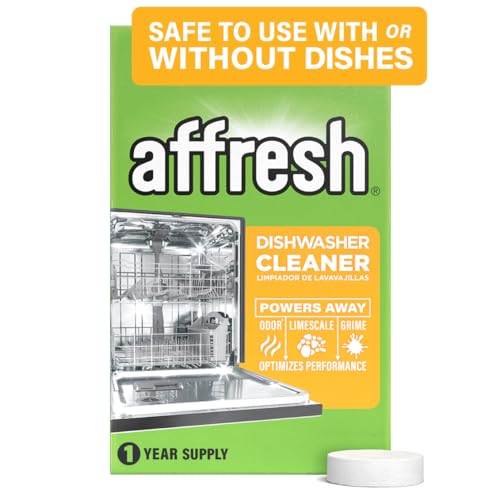
affresh Dishwasher Cleaner, 12 Month Supply
Whirlpool's own tablets, on EPA's Safer Choice list in October 2026. One a month, with or without dishes.
See affresh tablets on AmazonHard water, or want one ingredient?
Citric-acid cleanerHow we put this together: we read the makers' cleaning pages and manuals, three cleaner labels and EPA's Safer Choice list, and checked every quote twice, word for word. We have not tested these cleaners; the photos show everyday kitchen scenes, not test results.
How often should you clean your dishwasher?
For the whole machine, most makers say once a month. Whirlpool: “Monthly: Deep clean using the baking soda and vinegar method or use a dishwasher cleaner.” The filter is where they split.
| Maker | The filter | The whole machine |
|---|---|---|
| Whirlpool | 3 to 6 months; monthly if you run 4 to 7 unscraped loads a week | Monthly |
| KitchenAid | About once a month | About every 30 days |
| Café (GE Appliances) | Every couple of months | Vinegar rinse several times a year |
| Bosch | Every few months (manual: self-cleaning) | Not stated |
How to clean a dishwasher, step by step
What you need
A soft brush or old toothbrush
A damp cloth
Warm water and dish soap
A paper clip or tweezers
A dishwasher cleaner or white vinegar
Your owner's manual
- Empty it and clear the floor of food, glass and paper.
- Clean the filter (next section).
- Check the spray arms for blocked holes.
- Wipe the door gasket and edges.
- Run a cleaning cycle with a cleaner, or vinegar if your manual allows it.
- Wipe the outside with a damp cloth.
Spray arms
GE: “If you find the spray arm's jets are clogged, a gentle poke with a paper clip or tweezers can clear them out.” Gentle matters; GE warns, “Be careful not to damage the jets in any way as that will affect wash performance.” Bosch's manual says to flush the nozzles “under running water,” and Samsung uses a small brush. Check your manual before pulling an arm off.

Door gasket and edges
KitchenAid: “Gently clean the gasket with a soft toothbrush to help remove grime from tough-to-reach crevices without putting too much pressure on the seal.” Bosch's manual: “Regularly clean the door gasket with a damp cloth to remove food particles and other debris.”
How to clean the dishwasher filter
The filter catches the food that comes off your dishes. Whirlpool says regular cleaning helps stop that food from going round again in the next cycle. Whirlpool says it sits “in either a back corner of the dishwasher tub or around the base of the bottom spray arm.”
- Take out the lower rack.
- Unlock it. KitchenAid: “Turn the upper filter assembly ¼ turn counterclockwise and lift out.”
- Rinse under warm water; use a soft brush and dish soap on stuck bits.
- Nothing rough. Whirlpool: “Don't use a wire brush, scouring pad or anything rough to scrub the filter as these materials could damage the filter.”
- Lock it back in. Whirlpool: “do not operate your dishwasher without the filters properly installed.”

Some filters need no cleaning. Whirlpool says its “maintenance-free filter system does not require any regular cleaning or maintenance,” and Bosch's manual says “During normal use, the filter system is self-cleaning.” GE says to “Check your owner's manual to determine if your model has a removable filter.”
| Maker | How the filter comes out |
|---|---|
| Whirlpool, KitchenAid | Quarter turn counterclockwise, lift out |
| Café (GE Appliances) | Twist the ultra-fine filter counterclockwise; lift the flat fine filter from under its rear tabs |
| Bosch | Turn the knob left and lift; wash with warm, soapy water and a scrub brush |
| Samsung (Canada page) | Turn the handle counterclockwise; for a deep clean, soak overnight in white vinegar |
Buying a new machine? Our dishwasher buying guide covers the filter types.
Dishwasher cleaner tablets and pouches: what the labels say
A dishwasher cleaner is made for the machine: the grease and mineral scale you can't reach. Our three work differently. affresh runs with or without dishes; Whirlpool says: “If you're cleaning without dishes, place 1 tablet in the detergent tray.” Lemi Shine needs an empty machine. Finish In-Wash rides along with a normal load.
On EPA's Safer Choice list (checked October 9, 2026) we found affresh Dishwasher Cleaner and Lemi Shine Dishwasher Cleaner, but not Finish's.
As an Amazon Associate we earn from qualifying purchases.
Our pick
affresh Dishwasher Cleaner, 12 Month Supply
Whirlpool's own tablets, the cleaner its guides use. One a month; a second tablet for heavy buildup.
Good for: a monthly clean, with or without a load in the machine
The drawback: the line saying Whirlpool, KitchenAid and Maytag recommend it is in-house: Whirlpool says affresh and those brands are “all owned and distributed by Whirlpool Corporation.”
See affresh tablets on Amazon
Citric acid only
Lemi Shine Natural Dishwasher Cleaner, 8 pouches
One listed ingredient, citric acid, which Lemi Shine uses “to remove hard water build-up.” Lemon-scented.
Good for: hard-water scale and a once-a-month routine
The drawback: empty machine only (“Pour contents from pouch into bottom of empty dishwasher”), so it costs a cycle, and the label says “Do not mix with liquid bleach.”
See Lemi Shine cleaner on Amazon
Runs with your dishes
Finish Dishwasher Cleaner Tablets (In-Wash), 12 ct
One tab in the detergent cup during a normal load, so you don't lose a cycle.
Good for: busy households that never run the machine empty
The drawback: its Amazon ingredient list includes fragrance and dyes, Finish says it is “Not recommended for use with true silver cutlery,” and we did not find it on EPA's Safer Choice list.
See Finish tablets on AmazonCan you clean a dishwasher with vinegar and baking soda?
Most makers allow vinegar, each in its own way. KitchenAid warns: “not every dishwasher interior should be cleaned with vinegar, so be sure to review your dishwasher's Use and Care guide”. Whirlpool and KitchenAid both say vinegar is an acid that can damage the machine if used too often.
Swipe the table sideways on a phone.
| Maker | How much | Where it goes | Their note |
|---|---|---|---|
| Whirlpool | 2 cups, upright cup | Lower rack, empty machine | Baking soda in a later, separate cycle |
| KitchenAid | 2 cups, in a glass | Bottom of the tub, no detergent | Check your manual first |
| Café (GE Appliances) | 1 cup | Poured in just after the detergent cup opens | Several times a year if needed |
| Bosch (manual) | 8 oz cup | Top rack, mid-cycle | An odor fix |
| Samsung (Canada page) | 8 oz cup | Lower basket, Sanitize cycle | Soaks filter and spray arms too |
Vinegar and baking soda together?
Not at the same time. Whirlpool says to run “separate cycles with vinegar, followed by baking soda (never both at the same time)”, then “sprinkle 1 cup of baking soda in the bottom of the dishwasher and run a hot water cycle.” If a video pours both in at once, that is not Whirlpool's method.
Smells and mold
Most smells start with food left in the machine. GE's first checks are the tub floor, the pump inlet and the spray arm jets. Three other causes:
- Dirty water sitting in the tub. GE calls it an installation problem: “The Installation Instructions require either an air gap or a high drain loop.” Our troubleshooting guide covers drains.
- A new machine. KitchenAid says “Odors like petroleum, varnish or plastic often accompany a new dishwasher, and should dissipate within a few weeks.”
- Half-loads waiting for days. KitchenAid suggests a daily rinse-only cycle.

Bleach for mildew? The makers disagree
For mildew, GE says to “Mix one gallon of water with 1/2 cup of chlorine bleach OR mix one gallon of water with 1/2 cup of ammonia,” wipe the interior, then run a rinse cycle. GE says these solutions “will not harm the interior, gasket or outside surface”. Samsung disagrees: “Avoid using bleach in dishwashers with a stainless steel interior, as it can damage or discolor them.” Bosch's manual warns that “Some chloride-containing products can damage your dishwasher and may present health hazards!”
So use bleach only if your manual allows it, and never mixed. GE: “Mixing chlorine bleach and ammonia together will cause toxic fumes.” Lemi Shine's label: “Do not mix with liquid bleach.”
Hard-water buildup inside the machine
White crust on the tub, racks or filter is hard-water scale, and acids dissolve it. Lemi Shine's dishwasher cleaner is citric acid, Café says “Citric acid can also be used to clean your dishwasher's interior,” and Bosch's manual says “Concentrated lemon juice can reduce the build up of hard water stains.”
To keep it away, KitchenAid says to “keep the rinse aid dispenser filled at all times” and that “a water softener is strongly recommended if your water hardness is 15 grains or more.” For the detergent side, see the hard-water section of our non-toxic dishwasher detergent guide; for the water, our water softener guide.
The outside and the stainless door
Start gentle. KitchenAid: “A soft, damp cloth and mild detergent should do the trick.” Whirlpool says to “wipe in the direction of the grain”, and KitchenAid and Bosch both rule out abrasives. Polish splits them: KitchenAid says stainless exteriors “may benefit from specially formulated stainless steel cleaners,” while Café says: “Don't use appliance wax or any type of polish on the stainless-steel door finish.” Check your manual before buying a polish.
Dishes still dirty? See our guide to a dishwasher not cleaning dishes. Choosing a detergent? Our dishwasher detergent guide compares the options.
Dishwasher cleaners compared
All three were in stock for a US address on October 9, 2026.
As an Amazon Associate we earn from qualifying purchases.
Swipe the table sideways on a phone.
| Product | Form | With dishes? | Where it goes | EPA Safer Choice list (Oct 2026) | Watch for | |
|---|---|---|---|---|---|---|
| affresh Dishwasher Cleaner, 12 Month Supply | Tablet | Yes, or empty | Tray (empty) or tub floor (with dishes) | Yes | Its maker-recommended claim is in-house | See on Amazon |
| Lemi Shine Dishwasher Cleaner, 8 pouches | Citric-acid powder | No, empty only | Bottom of the tub | Yes | Don't mix with liquid bleach | See on Amazon |
| Finish In-Wash cleaner tablets, 12 ct | Tablet | Yes | Main detergent cup | Not found | Fragrance and dyes; not for true silver | See on Amazon |
Questions people ask
Is vinegar better than a dishwasher cleaner?
No maker we read says so. Whirlpool offers both and suggests a cleaner “If baking soda and vinegar don’t quite do the job”.
Can you run a dishwasher cleaner with dishes inside?
Some can. affresh and Finish In-Wash run with a load; Lemi Shine needs an empty dishwasher. Follow the label.
Does my dishwasher have a cleaning cycle?
Some do. Samsung's Self Clean cycle runs with the dishwasher “empty and without detergent.” The Bosch manual we read lists none. Check your manual.
Does a dishwasher sanitize itself?
A sanitize cycle is for your dishes: Samsung says its cycle “reaches 163 °F (73 °C) during the final rinse.” It isn't a substitute for cleaning the filter and seal.
How do you clean a dishwasher without vinegar?
Use a dishwasher cleaner, or baking soda: KitchenAid says to “Sprinkle one cup of baking soda along the bottom of the dishwasher.” Café mentions citric acid.
Do all dishwashers have a filter you need to clean?
No. Bosch's manual calls its filter self-cleaning, and Whirlpool has a maintenance-free system. GE says to check your owner's manual.
Keep reading
- Dishwasher not cleaning dishes? 10 causes and fixes
- Non-toxic dishwasher detergent: what the labels actually say
- Things you should never put in the dishwasher
- Dishwasher buying guide: 10 things to look for
About this guide: Written by Sara Ibrahim. We did not test these products. Where your dishwasher's manual or a product label differs from this guide, follow them. Listings and formulas change, so check the current label before you buy. As an Amazon Associate we earn from qualifying purchases.
Sources reviewed
- Whirlpool: How to clean a dishwasher
- Whirlpool: Fixing, removing and replacing dishwasher filters
- Whirlpool Product Help: Cleaning the removable filtration system
- KitchenAid: How to clean and deodorize a dishwasher
- KitchenAid Product Help: How to clean the dishwasher filters
- GE Appliances: How to clean your dishwasher
- GE Appliances support: Dishwasher odors
- Café Appliances (GE Appliances): The ultimate guide to a clean dishwasher
- Bosch: How to clean your dishwasher filter
- Bosch: Dishwasher Use & Care Manual, SHE, SHV and SHX series (US/Canada)
- Samsung Canada support: How to clean your Samsung dishwasher effectively
- affresh: Dishwasher Cleaner Tablets, 12 count
- Lemi Shine: Dishwasher Cleaner (directions and caution)
- Finish: In-Wash Dishwasher Cleaning Tabs
- Finish: How to clean a dishwasher
- US EPA: Products that meet the Safer Choice Standard (searched October 9, 2026)
- Amazon product listings (affresh, Lemi Shine, Finish), checked with a US delivery address on October 9, 2026.


