
Written by Sara Ibrahim. Sara researches home and kitchen products for Cupindy.
Published October 2026 · Last reviewed October 25, 2026 · Cupindy is not affiliated with any brand on this page.
The short answer
Yes. Pyrex says its glass bakeware is made for a completely preheated conventional or convection oven, at any temperature a baking recipe calls for. It publishes no maximum. It is not for the broiler, stovetop, toaster oven, grill or air fryer, and sudden temperature changes are what crack it.
November is when Pyrex works hardest. Casseroles get built the night before, the oven runs all day, and a dish that cracks takes dinner with it. Pyrex answers most oven questions on its own pages. What it leaves out is just as useful to know: a top temperature, which glass your dish is made of, and the capital-letter rule half the internet repeats. We read Pyrex's FAQ and care page, two other glass makers' instructions and the Corning Museum of Glass on October 25, 2026.
Pyrex's own oven rules
Seven rules, each from Pyrex unless noted:
- Preheat the oven fully, then put the dish in. Pyrex warns the dish “can break when exposed to the direct heating element while the oven is preheating.”
- Let a dish from the fridge come to room temperature first. Never go straight from the freezer to a hot oven; thaw it completely.
- For meat, vegetables and anything else that releases juice, add enough liquid to cover the bottom of the dish before it goes in.
- Never pour liquid into hot glass. Pyrex says it “may compromise the product’s strength, potentially resulting in breakage.”
- No direct heat: no stovetop, broiler, toaster oven, barbecue grill or air fryer.
- Set the hot dish on a dry cloth, potholder, wooden trivet or cooling rack. Not a wet or cold surface, not bare countertop or metal, not the sink.
- Plastic lids stay out of the oven, because they melt. Retire any dish that is chipped, cracked or deeply scratched.
As an Amazon Associate we earn from qualifying purchases.

Our quick pick for holiday casseroles
Pyrex Deep 9x13-Inch Glass Baking Dish with Lid
The best seller in Amazon's Baking Dishes category on October 25, 2026. The listing says it is safe in a preheated oven, the freezer and the microwave, and the extra depth gives saucy bakes more room.
See the Pyrex Deep dish on AmazonThe drawback: the lid is plastic. It is for the fridge, not the oven.
What temperature can Pyrex take?
Pyrex does not give a number. Its FAQ asks the question directly and answers that its glass bakeware “is designed for use in a completely preheated conventional or convection oven at any temperature that is called for in a baking recipe”, as long as you follow its safety instructions.
So 350°F, 400°F and 425°F are all inside Pyrex's own instructions. The 425°F limit you see on so many pages is not a Pyrex figure. It is Anchor Hocking's limit for its own glass, and the Home Baking Association uses the same number in its guide to caring for glass bakeware. OXO, which makes its dishes from borosilicate glass, prints 450°F. Here is what each maker publishes, for the dishes we would buy.
As an Amazon Associate we earn from qualifying purchases.
| Glass dish | Glass and oven limit, in the maker's words | Freezer to oven? | Amazon |
|---|---|---|---|
|
Pyrex Deep 9x13 + lid Our quick pick |
No number: any temperature a baking recipe calls for, oven fully preheated. Plastic lid not for the oven. | No. Thaw completely first | See it |
|
Pyrex Deep 3-piece set 9x13, 7x11, 8x8 |
Same as above. Three plastic lids, none for the oven. | No. Thaw completely first | See it |
|
OXO 8x8 + lid Borosilicate |
450°F. OXO says never use the lid in the oven. | Yes, from a 0°F freezer to a preheated oven up to 450°F | See it |
|
Anchor Hocking 3-piece Casserole, cake pan, loaf pan |
Up to 425°F in a preheated oven. | No. Not straight to a preheated oven | See it |
Our rule
For a glass dish with no maker's name or instructions on it, we stay at or under 425°F, the lowest number any maker here publishes, and keep it away from the broiler.
Can Pyrex go from the fridge or freezer to the oven?

Made ahead tonight, baked tomorrow. The hour in between is where glass breaks.
Pyrex's FAQ answers this twice, and the two answers do not match. One says “it is perfectly fine to take your Pyrex® glass dish from the refrigerator and put it directly into a completely preheated conventional or convection oven”. The other, under the same question, says “NO - Please allow the dish to come to room temperature before inserting into a preheated oven or microwave.”
On the freezer they agree. Pyrex advises letting a frozen dish “thaw completely” before it goes into the oven, and its care page puts it plainly: “DO NOT transfer directly from freezer to hot oven.”
Our rule
Follow the stricter answer. Take the dish out of the fridge when you turn the oven on, and let it sit on the counter while the oven heats. Frozen casseroles thaw in the fridge overnight first. It costs you nothing but the preheat time.
If you cook straight from the freezer a lot, glass made for that job exists. OXO says its borosilicate dishes “can go from a 0°F (-18°C) freezer to a pre-heated 450°F (232°C) oven without shattering.” For more on freezing food in glass, see our glass vs plastic storage guide.
As an Amazon Associate we earn from qualifying purchases.

If you cook from the freezer
OXO Good Grips Freezer-to-Oven 8x8-Inch Glass Baking Dish with Lid
Borosilicate glass, which OXO says is “able to withstand temperature changes”, rated by OXO from a 0°F freezer to a preheated oven up to 450°F. Square 8 by 8 inches, with a snap-on lid for storage.
Good for: Freezer meals, brownies, small casseroles
The drawback: One size only, too small for a holiday casserole for a crowd, and OXO says never to put the lid in the oven.
See the OXO dish on AmazonWhy Pyrex cracks, and how to stop it

A hot dish and a wet sink. This is how many glass dishes meet their end.
Glass breaks when one part of it heats or cools much faster than the rest. That is thermal shock, and it is behind nearly every Pyrex warning. The care page sums it up: “AVOID sudden temperature changes, to avoid the risk of breakage.”
These are the moments Pyrex warns about, in its own instructions:
- A cold dish going into a hot oven, or a frozen one going in at all.
- A dish going in while the oven is still preheating, when the element is running flat out.
- Juice hitting a dry, hot dish, which is why Pyrex wants liquid in the bottom before cooking.
- Broth or water poured into a dish that is already hot, to loosen a roast or top up a casserole.
- A hot dish set on a wet or cold surface, on bare countertop or metal, or in the sink.
People who search for the “Pyrex controversy” are usually reading about the long argument over whether newer Pyrex shatters more easily than old Pyrex. We cover that in our glass vs plastic guide. The useful part here is that Pyrex gives both of its glasses the same rules, and the rules above are what prevent breaks.
Damage counts too. Pyrex says to stop using a dish that is chipped, cracked or deeply scratched: “The strength of the dish may be compromised causing it to break or shatter (even long after a chip or crack appears).” A chip near the rim is easy to live with on a serving bowl. On a dish that goes into a 400°F oven, it is a reason to replace it.
As an Amazon Associate we earn from qualifying purchases.
If your dish has a chip
Pyrex Deep 9x13-Inch Glass Baking Dish with Lid
The best seller in Amazon's Baking Dishes category on October 25, 2026, and the Pyrex most people picture: a 9 by 13 inch rectangle, made deeper than the standard dish. The listing says it is safe in a preheated oven, the freezer and the microwave.
Good for: Lasagna, casseroles, roasted vegetables, make-ahead sides
The drawback: The plastic lid can't go in the oven, so cover it another way for baking, such as foil. And like any Pyrex, it should not go from the freezer straight to the oven.
See the Pyrex Deep dish on AmazonBroiler, stovetop, toaster oven, air fryer: no
Pyrex is direct about this one: “Do not use Pyrex® glassware on the stovetop (open flame, electric burner), under the broiler, in a toaster oven, or on a barbecue grill.” Its reason: “This type of use exposes Pyrex® glassware to potentially damaging direct heat sources.” The air fryer gets the same answer: “NO - Pyrex glass cannot be used in an Air Fryer as this is a direct heat source.”
That rules out sliding a sweet potato casserole under the broiler to brown the marshmallows, a very common Thanksgiving move. Our suggestion: brown the topping in the oven for the last few minutes instead, or bake that dish in a metal pan.
Our suggestion if you want glass in an air fryer: buy an air fryer built with a glass bowl. Our glass air fryer guide covers those.
Old Pyrex vs new Pyrex

Grandma's dish or this year's? Check the maker's rules for each.
The Corning Museum of Glass says Pyrex bakeware “was originally made of borosilicate glass in 1915”, and that in the United States it “has been made consistently of heat-strengthened, soda lime glass for several decades.” It gives no year for the change.
Pyrex itself says it makes both kinds of glass. In its words, “Soda lime is slightly more resistant to impact breakage than borosilicate, and borosilicate is slightly more resistant to extreme thermal changes than soda lime.” Then the line that matters for cooking: “They share the same Use & Care instructions”.
So whether your dish is your grandmother's or came this year, the oven rules are the same. In the FAQ entries we found, Pyrex's vintage answers cover only value and reissues, not cooking. On decorated dishes, Pyrex says current products have lead-free enamels and that “all of our decorations have always met the established FDA guidelines”. Old pieces deserve a closer look for chips, deep scratches and worn patches before they go back in the oven.
How to tell if a glass dish is oven safe
Pyrex's FAQ does not explain the marks on its dishes, so go by the maker's words rather than a guess. This is the order we check in:
- Look at the bottom of the dish and the packaging for the maker's own oven wording, such as "oven safe" or "preheated oven."
- Find the maker's care page. Pyrex, Anchor Hocking and OXO all publish one, and each has its own limits.
- If there is no maker, no mark and no instructions, it does not go in the oven. That is our rule, not a maker's.
Our oven-safe cookware guide explains the oven-safe symbols you will find on cookware and bakeware.
What other glass can go in the oven?
Other glass bakeware. Yes, by its own maker's rules. Anchor Hocking's care page allows preheated gas and electric ovens “up to 425°F”, warns against going straight from the freezer to a preheated oven, and wants liquid in the dish for foods that release it, much like Pyrex.

A glass pie dish is bakeware. A jar or a drinking glass is not.
Glass storage containers. It depends on the maker, and the lid almost always has to come off. Pyrex's care page warns that “Permanent discoloration may occur if decorated glass storage is used in oven.” Pyrex's plastic lids melt in the oven, and OXO says never to use its lids in the oven.
Mason jars. No. Penn State Extension says “Mason style jars are not tempered to be used in the oven” and that they “can explode in the oven.”
Drinking glasses, glass bowls and plates. Only when the maker says oven safe. Otherwise they stay out. For the microwave question, which has different answers, see can you microwave glass.
As an Amazon Associate we earn from qualifying purchases.
If you want a published number
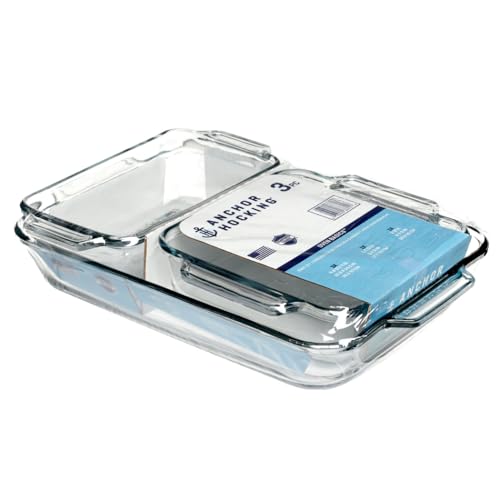
Anchor Hocking 3-Piece Glass Bakeware Set (casserole, cake pan, loaf pan)
Anchor Hocking's care page gives a plain everyday limit: preheated ovens “up to 425°F”. This set gives you a 3-quart casserole, a cake pan and a loaf pan, so it also covers bread and dessert.
Good for: Casseroles, sheet cakes, quick breads, meatloaf
The drawback: Sold by a third-party seller, and stock was low when we checked.
See the Anchor Hocking set on AmazonWhich glass baking dish to buy
For one dish that handles Thanksgiving, start with the Pyrex Deep 9x13: it is the size most casserole recipes are written for, and the extra depth gives bubbling sauce more room. Buy the three-piece set if you bake in more than one size every week. Pick OXO if you freeze meals and want to bake them without thawing, and Anchor Hocking if you want a printed temperature limit.
As an Amazon Associate we earn from qualifying purchases.
If you want every size
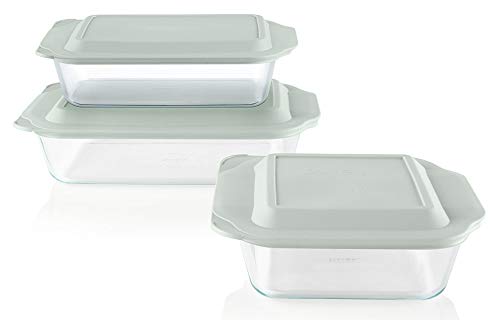
Pyrex Deep 3-Piece Glass Baking Dish Set (9x13, 7x11, 8x8)
Three Pyrex Deep dishes, 9 by 13, 7 by 11 and 8 by 8 inches, each with a plastic lid. Same glass and the same oven rules as the single dish.
Good for: Weekly baking, meal prep, holiday sides cooked at once
The drawback: Three plastic lids, none of them for the oven. If you mostly bake one size, the single dish does the job.
See the Pyrex Deep set on AmazonGlass is one good choice, not the only one. If you want a pan that goes from the stovetop into the oven, glass can't do it; see our picks for induction-ready, oven-safe pans. For a wider look at safe bakeware materials, including glass, ceramic and steel, see our non-toxic bakeware guide.
Questions people ask
Is Pyrex dishwasher safe?
Yes. Pyrex says “Pyrex® glassware and lids are dishwasher safe”. Some kitchen things should never go in, and our list of what not to put in the dishwasher covers them.
Are Pyrex lids oven safe?
Plastic lids are not: Pyrex says they will melt in a conventional or convection oven. Pyrex's care page says its glass lids can be used in a preheated conventional or convection oven. Check which lid you have before covering a dish.
Can you put Pyrex in an air fryer?
No. Pyrex says its glass cannot be used in an air fryer because the air fryer is a direct heat source.
Can you bake a cake or bread in a Pyrex dish?
Yes, at the temperature the recipe gives, in a fully preheated oven. You will often read that you should drop the oven 25°F for glass. King Arthur Baking calls that “common kitchen wisdom” and says it has not tested it, so treat it as a tip, not a rule. For bread, our loaf pan guide compares glass, metal and ceramic pans.
What is the difference between PYREX and pyrex?
You will see it claimed that dishes stamped in capital letters are borosilicate and lower-case ones are soda lime. Neither Pyrex's FAQ nor the Corning Museum of Glass says this, and we found no maker source for it. Pyrex says both glasses share the same use and care instructions, so follow those whatever the logo looks like.
Is Pyrex non-toxic?
Pyrex is glass, which does not need a nonstick coating. On decoration, Pyrex says “All current products have lead-free enamels”. Our non-toxic bakeware guide compares glass with other materials.
Can Pyrex go in the microwave?
Pyrex says both of its glasses suit microwave use. Our guide on whether you can microwave glass covers the rules for other glass.
How we chose
On October 25, 2026 we read Pyrex's FAQ and its product warranties, safety and usage page, Anchor Hocking's care page, OXO's glass use and care guide, and the Corning Museum of Glass Pyrex FAQ. Then we read Amazon's best sellers in Baking Dishes for a New York address. The Pyrex Deep 9x13 is our quick pick because it was the best seller in Amazon's Baking Dishes category that day and is the exact product this question is about. We kept dishes with at least 4.5 stars and over 1,000 ratings. That left out an Amazon Basics borosilicate set (too few ratings) and two Pyrex listings below the floor. We did not test these dishes, and no brand saw this page before it went up.
Sources (opened October 25, 2026). Product facts come from each Amazon listing on the same date.
- Pyrex: Frequently Asked Questions
- Pyrex: Product Warranties, Safety and Usage
- Corning Museum of Glass: Pyrex FAQ
- Anchor Hocking: Care and Use
- OXO: Glass Bakeware Use and Care (PDF)
- Home Baking Association: How to Care for Your Glass Bakeware (February 18, 2024)
- Penn State Extension: Say No to Oven Canning (updated February 12, 2024)
- King Arthur Baking: Baking cake in a dark pan (March 10, 2017)
Pyrex, OXO, Anchor Hocking and King Arthur Baking are trademarks of their owners and are named here only to identify their products. Listings change; check the listing before you buy.


