

Written by Sara Ibrahim. Sara researches home and kitchen products for Cupindy. · Published October 2026 · Last reviewed October 9, 2026
Slow brewing or flat coffee usually means it is time to descale. White vinegar is the classic fix, but the amounts change from brand to brand, and one brand says not to use it at all.
The short answer
- Method: run vinegar and water through a clean or brew cycle, then plain water.
- How much vinegar: equal parts (OXO), about 1:2 or 1:3 (Mr. Coffee, Cuisinart, Ninja), or 2 cups of vinegar (Hamilton Beach).
- Rinsing: one to three pots of plain water.
- The exception: Moccamaster says “We do not recommend descaling with vinegar.”
As an Amazon Associate we earn from qualifying purchases.

Our quick pick if you'd rather skip vinegar
Lemi Shine Coffee Descaler, 15 oz
On EPA's Safer Choice list by name when we checked on October 9, 2026. Lemi Shine lists just two ingredients: water and citric acid.
See Lemi Shine Coffee Descaler on AmazonOwn a Moccamaster? It names Urnex instead.
Urnex Dezcal, 4 usesHow we put this together: we read seven coffee maker brands' cleaning pages and manuals, three descaler labels and safety sheets, and EPA's Safer Choice list. We have not tested these products.
Scale and coffee oils are two different jobs
Moccamaster puts it simply: “While descaler will remove limescale buildup on the brewer’s boiling element, cleaner will remove the buildup of coffee oils and organic materials.”
Vinegar is for the scale. Minerals from your water settle inside the heater, out of reach, and “This buildup can slow and eventually stop the flow of water,” Moccamaster says. The oils sit mostly on parts you can wash: the carafe, basket and lid.

How to clean a drip coffee maker with vinegar
Fill the reservoir with white vinegar and water in your maker's ratio, run a clean or brew cycle, pour it out, then brew plain water one to three times. The brands below agree on that shape; they differ on the amounts and on whether to pause.
- Empty it. Throw out the grounds and filter. Cuisinart also says to take out the charcoal water filter.
- Mix the solution in your maker's ratio (table below), no higher than the max line.
- Run the clean cycle if you have one, otherwise a normal brew with no coffee.
- Pause only if your maker says so. Hamilton Beach stops after 30 seconds and waits 30 minutes; Ninja's clean cycle runs straight through.
- Pour it out and brew plain water one to three times, emptying the carafe each time.
- Wash the carafe and basket in warm, soapy water and refit any water filter.
Still smell vinegar? Brew one more pot of plain water; Mr. Coffee's water-only brews are there “to remove any remaining vinegar.”
What each coffee maker brand says
Swipe the table sideways on a phone.
| Maker | Vinegar to water | Pause or soak | Plain-water brews after | How often |
|---|---|---|---|---|
| Mr. Coffee | “around half as much vinegar as you have water” | 15 to 30 min after the brew | 2 | Monthly |
| Cuisinart | 1:3 for its Clean button; 1:2 elsewhere on the page | Clean button: none; others: 30 min halfway | 1 | 1 to 3 months, by water hardness |
| Hamilton Beach | 2 cups of plain white vinegar (no water named in the step) | 30 min, after 30 seconds of brewing | 2 to 3 | Not stated |
| Ninja (CE251) | 16 oz, topped up with water to 60 oz | None (25 to 35 min Clean cycle) | 1 | When a full pot gets slow |
| OXO | Equal parts | 15 to 30 min in the carafe after | 2 | Every few weeks |
| Moccamaster | No vinegar | Per descaler package | Per package | Every 100 brews |
| Breville (Precision Brewer) | Descaler packet in 34 oz warm water | About 30 min in total | In its video | When the brewer asks |
Cuisinart even gives two ratios on one page: “3 parts water and 1 part vinegar” for its Clean button, “2 parts water and 1 part vinegar” further down. The equal-parts, long-soak recipe common online matches none of these brands. Your own manual wins.
If you own a Moccamaster
Skip vinegar: Moccamaster says it “may not effectively remove buildup and can be difficult to thoroughly rinse, resulting in a lingering odor that could affect future brews.” Skip plain citric acid too, which it says “could damage the brewer.” It recommends Urnex descalers. (Moccamaster is one of the brewers in our non-toxic coffee maker guide.)
As an Amazon Associate we earn from qualifying purchases.
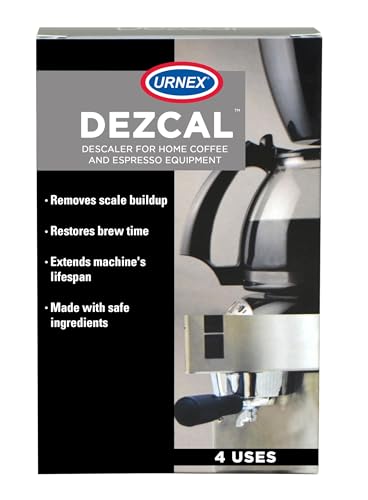
Named by Moccamaster
Urnex Dezcal Descaling Powder, 4 uses
One of the Urnex descalers Moccamaster recommends. Urnex lists citric acid, a sodium salt, sulfamic acid, aluminum sulfate and hydrated silica.
Good for: Moccamaster owners, and anyone whose manual names Urnex
The drawback: the longest ingredient list of the three, with sulfamic acid and aluminum sulfate, and it was not on EPA's Safer Choice list when we checked (October 9, 2026).
See Urnex Dezcal on AmazonThe clean light and clean button
- Cuisinart: press and hold Clean. “The light will blink to indicate it's working,” and at the end “you will hear five beeps and the indicator light will turn off.” If the light comes back, run another cycle with fresh vinegar and water.
- Ninja CE251: fill the reservoir and press CLEAN; “The clean cycle takes approximately 25–35 minutes.” Run it when a full carafe takes longer than 12 to 15 minutes.
- Mr. Coffee: “If your coffee maker has a clean function, use this function to run the most effective clean cycle.”
How often to descale a coffee maker
Monthly is the most common answer. Mr. Coffee says “once a month, you should deep clean the whole coffee maker”; OXO says every few weeks; Cuisinart says “Descale every 1–3 months depending on your water hardness.” Moccamaster counts brews: “Descale your brewer every 100 brew cycles, or after finishing a box of 100-count filters.”
Hard water means sooner, Cuisinart and Moccamaster both say. If you descale often, see our water softener guide.
What to use instead of vinegar
If “your coffee maker’s manual recommends against using vinegar,” as OXO puts it, or you dislike the smell, the brands offer a few alternatives.
Baking soda: three brands, three recipes
| Brand | Mix | Note |
|---|---|---|
| Cuisinart | ¼ cup in 1 cup warm water | Removable reservoir only; don't pause the brew; two plain-water cycles |
| Mr. Coffee | 1 part to 4 parts warm water | Stir first so it doesn't clump; two water-only brews |
| OXO | 1 part to 4 parts warm water | Let it sit in the carafe 15 to 30 minutes; two rinse brews |
Lemon juice, apple cider vinegar or citric acid
Mr. Coffee allows lemon juice, “using equal parts lemon juice and water,” and apple cider vinegar, though “apple cider has a stronger taste, so it may linger a bit more.” OXO allows apple cider vinegar too. None of these brands gives a recipe for plain citric acid powder, and Moccamaster advises against it, so we don't either.
Ready-made descalers
Here the brands split. Ninja says to “Use a descaling solution specifically formulated for coffeemaker cleaning and follow the directions on the package.” Cuisinart: “Here at Cuisinart, we don’t recommend these methods as our coffee makers have reliable, built-in cleaning functions instead.”
On EPA's Safer Choice list on October 9, 2026, we found only two home coffee descalers by name: Lemi Shine Coffee Descaler and Whirlpool's affresh Coffeemaker Cleaner tablets. The Urnex, OXO, De'Longhi and Impresa descalers were not on it.
As an Amazon Associate we earn from qualifying purchases.
Our pick
Lemi Shine Coffee Descaler, 15 oz
Lemi Shine lists two ingredients, deionized water and citric acid. One use is about half a cup in a full reservoir; the bottle holds four.
Good for: anyone who wants a listed descaler instead of vinegar
The drawback: the directions mix pod and drip steps (“Place large mug on drip tray.”), so with a drip maker you brew the full reservoir, then two reservoirs of plain water.
See Lemi Shine Coffee Descaler on Amazonaffresh tablets list sodium bisulfate, citric acid, sodium carbonate and three processing aids. OXO owners: OXO names its own solution.
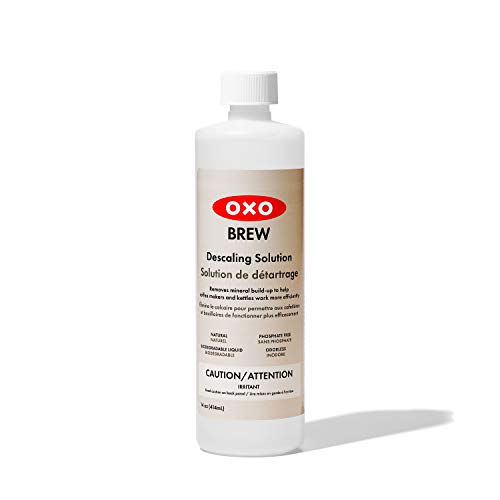
For OXO brewers
OXO Brew Descaling Solution, 14 oz
Named in OXO's own cleaning guide. OXO lists citric acid as the ingredient, says the solution “also contains a cleaning agent”, and calls it “Optimized for use with OXO Brew 9-cup Coffee Maker”.
Good for: OXO coffee makers and kettles
The drawback: OXO rates the bottle at three uses, the fewest of our three picks, and it was not on EPA's Safer Choice list when we checked (October 9, 2026).
See OXO Descaling Solution on AmazonHow to clean the carafe, filter basket and lid
This is where the oils live, and soap does most of the work. Cuisinart: “Use dish soap and a sponge after every brew.” For brown stains, fill with warm water and “add 1 tablespoon of baking soda or 1 teaspoon of dishwasher soap, let sit, then scrub.” For tough ones: “Add crushed ice, salt, and a bit of lemon juice.” Mr. Coffee swirls a little rice with warm, sudsy water.

Use the dishwasher only if your manual says so. Ninja's CE251 manual allows the top rack for the carafe, reservoir and permanent filter. Hamilton Beach allows it for FlexBrew parts but warns off the SANI setting, because “the temperatures in this cycle can damage your product.”

What not to do
- Don't put the base in water. Ninja: “DO NOT immerse the coffee maker in water.”
- Don't fill past the max line. Ninja says up to, “but not exceeding,” its 12-cup line.
- No vinegar or plain citric acid in a Moccamaster, and no distilled water: “We do not recommend using distilled or reverse-osmosis water.”
- No bleach. None of the brands we read uses it in a drip coffee maker.
The three descalers compared
All three were in stock for a US address on October 9, 2026.
As an Amazon Associate we earn from qualifying purchases.
Swipe the table sideways on a phone.
| Product | What's in it (maker's list) | EPA Safer Choice list (Oct 9, 2026) | Uses | Named by | |
|---|---|---|---|---|---|
| Lemi Shine Coffee Descaler, 15 oz | Deionized water, citric acid | Yes, by name | 4 | On EPA's list | See on Amazon |
| Urnex Dezcal powder, 4 uses | Citric acid, sodium salt, sulfamic acid, aluminum sulfate, hydrated silica | No | 4 | Moccamaster | See on Amazon |
| OXO Brew Descaling Solution, 14 oz | Citric acid plus an unnamed cleaning agent | No | 3 | OXO | See on Amazon |
Still slow, bitter or leaking? Slow: descale again. Bitter: wash the carafe and basket. Leaks or no brewing point to a fault; our coffee machine guide covers choosing a new one. Espresso machines have their own routine (how to clean an espresso machine), and pod machines follow their own descaling rules (see how to descale a Keurig).
Replacing your machine? Our best non-toxic coffee maker guide looks at what the hot water touches inside.
Questions people ask
How do I clean the water reservoir?
Cuisinart says to “Clean and dry the water reservoir routinely.” Ninja's CE251 reservoir can be hand-washed or go on the top rack, and Ninja suggests rinsing it after brewing.
Can I use apple cider vinegar?
Yes, Mr. Coffee and OXO both allow it. Mr. Coffee warns that “apple cider has a stronger taste, so it may linger a bit more,” so plan an extra rinse.
How do I clean a new coffee maker before first use?
Ninja's CE251 manual: wash the removable parts in warm, soapy water, then “Prime the system by running 2 full carafes on Classic brew with water only.” Your manual may differ.
Does vinegar damage a coffee maker?
None of the drip makers we read says it damages parts. Moccamaster advises against it for odor and incomplete descaling, and says plain citric acid “could damage the brewer.”
Can mold grow in a coffee maker?
Hamilton Beach cites a 2011 NSF International study that found coffee reservoirs “to be among the top 10 germiest places in the home.” Its answer is regular cleaning.
Keep reading
- Best non-toxic coffee maker: 5 picks and the part nobody checks
- How to choose a coffee maker for home
- How to clean an espresso and coffee machine safely
- How to clean small kitchen appliances
About this guide: Written by Sara Ibrahim. We did not test these products. Where your coffee maker's manual or a product label differs from this guide, follow them. Formulas and listings change, so check the current label before you buy. As an Amazon Associate we earn from qualifying purchases.
Sources reviewed
- Mr. Coffee: How to clean a coffee maker the easy way
- Cuisinart: How to clean a coffee maker
- Hamilton Beach: How to clean your coffee maker
- Ninja: CE251 12-Cup Programmable Coffee Brewer Owner's Guide (2019)
- OXO: How to give your coffee maker and gear some necessary cleaning attention (2026)
- OXO: Brew Descaling Solution
- Moccamaster: How frequently should I descale and clean my brewer, and what should I use?
- Moccamaster: Can I use citric acid to descale my Moccamaster?
- Moccamaster: What is descaling?
- Moccamaster: What kind of water should I use?
- Breville: How to perform a descale, Precision Brewer Glass
- Lemi Shine: Coffee Descaler (directions)
- Lemi Shine: Product ingredients
- Lemi Shine: Coffee Descaler Safety Data Sheet (2025)
- Urnex: Dezcal Powder ingredients
- Urnex: Dezcal Descaler Safety Data Sheet
- affresh: Coffee Maker Cleaner Tablets (ingredients)
- US EPA: Products that meet the Safer Choice Standard (searched October 9, 2026)
- Amazon product listings (Lemi Shine, Urnex, OXO), checked October 9, 2026.


