
You bought the pan because the box said oven safe. Now there is a chicken in it, the recipe says 425°F, and you are standing at the hob trying to remember whether that applied to the lid, or the handle, or only on Tuesdays.
So we went and read what eight manufacturers actually publish. Not what review sites say they publish. What is written on their own websites, on the day we looked.
The short version is that the pan is almost never the problem. The handle and the lid are, and the brands most likely to be in your kitchen are the least likely to tell you anything about either one.
Written by Sara Ibrahim, Cupindy Home & Kitchen Team. Sara covers cookware safety and buying guidance for Cupindy, working from manufacturer care documents, regulatory filings and live product listings rather than from specifications copied between buying guides.
How we researched this. We did not heat any pan until it failed, and we are not a laboratory. Every temperature below was read on the brand's own website or on the product's own listing, on the date given. Where a brand publishes nothing, we say so rather than filling the gap with a number from somewhere else. This is a guide to reading the documents, not a safety clearance for your specific pan. The figure that governs your pan is the one printed on your pan.
Last reviewed: September 2026 · Reviewed for: published oven temperatures, lid and handle ratings, broiler guidance and chemical disclosures across Carote, T-fal, SENSARTE, Granitestone, Lodge, All-Clad, Anchor Hocking and Pyrex, checked 14 September 2026.
The short version
A pan is only as oven-safe as its weakest part. Body, handle and lid carry three different ratings. Use the lowest one, or take the weak part off.
The lid is nearly always the lowest. All-Clad rates its glass lids to 350°F under pans it rates to 600°F. Take the lid off and cover with foil instead. This one habit fixes most of the problem.
Check your line, not your brand. T-fal publishes 350°F for one range and 500°F for another. "It's a T-fal" is not an answer.
Silicone muffin pans go in the oven, on a tray. Never under the broiler. And no regulator anywhere sets silicone a temperature, so the number on the box is the seller's own.
If you want no caveats at all, buy uncoated. Bare cast iron or plain stainless. Nothing attached that can melt, soften or peel. The cheapest honest way in is a bare cast iron skillet, and there is a section on it below.
What we'd buy, at a glance
These are affiliate links, and if you buy through one we earn a commission at no extra cost to you. As an Amazon Associate we earn from qualifying purchases. Each one is written up properly further down, in the section that explains why you would want it, and every write-up names a real drawback.
|
Lodge cast iron skillet Nothing on it that can melt |
Check on Amazon |
|
Cuisinart Chef's Classic skillet If you want the broiler too |
Check on Amazon |
|
Anchor Hocking glass set For baking, not searing |
Check on Amazon |
|
CAKETIME silicone muffin pan Muffins and egg bites |
Check on Amazon |
|
Trudeau Structure muffin pan If the floppy kind annoys you |
Check on Amazon |
|
Nordic Ware half sheet The tray that goes underneath |
Check on Amazon |
What each brand actually publishes
Most guides answer this question with materials science. That is the wrong unit, because you do not own a material. You own one specific pan, from one specific company, with one specific handle glued or riveted to it.
Here is what eight companies say on their own sites. The gaps between them are much wider than the metallurgy would suggest.
Carote
Oven figure: none we could find, anywhere on the site
Lid: not rated
Broiler: not mentioned
Chemical disclosure page: none found
T-fal
Oven figure: 350°F to 500°F, published per range
Lid: 350°F on one range, excluded entirely on another
Broiler: forbidden on its bakeware; silent on pans
Chemical disclosure page: yes, a full one
SENSARTE
Oven figure: 400°F to 500°F, published per range
Lid: not rated
Broiler: not mentioned
Chemical disclosure page: none found
Granitestone
Oven figure: a flat 500°F across every range
Lid: not rated, including on pans sold with lids
Broiler: permitted, on a page with no temperature on it
Chemical disclosure page: none found
Lodge
Oven figure: none for bare cast iron; 500°F for enamelled
Lid: not applicable on a bare skillet
Broiler: named as a normal use
Chemical disclosure page: nothing to disclose on iron and oil
All-Clad
Oven figure: 450°F to 650°F, published per range
Lid: glass 350°F, stainless 500°F
Broiler: answered per range, in both directions
Chemical disclosure page: not checked for this guide
Anchor Hocking
Oven figure: 425°F, stated as a ceiling
Lid: none supplied
Broiler: forbidden, in writing
Chemical disclosure page: not applicable to plain glass
Pyrex, US
Oven figure: none; says only that the oven must be preheated
Lid: none supplied
Broiler: forbidden, in writing
Chemical disclosure page: not applicable to plain glass
The last line of each card records what we were able to locate on 14 September 2026. It is a note about our search, not a finding about any company's compliance with California AB 1200 or any other law.
Are Carote pans oven safe?
Carote answers this question with real enthusiasm and no number at all.
On the product page for the Sakura ceramic set, the brand's own FAQ asks whether the sets are "truly compatible with induction cooktops and ovens." The answer begins: "Absolutely!! Carote sakura detachable cookware sets are fully compatible with induction, as well as gas, electric, and other stovetops. The removable handle feature is largely designed for use with ovens."
That is a clear yes. What follows it is nothing. The same page's care section covers preheating gently, using an oven mitt, where to grip the handle and how to wash up. No temperature appears in it.
There is no care document to fall back on
We went looking. The Care & Cleaning page renders a heading and no content. The instructions page for detachable sets renders the site header, the footer, and nothing in between. The main FAQ links only to shipping, returns, payment, warranty and order tracking. A knowledge-base FAQ address that other sites cite returns a 404. As of 14 September 2026 we could not find a single document on Carote's website giving an oven temperature, a lid rating or a handle material for anything it sells.
Two things follow from that. No lid is rated, though the sets ship with tempered glass lids. And the broiler is never mentioned in either direction, which is not the same as permission.
On chemicals, we could not find a California AB 1200 page or a Proposition 65 page. The nearest thing is a page titled "All you need to know about PTFE," and its entire content reads: "This product contains PTFE. For more information, please refer to:" The sentence stops there. Nothing follows the colon. The Sakura product page, separately, carries "PTFE Free" and "PFOA/PFOS Free" badges. We are reporting what each page says and leaving it there; if you want to know which statement covers your set, Carote is the one to ask. Our guide to cookware without fluorinated coatings explains how these filings work.
One page, two answers. The Sakura care text says to skip the dishwasher because it is harsh on ceramic coatings. A panel further down the same page says the set is fully dishwasher-safe. Both were live on the day we looked. It is a neat demonstration of why the marketing copy and the care copy have to be read as separate documents.
So what do you do? Carote has not given you a figure to rely on, which means the only number that governs your pan is the one printed on the pan, the box, or the leaflet that came with it. If your handle clicks off, take it off. The brand does at least say the removable handle is what makes oven use possible. Take the glass lid off too, because nothing rates it.
And if that answer frustrates you, it is the reason we keep one pan in the cupboard that needs no paperwork at all. A bare cast iron skillet has no coating, no plastic and no lid, so there is nothing on it to rate and nothing to look up. Full write-up and the honest drawback further down.
Can a T-fal pan go in the oven?
Yes, and of everyone here T-fal tells you the most about how. It publishes a separate figure for nearly every range, and it is unusually straight about what the figure excludes.
350°F
400°F pan, 350°F lid
400°F
450°F, no broiler
500°F, handle and lids removed
The Ingenio number is the one people quote and the one people get wrong. T-fal's wording is "oven-safe up to 500°F (without handle and lids)," and its own Ingenio FAQ answers the lid question in four words: "No. You must remove the lid before placing the pan in the oven." The detachable handle is cool-touch Bakelite and is kept out of the oven at any temperature, not merely derated. Groupe SEB's safety instructions say the same thing for the whole group: do not put the handle or lids in the oven.
T-fal is also the only company in this comparison publishing a proper California AB 1200 disclosure. It lists intentionally added chemicals by name, aluminium and nickel among them, and includes, word for word, "Perfluoroalkyl and Polyfluoroalkyl Substances (PFASs) (PTFE, PFA, and FEP)." The same page covers Colorado and Connecticut.
Worth knowing before you rely on it. Those numbers live on T-fal's US marketing pages. Groupe SEB's downloadable cookware manuals carry no oven temperatures at all, only general language about heat damaging plastic parts and glass lids. The figure you are trusting is a web page rather than a document that came in the box, so take a screenshot of the one for your range while it is up.
So what do you do? Find your range name. A Refresh Ceramic pan and an Ingenio pan are both T-fal, and the distance between them is bigger than the distance between most brands.
If the lid is what keeps catching you out, the way around it is a pan that never had one. An uncoated stainless skillet is the cheapest version of that, and it is the one category here where the maker publishes a broiler figure as well. Drawbacks below, and there are real ones.
Are SENSARTE pans oven safe?
SENSARTE does publish per-range figures: 400°F for the PTFE nonstick sets, 480°F for Black Titanium, 480°F or 500°F for ceramic depending which ceramic set you open, and 500°F for the enamelled cast iron. Two ceramic sets from one brand disagreeing by 20°F is a small thing, but it suggests the numbers are written per listing rather than measured once.
The instruction attached to them is the larger problem. Every rating is bracketed with "Please remove the handle before placing it in the oven." On the sets carrying those ratings, the handles are riveted on. On one 20-piece ceramic set the instruction sits inside a bullet headed "stay-cool and comfortable handle," describing a handle built to stay cool on the hob. A buyer who follows that instruction literally cannot.
No lid is rated either, which matters more here than elsewhere, because SENSARTE describes its lids in detail as silicone-sealed tempered glass. That assembly is the likeliest thing in the whole pan to fail first, and it is the one part with no number on it.
Credit where it is due: SENSARTE is the only brand here that plainly tells you not to heat an empty pan. "Make sure there is at least some oil, butter, liquid, or food in the pan before putting it on the stove." Good advice, and nobody else prints it.
So what do you do? Read the published figure as applying to the pan body and nothing else. Keep the lid out. The condition attached to the rating is one you cannot satisfy on a fixed handle, so treat that as a reason to check your own packaging rather than a reason to trust the number.
Are Granitestone pans oven safe?
Granitestone publishes one number, 500°F, and publishes it consistently across ArmorMax, Ceraluxe and the boxed sets. That consistency is a genuine point in its favour. What sits behind the number is thinner.
The figure appears on product pages only. The official FAQ carries no cookware specifications at all, no oven temperature, no lid rating, no handle material, no warnings. It is an ordering and returns page.
Nothing rates the lids, including on the pans specifically sold with tempered glass lids. Hold that against T-fal, which knocks its lids down to 350°F under a 400°F pan, and against All-Clad, which rates glass lids to 350°F under pans rated to 600°F. A flat 500°F printed on a set that contains glass lids, with no exclusion written anywhere, is the most striking thing in Granitestone's documentation.
Broiler guidance does exist, in an odd place. A care blog post says the ceramic cookware suits the oven, broiler, steamer oven, toaster oven, convection oven, microwave and cooktop, and names no temperature limit anywhere on that page. The pages carrying the 500°F figure never mention the broiler. The two are never brought together.
We could not find an AB 1200 page or a Proposition 65 page. Product pages carry composition claims instead, and they differ between ranges: Ceraluxe says made without PTFE, ArmorMax says without PFOA and PFOS. Those are different claims. We went further into this brand's paperwork in our closer look at what it files and states.
One point in its favour that the company never makes itself: Granitestone handles are riveted stainless, not plastic. That is the likely reason it can print a flat number where plastic-handled brands cannot.
Check yours against this before you heat it
On 2 April 2026 the US Consumer Product Safety Commission announced a recall of about 740,000 Granitestone Diamond Pro Blue stainless steel saute pans, sold as a 10-inch and 11.5-inch two-piece set under UPC 0-80313-08131-6. The stated hazard is that "the metal cap on the screw that connects the saute pan to the handle can become detached and forcefully eject when heated." CPSC records at least 98 incidents of that happening, including one report of bruising and burn injuries. The remedy is a refund. The recall covers that one product, not Granitestone cookware in general. If it is the set in your cupboard, deal with the recall before you heat it again.
The pattern underneath all of this
Read those eight cards again and something shows up that is more useful than any single number.
The companies publishing the most figures make the fewest claims about chemicals. T-fal gives you a rating per range, a separate rating for lids, a flat exclusion for the handle and a full candidate-chemical list, and it sells its pans as nonstick rather than as non-toxic. The brands whose pages lead with "100% nontoxic" and "PTFE free" are the ones where we found no lid rating, no handle rating, no broiler guidance and no filing.
That proves nothing about anybody's coating. It is a reliable signal about paperwork. A company that has done the work to file a chemical list has usually also done the work to rate its lids, and a company whose FAQ cannot tell you what its handle is made of has probably not spent a long afternoon testing that pan at 500°F either.
Can you put a silicone muffin pan in the oven?
Yes. The oven is the only place a silicone pan is meant to go. But the number printed on the packet is worth less than almost anyone realises, and two rules matter more than it does.
The figure everyone quotes comes from nowhere
You will see -40°F to 446°F attached to silicone bakeware everywhere. We could not find that range published by a single major US brand. It is a tidy conversion of 230°C, and it travels through marketplace listings rather than through anybody's care documentation.
What US brands do publish is wider, and lower:
Wilton: 375°F
Below the 400°F to 425°F most muffin recipes call for. If you own Wilton silicone and bake at 400°F, you are already past what the maker states.
Trudeau: 428°F
Printed on the product itself, in both Fahrenheit and Celsius, which is more than most of this shelf manages.
Silpat: 428°F or 500°F
Both sit on the brand's own US site. Product pages top out at 428°F; the how-to-use page says 500°F. We could not reconcile them.
USA Pan: nothing
Its silicone mat carries no temperature at all. The 450°F sometimes credited to the brand belongs to the coating on its steel pans, a different product.
Nobody sets that number except the seller
Here is the part that never makes it into these articles. There is no regulator, anywhere, that gives silicone an oven temperature.
In the US, silicone bakeware falls under 21 CFR 177.2600, "rubber articles intended for repeated use." That rule sets extraction limits. Distilled water at reflux, total extractives capped at 20 mg per square inch over the first seven hours and 1 mg over the next two. Hexane at reflux for fatty food, 175 mg and 4 mg across the same periods. The word "oven" does not appear in the section, and no maximum service temperature is set for silicone at all. The FDA is measuring how much material moves into your food, not how hot the pan may get.
The European standard people cite does not help either. LFGB compliance for silicone means BfR Recommendation XV, which requires the material to release no more than 0.5% volatile and 0.5% extractable content. The test heats about ten grams of sample for an hour at 100°C, then four hours at 200°C, and weighs what came off. It is a purity test. It sets no temperature rating, and there is no public register a shopper can look anything up in.
"Platinum cured" is the third phrase worth deflating. Neither the FDA rule nor the German recommendation mentions curing chemistry at all, and the European silicone industry's own compliance guidance draws no distinction between platinum-cured and peroxide-cured material. The worry the phrase gestures at, leftover curing by-products, is exactly what that 0.5% volatiles limit measures, whichever process was used.
Which leaves every oven temperature on every silicone pan as the seller's own claim, set by the seller and tested by the seller if at all. That is an argument for buying from a company with something to lose. Our longer piece on cooking with silicone covers the material itself.
The two rules that matter more than the number
Put a rigid tray under it, every time. This is not a convenience tip. Fat Daddio's says it about as plainly as a manufacturer ever says anything: "Always place your silicone baking mold on a rigid sheet pan before you fill it. Do not skip this step." Wilton and Silpat say the same in gentler words. A filled 12-cup silicone pan has no structure to it, and lifting one by the rim is how batter ends up on the oven floor. A bare aluminium sheet pan is the right thing underneath, because nothing on it is coated and so nothing on it has a temperature limit of its own.
Never the broiler, never direct flame, never the oven floor. Fat Daddio's again: "Stovetops and broilers will melt the material instantly." Silpat tells owners never to use a mat at the bottom of an oven, on a grill or on a barbecue. Wilton, worth noting, publishes a 375°F ceiling and no broiler warning at all.
The silicone bakeware we would buy
Two pans and the tray that has to go under them. Drawbacks are written into each one.

Buy without hesitating
CAKETIME 12-cup silicone muffin pan
The volume seller in this category by a distance, with a rating count in five figures and a 4.5-star average that has held while it scaled. Its listing publishes a range, which already puts it ahead of much of the shelf. It is also the cheapest entry point in its own family, which runs up through jumbo, mini and metal-framed versions if you decide you want one.
The honest trade: unframed silicone flops. Amazon's summary of the listing's reviews reports that the cups wobble and that buyers need an extra cookie sheet for support, and the listing itself concedes the point by telling you to set the pan on a metal tray before filling it. Treat the sheet pan below as part of the purchase rather than an accessory. If that bothers you on principle, buy the framed one instead.

Fine, with a caveat
Trudeau Structure silicone muffin pan, 12 cup
Silicone with a steel frame moulded into it, so it handles like a tin and releases like silicone. It is also the only pan in this section whose stated temperature, 428°F, reads the same on the product, the packaging and the listing instead of changing from page to page. At 4.8 stars it is the best-rated thing we looked at in the category.
The honest trade: Amazon's summary of the listing's reviews puts durability as mixed, with buyers saying the silicone cracks easily. That is an odd failure for the material, and a moulded-in frame can make it worse, because the silicone has to flex around something that will not. It also costs several times what the unframed pan above costs, for the same twelve muffins.

Buy without hesitating
Nordic Ware Naturals half sheet, 2-pack
Bare aluminium with a galvanised steel rim rolled into the edge, which is the detail that stops a sheet pan buckling with a bang halfway through baking. Thirty-five thousand ratings at 4.7 stars. Nothing is coated, so nothing on it has a temperature limit, which is exactly what you want underneath a silicone pan. Buy the two-pack; it works out cheaper per pan than one on its own.
The honest trade: bare aluminium discolours, and the dishwasher speeds it up. Amazon's summary of the listing's reviews names discolouration as a recurring theme. It is cosmetic, it is permanent, and the only fix is to wash them by hand and accept that they will look used. Worth noting too that the listing publishes no oven rating and never uses the words "oven safe," which is a good reminder that a missing number is not the same as a low one.
The ten-second check, on a pan you already own
1. Turn it over. Most makers stamp or print the rating on the base, often with a small oven symbol. This is the best source you have, because it was put on your pan at the factory.
2. Find the range name, not the brand. "T-fal" spans 350°F to 500°F. The range name is what maps to a real figure.
3. Rate three parts separately. Body, handle, lid. Use the lowest, or remove the weakest.
4. Look at what the handle is made of, not what it is called. "Stay-cool" and "soft-grip" describe how a handle feels on a hob. They say nothing about an oven.
5. Found nothing? Assume the lower number. An unmarked nonstick pan with a plastic handle is a 350°F pan until something tells you otherwise.
The handle is the limit, and nobody publishes its rating
This gap runs through every brand in this guide.
Cookware handles loosely called Bakelite are phenolic plastics, and retail listings describe them as oven safe to 350°F as a matter of routine. We could not find one cookware manufacturer publishing a temperature for its phenolic handles on its own site. Not one.
What the materials suppliers publish is lower. Curbell's linen-filled phenolic lists a maximum continuous service temperature of 257°F. A Bakelite-branded moulding compound lists a heat deflection temperature at the same 125°C. Those are industrial grades measured under mechanical load rather than cookware handles sitting in dry heat, so it is not a straight read-across, and we are not telling you your handle fails at 257°F. The narrower and more useful statement is this: 350°F is a retail claim with no manufacturer document behind it, and the published data for the material family sits a long way below it.
Which is why the company doing the best job here takes the handle out of the question entirely. T-fal's Ingenio handle detaches and stays out of the oven at any temperature. An honest exclusion beats a printed number nobody can source.
The silicone handle cover trap. Lodge rates its silicone hot handle holders to 500°F, the deluxe version to 550°F, and states on the same product pages that they are not intended for use in an oven, or during cooking, grilling or baking. They exist to carry a hot pan to the table. A high number on a handle cover is not permission to bake with it fitted.
Lids: the derating almost everyone misses
If you change one habit after reading this, change this one. Take the lid off.
Among brands that rate lids separately, the lid is always the lowest number in the set. All-Clad puts its glass lids at 350°F under pans it rates to 600°F, a gap of 250 degrees. T-fal puts its Ultimate Hard Anodized lids at 350°F under a 400°F pan, and keeps Ingenio lids out of the oven altogether. All-Clad's stainless lids, with no glass in them, go to 500°F.
The reason is the assembly rather than the glass. A tempered glass lid is a glass disc, a metal rim, a silicone gasket and a knob, all joined together and all expanding at different rates. The gasket and the knob give up long before the glass does.
Carote, SENSARTE and Granitestone rate no lid at all, and all three sell tempered glass lids. So SENSARTE's oven ratings are unbounded on the component likeliest to fail, Granitestone's flat 500°F is printed on sets containing glass lids with no exclusion written anywhere, and Carote publishes no figure for either part.
The rule that survives every brand: unless the maker has rated the lid for the temperature you are using, cover with foil instead.
Material by material
Use this to sanity-check a published figure, not to replace one.
Bare cast iron
No maximum found on Lodge's site. Broiler fine. What limits it is the seasoning, and your wrists.
Enamelled cast iron
500°F from Lodge, 650°F from All-Clad. The knob and thermal shock on the enamel are the limits.
Uncoated stainless steel
500°F to 600°F, broiler usually fine. The handle and lid limit it, never the steel.
Carbon steel
Usually unrated and treated like cast iron. Watch for wooden or epoxy-set handles.
Ceramic-coated nonstick
350°F to 500°F, a wide spread between brands. Mostly no broiler. The coating bond and the handle decide it.
PTFE nonstick
350°F to 500°F. No broiler on most brands that address it. See below on what the numbers mean.
Oven glass
425°F from Anchor Hocking, no figure from Pyrex. Both forbid the broiler. Thermal shock breaks it, not peak heat.
Silicone bakeware
375°F to 500°F depending on brand. Never the broiler. The seller sets the number; no regulator does.
Cast iron, the pan with nothing to look up
Bare seasoned cast iron is the only cookware in this guide with no assembly to it. One piece of metal, a baked-on layer of oil, and a handle that is part of the same casting. There is no coating to protect, no gasket to perish and no knob to soften, which is why it is the one answer that survives every question on this page.
Lodge publishes no maximum oven temperature for it, and we could not find one anywhere on their site. That reads oddly until you realise there is probably no meaningful number below the point where a domestic oven stops. Enamelled cast iron is different and does carry a figure, 500°F from Lodge and 650°F from All-Clad, because enamel is a coating and the knob on the lid is usually not iron. Our piece on enamelled ironware covers that side of it.
The one thing to watch is the accessory rather than the pan, and it catches people out constantly. See the note on silicone handle covers above: a 500°F rating on a handle holder is not permission to bake with it fitted.

Buy without hesitating
Lodge pre-seasoned cast iron skillet
Iron and oil. No coating to protect, no plastic to soften, no lid to remember to remove. It goes from hob to oven to broiler to a campfire without a single condition attached, which is the entire reason it is first on this list. The rating pool behind Lodge's skillets runs past a hundred and thirty thousand people at 4.6 stars, which is about as much evidence as this category ever offers. The 8-inch is the cheapest honest way in. Most people end up wanting the 10.25-inch, which is the size that takes a tray of thighs or a skillet cornbread.
The honest trade: we could not find a maximum oven temperature published anywhere on Lodge's site for bare seasoned iron. Almost certainly because there is no meaningful one below the point where your oven stops, but the truthful answer to "what is it rated to" is that they do not say. Beyond that, it is heavy, and the factory seasoning is not as non-stick as the box implies until you have built it up yourself. The 10.25-inch bundle that ships with a red silicone handle holder is handy for carrying, but Lodge states that holder is not for oven use, so it comes off before the pan goes in.
Can stainless steel go in the oven?
Yes, and it is the material least likely to be the thing holding you back. All-Clad rates uncoated stainless to 600°F for oven and broiler both, and notes that long exposure above 500°F can change the colour of the steel without affecting how it performs. That discolouration is what most people mistake for damage.
Grade is not the variable people think it is. 304, 18/10 and 18/8 all behave the same way in a domestic oven; what separates them is corrosion resistance and nickel content, not heat. What varies is everything attached to the steel. A riveted stainless handle goes wherever the pan goes. A silicone-wrapped handle, a plastic lid knob or a nonstick coating each set their own lower ceiling.

Fine, with a caveat
Cuisinart Chef's Classic stainless steel skillet
Uncoated 18/10 stainless with solid riveted stainless handles and no lid, so there is no plastic anywhere in the assembly. Unusually for a pan at this price, the range publishes a figure and names the method: the 10-inch listing says the finish holds up through dishwasher, freezer, broiler and oven use to 550°F. The 9-inch linked here shares the same review pool and is the cheapest way into a family that ladders up through 10, 12 and 14-inch pans. If you want the grades explained properly, our breakdown of what those numbers mean does that.
The honest trade: at 4.3 stars this is the lowest-rated thing on the page, and the reason is consistent. Amazon's summary of the listing's reviews says buyers disagree about stickiness, with plenty reporting that food sticks to the bottom. Uncoated stainless wants a properly preheated pan and enough fat, and people arriving from nonstick often hate the first month. It is heavier than it looks. And the cheaper 9-inch listing carries no temperature figure of its own; the 550°F claim sits on the 10-inch page.
Nonstick, PTFE and the temperature question
Two different things get muddled here: the temperature at which a coating starts to break down, and the temperature at which that becomes a health question.
The best primary source a home cook can reach is the fluoropolymer industry's own handling guide, published by the Plastics Industry Association. It gives a recommended continuous use temperature for PTFE of 500°F. It says hazardous fumes may be produced above 625°F, and toxic fumes may form at 840°F and above. Below those points it describes significant decomposition as happening only when the material is heated past its recommended processing temperatures.
Two caveats most articles skip. We could not find an oven-temperature warning for PTFE cookware published by any US agency, the CPSC and FDA included, so the 500°F figure in circulation comes from a trade body rather than a regulator. And the "Teflon is safe to 500°F, per DuPont" line is not currently verifiable on the brand owner's own website, which no longer publishes a consumer figure at all. We could not confirm it, so we are not repeating it as their claim.
In practice the oven is not where this bites. A domestic oven at 400°F puts a coated pan nowhere near a degradation threshold. The real exposure is the broiler, where the element radiates straight onto the coating and the surface gets far hotter than the air. That is why All-Clad tells nonstick owners to avoid the broiler while still allowing 500°F in the oven, and it is the single most useful distinction on this page. Our overview of what pans are made of goes further into coatings.
Why there is no T-fal pick, even though T-fal documents this best
We looked hard for one. The Ingenio sets carrying the 500°F rating sit well above the price we recommend at, on rating counts in the low hundreds rather than the thousands we want to see. The one Ingenio set inside our usual range turned out, on reading the bullets rather than the title, to contain three saucepans and no frying pan. We would rather say that than push a set out to fill a gap on the page. If you already own T-fal, the card above is the answer you came for. If you are replacing it, the skillets are what we would buy.
Glass breaks from the difference, not the heat
Glass bakeware almost never fails because the oven was too hot. It fails because two parts of the dish were at different temperatures at the same moment.
Anchor Hocking publishes the clearest rules in the category: preheated conventional or convection ovens up to 425°F; never on or under a flame or any direct heat source, which rules out the hob, the broiler, a toaster oven and a grill; never add liquid to a hot dish; never set a hot dish on a wet or cold surface; never go from freezer straight into a preheated oven; add enough liquid to cover the base when cooking something that will release more; and never use a dish that is chipped, cracked or badly scratched.
US Pyrex publishes the same prohibitions without a maximum, saying the dish is made for a fully preheated oven at whatever temperature a recipe calls for, and that it must not go in until preheating has finished.
The formulation point that explains those rules. Pyrex sold in the United States is tempered soda-lime glass, not the borosilicate the name is historically attached to; the composition changed before the brand was licensed on. Work published through the American Ceramic Society puts the difference starkly. Soda-lime resists fracture while the temperature difference stays under roughly 100°F. Borosilicate tolerates around 330°F. That is why "do not put a cold dish into a hot oven" is a rule rather than a suggestion. Anchor Hocking, which also uses tempered soda-lime, argues its tempering gives it thermal shock resistance equal to or better than annealed borosilicate, and that it breaks into smaller pieces when it does go.
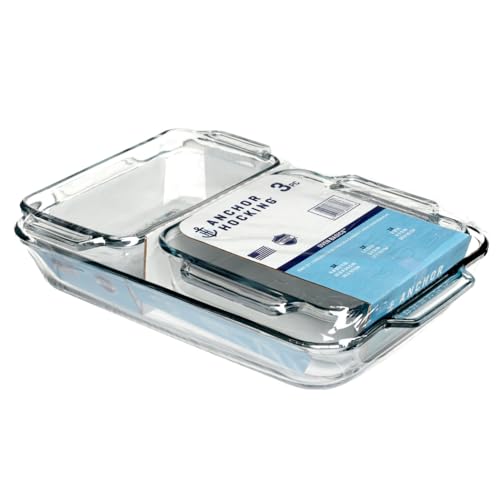
Fine, with a caveat
Anchor Hocking glass baking dishes, 3-piece set
We point at Anchor Hocking rather than the better-known glass name for one reason. It publishes an actual ceiling on its own website, 425°F, and a complete list of the things that break a dish: no flame, no broiler, no toaster oven, no cold liquid into a hot dish, no hot dish onto a wet worktop, no freezer straight into a preheated oven. Its main competitor publishes the prohibitions and no number. When the failure mode is thermal shock rather than peak heat, a company willing to write the number down is the one to buy from.
The honest trade: it is tempered soda-lime glass, not borosilicate, and Amazon's summary of the listing's reviews says so, alongside a recurring and serious complaint of dishes breaking in the oven. That is the material behaving the way soda-lime behaves under a temperature difference rather than a fault in this particular set, but the honest headline is that you follow the rules or it breaks. There are no lids. And the listing's bullet describes different sizes from its own title, so check the dimensions against what you actually need before ordering.
Oven safe, broiler safe and microwave safe are three different claims
Oven safe means the piece copes with hot circulating air up to some stated temperature. It is the weakest of the three and the one most often printed without a number beside it.
Broiler safe is about radiant heat landing directly on the surface, at close range, from an element far hotter than the air around it. Surface temperature under a broiler is not oven temperature. That is why All-Clad allows 500°F in the oven for its nonstick ranges but tells you to keep them out from under the broiler, why T-fal marks its ceramic bakeware as unsuitable for broiler use, and why every glass and silicone maker forbids it outright. Oven safe never implies broiler safe.
Microwave safe is about whether a material absorbs microwave energy and whether it contains metal. It has nothing to do with heat resistance at all. Most oven-safe cookware is metal and therefore emphatically not microwave safe, and T-fal states plainly that its pans should never go in one. Our guide to checking that claim covers the other side of it.
Six mistakes that ruin oven-safe cookware
Assuming the pan is fine because the body is metal. The body is almost never the limit.
Leaving a silicone handle cover on. Rated to 500°F and not for oven use are both true of the same object.
Baking with the glass lid on. Where it is rated at all, it is rated lowest. Foil does the job.
Setting hot glass on a cold or wet surface. The difference breaks the dish, not the temperature. Dry cloth or a wooden board, never a stone worktop or a damp tea towel.
Putting nonstick under the broiler. Radiant heat on the coating is a different exposure from hot air at the same nominal number.
Trusting the brand instead of the model. T-fal publishes 350°F and 500°F for different ranges of the same brand.
What to check before you buy
Is the number on the maker's own site, or only in a listing? Marketplace copy is written by whoever runs the listing. A figure on the manufacturer's site is a claim the company owns.
Is the lid rated separately? If not, assume it is not oven safe rather than assuming it inherits the pan's rating.
Does the handle come off, or is it metal? Those are the two designs that dodge the problem completely.
Is the broiler named either way? Silence is not permission.
Does a search for the brand plus "AB 1200" find a filing? California requires cookware makers to publish intentionally added chemicals on their own sites. A company that has done that has usually documented everything else too.
Would you still want it if the rating were 100°F lower? Published ratings are ceilings, reached briefly, lid off and handle out. Buy for how you actually cook.
If you are replacing a whole set rather than one pan, our comparison of bakeware sets and our notes on living with cast iron both go further than we can here. For coated ironware specifically, see our piece on enamelled pieces.
Questions people ask
Are Carote pans oven safe?
Carote says its detachable-handle sets are, and describes the removable handle as largely designed for oven use. What it does not do anywhere is name a temperature. We could find no oven figure on its current range, in its care text, or in any care document on its website. Take the handle off, take the glass lid off, and go by the number printed on your own pan or box.
Can a T-fal pan go in the oven?
Yes, but the number depends on the range. T-fal publishes 350°F for Refresh Ceramic, 400°F for Ultimate Hard Anodized and Stone Force, and 500°F for Ingenio, that last one explicitly without the handle and lids. Its own Ingenio FAQ answers the lid question with "No. You must remove the lid before placing the pan in the oven."
Are SENSARTE pans oven safe?
SENSARTE publishes 400°F for PTFE nonstick, 480°F for Black Titanium, 480°F or 500°F for ceramic depending on the set, and 500°F for enamelled cast iron. Every one of those comes bracketed with an instruction to remove a handle that is riveted on. No lid is rated. Read the figure as covering the pan body only.
Are Granitestone pans oven safe?
Granitestone publishes a flat 500°F across its ranges, on product pages. Its FAQ carries no cookware specifications at all, and no lid is rated anywhere despite pans being sold with tempered glass lids. A separate care page allows broiler and microwave use without naming any temperature. Handles are riveted stainless, which is the likely reason the pan body can carry one flat figure.
Can you put a silicone muffin pan in the oven?
Yes. Set it on a rigid baking sheet before you fill it, keep it away from the broiler and the oven floor, and stay under whatever the maker states, which runs from 375°F to 500°F depending on brand. No US or EU regulator sets silicone a temperature, so that figure is the seller's own claim.
How do I know if my pan is oven safe?
Read the base first, then find the range name and look that up on the maker's own site rather than on a retail listing. Rate body, handle and lid separately and use the lowest. If nothing is marked, treat a plastic-handled nonstick pan as a 350°F pan.
Can stainless steel pans go under the broiler?
Uncoated stainless usually can. All-Clad rates its uncoated pans to 600°F for oven and broiler both. Stainless pans with a nonstick coating inside are a different question, and All-Clad tells owners of those to stay out from under the broiler while still allowing 500°F in the oven.
Can nonstick pans go in the oven?
Most can, inside a stated limit that usually lands between 350°F and 500°F, with the handle and lid accounted for separately. The fluoropolymer industry's own guidance gives a recommended continuous use temperature of 500°F for PTFE and describes hazardous fumes above 625°F. Ordinary oven use sits well below that. The broiler is the exposure to avoid.
Is oven safe the same as microwave safe?
No, and the two are unrelated. Oven safe is about heat resistance. Microwave safe is about how a material interacts with microwave energy and whether it contains metal. Most oven-safe cookware is metal and therefore not microwave safe.
The takeaway
There is no brand-level answer to "is this pan oven safe," and the brands most people own are the ones least able to give one. Carote says yes with real warmth and publishes no number anywhere. SENSARTE tells you to remove a handle that is riveted on. Granitestone prints a figure on sets whose lids it has never rated. T-fal, which makes no non-toxic claims at all, is the one publishing a number per range, a separate rating for lids, a flat exclusion for the handle and a full chemical filing.
Until that changes, the fix is structural rather than informational. Own one piece with nothing attached to it, bare cast iron or plain stainless, and reach for that whenever the recipe goes into the oven. Keep the coated pans on the hob where their ratings are not in doubt. Take every glass lid off, and every silicone handle cover off. That covers almost every case where the number you cannot find would not have helped you anyway.
Sources reviewed
Every manufacturer page below was read on the brand's own website on 14 September 2026, and product details on the live listings the same day.
Carote — current product pages including care and product FAQ sections, the site FAQ, the Care & Cleaning page, the detachable cookware instructions page, and the PTFE statement page.
T-fal — Ultimate Hard Anodized, Stone Force, Refresh Ceramic, Ingenio Stainless Steel, Ingenio Expertise, Ingenio Essentials and stackable ceramic bakeware pages; the T-fal AB 1200 disclosure page; Groupe SEB cookware safety and use-and-care documents.
SENSARTE — nonstick, Black Titanium, ceramic and enamelled cast iron product pages; the instructions and precautions page; the brand Q&A pages.
Granitestone — ArmorMax and Ceraluxe product pages, boxed set pages, the official FAQ, the ceramic care post, and the notices page.
US Consumer Product Safety Commission — recall notice, E Mishan recalls Granitestone Diamond Pro Blue stainless saute pans due to impact and burn hazards, 2 April 2026.
Lodge — cleaning and care pages for seasoned and enamelled cast iron; silicone handle holder product pages.
All-Clad — care and use page covering stainless, nonstick, hard anodized, ceramic nonstick, enamelled cast iron and bakeware, with separate lid ratings.
Anchor Hocking and Pyrex US — care and use pages, materials pages, product warranty and usage pages, and FAQs.
US Food and Drug Administration — 21 CFR 177.2600, rubber articles intended for repeated use; guidance on how food-contact substances are regulated.
German Federal Institute for Risk Assessment — Recommendation XV on silicones and the method for determining volatile compounds; Silicones Europe compliance testing guidelines.
Plastics Industry Association, Fluoropolymers Division — Guide to the Safe Handling of Fluoropolymer Resins, fifth edition; Toxics Use Reduction Institute on thermal degradation of fluoropolymers.
American Ceramic Society — published analysis of thermal stress in soda-lime and borosilicate glass cookware.
Wilton, Silpat, USA Pan, Trudeau and Fat Daddio's — published silicone bakeware temperatures and use instructions.
Curbell Plastics and Bakelite Synthetics — published service and heat deflection temperatures for phenolic compounds.
A note on freshness. Manufacturers revise care pages and specifications without announcing it, and several brands here changed what they publish between product generations. Where a figure matters to you, check it against your own model's paperwork and the brand's current page before relying on it.


