
Written by Lara Yehia. Lara researches home and kitchen products for Cupindy.
Last reviewed October 27, 2026 · Cupindy is not affiliated with any brand on this page.
An iron presses fabric flat with a hot plate and the weight of your hand. A steamer pushes steam into the fibers while the garment hangs, so the wrinkles relax and drop out. An iron can set a crease, and a steamer can't, but the steamer needs no board and goes easy on delicate fabric. Which one you need depends on your closet, so we sorted it by situation.
As an Amazon Associate we earn from qualifying purchases.

Our quick pick if you only want one tool
Conair Turbo ExtremeSteam Handheld Steamer (GS59L)
A handheld steamer with a quilted aluminum plate that Conair says “doubles as an iron.” We see it as a collar-and-cuff tool. For a trouser crease we would still use an iron.
Check today's price on AmazonThe drawback: it is built for North American 120V outlets, and the listing mentions no dual voltage, so it stays home when you fly abroad.
The short answer
Buy a steamer if most of your clothes are knits, blends, dresses or anything you would rather not lay flat. Buy an iron if you wear 100% cotton dress shirts, pressed trousers or linen you want crisp. If you want one tool for both, a steamer with a pressing plate gets close. A 2-in-1 such as the Rowenta Pure Force adds an ironing mode, but it still needs a board.
Iron vs Steamer at a Glance
Warm-up times come from the listings and the Rowenta manual for the products on this page.
| Iron | Steamer | |
|---|---|---|
| How it works | A hot plate plus pressure flattens the fibers | Steam relaxes the fibers while the garment hangs |
| Finish | Flat and crisp; it can set a crease | Smooth and soft; it will not set a crease |
| Setup | A board or a flat, padded surface | A hanger and a hook; no board |
| Warm-up on our picks | Not stated on the Black+Decker listing | 35 to 40 seconds (Conair), 15 to 25 seconds (Rowenta), 2 minutes (HiLIFE) |
| Main risk | Shine or scorch marks on the wrong setting | Burns from the steam |
| Best for | Cotton shirts, trousers, linen, sewing | Knits, delicates, dresses, quick fixes, travel |
Which One You Need: The Verdict by Situation
| Your situation | Better tool | Our pick |
|---|---|---|
| Cotton dress shirts every day | Iron, or a steamer with a plate for the collar | Black+Decker iron or the Conair |
| Easy-care or non-iron shirts | Steamer | Conair or HiLIFE |
| Silk, chiffon, knits | Steamer, only if the label allows steam | HiLIFE, after a hidden-seam test |
| Thick cotton and linen | Iron, or a 2-in-1 | Rowenta Pure Force |
| Travel | Handheld steamer; check the voltage | See our steamer guide |
 A steamer works on the hanger. No board, no folding.
Daily office shirts
A cotton dress shirt is where the two tools split. Steam smooths the body and sleeves, but the collar, cuffs and placket come out softer than they would from a board. Panasonic's ironing chart puts cotton on high heat with steam, and a crisp collar needs that heat plus the pressure of a flat plate.
Non-iron and cotton-polyester shirts are where a steamer earns its place, in our view. If you do iron a blend, a Philips iron manual says to use the lowest ironing temperature of the fibers in it.
Delicate fabrics: silk, chiffon, satin and knits
With delicates, the risk from an iron is shine. A Philips iron manual says to iron silk and synthetics on the reverse side to avoid shiny spots. A steamer does not press a hot plate into the fabric, which is why people reach for one here.
There is a catch with silk. Panasonic's chart says steam can leave marks on it, while steamer listings sell their machines for silk. Let the garment label decide, and test a hidden seam first.
As an Amazon Associate we earn from qualifying purchases.
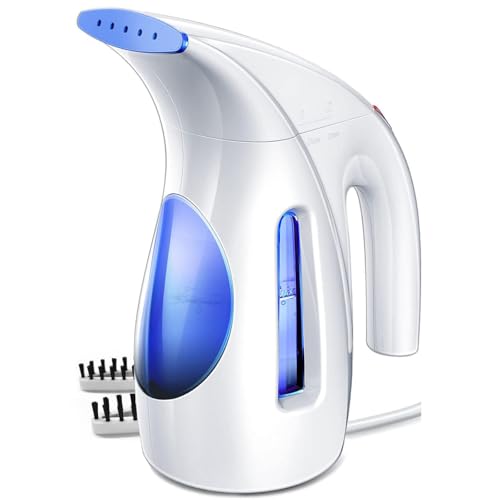
Cheapest steamer on this page
HiLIFE 700W Handheld Steamer (HL7)
A plain steamer with a brush on the head and a 240 ml tank, and no plate. The listing says it heats in about 2 minutes and steams for up to 15 minutes per fill. It suits a blouse or a dress before you head out. It will not press anything.
See the HiLIFE on AmazonThe drawback: it is a 120V-only steamer. The listing warns that plugging it into a 220-240V outlet will damage it, so it is not one to take abroad.
Thick cotton and linen
Steam alone leaves linen soft and a little rumpled. Flat linen takes heat and pressure, and Panasonic lists it at the high setting, with steam. A 2-in-1 covers both jobs.
 Linen and heavy cotton need heat and pressure, not steam alone.
As an Amazon Associate we earn from qualifying purchases.

Steam and iron in one
Rowenta Pure Force 2-in-1 Steamer and Iron (DR8822U1)
Rowenta's page says it moves from “horizontal ironing to vertical steaming.” It has a large soleplate, a 7.1 oz tank and an 8.5-foot cord, and weighs about 3 pounds. The manual says it is ready in roughly 15 to 25 seconds and is designed for plain tap water. Rowenta says not to use pure distilled water.
See the Rowenta on AmazonThe drawback: it does not replace the ironing board. For horizontal use, Rowenta's manual says to move it back and forth on the iron board.
Travel
A handheld steamer packs better than an iron and needs no board. The thing to check is voltage. The Conair and the HiLIFE are made for 110-120V outlets, and neither listing mentions dual voltage. If you travel abroad, you want a dual-voltage model, and we compared those in our guide to handheld garment steamers.
No tool with you at all? Our guide to getting wrinkles out without an iron covers the shower trick, the dryer and a homemade wrinkle-release spray.
Can a Steamer Replace an Iron?
For a lot of people, yes. If your week is T-shirts, knit tops, dresses and the odd shirt that only needs to look tidy, a steamer covers it. It stops being true the moment you want a crease. Steam relaxes fabric. It does not press it. Our handheld steamer comparison says the same thing: a handheld will relax a wrinkle, but it will not press a crease.
Steamers get closer to an iron in steps:
- A plain handheld, like the HiLIFE, only steams.
- A handheld with a pressing plate, like the Conair. Conair's GS59X page says the plate “doubles as an iron,” and its content on the GS59L Amazon listing promises a heated soleplate that presses creases. Those are Conair's claims, not our test results.
- A 2-in-1, like the Rowenta Pure Force, which irons on a board and steams on the hanger.
- A standing steamer, like the SALAV X3A in our table, holds far more water, which helps with a weekly rack of shirts. It still will not set a crease.
 Collars and cuffs are where a steamer with a plate earns its place.
As an Amazon Associate we earn from qualifying purchases.
Our pick if you want one tool
Conair Turbo ExtremeSteam Handheld Steamer (GS59L)
It runs at 1875 watts with five steam settings. The plate is the reason it leads this page: you can steam a shirt, then press the collar and cuffs. It suits someone who irons a few shirts a week and steams everything else.
See the Conair on AmazonThe drawback: a tank lasts up to 20 minutes, so a big pile means stopping to refill. It is also made for North American 120V outlets, with no dual voltage mentioned.
When the Iron Still Wins
Some jobs only an iron does well:
- Creases down trousers and pleats in skirts.
- Cotton dress shirts you want crisp from collar to cuff.
- Linen napkins, tablecloths and pillowcases.
- Sewing: pressing seams open and turning up hems.
For a big basket every week, look at a steam generator iron, which pairs the plate with a separate, larger water tank. For a few shirts and trousers, a basic steam iron does the job.
 The iron for creases, the steamer for everything else.
As an Amazon Associate we earn from qualifying purchases.

When you need a crease
BLACK+DECKER Easy Steam Compact Iron (IR40V)
A small, light 1,200-watt steam iron with a spray mist, a steam burst and a 3-way auto shutoff. We could not find a Black+Decker page for this exact model, so these facts come from the Amazon listing. Being compact, it suits shirts and trousers better than a king-size sheet.
See the Black+Decker on AmazonThe drawback: the listing cannot decide what the soleplate is made of. The title says nonstick; the material field says stainless steel. Check the photos if that matters to you.
Iron or Steamer, Fabric by Fabric
Start with the care label. The FTC's Care Labeling Rule requires care instructions on clothing, and the iron symbol shows the most heat a garment can take. On the standard chart, high is about 200 C (390 F), medium 150 C (300 F) and low 110 C (230 F). A crossed-out iron means no ironing.
The middle column is what Panasonic's ironing chart says. The last column is our call.
| Fabric | Ironing, per Panasonic | Our call |
|---|---|---|
| Cotton | High heat, with steam if possible | Iron for crisp; steamer for a quick tidy |
| Linen | High heat with steam | Iron or a 2-in-1 |
| Polyester | Low to medium, on the reverse side | Steamer |
| Rayon (viscose) | Low to medium, on the reverse side | Steamer, or iron inside out on low |
| Silk | Low, on the reverse side. Panasonic warns steam can mark it | Follow the label and test a hidden seam first |
| Wool | Medium, with a pressing cloth | Steamer, or iron through a cloth |
| Nylon and acetate | Low, without steam; they can melt | Follow the label before using either tool |
Not sure what something is made of? Panasonic suggests testing the iron on a small, hidden area first.
Compare the Picks
Each button opens the Amazon listing, where you can check the current price.
As an Amazon Associate we earn from qualifying purchases.
| Pick | Why it is here | Amazon |
|---|---|---|
|
Conair Turbo ExtremeSteam Our pick for one tool |
Steamer with a pressing plate for collars and cuffs. 120V, no dual voltage mentioned | See it |
|
HiLIFE 700W Cheapest steamer |
Plain handheld steamer. 120V only | See it |
|
Rowenta Pure Force 2-in-1 Steam and iron in one |
Adds an ironing mode, but still needs a board | See it |
|
SALAV X3A standing steamer Premium: a rack of shirts every week |
3-liter tank per SALAV's X3 page, which also lists 1.8 liters. We could not find a manual | See it |
|
BLACK+DECKER Easy Steam IR40V When you need a crease |
Small, light steam iron. Listing unclear on the soleplate | See it |
Questions People Ask
Do you need an ironing board to use a steamer?
No. A handheld or standing steamer works on a garment on a hanger. The exception is a 2-in-1: Rowenta's manual says to use the Pure Force on the iron board when you iron flat. The Conair's listing says its plate handles collars and cuffs without a board.
Which is more likely to damage clothes, an iron or a steamer?
The iron carries more risk of shine and scorching, because its hot plate sits on the fabric. Panasonic warns that nylon and acetate can melt. With a steamer, the risks are marks on silk and burns to you. Rowenta's manual says never steam a garment while someone is wearing it.
Which uses more electricity, an iron or a steamer?
Of our picks, the Conair steamer draws more power (1,875 watts) than the Black+Decker iron (1,200 watts), so the minutes you run each one matter more than the tool. At full power, 20 minutes of ironing would use about 0.4 kWh and 10 minutes of steaming about 0.31 kWh. Those are example times, not a like-for-like test.
How hot does a steam iron get?
On the care-label symbol chart, the high setting tops out around 200 C (390 F), medium around 150 C (300 F) and low around 110 C (230 F). These are the label limits, not readings from any iron on this page. Panasonic's chart puts cotton and linen on high and silk on low.
Does steaming clean clothes?
It freshens them, but it is not washing. We cover what steam can and cannot do for odors and germs in our steamer guide.
How We Chose
We did not test these tools. On October 27, 2026 we started from Amazon's most popular steamer and iron listings, then read the makers' pages and manuals where we could find them.
We led with the Conair rather than the cheaper HiLIFE because it has a pressing plate, and on a page about replacing an iron that plate is the point. The HiLIFE stays as the budget pick. Conair's product page covers the GS59X, a sister model of the GS59L we link, and SALAV's page covers the X3, not the X3A. We found no manual for the SALAV or for this exact Black+Decker model. We left out two other popular models whose specs we could not confirm. No brand saw this page before it went up.
Sources (opened October 27, 2026). Product facts come from each Amazon listing on the same date.
- FTC: Care Labeling of Textile Wearing Apparel (16 CFR Part 423)
- University of Tennessee Extension: Care symbols chart
- Panasonic: Fabric ironing chart and recommendations
- Philips: steam iron user manual
- Conair: Turbo ExtremeSteam product page
- Rowenta: Pure Force 2-in-1 Steamer & Iron
- Rowenta: DR88 steamer instructions (PDF)
- SALAV: X3 full-size garment steamer
Conair, HiLIFE, Rowenta, SALAV, BLACK+DECKER, Panasonic and Philips are trademarks of their owners and are named here only to identify their products. Listings change; check the listing before you buy.
