

You can buy a rice cooker described as PFOA-free, BPA-free and healthy, and still have no idea what the bowl your rice sits in is actually made of. None of those phrases answers that question.
There is a document that does, and the manufacturers write it themselves. This guide reads it for five brands and tells you which cooker we would buy.
Written by Lara Yehia. Lara researches home and kitchen products for Cupindy.
How we researched this: we read the chemical disclosures these manufacturers publish under California AB 1200 and Colorado HB 22-1345, and we checked the stated food-contact material of every cooker named here. We did not lab-test anything. We did not measure any chemical ourselves, and we say so again further down where it matters.
Published September 2026. Last reviewed September 2026.
The short version
- Nearly every rice cooker pot is coated. Usually a fluoropolymer, sometimes a ceramic-style layer. Bare metal is rare.
- “PFOA-free” tells you nothing useful. PFOA left manufacturing years ago. It is true of almost every non-stick pan sold and says nothing about what is on your pot today.
- “Stainless steel” in a product title usually means the basket, the lid or the housing. Not the pot.
- One cooker we checked has nothing on its pot at all. Aroma’s Select Stainless, and its own chemical filing backs that up. It is also the cheapest machine here.
- Nobody has measured the thing everyone argues about. We could find no published test of what a coated rice cooker pot releases at cooking temperatures. We think that is worth saying out loud.
Nothing on the pot
Aroma Select Stainless
Bare 304 stainless. The only uncoated pot here, and the cheapest machine.
Check on AmazonBetter rice, coated
Toshiba 6-cup
Fuzzy logic, seven functions. Coated, and Toshiba says so on the box.
Check on AmazonOne or two people
Toshiba Mini
Three cups, small footprint. Also coated, and it wears faster.
Check on AmazonEach one is written up properly below, drawback first. We would rather you read the drawback than the headline.
What is actually in the pot
Nearly every rice cooker sold in the United States has an aluminium inner pot with a coating on it. Usually that coating is a fluoropolymer. PTFE is the common one, and PFA and FEP are close relatives. More recently a ceramic-style coating has appeared, sold as the alternative, and we go through how those compare across the whole category in our non-toxic cookware guide.
A small number of cookers use an inner pot of bare stainless steel with nothing applied to it. That is the whole distinction. Everything else in this category is a question of which coating.

The marketing language is built to blur the difference. “PFOA-free” is true of essentially every non-stick pan sold today, because PFOA left manufacturing years ago, and it says nothing about whether PTFE is on the pot now. “Ceramic” is not a regulated term, and it does not mean uncoated. It means a different coating.
And a cooker with “stainless steel” in its title very often has a stainless exterior, a stainless steamer basket or a stainless lid wrapped around a coated aluminium pot.

So the question is never “is this non-toxic.” It is: what is the inner pot made of, and is anything on it?
What the makers put in writing
Under California’s AB 1200, a cookware manufacturer selling into the state has to publish the intentionally added chemicals in its products on its own website. Colorado’s HB 22-1345 asks for something similar on PFAS, plus a reason why it was added. These are documents the companies write about themselves, and they are far more specific than the copy on the box. Here is what four of them say.
Zojirushi
Zojirushi sorts its rice cookers into three groups, and the detail matters because the groups list different chemicals.
PTFE and PFA
NW-JEC10/18
PFA
NP-NWC10/18, NP-HCC10/18, NW-QAC10/18, NP-GBC05, NS-ZCC10/18
PTFE
Sixteen entries, including the NS-TSC, NL-GAC, NL-DCC, NL-EAC, NS-WAC and NS-RPC lines
The document’s own opening line says these chemicals “are used on cooking surfaces to make the surface nonstick.” So PTFE, not PFA, is the coating on most of the range.
Separately, Zojirushi’s customer FAQ says: “Yes, all of our rice cookers’ nonstick coated cooking pans are PFOA-free.” That looks like a contradiction and is not one. PFOA was a processing aid used to make fluoropolymers. PTFE and PFA are the fluoropolymers themselves. A pan can be completely free of PFOA while being coated in PTFE, and that is what Zojirushi is describing. Both statements are true. The FAQ simply answers a narrower question than most people think it does.
Zojirushi has also released a line that goes further. The NS-TPC10 and NS-TPC18 are sold with the statement that “All surfaces that come into contact with food or beverages are free of PFAS (including PTFE and PFOA) as well as BPA.” Those model numbers do not appear in the disclosure above, which is consistent with that claim. It is still a coating, just not a fluoropolymer one.
Tiger
Tiger’s regulatory page, filed against Colorado’s requirement, says PFAS chemicals were added to “provide non-stick properties to the inner pot.” It covers rice cooker models including the JAX-T18U, JKT-D18U and JNP-S18U.
This is the most direct of the four. Tiger names the chemical class, names the part it sits on, and says why it is there. We would rather read that than a paragraph about wellness.
Cuckoo
Cuckoo’s page is the one that surprised us. Across the whole document, the words PTFE, PFA, FEP and PFAS do not appear once.
What it does list, against a group of twelve induction-heating models, is lead and organic tin compounds, alongside aluminium, nickel, copper, manganese, iron and zinc. A separate basic model lists manganese only.
We would not read that as “Cuckoo is the clean one.” Finding lead in a disclosure is not a reassuring result, and AB 1200 covers chemicals in a product’s materials, which can include parts you will never touch. But on the narrow question of fluoropolymer coatings, Cuckoo is silent where the others are explicit.
Cosori
Cosori’s disclosure, linked from its own site and dated 17 August 2026, lists the CRC-R501-KUS rice cooker in two places under different SKU codes, and the two entries do not match. One lists iron, chromium, nickel, manganese, phosphorus and carbon black. The other lists those six plus Polytetrafluoroethylene. A separate per-model sheet distributed with the product states: “This product contains Chromium,Total/PTFE.”
We are not going to tell you what the discrepancy means, because we do not know. It could be a manufacturing change between SKU generations, or a documentation artefact. What we can say is that PTFE appears against this cooker in Cosori’s own paperwork, in two separate documents. Worth knowing if you chose it because the product title says “ceramic coating, BPA, PFOA & PFOS-free.” That phrase is accurate. It is also not a statement about PTFE.
None of this means any company has done anything wrong. Publishing the disclosure is the company following the law, and a filing that names a fluoropolymer is a manufacturer telling you what is in its product. That is the outcome the law was written to produce. We read these documents because they are more precise than marketing copy.
So what would we buy
Three cookers, sorted by what you actually want. Start with the one that matches you and stop reading.
If you want nothing on the pot
Aroma publishes the most granular disclosure of any brand here, a separate chemical table for each of roughly a hundred models. Polytetrafluoroethylene is named on seventeen of them, and a generic PFAS entry appears on many more. So this is not a company that avoids the subject.
Which makes what follows more interesting. The Select Stainless models, ARC-753SG, ARC-753SGB, ARC-753SGR and ARC-753-1SG, each list exactly four substances: chromium compounds, iron, manganese and nickel. No fluoropolymer. No PFAS entry of any kind. That is what a disclosure for a bare metal pot looks like, and it is the reason this is our pick.
For contrast, Aroma’s own ceramic-coated ARC-763C lists thirteen substances, including aluminium, copper, carbon black, titanium dioxide and crystalline silica. It lists no fluoropolymer either, so its PFAS-free positioning holds up. But “no fluoropolymer” and “nothing on the pot” are different statements, and the two tables side by side show it plainly.
Our pick, and the cheapest here

Aroma calls the pot food-grade 304 stainless, the Amazon listing calls it coating-free, and the filing lists four metals and no fluoropolymer. The marketing and the paperwork agree, which is rarer in this category than it ought to be. It is also the least expensive machine in this guide, which is worth saying plainly: here, the pot without the coating costs less than the pots with one.
The honest trade: rice sticks to bare stainless. You will get a crust on the bottom on most cooks and you will be soaking the pot. If you want rice that lifts out cleanly every time, this is the wrong machine and you should buy a coated one knowing that you did. It is also much simpler than the Toshibas, one-touch with no fuzzy logic, so brown rice and mixed grains need more attention from you. One oddity: the listing bullets call the pot dishwasher-safe while the specification says hand wash, so treat that as unsettled and wash it by hand.
Check price on Amazon
If you want better rice and you will take a coating
Before the recommendation, the gap in it. We could not find a model-level chemical disclosure for either Toshiba below. Toshiba’s US home appliances are operated by Midea America, and Midea does publish an AB 1200 page whose rice cooker section lists tetrafluoroethylene on the inner pot, along with carbon black and a silicone compound. The Toshiba model numbers do not appear on it, and we found no Toshiba page of its own.
We are not suggesting anybody failed to do anything. We are telling you what we could and could not find, because you would not have found it either. What is not in doubt is the coating: Toshiba states it plainly in its own product listings, which is more than several brands selling on a non-toxic message manage.
The step up

Fuzzy logic adjusts the cook based on what is happening inside the pot, and it handles brown rice, multi-grain and porridge far better than a one-touch machine. Seven functions, a fifteen-hour keep-warm, two delay timers. If rice quality is what you are optimising for, this is the one.
The honest trade: the inner pot is coated, and it is in the product title. We are not filing this under non-toxic and hoping you skip that line. It is here because it cooks better, and because a brand that puts the coating in its own title is easier to trust than one that leaves you to work it out from a photograph.
Check price on AmazonIf you cook for one or two
A 6-cup machine will have you making more rice than you want, in a pot too large to cook a single portion well. The same disclosure gap applies here as above.
Small kitchens
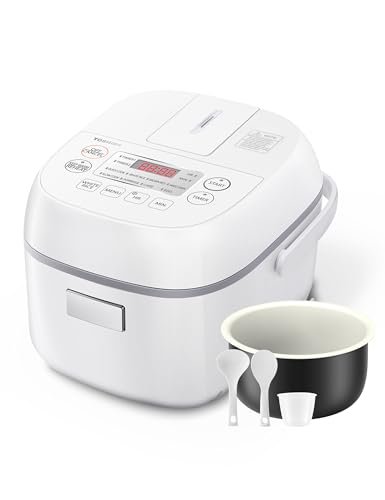
Three cups uncooked, fuzzy logic, a 24-hour delay timer, and a footprint that fits a small counter. Eight functions, including slow cook and porridge, so it does more than its size suggests.
The honest trade: coated again, and Toshiba’s listing adds that it should be washed by hand with a soft cloth rather than in a dishwasher. A small pot also concentrates wear. You are scraping the same modest surface every day instead of spreading it across a larger one, so expect the coating to age faster than on a full-size machine.
Check price on AmazonWhere the evidence runs out
Here is the part most articles in this category leave out.
We could not find a published study measuring how much, if any, fluoropolymer material comes off a rice cooker inner pot at the temperatures a rice cooker actually reaches. Research exists on non-stick coatings breaking down under high dry heat, mostly on frying pans well above rice-cooking temperatures, and research exists on coating wear. Neither answers this question.

That gap cuts both ways and we are not going to pretend otherwise. Nobody can honestly tell you a coated rice cooker is exposing you to a measured dose of anything. Nobody can tell you it is not, either. Rice cookers hold food hot for hours, pots get scratched by paddles and washing, and no published work we found measures what either of those does.
So the case for an uncoated pot is not that coated pots have been shown to be harmful at these temperatures. It is that an uncoated pot removes a variable nobody has measured, for less money. If that reasoning does not move you, a coated cooker from a brand that discloses clearly is a perfectly defensible choice, and the sections above say which ones do.
Checking a cooker we have not covered

The filings are public and the check takes about two minutes.
- Search the brand name plus “AB 1200” and open the manufacturer’s own page. Look for your exact model number, not the product line. As the Cosori entries show, two SKUs of one cooker can carry different lists.
- Look for PTFE, PFA, FEP or PFAS by name. A table listing only metals is a different finding from one naming a fluoropolymer.
- Check who actually makes it. Toshiba’s US appliances are operated by Midea, so searching the brand on the box can miss the filing entirely.
- Read the product title for where the stainless steel really is. Steamer basket, housing and lid are not the pot.
- Treat a single blanket sentence as no answer. Instant Brands, for one, covers its whole catalogue by saying its products contain a list of metals “and/or PFAS (including PTFE, PFA, and FEP).” That cannot tell you about your model, and its vagueness is not a clean result.
The same trail works for other countertop appliances. We used it on the slow cooker category, where it turned up two widely recommended models whose food-contact material is not what the product name suggests.
Questions people ask
Is a scratched non-stick rice cooker pot dangerous?
We could not find a published measurement that answers this at rice cooker temperatures. What we can say is that a damaged coating has stopped doing the job you paid for, and manufacturers themselves tell you to replace a pot once the coating is compromised. Inner pots are sold separately for most major brands.
Does a stainless pot make the rice worse?
It makes it stickier at the bottom, not worse in flavour. In much of the world the crust at the bottom is the point rather than a fault. But you will be soaking the pot, and that is a real daily cost.
Is ceramic safer than PTFE?
It is a different coating, and it sits outside the fluoropolymer disclosures, which usually means less public information rather than more. Aroma’s ceramic model lists thirteen substances including titanium dioxide and crystalline silica, and no fluoropolymer. We would not treat ceramic as an automatic upgrade, and we would not treat it as uncoated. The same reasoning applies across pans and pots, which we work through in the non-toxic cookware guide.
What does PFOA-free actually mean on a rice cooker box?
Less than it sounds. PFOA was a processing aid, not the coating itself, and it left manufacturing years ago, so the claim is true of almost every non-stick product on sale. It tells you nothing about whether PTFE or PFA is on your pot today. We unpack the wording in full in what PFOA-free really means.
Do these filings mean a company did something wrong?
No. Publishing the disclosure is the company following the law. A filing naming a fluoropolymer is a manufacturer telling you what is in its product, which is exactly what the law was written to produce. We read these documents because they are more precise than marketing copy, not because they are accusations.
Editorial note
This guide reports what manufacturers publish in their own regulatory filings, and what the food-contact surface of each cooker is made from. It is not a laboratory test. It is not a verdict on whether any brand has complied with any law, and nothing here should be read as saying a company has broken one.
Freshness: disclosures are revised as product lines change. The filings here were read in September 2026, and the Cosori document carried an update date of 17 August 2026. If you are reading this later, open the sources below for the current version before relying on any model number.
Sources reviewed
- Zojirushi, California AB1200 Chemical Disclosures. zojirushi.com
- Zojirushi customer FAQ, nonstick cooking pan and PFOA. zojirushiamerica5787.zendesk.com
- Zojirushi, Micom Rice Cooker and Warmer NS-TPC10/18. store.zojirushi.com
- Tiger Corporation, Regulatory Information. tiger-corporation.com
- CUCKOO America, California AB1200 Regulation Information. cuckooamerica.com
- Aroma Housewares, AB1200 Regulation Information Disclosure. aromaco.com
- Aroma Housewares, Select Stainless Rice and Grain Cooker. aromaco.com
- COSORI, California AB 1200 and State Cookware Disclosures. cosori.com
- COSORI, AB 1200 chemical disclosure list, updated 17 August 2026. cdn.shopify.com
- Midea America, Disclosure on AB-1200. midea.com
- Instant Brands, Cookware Chemical Disclosures. instantpot.com
- California Department of Toxic Substances Control, Chemical Disclosures for Cookware. dtsc.ca.gov


