
By Rawia Younis · Last reviewed November 2026
The dishwasher safe symbol is a small square with plates or a glass inside it and water drops or lines falling on them. If the water covers the whole square, the item can usually go on either rack. If it only reaches the top of the dishes, or the words "top rack" are printed with it, keep it on the top rack.
The same picture crossed out, or a hand dipped in a bowl of water, means wash it by hand. There is no single official design, so each maker draws its own version. If you're choosing the machine itself, our guide to what to look for when buying a dishwasher covers the racks and wash cycles these symbols refer to.
As an Amazon Associate we earn from qualifying purchases.
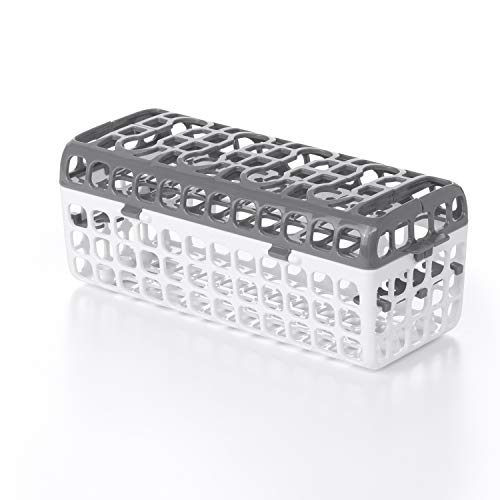
For the small top-rack pieces
Lids, straws and bottle parts are the top-rack items most likely to tip over or slip through the rack and end up near the heater at the bottom. A small dishwasher basket keeps them together up top. The one we'd point you to is OXO's: OXO sells it for baby-bottle parts, and the same closed basket can hold other small top-rack pieces.
See the OXO dishwasher basket on AmazonDishwasher safe symbol chart: what each symbol means
These are the marks you're most likely to find on the base of a cup, plate, bowl or food container. We drew them ourselves from the designs makers use most, so you can hold your dish up against them. Yours may look a little different. What matters is the water, the dishes and any words printed with them.

The eight marks you'll see most often. The table adds a ninth, Bosch's dishwasher-proof mark. The top row and the first two in the bottom row all say the item can go in the dishwasher. The red ones say it can't.
| Symbol | What it means | What to do |
|---|---|---|
 |
Dishwasher safe. Water drawn above and below the dishes is usually read as any rack. | Either rack. Plastic still does better on top. |
 |
Dishwasher safe. The most common version on plates and bowls. | Drops stop above the plates, so top rack is safest unless the maker says any rack. |
 |
Dishwasher safe. Maytag lists a plate next to a large drop as the same claim. | Same as above. |
 |
The glass can go in the dishwasher. | Top rack. Thin glass on a glass or low-heat cycle. |
 |
The same promise in words. Common on plastic and on boxes. | Read the whole line. "Top rack" changes it. |
 |
Dishwasher safe on the top rack only. | Top rack, every time. |
 |
Wash it by hand. | Sink, warm soapy water. |
 |
Not dishwasher safe. | Hand wash only. |
 |
"Dishwasher proof." Bosch says the number is how many cycles the item can take. | Machine wash. A higher number means a tougher item. |
No mark at all doesn't mean the item will break. It means nobody has promised you it won't. That case has its own section below.
Top rack dishwasher safe: what the water lines tell you
Finish, the detergent maker, reads the drawing like this: if the drops or lines cover the whole square, the item is probably fine on either rack. If they only reach the tops of the plates or glasses, it belongs on the top rack. The heating element sits at the bottom of most machines, so the top rack runs cooler.
Whirlpool and Maytag explain it a little differently. On their pages, the top-rack symbol comes with the words "top rack" printed on it, and the point of the top rack is to keep heat-sensitive things away from the heated dry element. CHOICE, the Australian consumer group, adds the second half: the bottom rack gets hotter water and a harder spray, and that combination is what wears a top-rack item down fast.
Where the sources don't agree
Finish judges the rack from where the water is drawn. On Whirlpool's and Maytag's pages, the top-rack symbol comes with the words printed on it. In practice:
- If there are words, follow the words.
- If there are no words and the water only touches the tops of the dishes, treat it as top rack. It's the safer choice.
- Plastic goes on top whatever the drawing shows. Finish and GE both put dishwasher-safe plastics on the top rack.

Plastic containers and lids go on the top rack, as far as they can be from the heater at the bottom.
How hot does it get down there? Bosch lists its own programs at 40°C (104°F) for the glass cycle, 50°C (122°F) for Eco and 70°C (158°F) for Intensive, with the hygiene option holding up to 70°C (158°F) in the final rinse. Miele suggests 45°C (113°F) for delicate glassware. Your machine will differ, but those numbers show why a soft plastic lid that's fine in hot tap water can warp on a heavy cycle.
Some symbols carry a temperature too. Finish notes that a number on the symbol is the highest setting the item is meant for. If you see one, check it against your cycle before you choose Intensive or a sanitize rinse.
The other way top-rack items end up on the bottom is that they fall there. Straws, small lids and chopsticks slip through the gaps mid-wash. GE suggests the open pockets of the silverware basket for small things like lids and measuring spoons. A basket that hooks onto the top rack does the same job one level up.
As an Amazon Associate we earn from qualifying purchases.

Viscogrip stainless steel chopstick basket, set of 2
Why it fits: two small 304 stainless steel baskets with hooks, made to hang on a rack and hold chopsticks, straws, forks and spoons. Being steel, it won't warp the way a plastic caddy can.
The drawback: it's a newer listing with fewer ratings than the big-name baskets. It's open, so the tiniest pieces can slip through the gaps. Bottle parts are what the OXO basket above is sold for.
Check it on AmazonHand wash only symbol and the crossed-out dishwasher icon
Both mean the same thing: keep it out of the machine. CHOICE describes the two you'll see. One is the dishwasher symbol with a line through it. The other is a hand in a tub of water, which on cutlery and crockery means wash by hand. Some makers skip the picture and print "hand wash only" or "not dishwasher safe".
The things that usually carry these marks are the same across the maker guides we read:
- Wood: spoons, boards and anything with a wooden handle. Miele lists wooden-handled cutlery and wooden boards, and Maytag says wood can discolor.
- Hand-painted china and lead crystal: Maytag lists hand-painted china, and CHOICE lists both.
- Cast iron: on Maytag's list. The wash strips the seasoning.
- Copper, tin and silver: Miele lists copper and tin. Maytag says silver can tarnish.
- Non-stick pans and knives: CHOICE lists non-stick pans, Maytag lists knives and warns non-stick coatings can wear off.
- Thin or soft plastic: Maytag lists thin plastic, and Miele rules out plastic that isn't heat resistant.

Painted plates and wooden spoons are the usual hand-wash-only pieces. Wash, rinse and dry them straight away.
For the full list, with the reason behind each item, see what never to put in the dishwasher.
Dishwasher safe logo, icon and sign: same mark, different names
Logo, icon, sign: whatever you call it, it's the same small picture. There is no official one. Bosch says there is no universal definition or symbol for "dishwasher safe", and Whirlpool, Maytag, Finish and CHOICE say the same. Each maker draws its own mark and runs its own tests.
The words aren't standard either. Bosch treats "dishwasher proof" as a separate, tougher mark: a water jet with a number showing how many wash cycles the item can take. Bosch notes these marks mostly appear on premium or professional-quality items. Other makers don't always draw that line. Miele's manuals just say "dishwasher safe". So read the picture, not just the name.
One more thing the mark doesn't promise: that the item lasts forever. Bosch says "dishwasher safe" doesn't rule out long-term damage such as discoloring. CHOICE puts it as wear that takes months or years rather than days or weeks.
Symbols that look similar but are not dishwasher ratings
The base of a container can carry four or five marks at once. These ones get mistaken for a dishwasher rating, and none of them is one.

Glass and fork
Safe to touch food. Says nothing about washing.

Wavy lines
Microwave safe. A separate promise.

Snowflake
Freezer safe.

Number in a triangle
The type of plastic, for recycling. Not a wash rating.
You may also see two temperatures side by side. Whirlpool explains that one as the lowest and highest temperature the piece can handle, which is about the freezer and the oven, not the dishwasher. If it's the wavy lines you're unsure about, our microwave-safe symbol guide covers every version.
Where to find the symbol on a cup, bowl or pan
Turn it over. On mugs, plates and bowls the mark is printed or stamped on the base, often next to the maker's name. Tilt it toward a window if it's pressed into the glaze; raised marks are easier to see in side light than straight on.

On plates and bowls the mark usually sits in the middle of the base, inside the unglazed ring.
On plastic containers it's molded into the underside, usually near the recycling triangle. Check the lid on its own. Lids are often thinner than the box and can carry a different mark, or none.
Pans, knives and travel mugs often don't carry a symbol on the item. The care line is on the box, the manual or the maker's website, so look there before the first wash.
No symbol? How to tell if it's dishwasher safe
Go in this order:
- Look for words. The box, the product listing or the maker's care page often says it even when the item doesn't.
- Go by the material. The table below covers the common ones.
- If it's plastic with no mark, hand wash it. A GE dishwasher manual says not to wash plastic unless it's marked dishwasher safe or the equivalent. Finish says the same.
- Still not sure? Hand wash. Miele's own advice for glassware is "when in doubt, wash by hand", and it holds for anything you'd hate to lose.
| Material | Without a mark |
|---|---|
| Plain glass, everyday ceramic | Usually fine. Glasses on top. Thin or old glass by hand. |
| Stainless steel | Usually fine. See stainless steel in the dishwasher for the exceptions. |
| Insulated bottles and tumblers | Depends on the brand. We checked Yeti, Stanley, Owala and Hydro Flask. |
| Plastic | Hand wash. Only marked plastic goes in, and on top. |
| Hand-painted china, crystal | Hand wash. |
| Wood, cast iron, copper | Hand wash. |
| Non-stick pans | Check the maker's care page. CHOICE lists non-stick pans as generally not dishwasher safe. |
What happens if a top-rack item goes on the bottom rack
Finish says it may come out discolored, warped or damaged by the end of the cycle. One wash won't always ruin it, but warping doesn't go back. A lid that bends even a little stops sealing, and a container that has gone cloudy or rough on the inside is worn.

A warped lid next to a flat one. Once a lid bends, it won't seal again.
If something has fallen onto the heating element and melted, switch the machine off and let it cool before you reach in. GE's manual warns against touching the element during or right after a cycle. Once it's cold, peel off what you can, and check your own manual for how to clean the element.
As an Amazon Associate we earn from qualifying purchases.
| Keeps small pieces up top | Best for | |
|---|---|---|
| OXO Tot dishwasher basket | Bottle parts and small lids | See it |
| Viscogrip steel chopstick basket | Chopsticks, straws, spoons | See it |
Questions people ask
What does the dishwasher safe symbol look like?
Usually a square with plates or a glass inside and water drops or slanted lines falling on them. Some makers use a single plate beside a large drop, or just print the words "dishwasher safe".
Is dishwasher safe the same as top rack safe?
No. Top rack safe is narrower: the item can be machine washed, but only on the top rack, away from the heater at the bottom. Plain dishwasher safe, with water drawn over the whole square, usually means either rack.
What is the symbol for not dishwasher safe?
The dishwasher symbol with a line or an X through it, or a hand dipped in a tub of water. Both mean wash it by hand.
What does the dishwasher safe symbol look like on plastic?
The same square with dishes and water, molded into the underside, often with "top rack" beside it. Plastic with no mark at all should be washed by hand.
How hot does a dishwasher get?
It depends on the cycle. Bosch lists 40°C (104°F) for its glass program, 50°C (122°F) for Eco and 70°C (158°F) for Intensive. The bottom rack, nearest the heater, gets the most of it.
What does a number inside the dishwasher symbol mean?
On Bosch's "dishwasher proof" mark, it's the number of wash cycles the item can take. A number with a degree sign is a temperature: the hottest setting the item is meant for.
Does the glass and fork symbol mean dishwasher safe?
No. It means the item is made to touch food. Look for a separate dishwasher mark.
Will a dishwasher safe item last forever?
No. Bosch says the label doesn't rule out long-term damage like discoloring, and CHOICE says wear still happens, just over months or years instead of weeks.
How we checked
On 9 November 2026 we read the symbol and loading guides from Bosch, Whirlpool, Maytag, GE Appliances and Finish, two Miele dishwasher manuals and a GE dishwasher manual, and CHOICE's guide to dishwasher symbols. We didn't run lab tests. We drew the symbols ourselves from the designs these sources describe, so no maker's artwork is shown. Product details come from the Amazon listings on the same date.
Written by Rawia Younis, who writes Cupindy's kitchen care guides.
Sources
- Bosch: Dishwasher symbols (read 9 Nov 2026)
- Whirlpool: Dishwasher safe and other tableware symbols (read 9 Nov 2026)
- Maytag: Decoding dishwasher safe and other tableware symbols (read 9 Nov 2026)
- Finish: What does dishwasher safe mean? (read 9 Nov 2026)
- GE Appliances: How to load a dishwasher (read 9 Nov 2026)
- GE GSD1380 dishwasher owner's manual (read 9 Nov 2026)
- Miele G 879 SCVi operating instructions: items not suitable for dishwashers (read 9 Nov 2026)
- Miele G 868 operating instructions: glassware (read 9 Nov 2026)
- CHOICE: Common dishwasher symbols explained (Ashley Iredale, 3 Apr 2024)
As an Amazon Associate we earn from qualifying purchases. Cupindy earns a commission if you buy through the Amazon links on this page, at no extra cost to you. No brand paid to be included.