
Written by Sara Ibrahim. Sara researches home and kitchen products for Cupindy.
Published November 2026 · Last reviewed October 31, 2026 · Cupindy is not affiliated with any brand on this page.
The short answer
Yes, you can put hot food in the fridge, and warm food too. USDA wants leftovers in there within 2 hours of cooking, or 1 hour if it is above 90°F (32°C). The catch is size. Split a big batch into shallow containers first, about 2 inches (5 cm) deep for thick food like chili or stew. What you should not do is slide a deep, full pot onto the shelf and walk away.
As an Amazon Associate we earn from qualifying purchases.

Our quick pick for leftovers
Anchor Hocking 2-Cup Glass Storage Containers, set of 4
Small glass dishes with snug lids, sized for next-day portions of soup, rice or stew. Amazon lists each dish at about 2.4 inches (6 cm) tall, so a full one sits close to the 2-inch rule without any measuring.
See the Anchor Hocking set on AmazonThe drawback: each holds only 2 cups, so one pot of soup fills several. Anchor Hocking also warns against sudden temperature changes with its glass. Our advice: wait until the food stops steaming before you pour it in.
Most of us were taught to let food cool on the stove before it went in the fridge. The chili sat there all evening and the fridge door stayed shut until the pot stopped steaming. Ben Chapman, a food safety professor at NC State, calls that a myth. He told the Center for Science in the Public Interest that the idea comes from old refrigerators, pre-1970s ones, which cycled on and off and could be overworked by hot food. A modern fridge holds a steady temperature and copes.
What goes wrong now is time and depth. Food left out too long gives bacteria their hours. So does food that goes in on time but in a container so deep the middle stays warm overnight. A fridge running above 40°F (4°C) makes both worse, so if you have never put a thermometer in yours, check what it actually reads.
Hot food in the fridge: what goes straight in
| Food | Straight in? | The rule |
|---|---|---|
| Thick stew, chili, curry | Yes, once split | Shallow containers, food about 2 in (5 cm) deep |
| Soup, broth | Yes, once split | Up to about 3 in (7.5 cm) deep; a big pot goes in an ice bath first |
| Rice | Yes, quickly | Chill within about an hour, eat within a day |
| Chicken, ham, roasts | Yes, cut up | Cut into smaller pieces before chilling |
| Whole roast turkey | Not whole | Slice the breast meat; legs and wings can stay whole |
| Casserole, mashed potatoes | Yes, in a shallow dish | Food about 2 in (5 cm) deep |
| A full, deep pot of anything | No | Split it, or chill the pot in ice water first |
The rice row comes from Food Standards Scotland. The rest follows USDA and NC State Extension, explained below.
Is it safe to put hot food in the fridge? The 2-hour rule
It is, and sooner is safer. FDA says hot food will not harm your refrigerator (FDA). USDA sets the limit: get leftovers into the fridge within 2 hours of cooking, or within 2 hours of taking them off an appliance that was keeping them warm. Above 90°F (32°C) the limit drops to 1 hour. Think of a summer cookout outside.
Behind that limit is the range USDA calls the danger zone, 40 to 140°F (4 to 60°C). Bacteria grow fast in it. Perishable food that has sat at room temperature for more than 2 hours should go in the bin, not the fridge (USDA FSIS).
The fridge itself needs to be at 40°F (4°C) or colder. FDA also says not to overpack it, because cold air has to move around the food. That is worth remembering after a holiday meal, when every shelf fills at once.
The 2-inch rule: how deep is too deep

USDA and FDA both say "shallow containers" and leave it there. The numbers come from NC State Extension, which tells cooks to keep thick food like gravy, chili, stew and mashed potatoes to about 2 inches (5 cm) in a shallow pan, and thinner soups to about 3 inches (7.5 cm). Those figures are written for food-service kitchens. The same depth limits are a sensible target at home.
Depth matters because heat leaves food from the outside in. A deep pot cools at the edges while its center stays warm. Chapman's example in the CSPI interview is a deep pot of chili that can still be 50 or 60°F (10 to 16°C) in the middle days later. That center has spent its whole time in the fridge inside the danger zone.
Ladle the pot into two or three wide containers, or spread food on a rimmed baking sheet until it stops steaming, then pack it away. Cut big pieces of meat down as well; NC State suggests pieces no more than 2 inches thick.
A big pot of soup or chili: use an ice bath
USDA gives two options for hot food: put it straight in the fridge, or chill it first in an ice or cold-water bath. For a large pot, the bath is the faster route. NC State Extension's method:
- Fill the sink, or a pan bigger than your pot, with about half ice and half cold water.
- Set the pot or pan of hot food in it.
- Once the food is down to about 70°F (21°C), cover it and move it to the fridge to finish cooling.

NC State is stricter than USDA on one point. It says never to use the fridge to cool large quantities of hot food, while USDA and FDA say hot food can go in. If you split the batch or bath the pot first, you are following both.
Lid on or off while it cools?
Off, or close to it. Chapman's advice, in his CSPI interview and in a piece for The Kitchn, is to leave food uncovered, or the lid open at one corner, while it is still steaming, because a closed lid traps heat. Seal it once it has cooled. This is his advice, not a USDA rule.
Glass or metal for the hot stage?

Glass is what most of us store leftovers in, and Anchor Hocking's care page warns against sudden or severe temperature changes and against setting hot glass on a cold or wet surface. It does not say anything about hot food going into the fridge, so here is what we do: keep the hot stage in the pot, a metal pan or a sheet pan, in an ice bath if it is big, and move the food into glass once it has stopped steaming.
For the fridge, the material barely matters. Chapman told The Kitchn that glass or plastic makes no real difference to cooling. It matters in the freezer, where glass needs to be rated for freezing and the container needs room at the top, because water expands as it freezes.
Check that it worked
Check two things. The first is your fridge: 40°F (4°C) or colder, measured with a thermometer rather than guessed from the dial. Our fridge thermometer guide covers where to put one and which to buy.
The second comes later. USDA says leftovers keep 3 to 4 days in the fridge and 3 to 4 months in the freezer. When you reheat, bring them to 165°F (74°C) measured with a food thermometer, and bring soups, sauces and gravy to a rolling boil. Our reheating guide has times by food.

The products on this page
| Product | What it is for | The drawback | |
|---|---|---|---|
| Anchor Hocking 2-Cup Glass, set of 4 | Shallow next-day portions | Small; no sudden temperature changes | See on Amazon |
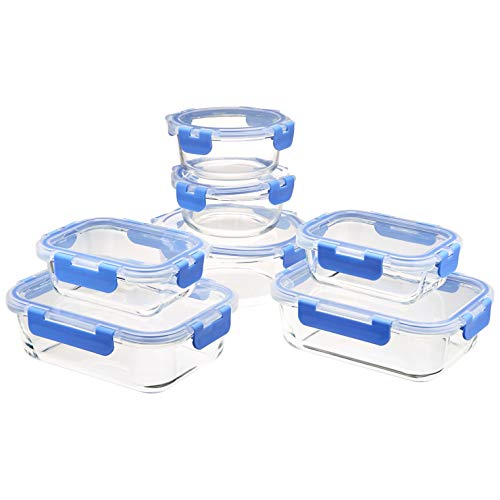
| Amazon Basics Glass, 7 containers | Splitting a full batch | Lids best washed by hand | See on Amazon |
| Alpha Grillers Instant Read Thermometer | Checking reheated food reaches 165°F (74°C) | Coin-cell battery, hand wash only | See on Amazon |
Questions people ask
How long should you let food cool before putting it in the fridge?
There is no need to wait. Split it into shallow containers and get it in within 2 hours of cooking, or 1 hour above 90°F (32°C).
Is it bad to put hot food in the fridge?
No. A modern fridge holds a steady temperature and will not be damaged by hot food, according to FDA and Chapman. The problem with a huge pot is its center, which stays warm for hours, so split it or use an ice bath.
Is it safe to eat food that was left out overnight?
No. USDA says to throw out perishable food left at room temperature for more than 2 hours. Reheating does not rescue it either: as the CSPI article explains, some bacteria leave toxins and spores that heat does not destroy.
Can you put hot rice in the fridge?
It should go in fast. Food Standards Scotland says to chill cooked rice ideally within an hour, keep it in the fridge for no more than a day and reheat it only once, until steaming hot.
Can you put hot chicken or turkey in the fridge?
Cut it into smaller pieces first. USDA says to slice turkey breast meat, while legs and wings can stay whole.
Can you put hot food in the freezer?
Split it into small containers first, as for the fridge. Use freezer-rated glass or plastic and leave space at the top, because food expands as it freezes.
Is warm food any different from hot food?
No. The same 2-hour rule and the same shallow containers apply.
How long do leftovers last in the fridge?
3 to 4 days, according to USDA. Freeze anything you will not eat by then.
How we checked
On 31 October 2026 we read the food-safety pages from FDA and USDA's Food Safety and Inspection Service, and NC State Extension's cooling guide. Expert comments come from Ben Chapman of NC State, interviewed by CSPI and by The Kitchn. Rice advice is from Food Standards Scotland, and the container rule from Anchor Hocking's care page. Product details come from the Amazon listings on the same date.
Sources
- FDA: Tips to chill food (content current as of 27 Sep 2018)
- USDA FSIS: Leftovers and food safety (updated 31 Jul 2020)
- NC State Extension: Cool hot foods (reviewed 4 Oct 2023)
- Food Standards Scotland: Rice
- CSPI: Can I put hot food in the fridge? and other food safety questions (updated 6 Aug 2025)
- The Kitchn: Is it safe to put hot food in the fridge?
- Anchor Hocking: Care and use


