
Written by Sara Ibrahim. Sara researches home and kitchen products for Cupindy.
Published November 2026 · Last reviewed October 31, 2026 · Cupindy is not affiliated with any brand on this page.
The short answer
For most home bakers, a plain wooden rolling pin with handles is the one to start with. It feels familiar, it does pie crust, cookies and pizza without fuss, and when King Arthur's tester rolled pie crust, sugar cookies and puff pastry with four styles of pin, a handled maple pin did well in all three. (King Arthur didn't test the HelferX.) Our pick is the HelferX wooden rolling pin, #1 in Amazon's Rolling Pins best-seller list when we checked on October 31, 2026.
As an Amazon Associate we earn from qualifying purchases.

Our quick pick
HelferX Wooden Rolling Pin, 17.6 inch
A classic handled pin with a 10-inch barrel and nylon bearings, so the barrel turns while your hands stay still. Light enough for everyday cookies and pie crust, at about 15.5 ounces (440 g).
See the HelferX rolling pin on AmazonThe drawback: the listing calls the wood beech in one place and oak in another.
If you make a lot of pie or pastry, a French pin or a marble pin may suit you better. All six picks are below, each with what its maker says about care and one real drawback.
The 6 best rolling pins at a glance
Every pick here is rated 4.6 stars or higher by more than 1,000 Amazon buyers. The care notes come from each maker or seller, not from our own testing.
| Pick | Material and size | Care, and the catch | |
|---|---|---|---|
| HelferX wooden rolling pin. Best overall, everyday baking. | Wood (listed as beech), 17.6 in (45 cm) long, 10 in barrel. | Hand wash (seller says dishwasher friendly). Wood type listed two ways. | See it |
| J.K. Adams maple dowel. Cookies, puff pastry, big batches. | Maple, one piece, 19 x 2 in (48 x 5 cm). | Wipe clean, beeswax finish. Long: needs a 20-inch drawer. | See it |
| Ultra Cuisine French pin. Pie crust, tarts, steering. | Stainless steel, tapered, 15.75 in (40 cm). | Dishwasher safe, freezable. Very light, you supply the pressure. | See it |
| Fox Run marble pin. Butter-rich pastry. | Marble barrel, wood handles, 10 in (25 cm) barrel. | Wipe clean; no care rules listed. 4.6 lb with its cradle. | See it |
| Joseph Joseph PrecisionPin. Cookies at an even thickness. | Beech, 5 ring sets, 2 to 10 mm. | Hand wash, don't submerge, oil often. Rings limit how wide you can roll. | See it |
| Vinoil adjustable steel pin and mat. Cut-out cookies on a budget. | 304 stainless, rings in 4 sizes, 17 in (43 cm), silicone mat. | Steel, no oiling. Listing gives two sizes for one ring. | See it |
How we picked: we don't run a test kitchen, and we won't claim to. We compared maker and listing details, read King Arthur Baking's rolling pin test, and kept only pins rated 4.6 stars or higher by more than 1,000 buyers. Listings were last checked on October 31, 2026.
Which type of rolling pin fits what you bake?
There are four shapes worth knowing. The right one depends on what you roll most often.
| Type | What it looks like | Good at | Not so good at |
|---|---|---|---|
| Handled (American) | Barrel on an axle, two handles | Easy to learn, steady pressure | You feel the dough less |
| Straight dowel | One even cylinder, no handles | Even sheets, big batches, puff pastry | Bulky to store |
| French tapered | Thick in the middle, thin at the ends | Turning a pie crust into a neat circle | Takes practice |
| Adjustable (rings) | Straight pin with spacer rings at the ends | Cookies at the same thickness every time | Wide sheets and big crusts |

From left: handled, straight dowel, French tapered and adjustable. Each one suits a different kind of baking.
Handled pins are the ones most of us grew up with. The barrel spins on an axle, usually with bearings, and you push on the handles. They are easy to pick up and roll straight, and King Arthur's tester found the handles comfortable to hold. The one drawback noted was effort: it took a little extra work rolling back and forth. Handles also put your hands a little further from the dough, so you feel less of what is happening under the pin.
As an Amazon Associate we earn from qualifying purchases.
Our quick pick: handled wood
HelferX Wooden Rolling Pin, 17.6 inch
Good for: everyday cookies, pie crust and pizza, and anyone new to rolling dough.
Why it is here: the everyday handled pin, with a 10-inch barrel, 3.7-inch handles and nylon bearings. At about 15.5 ounces (440 g) it is light enough for a long session of cookies.
The drawback: the listing names the wood as beech in its specs and as hard oak in its product story, so you can't be sure which you get. The listing also calls it dishwasher friendly; we would hand wash it, as the bearings can hold water.
See the HelferX rolling pin on AmazonStraight dowel pins have no handles at all. You press with your palms across the barrel, so the pressure is even from end to end. King Arthur called its 19-inch straight pin, 2 inches thick, the most versatile pin in its test. The downside is size. A 19-inch pin is long in a drawer and heavier than most.

Straight dowel
J.K. Adams Maple Dowel Rolling Pin, 19 x 2 inch
Good for: cookies, puff pastry and big batches of dough.
Why it is here: a one-piece maple dowel with a beeswax finish and no moving parts to wear out. J.K. Adams says the 19-inch length covers pizza dough and pie crusts in fewer passes, and that the slightly textured wood holds a dusting of flour.
The drawback: it is sold and shipped by a third-party store, Spreetail, rather than Amazon, and at 1.3 pounds and 19 inches it needs a long drawer.
See the J.K. Adams pin on AmazonFrench pins taper toward both ends. Because the ends are thinner, you can tilt the pin and steer it, which makes it easier to turn a lump of dough into a round crust. King Arthur's tester got the neatest pie circle with the French pin, but found dough stuck to it a bit more, and that it takes some practice to get the hang of.

A French pin pivots easily, which helps turn a disk of dough into a round crust.

French tapered
Ultra Cuisine French Rolling Pin, Stainless Steel
Good for: pie crust, tarts and anyone who likes to feel the dough.
Why it is here: a seamless stainless steel French pin, 15.75 inches long and 1.5 inches across the middle, tapering to 1.25 inches at the ends. Ultra Cuisine says it is dishwasher safe and can go in the freezer to keep butter-heavy dough cold.
The drawback: at 10 ounces it is very light. The maker says so itself: you set the pressure with your hands, and moving from a handled pin takes some getting used to.
See the Ultra Cuisine French pin on AmazonAdjustable pins are straight pins with removable rings at each end. The rings ride on the counter and hold the barrel at a set height, so the dough can only get so thin. That is a big help for cut-out cookies, where uneven dough means some cookies burn while others stay pale. More on these below.
Wood, marble, stainless or silicone: which material is best?
Short version: wood for everyday baking, marble or chilled steel if your kitchen is warm and you make a lot of butter pastry, silicone if you want a pin sold as nonstick.
Wood is the usual choice. A dusting of flour clings to it, and it is light enough to handle for a long session. It does need a little care. Keep it out of standing water, dry it right after washing, and oil it now and then (see the care section below). For more on wooden kitchen tools in general, read our look at the pros and cons of wooden kitchenware.
Marble is heavy and smooth. Fox Run says its marble helps keep dough cool while you roll and that the polished surface releases dough easily. The weight is the catch. A marble pin does a lot of the work for you on stiff dough, but it can squash soft dough.

A marble pin is heavy and smooth. Fox Run says its marble helps keep dough cool while you roll.
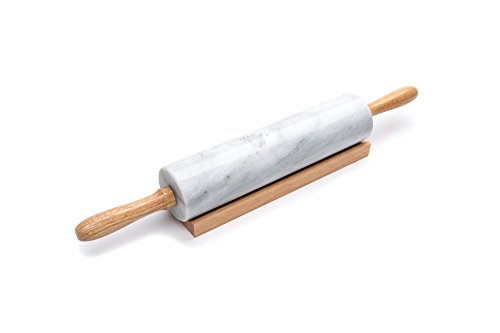
Marble
Fox Run Polished Marble Rolling Pin with Wooden Cradle
Good for: butter-rich pastry and stiff doughs in a warm kitchen.
Why it is here: a 10-inch marble barrel on nylon bearings, with wooden handles and a wooden cradle so it doesn't roll around on the counter. Sold by Amazon.
The drawback: it weighs about 4.6 pounds with its cradle, and the 10-inch barrel is short, so wide sheets of dough take more passes. One more thing: the listing's material field says "plastic," while the title and description say marble. We go by the description.
See the Fox Run marble pin on AmazonStainless steel has no finish to wear and doesn't need oiling. Many steel pins are dishwasher safe, the Ultra Cuisine among them (check the maker), and a steel pin chills fast in the freezer, which helps with pastry. Bare steel is smooth, so give it a light dusting of flour. If you want to know what grades like 304 mean, our guide to stainless steel grades explains them.
Silicone pins are a silicone sleeve over a core, usually with handles. They are sold as nonstick and are easy to wash. We didn't put one on our list because none of the silicone pins we looked at matched the top picks on ratings and volume of buyers. If you are weighing silicone for baking in general, our article on whether silicone is safe for cooking covers what to check.
Adjustable rolling pins for even cookies
If you bake cut-out sugar cookies or gingerbread, an adjustable pin is worth a look. The rings set the thickness for you, so every cookie on the tray bakes in the same time.
There are two limits. The rings sit at the ends of the barrel, so you can't roll anything wider than the space between them, and the dough can't go thinner than the ring you chose. King Arthur saw both with a fixed quarter-inch pastry pin. Its ends got in the way once puff pastry had to go past 18 inches. And its pie dough stopped at 9 inches across instead of 12, because the pin couldn't roll it thinner than a quarter inch. For cookies neither matters. For pie, take the rings off.

The rings ride on the counter, so every part of the sheet comes out the same thickness.
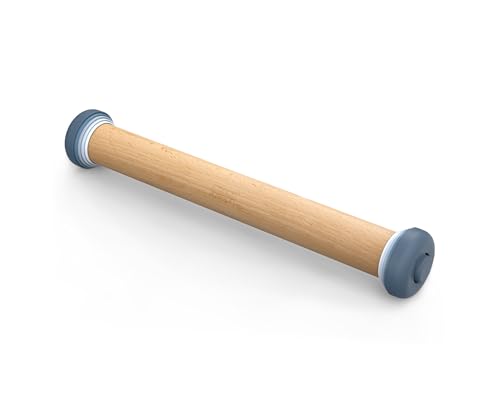
Adjustable, wood
Joseph Joseph PrecisionPin Adjustable Rolling Pin
Good for: cut-out cookies, gingerbread and anyone who wants the same thickness every time.
Why it is here: a beech pin with five sets of color-coded rings for about 2, 4, 6, 8 and 10 mm (roughly 1/16 to 3/8 inch). Twist off the rings you don't need, or take them all off and use it as a plain pin. Sold by Amazon.
The drawback: with the rings on, you can only roll as wide as the barrel between them, so it is a cookie tool more than a pie tool. It is also hand wash only: Joseph Joseph says not to submerge it, to dry it straight away, and to oil it often.
See the Joseph Joseph PrecisionPin on Amazon
Adjustable, steel, with a mat
Vinoil Adjustable Stainless Steel Rolling Pin with Pastry Mat
Good for: cut-out cookies on a budget, if you also want a pastry mat.
Why it is here: a 17-inch pin in 304 stainless with rings in four sizes and a silicone pastry mat with measurements printed on it, about 23.6 x 15.7 inches. Good value if you want both pieces.
The drawback: the listing can't agree on one ring size: one section says 3 mm, another says 4 mm (1/8 inch is about 3 mm). Use a ruler the first time. The current seller is a different brand name, Fulimax US, though it ships from Amazon.
See the Vinoil set on AmazonIf you roll cookies straight onto parchment and slide them onto a pan, our cookie sheet picks cover the flat and rimmed sheets that make that easy.
What size rolling pin should you buy?
The barrel, the part that touches the dough, should be wider than the widest thing you roll, or you end up rolling in strips and leaving ridges.
- For pie, King Arthur's test aimed for a 12-inch (30 cm) round of dough. A barrel of 12 inches or more covers that in one pass. Shorter barrels work, you just turn the dough more.
- A straight dowel of 18 to 20 inches (46 to 51 cm), like the 19-inch J.K. Adams, covers a full sheet of cookie dough or pastry.
- Handled pins are measured end to end, handles included. The HelferX is 17.6 inches overall but the barrel is about 10 inches.
- Thickness changes the feel. A thin pin (around 1.5 inches, like the Ultra Cuisine) is nimble. A thick one (2 to 2.5 inches) presses more evenly but feels heavier in the hand.
Before you order a long pin, measure the drawer you plan to keep it in.
How to clean and care for a wooden rolling pin
A wooden pin only touches flour, fat and dough, so cleaning is simple.
- Scrape off stuck dough with a bench scraper or a dull knife while it is still soft.
- Wipe the pin with a warm, damp cloth and a little dish soap. Don't leave it soaking in the sink.
- Dry it right away with a towel, then let it air dry before you put it away.
- Oil it when the wood looks dry or pale. The University of Kentucky's Robinson Center advises food-safe mineral oil for wooden boards, monthly or every other month with heavy use, and says never to use vegetable or nut oils because they go rancid. Joseph Joseph gives similar advice for its beech pin: oil it often with a food-safe oil. Rub in a thin coat, let it sit, and wipe off the excess.
If the pin has touched raw egg or raw meat, you may want to sanitize it. University of Wisconsin extension, passing on USDA advice for cutting boards (not rolling pins), says to flood the surface with 1 tablespoon of unscented liquid chlorine bleach per gallon of water, let it stand several minutes, then rinse with clear water and dry. It is the closest official guide we found.
The HelferX listing calls its pin "dishwasher friendly." We would still hand wash any wooden pin. Joseph Joseph, for one, tells owners not to submerge its beech pin and to dry it right away, and a handled pin has an axle and bearings where water can sit. Our wooden spoon guide goes through oiling in more detail, and the same steps work for a pin.
No rolling pin? What works instead
If you need to roll something tonight and don't own a pin, a few things in your kitchen will do the job.
- A wine bottle. Peel off the label, wash it, and dust it with flour. A full bottle is heavier and rolls more evenly than an empty one.
- A tall, straight-sided glass or jar. Fine for a small batch of cookies. Avoid glasses with a pattern or a lip.
- A smooth can. Wrap it in plastic wrap (cling film) so the seams don't mark the dough.
- Your hands. For pizza and flatbread, pressing and stretching by hand works and keeps more air in the dough.
None of these is as even as a real pin, and glass can break if you press hard. If you find yourself reaching for the wine bottle every holiday, a basic wooden pin like our quick pick is an easy fix.
Rolling pin questions
What is the best wood for a rolling pin?
A tight-grained hardwood. Maple and beech are the most common, and both are hard and smooth. Our picks include a maple dowel (J.K. Adams) and beech pins (HelferX, as listed, and Joseph Joseph).
Should you oil a wooden rolling pin, and with what?
Yes, now and then, when the wood looks dry. Use food-safe mineral oil. Skip olive, vegetable and nut oils, which can go rancid in the wood.
How do you clean a wooden rolling pin?
Scrape off the dough, wipe the pin with a warm, soapy cloth, and dry it straight away. Don't soak it. If it touched raw egg or meat, the USDA cutting-board method is the closest guide: 1 tablespoon of unscented bleach per gallon of water, a few minutes, then rinse and dry.
Should you use a rolling pin for pizza dough?
You can. A pin gives a thin, even base and is easier if you're new to pizza. Rolling also presses out the air bubbles, so the crust bakes flatter, with less puff at the edge. Stretching by hand keeps more air at the edge for a puffier crust.
Which is better, a metal or wooden rolling pin?
Neither wins outright. Wood holds flour well and is the easier everyday choice. Metal doesn't need oiling, many steel pins are dishwasher safe, and it can be chilled for pastry. If you only buy one, buy wood.
What is the difference between a French rolling pin and a regular one?
A French pin has no handles and tapers toward both ends, so you can tilt and steer it to roll a round crust. A regular pin has handles and a straight barrel, which makes it easier to roll at an even thickness.
What is a rolling pin used for?
Mostly for flattening dough: pie crust, cookies, pizza, pasta, flatbread and pastry. Bakers also use one to crush crackers or cookies for a crumb crust, or to crack nuts in a zip-top bag.
What size rolling pin should I buy?
Pick a barrel at least as wide as what you roll most. For a 12-inch pie round, a barrel of 12 inches or more is easiest. For big sheets of cookie dough and pastry, a straight dowel of 18 to 20 inches.
The verdict
For most kitchens, the HelferX wooden rolling pin is the one to buy. It's a familiar handled pin, and it was #1 in Amazon's Rolling Pins best-sellers when we checked. If you bake a lot of pie or pastry, the J.K. Adams maple dowel or the Ultra Cuisine French pin will give you more control, and Fox Run says its marble pin helps keep dough cool. If you bake a lot of cut-out cookies, the Joseph Joseph PrecisionPin sets the thickness for you.
As an Amazon Associate we earn from qualifying purchases.
See the HelferX rolling pin on Amazon
Related guides: Best cookie sheets · Best wooden spoons · Bakeware buying guide · Best non-toxic bakeware
Sources (opened October 31, 2026). Product facts for all six pins come from each Amazon listing on the same date.
- King Arthur Baking: The best rolling pin, based on what you like to bake
- University of Wisconsin-Madison Extension: How Safe is Your Cutting Board? (USDA Meat and Poultry Hotline tips)
- University of Kentucky, Robinson Center: Cutting board care
- Joseph Joseph: PrecisionPin adjustable rolling pin, care text
HelferX, J.K. Adams, Ultra Cuisine, Fox Run, Joseph Joseph, PrecisionPin, Vinoil and King Arthur Baking are trademarks of their owners and are named here only to identify their products. Listings change; check the listing before you buy.
As an Amazon Associate we earn from qualifying purchases.


