
A wooden spoon is the one kitchen tool almost nobody argues about, until a video shows one being boiled and the water turning brown. Then the questions start. Is it full of bacteria? Is it better than silicone? And if you are buying new ones, which wood, and which set?
We went back to what the research on wood and food actually says, and then did something the other guides skip: we read the Amazon listings for the best-selling wooden utensil sets to see what is on the surface of the wood. Most of the best sellers are coated in clear lacquer. Below are the real pros and cons, the safety question answered with sources, and the four we would buy.
Written by Lara Yehia. Lara researches home and kitchen products for Cupindy.
How we researched this: we read the published research on wood and bacteria, the FDA Food Code, and the Amazon listings and review summaries for each product as they appear to a US shopper. We did not lab-test anything, and we did not cook with every set on this page. Where a listing leaves a question open, we say so.
Published: April 7, 2025 · Last reviewed: September 2026
The short version
- Are wooden utensils good? Yes, for stirring and scraping. They will not scratch nonstick or enamel, they do not melt, and the research does not show wood to be less hygienic than plastic.
- The real cons: no dishwasher, they stain and hold smells, they crack if left to soak, and the thick edge is clumsy for flipping eggs.
- The check nobody does: many best-selling teak sets are coated in clear lacquer. If you want bare wood you can re-oil at home, look for an oil-only finish.
- What we'd buy: the Woodenhouse 10-piece teak set for a whole drawer, OXO's beech spoons as the cheap start, the Tramanto olive wood set for an oil-only finish, and a thin teak turner for flipping.
Our picks at a glance
Affiliate links below. As an Amazon Associate we earn from qualifying purchases. It costs you nothing extra and never decides what we recommend.
Each one is written up below in the section that makes the case for it, drawbacks included.
The pros of wooden cooking utensils
Gentle on your pans
Wood is softer than any cookware coating, so it will not scratch nonstick, ceramic-coated or enameled pots. This is the main reason most cooks keep one.
It does not melt
Leave a nylon spoon resting on a hot pan edge and it can deform. Wood can scorch if you leave it there long enough, but it will not soften into your food.
The handle stays comfortable
Wood conducts heat far less than metal, so the handle stays cool enough to hold during a long stir.
Nothing reacts with your sauce
Tomato, wine and citrus do not react with wood the way they can with aluminum. The wood may stain, but it does not change the taste of the food.
Long life for little money
A decent wooden spoon costs very little and, dried properly, lasts for years. When it finally cracks, it is solid wood rather than plastic.
Quiet, and it feels good in the hand
It sounds trivial until you have scraped a metal spoon around a steel pot every night.
The cons, honestly
Every one of these is real, and every one is manageable. None of them is a safety problem if you dry the wood properly.

- No dishwasher. Long hot cycles and harsh detergent dry wood out and crack it. Every product we recommend says hand wash only.
- It stains and holds smells. Turmeric, tomato and garlic leave their mark. Many cooks keep one spoon just for curries and another for sweet things.
- It cracks if it soaks. A spoon left overnight in a sink of water swells, then dries and splits. Wash it and dry it straight away.
- It needs oil now and then. Bare wood goes pale, dry and fuzzy without it. Lacquered wood needs less, which is part of why brands use lacquer.
- The edge is thick. A wooden spoon is a poor tool for sliding under a fried egg. For that you want a thin turner, which is why one is in our picks.
- Quality varies more than with plastic. Cheap sets can arrive rough or splinter. Amazon's review summaries mention cracks and thin spots even on well-rated sets, and we name them below.
Are wooden utensils safe?
The worry is bacteria, because wood is porous. The research points the other way, with one honest limit.
The study everyone quotes is from 1994. Researchers at the University of Wisconsin put bacteria on plastic and wooden cutting boards and tried to recover them. Bacteria stayed recoverable on plastic for minutes to hours, while clean wood usually absorbed them within a few minutes and recoveries were lower. The authors wrote that their findings do not support the idea that plastic boards are more sanitary than wood.
A 2016 review of the research on wood in contact with food reached a similar view: the porous nature of wood is not what limits its hygiene, and may even help it. The honest limit is in the same review. Most of the studies it covers are about cutting boards. Spoons and spatulas have been studied far less, so the evidence for them is borrowed from boards.
Food safety researcher Ben Chapman of North Carolina State University told reporters there are no examples he knows of where wooden utensils or boards have led to foodborne illness. The factor he stresses is drying: wood that stays damp is where problems start.

The rules for restaurants say something similar. The FDA Food Code, the model that US states adopt for restaurants and food shops, bans wood as a food-contact surface with a few exceptions. One of them is hard maple or an equally hard, close-grained wood, which is allowed for cutting boards, bakers' tables and utensils such as rolling pins and chopsticks. The code does not ban wood outright. It names dense, close-grained wood as the acceptable kind. That is a useful rule to shop by at home too.
What about the boiling video?
Boiling an old wooden spoon can turn the water cloudy or brown. That shows something true: wood absorbs oil and food residue over time. It does not show that the spoon is making anyone ill, and none of the research above suggests boiling is necessary. The better habit is simpler. Wash it in hot soapy water, dry it straight away, and stand it up where air can reach it.
Oil or lacquer: the check nobody does
Old advice on wooden utensils, including an earlier version of this page, says to look for a food-grade oil finish and avoid lacquer. When we read the listings for the best-selling teak sets, most of them state the opposite. Here is what each listing says about the surface of the wood:
Clear lacquer, stated on the listing
Zulay 6-piece teak set; Mooues 9-piece teak set; Woodenhouse flat teak turner (listed as food grade lacquer).
Oil finish, stated on the listing
OXO Good Grips beech spoons (natural oil finish); Tramanto olive wood set (a light coat of olive oil, "and that's it").
Not stated
Woodenhouse 10-piece teak set. The listing describes a "superb finish" without saying what it is.


Lacquer is not a hidden danger. Brands that use it describe it as food grade, and we found nothing to say it is unsafe. The difference is practical. With lacquer, the surface touching your food is a clear coating rather than the wood itself. It keeps the wood glossy and slower to stain, and it wears over the years, especially on the edge you scrape with. You cannot re-oil a lacquered spoon in the usual way, because the oil has nowhere to go.
An oil finish is the opposite trade. The spoon looks drier and stains sooner, and you rub in a little food-grade mineral oil every few weeks. In return, what touches your food is wood, and you can keep it going indefinitely at home.
If bare wood is the point for you, these two are the ones whose listings say so.
Affiliate links. As an Amazon Associate we earn from qualifying purchases.
Oil-only finish, olive wood

Tramanto 5-piece olive wood utensil set
Five pieces: a flat spatula, a curved spatula, a slotted spatula, a round spoon and a corner spoon, each about 12 inches long. Olive wood is hard and close-grained, the kind of wood the Food Code has in mind, and the grain is striking. The listing says each piece gets a light coat of olive oil and nothing else, and that the olive trees are never treated.
Amazon's review summary praises the grain and the value, and one reviewer mentions it works well with cast iron. It is sold under the Thirteen Chefs brand store.
The honest trade: It has fewer ratings than the other picks here, under a thousand, and Amazon's review summary notes the colour can fade with water. That is what an oil-only finish looks like over time; a little oil brings it back. It also costs more than a teak set with twice as many pieces.
Check price on AmazonThe cheapest start, beech

OXO Good Grips 3-piece wooden spoon set
Three plain spoons in small, medium and large, made of solid beech. The listing says the finish is natural oil and the title describes the beech as FSC-certified. It is the cheapest pick on this page by a distance, and it has thousands of ratings.
If you only want to replace a melted plastic spoon or two, start here.
The honest trade: Amazon's review summary says some owners found the medium and small spoons cracked quickly, and a few found the texture rough. Beech is lighter than teak or olive and less forgiving of soaking. Dry it straight away.
Check price on AmazonWhich wood is best for cooking utensils?
The Food Code's test is a good one to borrow: hard and close-grained. Here is how the woods you will actually see compare.

Teak
Dense and naturally oily, so it shrugs off water better than most. Most best-selling sets on Amazon are teak, and many are lacquered, so check the listing.
Olive wood
Very hard, tight grain, beautiful figure. Usually oil-finished and usually pricier. The colour fades with washing until you oil it.
Hard maple
The wood the FDA Food Code names. Pale, dense and plain. Most made-in-USA spoons are maple or cherry.
Beech
The classic European spoon wood. Light, cheap and fine for stirring, but more prone to cracking if it soaks.
Acacia
Common on budget spatulas and serving pieces. Hard enough for daily use; check the listing for how it is finished.
Bamboo
Technically a grass. Most bamboo utensils are thin strips bonded with adhesive, and listings rarely say which adhesive. Amazon's review summary for the best-selling Riveira bamboo set mentions some splintering. Cheap and light, but we would pick solid wood.
Softer, open-grained woods such as pine are not what you want near food. The good news is that you will rarely see them sold as cooking utensils.
If you want a whole drawer in one box
Most people searching for wooden utensils want a set, and teak sets dominate the category. This is the one we would buy, and it is the best-selling wooden set we found.
Affiliate links. As an Amazon Associate we earn from qualifying purchases.
Our first choice, full set
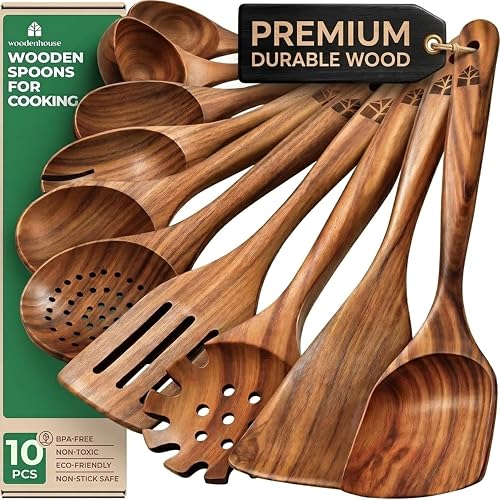
Woodenhouse 10-piece teak cooking utensil set
Ten pieces cover almost everything: a flat frying spatula, a wok spatula, a slotted spatula, a pasta server, a serving spoon, a mixing spoon, a soup ladle, a skimmer, a small seasoning spoon and a salad fork. The listing says each piece is carved from one piece of teak, and to hand wash only.
It has close to nine thousand ratings, more than 10,000 bought in the past month when we checked, and was the top pick in a hands-on test by Yahoo Shopping this summer.
The honest trade: Amazon's review summary calls durability mixed: most owners say the set holds up, but some report cracks and thin spots. The listing does not say what the finish is, and the same brand's turner is lacquered, so do not assume bare wood. If an oil-only finish matters to you, the Tramanto set above is the one.
Check price on AmazonIf you mainly need a spatula
The one job wooden spoons do badly is getting under food. A thin, flat turner fixes that,.
Affiliate links. As an Amazon Associate we earn from qualifying purchases.
Best for flipping

Woodenhouse flat teak turner, set of 2
Two 12-inch flat turners with a front edge the listing gives as 0.03 inches thin, so they slide under eggs and pancakes and scrape fond off cast iron without scratching a nonstick pan. It is rated 4.8 stars on around 2,500 ratings, and the review summary praises the grain and the durability.
The honest trade: The listing says these are coated in clear, food grade lacquer. That keeps them glossy and slower to stain, but it is a coating, and the thin front edge is where it will wear first.
Check price on AmazonOther names you will see
These came up in our research and in what readers search for. None made our picks, and here is why.
Zulay Kitchen teak set
A well-rated 6-piece teak set. Its listing says it is coated with clear lacquer. We include it in our non-toxic cooking utensils guide as the wooden option; here, the Woodenhouse set gives you more pieces for similar money.
Mooues teak set
A cheaper 9-piece teak set with a spoon rest, also lacquered according to its listing. Reasonable if price comes first.
Riveira bamboo
The best-selling bamboo set. Cheap and light, but bamboo is bonded strips, and Amazon's review summary mentions splintering.
Woodenhouse 12-piece with holder
The same teak with a holder and hooks. Amazon's review summary notes some pieces are very small. The 10-piece set is the better buy.
Caraway, Our Place, Made In
Direct-to-consumer brands selling birch or beech utensils on their own sites. We did not review them for this page.
Woodsen
A teak utensil brand people often search for alongside this topic. We did not review it for this page.
Made in the USA
Amazon carries small makers such as Modern Artisans (hard maple, made in North Carolina according to reviewers) and Amish-made maple and cherry spoons. Lovely, and pricier, with far fewer ratings than the sets above.
Wood vs silicone vs plastic vs stainless
| Wood | Silicone | Nylon / plastic | Stainless steel | |
|---|---|---|---|---|
| Safe on nonstick | Yes | Yes | Yes | No, it scratches |
| Melts on a hot pan | No, can scorch | No, at normal cooking heat | Can deform | No |
| Dishwasher | No | Yes | Yes | Yes |
| Holds stains and smells | Yes | Can hold smells | Can stain | No |
| Thin edge for flipping | Only flat turners | Yes | Yes | Yes |
| Lasts | Years, if dried | Years | Until it melts or frays | Decades |
For nonstick pans, wood and silicone are the two sensible choices, and many kitchens keep both: wood for stirring, silicone for scraping bowls and flipping. We compare all of them, with picks, in our guide to non-toxic cooking utensils, and look at the material itself in is silicone safe for cooking. For boards, the same wood-versus-plastic research is covered in our non-toxic cutting board guide.
How to clean and care for wooden utensils
- Wash by hand, straight after use, in hot water with ordinary dish soap. Do not leave it soaking.
- Dry it properly. Towel it off, then stand it up with the head pointing upward, somewhere air can reach it. Chapman recommends giving wood a full day to dry out before it goes into a closed drawer.
- Oil bare wood when it looks pale or feels dry, every few weeks for spoons in daily use. Use food-grade mineral oil, rub it in, leave it a few hours and wipe off the excess. Avoid cooking oils like olive oil for routine care, which can go rancid over time. Cutting boards take the same oil: see how to oil a wooden cutting board.
- Lacquered wood needs only washing and drying. Do not sand it.
- Smells and stains: rub with coarse salt and half a lemon, or a paste of baking soda and water, then rinse and dry.
- Keep it off the hot pan edge. A spoon left resting across a hot pan scorches at the point of contact.
Note that Tramanto's own listing suggests coconut, mineral or olive oil for its olive wood. Mineral oil is the one that will not go rancid.
When to replace a wooden spoon
There is no fixed lifespan. Replace one when you see any of these:

- A crack or split you can catch a fingernail in, especially along the head
- Grain that has gone fuzzy or soft and no longer dries out properly
- Black spots or mould that do not scrub off
- Charring deep enough that the edge is rough or flaking
- On a lacquered spoon, a coating that is visibly peeling
What about wooden bowls and plates?
The same rules apply. The Food Code's list of accepted wooden items for hard, close-grained wood, as adopted in states such as Indiana, includes salad bowls, and a well-oiled wooden bowl is a fine thing to serve from. Keep wooden bowls and plates out of the microwave and the dishwasher: both dry the wood out and crack it. Wooden plates are best for dry food, since wet sauces soak in and stain. For everyday plates and bowls, our non-toxic dinnerware guide covers the materials that can go in the dishwasher.
Questions people ask
Are wooden spoons safe to cook with?
Yes. The research on wood and bacteria does not show wood to be less hygienic than plastic, and food safety researchers point to proper drying as what matters. Most of that research is on cutting boards, so the evidence for spoons is borrowed, but nothing we found suggests a risk from a clean, dry wooden spoon.
Do wooden utensils hold bacteria?
Wood absorbs moisture, and bacteria with it, which is why drying matters. In the 1994 Wisconsin study, bacteria were recovered less from clean wood than from plastic. A spoon that is washed, dried and stood upright is not a bacteria problem; one that lives damp in a closed drawer can be.
Can wooden utensils go in the dishwasher?
No. Every product on this page says hand wash only. The heat and long wet cycle crack and warp wood, and lacquered pieces lose their coating faster.
Is wood or silicone better for nonstick pans?
Both are safe on nonstick. Wood is stiffer and better for stirring thick food; silicone is thinner and better for flipping and scraping. See our cooking utensils guide for silicone picks.
What is the best wood for cooking utensils?
Hard, close-grained wood: maple, olive, teak and cherry are all good. Beech and acacia are fine for everyday use. Bamboo is bonded strips rather than solid wood.
Are acacia wood utensils safe?
Acacia is a hardwood and is widely used for spatulas and serving pieces. As with any wood, check the listing for how it is finished and dry it after washing.
Are teak utensils coated?
Many are. Several of the best-selling teak sets on Amazon state on their listing that they are coated in clear lacquer. If you want bare wood, look for a listing that says oil finish.
How long do wooden spoons last?
Years, if you dry them properly and keep them out of the dishwasher. Replace one when it cracks, stays fuzzy after drying, or shows mould.
Are wooden bowls microwave safe?
No. Microwaving dries wood out unevenly and can crack it. Serve from wood; heat food in glass or ceramic.
Editorial note
As an Amazon Associate we earn from qualifying purchases. Cupindy earns a commission if you buy through the Amazon links on this page, at no extra cost to you. No brand paid to be included, and every pick names a real drawback. Product details and availability were checked in September 2026 and can change.
Sources reviewed: Ak, Cliver and Kaspar, Cutting boards of plastic and wood contaminated experimentally with bacteria, Journal of Food Protection, 1994; Aviat et al., Microbial safety of wood in contact with food: a review, 2016; FDA Food Code section 4-101.17, wood use limitation, as adopted in Indiana; interview with Ben Chapman, North Carolina State University; Amazon listings and review summaries for each product named.
Related reading: Best non-toxic cooking utensils · Non-toxic cutting boards · Is silicone safe for cooking?


