
Written by Sara Ibrahim. Sara researches home and kitchen products for Cupindy. · Published September 8, 2024 · Updated October 10, 2026
Every electric bill comes down to two numbers: the kilowatt-hours (kWh) you used and the price of each one. The second has been climbing: the average U.S. home paid 18.19 cents per kWh from January to July 2026, up from 17.01 cents a year earlier, EIA data show. That is a 6.9% rise, so part of a higher bill may not be your doing.
This guide shows how to tell which number moved, find what uses the most power in your home, and fix the biggest users first.
The short answer
- Compare kWh first: this bill against the same month last year.
- Usage up? Measure your big users. Heating, cooling and water heating come first.
- Usage flat? Your price per kWh or fees went up. See your state in the table below.
- Thinking of a plug-in power saver box? Measure first.
As an Amazon Associate we earn from qualifying purchases.

Our quick pick: measure first
Tapo P115 energy-monitoring smart plug, 2-pack
Plug an appliance into it and the app shows its power use and estimates the cost once you enter your rate. Leave one on the fridge for a week and move the other around the house.
See the Tapo P115 2-pack on AmazonHow we put this together: on October 10, 2026 we read EIA's latest price and usage tables, ENERGY STAR's guidance, Lawrence Berkeley National Laboratory's standby-power research and the product makers' spec pages. The U.S. Department of Energy removed more than 1,600 of its Energy Saver pages in July 2026, so we cite these sources instead. We haven't tested these products, and every cost below is a worked example, not a measurement.
Why is my electric bill so high?
Either you used more kWh or each kWh cost more. Put this bill next to the same month last year and compare the kWh line first. If usage rose, look at the season or something new that runs a lot. If usage is about the same, the price or fees went up.

| If your bill... | Most likely cause | First thing to check |
|---|---|---|
| Jumped in summer | Air conditioning running longer | Thermostat setting, air filter, ceiling fan direction |
| Jumped in winter | Electric heat, heat pump backup heat, space heaters | Thermostat schedule, drafts, space heater hours |
| Doubled, no season change | Something new or stuck on | A second fridge, a well pump or water heater that keeps running |
| Is high all year | Big users plus devices left on | Measure the fridge and the TV corner for a week |
| Rose while kWh stayed flat | Higher price per kWh or fees | The rate lines on your bill; your state below |
| Says estimated | The meter wasn't read this month | Ask your utility for an actual reading |
How to read your electric bill: kWh, rate and fixed charges
Three parts make up the total: the kWh you used, the price per kWh (often split into supply and delivery charges), and fixed charges you pay even if you use nothing. A kWh is 1,000 watts used for one hour; EIA defines it as “A measure of electricity defined as a unit of work or energy”. Cutting kWh lowers the first two parts but never the fixed charges.

Time-of-use and off-peak rates
Some utilities charge more at busy hours and less at night or on weekends; your bill or rate page will say time-of-use, on-peak or off-peak. On such a plan, running the dishwasher, laundry or car charger off-peak lowers the price of those kWh. On a flat rate, the hour doesn't matter.
Average electric bill and price per kWh by state
In 2024 the average U.S. home bought 863 kWh a month and paid $142.26, at 16.48 cents per kWh, according to EIA's latest annual figures. Prices have climbed since. The table shows each state's average home price for January to July of 2026 and 2025, plus its 2024 average bill.
| State | 2026 (Jan-Jul), cents/kWh | 2025 (Jan-Jul) | 2024 avg bill/month |
|---|---|---|---|
| U.S. average | 18.19 | 17.01 | $142.26 |
| Alabama | 16.54 | 15.97 | $173.50 |
| Alaska | 27.09 | 25.81 | $143.54 |
| Arizona | 15.44 | 15.30 | $160.24 |
| Arkansas | 13.61 | 12.60 | $129.13 |
| California | 33.25 | 32.45 | $160.86 |
| Colorado | 16.72 | 15.48 | $100.57 |
| Connecticut | 27.97 | 30.29 | $199.66 |
| Delaware | 17.86 | 16.76 | $150.87 |
| District of Columbia | 24.66 | 20.93 | $113.23 |
| Florida | 15.30 | 15.03 | $156.09 |
| Georgia | 15.40 | 14.74 | $151.25 |
| Hawaii | 46.28 | 41.08 | $212.12 |
| Idaho | 12.96 | 11.57 | $108.73 |
| Illinois | 19.22 | 17.36 | $109.99 |
| Indiana | 17.04 | 15.86 | $133.06 |
| Iowa | 14.20 | 13.52 | $111.54 |
| Kansas | 15.21 | 14.32 | $123.90 |
| Kentucky | 14.27 | 13.12 | $133.81 |
| Louisiana | 13.35 | 12.61 | $140.96 |
| Maine | 29.99 | 27.46 | $133.60 |
| Maryland | 21.30 | 18.75 | $165.87 |
| Massachusetts | 30.14 | 30.22 | $167.20 |
| Michigan | 21.53 | 19.78 | $119.31 |
| Minnesota | 16.25 | 15.59 | $110.06 |
| Mississippi | 15.19 | 13.92 | $154.83 |
| Missouri | 13.96 | 13.18 | $129.18 |
| Montana | 13.95 | 12.53 | $107.91 |
| Nebraska | 12.90 | 12.03 | $110.28 |
| Nevada | 13.53 | 13.19 | $139.39 |
| New Hampshire | 26.79 | 23.26 | $144.87 |
| New Jersey | 23.98 | 22.07 | $128.13 |
| New Mexico | 15.08 | 14.67 | $92.88 |
| New York | 29.38 | 26.01 | $139.53 |
| North Carolina | 14.94 | 13.71 | $143.50 |
| North Dakota | 12.36 | 11.51 | $118.38 |
| Ohio | 18.70 | 16.55 | $135.16 |
| Oklahoma | 13.58 | 12.60 | $132.05 |
| Oregon | 15.40 | 15.19 | $129.62 |
| Pennsylvania | 21.04 | 18.70 | $145.17 |
| Rhode Island | 29.22 | 29.55 | $162.40 |
| South Carolina | 15.93 | 14.80 | $149.51 |
| South Dakota | 14.50 | 13.15 | $127.81 |
| Tennessee | 13.87 | 13.22 | $143.32 |
| Texas | 16.06 | 15.20 | $163.72 |
| Utah | 13.16 | 12.73 | $94.57 |
| Vermont | 23.95 | 22.46 | $125.66 |
| Virginia | 16.83 | 14.88 | $148.77 |
| Washington | 14.40 | 12.74 | $113.68 |
| West Virginia | 15.47 | 15.35 | $154.76 |
| Wisconsin | 19.00 | 18.03 | $110.87 |
| Wyoming | 13.95 | 12.94 | $107.65 |
Prices: EIA Electric Power Monthly, Table 5.6.B (preliminary). Bills: EIA 2024 average monthly residential bill. Your bill depends far more on your home, climate and heating type than on the state average.
What uses the most electricity in a home?
Cooling and heating. EIA's 2025 estimate puts space cooling at 17.3% of U.S. home electricity and space heating at 14.1%, followed by water heating (8.5%) and refrigerators and freezers (8.0%). Lighting is only 3.4%. The largest slice, 44.5%, is all other uses: washers, dryers, dishwashers, cooking and many smaller devices. In EIA's words, “air conditioning is the largest use of electricity in homes”.

Your home may differ: gas heat takes those slices off your electric bill, while electric heat or a pool pump can dominate it. Measuring beats guessing.
How to find your own biggest energy users
- Check your utility account. With a smart meter, the app may show use by hour; a daily spike points to the culprit.
- Read the yellow EnergyGuide label on big appliances. ENERGY STAR says to use it to “estimate annual operating costs”.
- Measure plug-in appliances for a few days each: fridge, freezer, dehumidifier, space heater, the TV corner.
- Know the limit. Plug-in monitors handle ordinary 120-volt outlets only; the Tapo P115 is rated “15A, 1800W”. Central AC, an electric range, a water heater and most electric dryers are hard-wired or 240-volt; use the bill or nameplate for those.
As an Amazon Associate we earn from qualifying purchases.
Our pick to find waste
Tapo P115 smart plug with energy monitoring, 2-pack
Shows live watts and past-week kWh in the Tapo app and, per TP-Link, takes your electricity rate “for bill estimates”. It can also switch the appliance off on a schedule.
Good for: finding out what your fridge, freezer, dehumidifier or TV corner really uses
The drawback: it needs your 2.4 GHz Wi-Fi and the Tapo app, and it can't measure hard-wired or 240-volt loads, which are often the biggest users.
See the Tapo P115 2-pack on AmazonRather not use an app? The Kill A Watt EZ shows usage on its own screen and, per its maker, “Calculates cost and forecasts by week, month and year”.
A professional home energy audit
For drafts, insulation and ducts you can't see, ask your utility about a home energy assessment. ENERGY STAR also points to its online Home Energy Yardstick to measure your home's performance.
How much does it cost to run an appliance?
Watts × hours a day ÷ 1,000 = kWh a day. Multiply by 30 for a month, then by your price per kWh. A 1,500-watt space heater run 8 hours a day uses 360 kWh a month: about $65 at 18.19 cents. Find the watts on the appliance label, then try your own numbers:
Appliance cost calculator
About 360.0 kWh and $65.48 a month, $785.81 a year.
Estimate only. Appliances with a thermostat, like fridges and heaters, cycle on and off, so their real hours are lower than the hours they are plugged in.

Anything that heats, cools or runs for hours dominates; a phone charger barely registers.
Heating and cooling: the biggest lever
ENERGY STAR puts it plainly: “Nearly half of the energy used in your home goes to heating and cooling.” Start here:
- Air filter: “Check your filter every month, especially during heavy use months (winter and summer).” And “At a minimum, change the filter every 3 months.”
- Schedule: let the temperature drift while you sleep or are out. A smart thermostat does it for you; ENERGY STAR says homes with high heating and cooling bills, or empty for much of the day, “can save approximately $100 a year with an ENERGY STAR certified smart thermostat.”
- Ducts: sealing and insulating ducts in the attic or crawlspace can raise system efficiency “by as much as 20 percent”, per ENERGY STAR.
- An old system: ENERGY STAR suggests a professional check once equipment is over 10 years old, and fixing big air leaks before replacing it.
Ceiling fan direction for summer and winter
“In the summer, use the ceiling fan in the counterclockwise direction.” “In the winter, reverse the motor and operate the ceiling fan at low speed in the clockwise direction.” ENERGY STAR adds that “Ceiling fans cool people, not rooms.” Turn the fan off in an empty room and nudge the thermostat when it runs.
As an Amazon Associate we earn from qualifying purchases.

For heating and cooling
Sensi Smart Thermostat (ST55)
A Wi-Fi thermostat with flexible scheduling, remote control and usage reports. Its Amazon listing calls it ENERGY STAR certified and says a common wire (c-wire) “is not required in most applications”.
Good for: homes that sit empty during the day and owners who will actually set a schedule
The drawback: it saves nothing on its own. ENERGY STAR's estimate assumes high heating and cooling bills or an empty house, and ENERGY STAR says: “Make sure the smart thermostat you purchase is compatible with your heating and cooling system.”
See the Sensi ST55 on AmazonDrafts, doors and windows
Sealing air leaks and adding insulation can “provide up to a 10% savings on your annual energy bills”, ENERGY STAR says, and “Simple fixes include installing weather stripping on doors and caulking around windows”. Look for daylight under exterior doors and feel for cold air around windows on a windy day.

For a gap under the door
Sunolga door draft stopper, 38 inches
A weighted fabric tube that sits along the bottom of a door, with a cover that unzips for washing. It just rests against the door, which suits renters.
Good for: drafty exterior and basement doors
The drawback: it only blocks the gap under the door, up to 3 inches per the listing. Air leaking around the sides and top needs weatherstripping.
See the Sunolga draft stopper on Amazon
For windows
NICETOWN thermal insulated curtains, 2 panels
Triple-weave blackout panels that the maker says insulate “against summer heat and winter chill”. Close them on winter nights and on hot, sunny afternoons.
Good for: single-pane or drafty windows and sun-facing rooms
The drawback: blackout fabric darkens the room, so you may switch lights on during the day; and this set is 42 by 63 inches per panel, so measure your window first.
See NICETOWN thermal curtains on AmazonWater heating
Water heating is 8.5% of U.S. home electricity, per EIA. The free fix is the thermostat: the U.S. Consumer Product Safety Commission “urges all users to lower their water heaters to 120 degrees Fahrenheit”, adding that “this decrease in temperature will conserve energy and save money”. CPSC's point is scald prevention too. Our tip: on an electric tank the thermostat sits behind a panel, so switch off the breaker first, or ask a plumber.
Replacing a tank anyway? ENERGY STAR points to heat pump water heaters, which need an indoor space that stays between 40 and 90°F year-round. And when the washer is due, ENERGY STAR certified models “use about 20% less energy and about 30% less water than regular washers.”
Does unplugging appliances save electricity?
A little, and less than most people think. Standby power, in Lawrence Berkeley National Laboratory's words, “is the electricity consumed by devices when they are switched off or not performing their primary functions.” LBNL says “Most products draw relatively little standby power”, under 0.5 watts, but “Together these amount to 5-10% of residential electricity use.”
Our math: one device drawing 0.5 watts all year uses 4.38 kWh, about $0.80 at 18.19 cents. Unplugging one charger saves pennies. The real target is the cluster that stays half awake: TV, console, cable box, sound bar, desktop computer. Measure it, then put it on a strip you switch off.
As an Amazon Associate we earn from qualifying purchases.
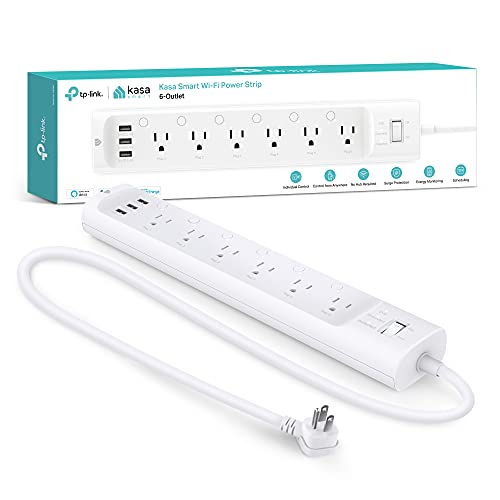
For the TV corner
Kasa HS300 smart power strip, 6 outlets
Six outlets you can switch and schedule one by one from the Kasa app, each with energy monitoring, plus surge protection and three USB ports.
Good for: a TV, console and set-top box cluster or a home office desk
The drawback: all six outlets share one limit, “15A 1875W maximum load in total” per the listing, and it needs Wi-Fi and the Kasa app. A plain switched strip cuts standby without the monitoring.
See the Kasa HS300 on AmazonDo plug-in power savers like StopWatt work?
We found no independent lab test of StopWatt itself, so we make no claim about that brand. What we can say: you pay for the kWh your appliances use, and a box plugged into one outlet does not change what a fridge or an air conditioner needs. In UK tests of four unnamed plug-in savers, power use went up.
VERIFY reported in March 2024 that Buckinghamshire and Surrey Trading Standards in England had tested four plug-in electricity-saving devices and found that “electrical consumption actually increased when using the products”, along with “poor construction and access to live parts”.
The honest test costs little: measure an appliance for a week with an energy-monitoring plug, add the box, and measure another week. The same test applies to dirty-electricity filters sold to lower bills.
Lighting and appliance upgrades
ENERGY STAR's rule for bulbs: “To save energy, find the bulbs with the lumens you need, and then choose the one with the lowest wattage.” The Sylvania LED in our table gives 800 lumens at 8.5 watts, its listing says. In place of a 60-watt bulb on 3 hours a day, that saves about $0.84 a month at 18.19 cents in our example. Small per bulb, so start with the lights on longest.
Replacing a working appliance rarely pays off fast: ENERGY STAR says certified refrigerators are “about 9 percent more energy efficient than models that meet the federal minimum energy efficiency standard”. Keep yours running well with our fridge care guide and check the energy section of our dishwasher buying guide before you replace. A dryer that needs two cycles may just need a clean vent or wool dryer balls. For the kitchen, see our toaster oven comparison and stove type guide.
What to fix first, and the tools that help

Everything below targets real kWh. All were in stock, with a buy box, for delivery to New York when we checked on October 10, 2026.
As an Amazon Associate we earn from qualifying purchases.
| Problem | Tool | |
|---|---|---|
| Don't know what uses the most | Tapo P115 smart plug, 2-pack (app) | See on Amazon |
| Want a monitor with no app | Kill A Watt EZ (shows cost) | See on Amazon |
| TV and console standby | Kasa HS300 smart power strip | See on Amazon |
| Heating and cooling run all day | Sensi ST55 smart thermostat | See on Amazon |
| Gaps around doors and windows | Alien Draft Seal weatherstripping | See on Amazon |
| Cold air under a door | Sunolga door draft stopper | See on Amazon |
| Old bulbs in long-use lights | Sylvania 60 W-equivalent LED | See on Amazon |
Help paying the bill, and tax credits
If the bill is the problem now, call your utility before it is late and ask about payment plans, budget billing and assistance. The federal Low Income Home Energy Assistance Program also helps: “LIHEAP provides federally funded assistance to reduce the costs associated with home energy bills, energy crises, weatherization, and minor energy-related home repairs.”
On tax credits, the IRS says of the Energy Efficient Home Improvement Credit: “You can claim the credit for improvements made through December 31, 2025.” Upgrades made in 2026 don't qualify, so check your utility and ENERGY STAR's rebate finder for local offers.
Questions people ask
Is $200 a month a lot for electricity?
It is above the 2024 U.S. average of $142.26 a month, per EIA, but states vary widely: Hawaii averaged $212.12 and Utah $94.57. Compare with your state in the table and with your own bill from a year ago.
Can I cut my electric bill in half?
Sometimes, in a home with a lot of waste, such as old space heaters, leaky ducts or a second fridge. No product or tip can promise it. Fixed charges stay, and the biggest cuts usually come from heating and cooling.
Is electricity cheaper at night?
Only if you are on a time-of-use plan. Check your bill or your utility's rate page for on-peak and off-peak hours. On a flat rate, every kWh costs the same.
What is budget billing?
Many utilities let you pay a similar amount each month based on your yearly use, then adjust it later. It smooths out summer and winter spikes but does not lower the total.
Can a water leak cause a high electric bill?
Yes, if electricity moves or heats the water: a well pump that keeps cycling, or an electric water heater refilling with cold water. A running toilet on city water raises the water bill instead.
Does a smart thermostat save money?
It can if it actually changes your schedule. ENERGY STAR estimates about $100 a year for homes with high heating and cooling bills or that are empty much of the day.
Are there tax credits for energy upgrades in 2026?
Not the federal Energy Efficient Home Improvement Credit: the IRS says it covered improvements made through December 31, 2025. Check your utility and ENERGY STAR's rebate finder for local rebates.
Should I switch electricity suppliers?
Only if your state lets you choose a supplier. Compare the price per kWh, fixed versus variable rates, contract length and cancellation fees, and keep the delivery charges in mind, since your utility still bills those.
How can I lower my electric bill in an apartment?
Use fans and a sensible thermostat schedule, ask the landlord about the air filter, block door drafts, switch off the TV corner at the strip, and measure any space heater before you rely on it.
Keep reading
- Refrigerator benefits, drawbacks and care
- Are smart fridges worth it?
- How to clean a dryer vent
- All major appliance guides
- All small appliance guides
About this guide: Written by Sara Ibrahim. Updated October 10, 2026 with EIA prices through July 2026. We did not test these products; all costs are worked examples using 18.19 cents per kWh, the U.S. average home price for January to July 2026, and your rate will differ. The U.S. Department of Energy removed more than 1,600 of its Energy Saver pages in July 2026, so this guide relies on EIA, ENERGY STAR, national laboratory and agency sources. Product details come from the makers and the Amazon listings, checked October 10, 2026. As an Amazon Associate we earn from qualifying purchases.
Sources reviewed
- U.S. Energy Information Administration (EIA), Electric Power Monthly, Table 5.6.B, average price by state, year to date through July 2026 and 2025 (preliminary), read October 10, 2026
- EIA, 2024 Average Monthly Bill - Residential (Table 5A), released October 7, 2025
- EIA, Use of electricity (end-use shares from Annual Energy Outlook 2026, Table 4, April 2026)
- EIA Glossary: kilowatthour
- ENERGY STAR, Heat and Cool Efficiently
- ENERGY STAR, Seal and Insulate
- ENERGY STAR, Ceiling Fan Installation and Usage Tips
- ENERGY STAR, Smart Thermostats
- ENERGY STAR, Learn About Brightness
- ENERGY STAR, Refrigerators
- ENERGY STAR, Clothes Washers
- ENERGY STAR, Heat Pump Water Heaters
- Lawrence Berkeley National Laboratory, Standby Power
- U.S. Consumer Product Safety Commission, Avoiding Tap Water Scalds (document 5098)
- IRS, Energy Efficient Home Improvement Credit (page reviewed April 28, 2026)
- U.S. Department of Health and Human Services, Low Income Home Energy Assistance Program (LIHEAP)
- VERIFY (WTSP), “No, these plug-in devices won’t save money on your power bill,” March 7, 2024
- Government Executive, July 2026: Energy Department removes more than 1,600 webpages
- TP-Link, Tapo P115 specifications
- P3 International, Kill A Watt EZ P4460

