
Take the lid off a pressure cooker and count what the steam touches on its way out. The pot, yes. Then a silicone ring, the underside of the lid, a small float valve with its own seal, and on many electric models a little cap over the steam vent. Almost every non-toxic list stops at the first one.
We went further. We read the chemical filings Instant Brands and Cosori publish for California and Colorado, and checked what each listing says about the ring and the lid. Four cookers made it through, one of them with a coating we'll be upfront about. Here is what we'd buy, and what each one asks you to trade.
Written by Lara Yehia. Lara researches home and kitchen products for Cupindy.
How we researched this: we read each brand's own chemical disclosure documents, the Amazon listings as they appear to a US shopper, and Amazon's summaries of customer reviews. We did not lab-test anything, and we did not cook with every model on this page. Where a document leaves a question open, we say so rather than fill the gap.
Published: September 22, 2026 · Last reviewed: September 22, 2026
The short version
- Best for most kitchens: the Instant Pot Duo. Its inner pot is uncoated stainless steel, and Instant's own disclosure puts it in the stainless table, not the PTFE one.
- Fewest parts touching your food: a stovetop cooker in stainless steel. The Presto 01362 is the one we'd start with; the T-fal Clipso if you want a one-hand lid.
- If you want a coated pot anyway: the Cosori 6-quart. Its ceramic coating is still a coating, but Cosori's filing for this model names no PTFE.
- What to skip: any list that only names the pot. The ring, the lid and the valve are food-contact parts too.
Our picks at a glance
Affiliate links below. As an Amazon Associate we earn from qualifying purchases. It costs you nothing extra and never decides what we recommend.
Each one is written up below in the section that makes the case for it, drawbacks included. We'd rather you read the drawback first.
What actually touches your food
A pressure cooker is sealed on purpose, so everything inside the lid sits in hot steam for the whole cook. That makes the list of food-contact parts longer than on an ordinary pot. Here is what to look at, in the order it matters.

The inner pot
The biggest surface by far, and the one that decides the rest. Bare stainless steel, a ceramic coating, or a fluoropolymer (PTFE) coating. Everything else on this page follows from which of the three you pick.
The sealing ring
The gasket that runs around the lid. On electric cookers it is usually silicone; some makers state the material on their replacement rings and some do not. It is the part you will replace most often, so buy the maker's own ring for your model.
The underside of the lid
On stovetop cookers it is the same stainless steel as the pot. On electric cookers, look at it before you buy: steam and splatter reach it on every cook.
The float valve and vent cap
The small pin that rises when pressure builds, its tiny seal, and on many electric lids a removable cap under the steam vent. Small, but they sit directly in the steam, and they are the parts people forget to clean.
The practical takeaway is simple. Choose the pot material first, then check that you can take the ring and valve parts out to wash them. Every cooker we recommend lets you do that.
Coated or uncoated is the real question
Most pressure cooker labels shout "PFOA-free". That tells you very little. Under an EPA stewardship program that ran to 2015, the eight major makers of PFOA committed to eliminating it from their emissions and products, and all of them say they met that goal. Almost every coated pot on sale today can print "PFOA-free". We explain why in what PFOA-free really means.
The distinction that matters is whether anything has been applied to the surface your food sits in. There are three possibilities:
- Uncoated stainless steel. Nothing applied. It will not release eggs or rice as easily, and it can take scrubbing, but there is no coating to wear. Our guide to stainless steel grades explains what 18/8 means.
- Ceramic coating. A mineral-based nonstick layer. Brands sell it as PTFE-free, and on the model we recommend, the maker's filing supports that. It still wears with use.
- Fluoropolymer coating (PTFE and related). The classic nonstick. PTFE belongs to the PFAS family, which is one reason several US states now require brands to disclose it.


"Non-toxic" on a pressure cooker box is a marketing phrase. The pot material is a fact you can check.
What Instant Pot's own filing says
Instant Brands opens its disclosure page with a one-line statement, and a shorter version of it appears on the Instant Pot Duo's Amazon listing. The page says its products contain iron, chromium, manganese, nickel, phosphorus, aluminum, carbon black, titanium dioxide "and/or PFAS (including PTFE, PFA, and FEP)". Read on its own, that covers every product the company makes and tells you nothing about the one in your kitchen.
The useful document is the detailed one linked from that page. It sorts products into tables by cooking surface, and this is what it shows for pressure cookers:
PTFE-coated cooking surface
The Duo Crisp multicooker and air fryer combos (6 and 8 quart, and the Duo Crisp Light), the Pro Crisp, plus Vortex air fryers, an indoor grill and a milk frother. Chemicals listed: PFASs and BPA. Some Crisp models also appear in the stainless table below.
Stainless steel cooking surface
The Duo Mini, the 6 and 8 quart Duo, the Rio, the Duo Plus and the Pro, alongside air fryers, toaster ovens and frothers. Chemicals listed for the group: chromium, manganese, nickel, phosphorus, iron, cadmium, tin and compounds, three phthalates (BBP, DiDP, DnHP) and BPA.
Aluminum and coated aluminum
The Duo Mini and the 6 quart Duo appear here as well, alongside many air fryers and toaster ovens. Chemicals listed: aluminum, titanium dioxide, iron and carbon black.
Two things follow. The plain Duo is filed under stainless steel and is not in the PTFE table; the Duo Crisp, the version with the air fryer lid, is. So if you are choosing between them for coating reasons, the answer is the plain Duo. Our non-toxic air fryer guide covers the air fryer side.
The second point is less tidy. The stainless table lists its chemicals for the whole group, pressure cookers alongside air fryers, toaster ovens and frothers, without saying which product or which part each one belongs to. We could not find a more specific breakdown from Instant.
If you want an electric cooker with nothing on the pot
This is the pick for most people: set it, get on with something else, and nothing coated is touching dinner.
Affiliate links. As an Amazon Associate we earn from qualifying purchases.
Our first choice, electric

Instant Pot Duo Mini (3 quart)
The inner pot is 18/8 stainless steel with a tri-ply base, according to Instant's listing, and nothing is applied to it. It is filed under stainless steel in Instant's disclosure, not under PTFE. It pressure cooks, slow cooks, sautes, steams, and makes rice and yogurt, and the listing says both the lid and the inner pot are dishwasher safe.
It also sits near the top of Amazon's electric pressure cooker best-seller list, and the Duo family has more ratings than any cooker we looked at. That rating count is shared across the Duo sizes, so read it as the family's record rather than this size alone.
The honest trade: Three quarts is a cooker for one to three people. For a family, the 6-quart Instant Pot Duo uses the same stainless pot and costs more. The bigger caveat is the paperwork: the stainless table the Duo sits in also lists cadmium, tin, three phthalates and BPA for the group, without naming the part. If that detail matters to you, the stovetop cookers below have fewer parts to wonder about.
Check the 3-quart on Amazon See the 6-quartStovetop cookers: the fewest parts you can buy
A stovetop pressure cooker is a steel pot, a steel lid, one sealing ring, and a valve. There is no electronics housing, no inner plastic, and no coated insert, because there is no insert at all. You set the heat yourself and listen for the regulator, which takes a few cooks to learn. If the question is "how few materials can touch my food", this is the answer.

Stainless, not aluminum
One trap first. The best-selling stovetop cookers come in two metals that look almost identical in photos. Presto sells a 6-quart aluminum model beside the stainless one, at a lower price, with a similar rating. Aluminum reacts more readily with acidic and salty food than stainless steel does, and Amazon's review summary for the aluminum Presto mentions discoloration. Check that the title says stainless steel before you buy. For the pressure side of the question, our guide to whether pressure cookers are safe covers that side.
Affiliate links. As an Amazon Associate we earn from qualifying purchases.
Fewest parts, no electronics

Presto 01362 6-quart stainless steel pressure cooker
A stainless steel body and lid, a sealing ring, an overpressure plug, and a regulator that holds cooking pressure by itself. The listing says it works on regular, smooth-top and induction ranges, and that the pot can go in the dishwasher once you take out the ring and plug, which must be washed by hand. Per the listing, a cover lock indicator shows when there is pressure inside and keeps the cover from opening until it drops. Presto backs it with a 12-year limited warranty, per the listing.
The honest trade: Amazon's review summary notes some owners reporting that the bottom handle broke. Presto's own page for the replacement sealing ring (stock no. 09936) does not state what the ring is made of, and Presto's PFAS page does not list individual products; it asks you to call customer service instead. We could not find a stated ring material for this model. You also do all the timing yourself.
Check price on AmazonStovetop with a one-hand lid

T-fal Clipso 6.3-quart stainless steel pressure cooker
The Clipso's lid closes and opens with one hand, and its adjustable valve replaces the small weight you can lose on older designs. The pot is stainless steel and dishwasher safe, and the listing states a 10-year warranty on the pot. The Clipso's replacement gasket (part X9010501) is listed on Amazon as silicone, so unlike the Presto, the ring material is stated.
The honest trade: Amazon's review summary describes durability as mixed, with some owners reporting it breaking after limited use.
Check price on AmazonIf you want a coated pot anyway
There is a fair case for a coating. Rice, oatmeal and anything with cheese will stick to bare stainless, and some people would rather not scrub. If that is you, the choice is between ceramic and PTFE, and a ceramic pot whose maker has put its chemistry on paper is the better of the two.
Cosori's filing lists this cooker by model number. For the CMC-CO601-SUS, the 6-quart model below, it lists iron, chromium, nickel, manganese, phosphorus, aluminum, copper and carbon black. PTFE is not among them. The same document does name PTFE on several of Cosori's air fryers, so it is a filing that names PTFE when a product has it.
Affiliate links. As an Amazon Associate we earn from qualifying purchases.
Coated, on purpose
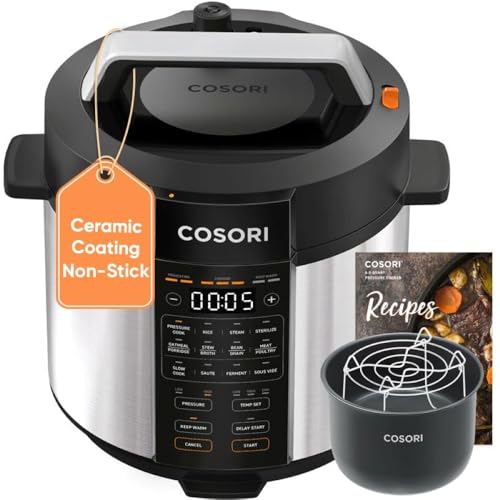
Cosori 6-quart pressure cooker with ceramic coated pot
The ceramic coating is what makes it easy: Amazon's review summary singles out easy cleaning, and it was the top seller in Amazon's pressure cooker category when we checked. Nine functions, including sous vide. The listing says the lid and the coated inner pot are dishwasher safe.
The honest trade: It is a coated pot, and a coating is the one part of a cooker that wears. We could not find anything in Cosori's listing on how long the ceramic lasts. One more thing to know: Amazon's specification box for this listing says "Material: Stainless steel", which describes the housing. The title says ceramic coating, and the title is the one that describes the pot.
Check price on AmazonOther names you will see
These came up in our research and in what readers search for. None made our picks, and here is why.
Ninja PossibleCooker
Not a pressure cooker. Ninja lists slow cook, sous vide, sear, braise, steam, bake, proof and keep warm, and no pressure function. Ninja describes the pot as PFAS-free. It belongs with slow cookers, and we cover it in our non-toxic slow cooker guide.
Instant Pot Duo Crisp
The pressure cooker with an air fryer lid. Instant's disclosure lists the Duo Crisp models in the PTFE-coated table, and some Crisp models in the stainless table too. If you do not need the air fryer, the plain Duo is not in the PTFE table at all.
Instant Pot Rio
Filed in the same stainless table as the Duo. Availability was patchy when we checked, and the Duo has the longer record, so we'd pick the Duo.
Presto aluminum models
The same shape as the stainless Presto, in aluminum, for less. See the section above; we'd pay the difference for stainless.
Our Place Dream Cooker
A ceramic nonstick pressure cooker. It is priced well above our other picks and rated lower on Amazon than any of them.
Cuckoo
Cuckoo's pressure models are rice cookers first. We cover them, and what Cuckoo's own disclosure lists for them, in our non-toxic rice cooker guide.
Looking after the ring and the valve
The pot will outlast everything else on the cooker. The ring and the small valve seals are the parts that age, and they are the ones people skip when washing up.

- Take the ring out after each use and wash it by hand. Presto's listing says this outright for its dishwasher-safe pot, and it is good practice on any cooker. Presto also recommends replacing the ring and the overpressure plug at the same time.
- If your manual shows how, take the float valve seal and any vent cap off now and then and clean behind them. Food and steam condensate collect there.
- Replace the ring when it cracks, stiffens, stretches or stops sealing, and follow your manual on timing. Buy the maker's own ring for your model, so the material is one the maker stands behind.
- Silicone rings can hold on to smells. Our look at whether silicone is safe for cooking goes into the material itself.
How sure we are about each one
Our first choice
The Instant Pot Duo, in whichever size fits your household. Uncoated pot, filed outside the PTFE table, and more owner ratings than any other cooker here.
Good, with one caveat
The Presto 01362 and the T-fal Clipso. Fewer parts than any electric cooker; the caveats are durability reports on Amazon and, for Presto, a ring material we could not confirm.
Fine if you want a coating
The Cosori 6-quart. Its filing names no PTFE for this model, but a coating wears, and you will eventually replace the pot or the cooker.
Questions people ask
Is the Instant Pot non-toxic?
It depends on the model. Instant's disclosure puts the plain Duo, Rio, Duo Plus and Pro under stainless steel cooking surfaces and not under PTFE. The Duo Crisp models, with the air fryer lid, are in the PTFE table. The stainless table also lists cadmium, tin, phthalates and BPA for its whole group without naming the part, so "non-toxic" is more than the paperwork can confirm either way.
Does the Instant Pot have Teflon in it?
The standard stainless inner pot is not in Instant's PTFE table. The PTFE table does include the Duo Crisp and Pro Crisp combos and Vortex air fryers. If you want to avoid PTFE, choose the plain Duo and keep its stainless pot.
Is the Ninja PossibleCooker a pressure cooker?
No. Ninja's own list of functions for the PossibleCooker PRO has no pressure setting; it slow cooks, sears, braises, steams, bakes, proofs and cooks sous vide. See our slow cooker guide for how it compares.
Stainless or ceramic inner pot?
Stainless if you want nothing applied to the surface and will accept some soaking and scrubbing. Ceramic if easy release matters more to you, with the understanding that the coating wears over time.
Are aluminum pressure cookers a problem?
Aluminum reacts more readily with acidic and salty foods than stainless steel, and can darken with use; Amazon's review summary for Presto's aluminum model mentions discoloration. If you are buying new, stainless costs a little more and avoids the question. For pressure safety on any cooker, old or new, see our pressure cooker safety guide.
What does "PFOA-free" mean on a pressure cooker?
Very little today. The eight major makers of PFOA committed under an EPA program to eliminate it by 2015, and all say they did, so nearly every coated pot can say it. It does not tell you whether the pot is coated. Our PFOA-free explainer has the detail.
How often should I replace the sealing ring?
Follow the timing in your manual, and replace it sooner if it cracks, hardens, stretches or stops sealing. Use the maker's own ring for your model.
Editorial note
As an Amazon Associate we earn from qualifying purchases. Cupindy earns a commission if you buy through the Amazon links on this page, at no extra cost to you. No brand paid to be included, and every pick names a real drawback. We report what each brand's documents say and what we could not find; we do not make legal judgments about any company's disclosures. Product details and availability were checked in September 2026 and can change.
Sources reviewed: Instant Pot cookware chemical disclosures and the detailed disclosure document linked from it; Cosori state cookware disclosures; Presto PFAS disclosure; Ninja PossibleCooker PRO product page; California DTSC, cookware chemical disclosures; Amazon listings for each product named.
Related reading: Best non-toxic slow cooker · Non-toxic rice cooker · Are pressure cookers safe?


